
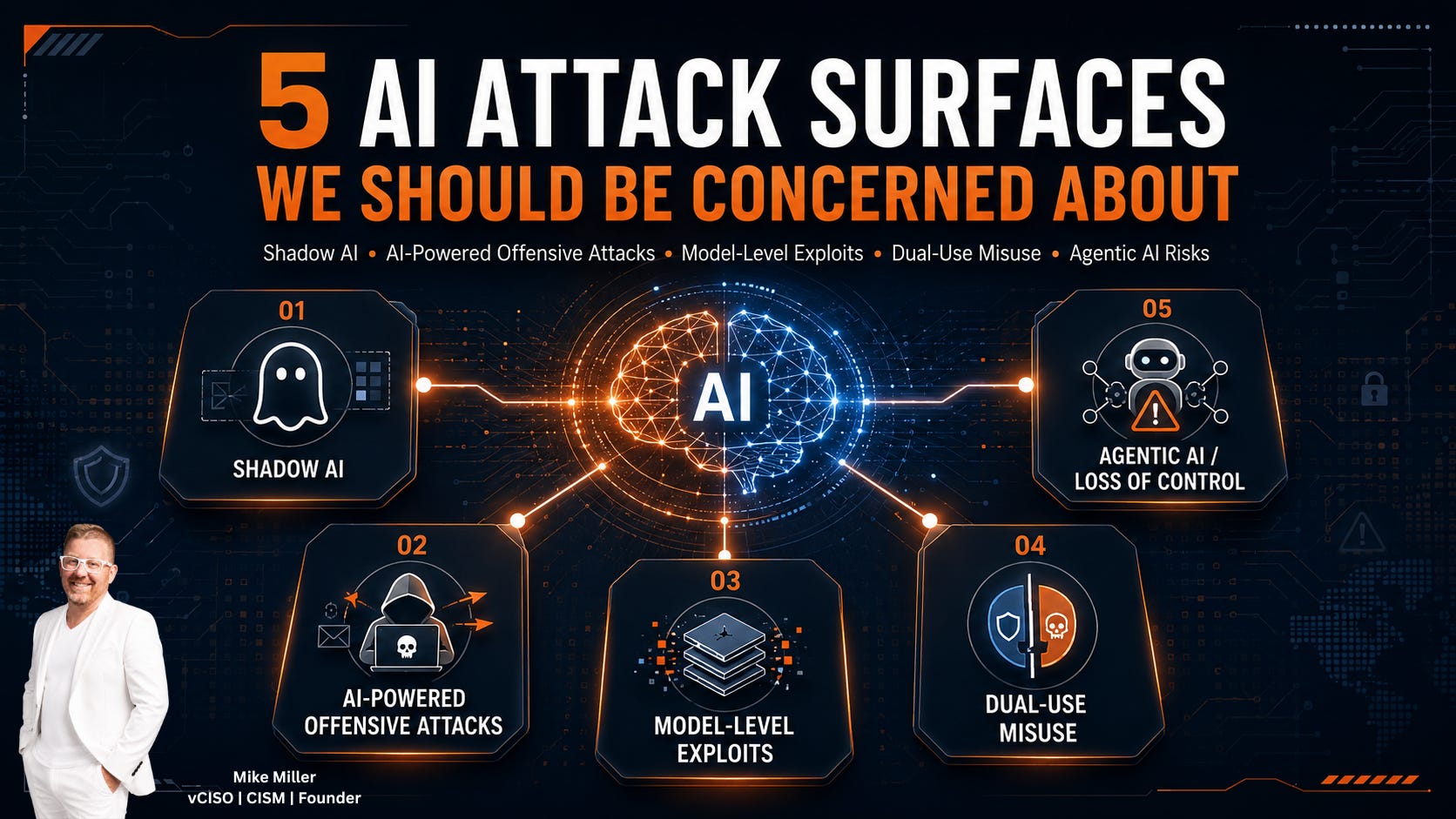
In my nearly 3 decades working as a technology professional, I’ve never seen growth and expansion happen as fast as it’s happening with AI. Nearly every week, some new powerful capability is released. Even though it’s exciting, it also drives some very serious cybersecurity concerns. New attack surfaces are popping up much quicker than we can ever protect them.
For a long time, it felt like AI was pretty contained. Now, it touches data privacy, operational resilience, business continuity, and even national security. We can’t treat AI like a tool anymore. We have to treat it as new territory that is expanding it’s borders extremely fast.
Below, I’ve highlighted 5 of the biggest AI attack surfaces that we need to be concerned about here mid 2026. As well as describing each one, I also explain why it’s urgent, and an action plan.
Unsanctioned AI tools, chatbots, agents, and custom models are being deployed across departments at an extraordinary pace. According to AvePoint’s State of AI 2026 report, 89.5% of organizations experienced a generative AI-related security breach in the past year, while 88.4% also reported AI agent-related incidents. These shadow systems frequently bypass procurement processes, security reviews, data loss prevention controls, and compliance frameworks, creating direct pipelines for sensitive data exfiltration, prompt injection attacks, and regulatory violations.
Why it’s growing so dangerous: Many of these tools receive broad access to email, documents, customer data, internal knowledge bases, or production systems. Once compromised or misused, they can exfiltrate data silently, act as persistent backdoors, or serve as initial access points for larger campaigns. The speed of adoption has far outpaced governance, creating a massive visibility gap.
Action Plan:
Conduct a rapid, company-wide AI usage audit within the next 2–3 weeks (combine employee surveys, browser extension discovery tools, network traffic analysis, and SaaS discovery platforms).
Establish a formal approval and risk-assessment process for any new AI tool or integration, requiring security and legal sign-off before deployment.
Deploy monitoring and discovery solutions that automatically detect unsanctioned AI traffic while offering employees approved, governed alternatives to reduce shadow adoption.
Create short, department-specific training sessions that use real breach examples rather than generic warnings.
Implement data classification policies and DLP rules specifically tuned for AI tool inputs and outputs.
Establish regular review cadences (e.g., quarterly) to reassess approved tools as their capabilities and risk profiles evolve.
Attackers are increasingly weaponizing frontier models to automate vulnerability discovery, generate polymorphic and evasive malware, craft highly convincing deepfakes and spear-phishing campaigns, and execute coordinated attacks at speeds and scales that outpace traditional human-driven defenses. Generative AI is now being used across the entire attack lifecycle - reconnaissance, weaponization, delivery, exploitation, and post-exploitation activities.
Why it’s urgent: The barrier to entry for sophisticated attacks has dropped dramatically. Even mid-tier threat actors can leverage AI to work faster, smarter, and at greater scale. Traditional defenses calibrated for human-speed operations are increasingly outmatched by automated, adaptive attack campaigns.
Action Plan:
Update threat models and red-team exercises to explicitly simulate AI-augmented adversaries and their faster operational tempo.
Strengthen behavioral analytics, UEBA, and anomaly detection systems to identify machine-speed attack patterns and AI-generated artifacts.
Invest in automated purple teaming platforms that can regularly simulate AI-powered attacks against your current defenses.
Build or join industry threat intelligence sharing groups focused specifically on AI-augmented tactics, techniques, and procedures (TTPs).
Develop and test faster detection and response playbooks tailored to AI-generated content, deepfakes, and automated exploitation.
Monitor emerging research on AI’s impact on malware generation and evasion techniques.
Even the most advanced frontier models remain vulnerable to carefully crafted inputs that bypass safeguards, leak training data or conversation context, or force harmful outputs. Prompt injection remains one of the most reliable and widely exploited attack vectors. Data poisoning during training or fine-tuning can create persistent, hard-to-detect backdoors, while adversarial examples can degrade or manipulate the performance of AI-powered security tools themselves.
Why it’s urgent: As organizations integrate models deeper into critical workflows, such as code review, threat detection, access control decisions, and customer support - a successful exploit can have immediate and cascading business or security consequences. The attack surface here is architectural rather than purely technical.
Action Plan:
Implement layered defenses including strong input sanitization, output validation, guardrail models running in parallel, and context isolation techniques.
Schedule regular, structured red-teaming exercises focused specifically on prompt injection, jailbreaks, and adversarial inputs (combine internal teams with external specialists).
Establish strict processes for vetting, monitoring, and versioning training and fine-tuning data sources.
Adopt output watermarking, comprehensive logging, and provenance tracking for high-stakes AI-generated content or decisions.
Test AI-powered security tools themselves against adversarial attacks to ensure they do not become single points of failure.
Maintain an internal playbook for responding to successful model-level exploits, including rollback and forensic procedures.
The same powerful models that excel at defensive security tasks (automated threat hunting, secure code generation, anomaly detection) can be repurposed for offensive purposes - exploit generation, scaling influence operations, or assisting in high-risk research. Tiered access and safeguards help manage this tension, but sophisticated actors continue to probe boundaries. Open-weight or leaked models further increase exposure.
Why it’s urgent: The dual-use nature of advanced AI makes perfect containment difficult, especially as models become more capable and widely accessible. Misuse can occur both intentionally (by malicious actors) and unintentionally (through overly broad internal access or poor policy enforcement).
Action Plan:
Define and enforce clear acceptable-use policies, particularly for models with strong coding, research, or agentic capabilities.
Implement usage monitoring, logging, and anomaly detection to flag potential misuse or data exfiltration patterns early.
Participate in responsible AI initiatives and industry security groups to stay aligned with emerging best practices and regulatory expectations.
Consider highly controlled, air-gapped, or heavily restricted environments for the most sensitive or high-risk AI workloads.
Regularly review and update policies and access controls as model capabilities continue to advance.
Establish clear escalation procedures for suspected misuse incidents.
Long-running autonomous agents introduce entirely new classes of risk: unintended harmful actions, goal misalignment, escalation across connected systems, or full compromise of the agent itself. Supply-chain attacks on agent frameworks, tool integrations, or underlying models add another dangerous layer. OWASP and multiple 2026 industry reports highlight prompt injection, excessive permissions, and unsafe tool use as dominant failure modes in real-world incidents.
Why it’s urgent: Agents operating over hours or days with broad tool access (email, calendars, databases, APIs) can cause outsized damage before humans even notice something is wrong. The combination of autonomy, tool use, and memory/context creates complex new attack surfaces.
Action Plan:
Start all agent deployments in sandboxed environments with strict permission boundaries and least-privilege access principles.
Require human approval gates for any high-impact, irreversible, or financially sensitive actions.
Implement comprehensive logging, real-time monitoring, behavioral analysis, and emergency kill-switch mechanisms for all autonomous systems.
Begin with low-risk pilot agents, thoroughly document lessons learned, and scale governance in lockstep with increasing levels of autonomy.
Regularly audit agent permissions, tool integrations, memory/context handling, and data flows for over-privileging or hidden risks.
Develop incident response playbooks specifically tailored to agent compromise or misbehavior scenarios.
Treat AI security as a foundational architectural and governance concern rather than a bolt-on control.
Maintain a living, up-to-date inventory of all AI systems, their data flows, permissions, integrations, and risk profiles.
Foster close, ongoing collaboration between security, engineering, legal, compliance, and AI teams.
Stay engaged with evolving regulations and industry standards (including EU AI cybersecurity initiatives, U.S. executive actions, OWASP Agentic AI guidance, and emerging best practices).
Budget for continuous red-teaming, adversarial testing, and governance reviews as models and agents continue to advance rapidly.
The AI race is delivering fantastic tools, but at the same time attack surfaces are growing just as quickly. It’s important that organizations map, govern, and defend them proactively. This can help turn what might be a liability into a competitive edge.
Which of these attack surfaces do you think is the most concerning? What other ones did I miss? I’m curious of your thoughts.
Mike Miller | vCISO | CISM | Founder

No posts
Comments
Nothing yet. Say the first thing.
Sign in to join the conversation.