
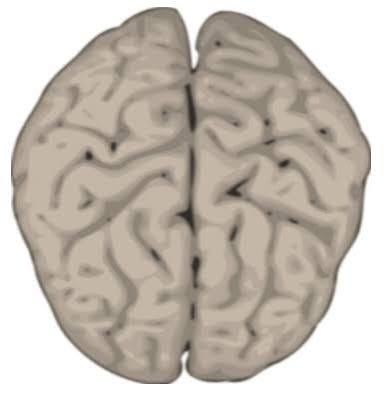
Ever wonder why the human brain has two hemispheres? I mean, wouldn’t it be a more efficient way to know things if God created the brain as one undivided sphere?
It might be efficient, but it wouldn’t be effective if we aim to know things truly, deeply. According to Blaise Pascal, that level of knowledge requires two modes of knowing. And according to neuroimaging, that requires a brain with two hemispheres collaborating.
To see why this is so, let’s begin with something Pascal wrote in Pensées:
The heart has its reasons which reason knows nothing of. We know the truth not only by the reason, but by the heart.
Pascal is distinguishing between l’esprit de géométrie (the geometric, or rational, mind) and l’esprit de finesse (the intuitive mind). The geometric mind knows what it knows by reason. But it “knows nothing of” the reasons for which the intuitive mind knows things.
That’s because the geometric mind is analytical, abstract, systematic. It’s rationalist, knowing what it can define, prove, and predict – in a word, control. That’s how Iain McGilchrist describes the left hemisphere of the brain. It seeks to control how we know things by claiming we only know what can be proven true. But it overlooks how the point of rationality is to prove the limits of rationality. We can’t, for example, prove God exists.
Nor did Pascal feel it wise trying to prove the Church’s historic view of the Real Presence of Christ in the Eucharist was scriptural, something the European Reformers thought they proved was not scriptural. Pascal felt the Reformers missed the point. The Real Presence is trans-rational, beyond reason. The intuitive mind knows this because it knows mysteries “which reason knows nothing of.”
Which is why knowing anything deeply, truly, requires a collaboration between the two modes of knowing. It requires Pascal’s second faculty (l’esprit de finesse) because the heart; that is, the intuitive mind, perceives wholes, nuances, and living patterns that logic cannot capture. The intuitive mind perceives mysteries the geometric mind misses.
McGilchrist writes that this perception of mysteries is the domain of the right hemisphere of the brain. It alone offers a subtle perception of things, even God, that apprehends meaning, a wisdom that moves through intuition, moral imagination, and love.
But there’s more. Pascal said the intuitive mind is the master. It leads. The geometric mind is the servant. It follows. That’s the sequence McGilchrist describes in The Master and His Emissary. To know that which is beyond reason, the right hemisphere of the brain, the intuitive mind, must be the master. It leads. The left hemisphere of the brain, the brilliant emissary that is the geometric mind, must follow.
That’s why the human brain has two hemispheres. There are two modes of knowing things, including knowing God, which requires two hemispheres, right and left. But the right hemisphere is the master that leads, while the left is the servant that follows.
Which brings us to my next post.
McGilchrist says this sequence of the master leading with the servant (or emissary) following has been reversed in the western world. He puts it this way in a paraphrase of a famous reflection often credited to Albert Einstein: “The intuitive mind is a sacred gift and the rational mind is a faithful servant. We have created a society that honors the servant but has forgotten the gift.”
We’ll consider the repercussions of this reversal in my next post.
No posts
Comments
Nothing yet. Say the first thing.
Sign in to join the conversation.