
A few months ago, I wrote about a persistent conflation trapping campus AI discussions in a loop: the tendency to blur the ethical question of whether/when to use AI with the pedagogical question of how to build critical student cognition (Separate AI Literacy and Assessment Integrity, May 2026).
If you’ve sat in a Senate meeting, a working group, or a Dean’s council over the last academic year, you’ve likely felt this paralysis firsthand. The conversation starts with curriculum design, pivots instantly to academic integrity panics, devolves into a debate over syllabi language or detection software, and ends with little structural progress and an exhausted faculty.
We often attribute this gridlock to faculty resistance or administrative sluggishness. I don’t think either are the real issue.
It’s more of an architectural error. Most institutions are running one committee charged with solving two mutually exclusive agendas at the exact same time.
I’ve sat in on a wide range of AI Committee conversations over the last few years, and the conversation tends to follow a similar “loop” pattern, one that is entirely logical and rational, until you realize it is actually a snake eating its own tail.
Faculty A (Literacy): “We need to teach students how to work with AI. It is an essential career capability.”
Faculty B (Assessment): “If we normalize it in class, AI cheating will skyrocket on take-home assignments.”
Faculty A: “Not if we teach them how to use it responsibly.”
Faculty B: “We don’t even know what ‘responsible’ means yet. What if your experiment fails and my students graduate without basic writing skills?”
Faculty A: “We won’t know until we try.”
Faculty B: “At the expense of core learning outcomes?”
Flip the script, and the exact same loop plays out in reverse:
Faculty B (Assessment): “Unchecked AI use is undermining the integrity of our degrees.”
Faculty A (Literacy): “That is only because we aren’t teaching them how to use the tools effectively.”
Faculty B: “Use it effectively? No one has defined what that means, let alone how to measure it.”
Faculty A: “If we teach AI literacy, academic misconduct will naturally decrease.”
Faculty B: “And if it doesn’t? We just abandon our foundational disciplinary goals to become prompt engineering coaches?”
Lest I seem like I am “calling out” one side or the other, let me say this as clearly as I can: neither side is wrong. Both colleagues are entirely correct.
But because both goals sit on the exact same agenda, they act like opposing gravitational forces. They pull each other into the center (a perpetual panic over AI Cheating) and prevent the institution from ever exploring the rich, outer bounds of either domain.
To understand why your committee is stuck, picture a simple Venn diagram.
On the left sits AI Literacy. On the right sits Assessment Redesign.
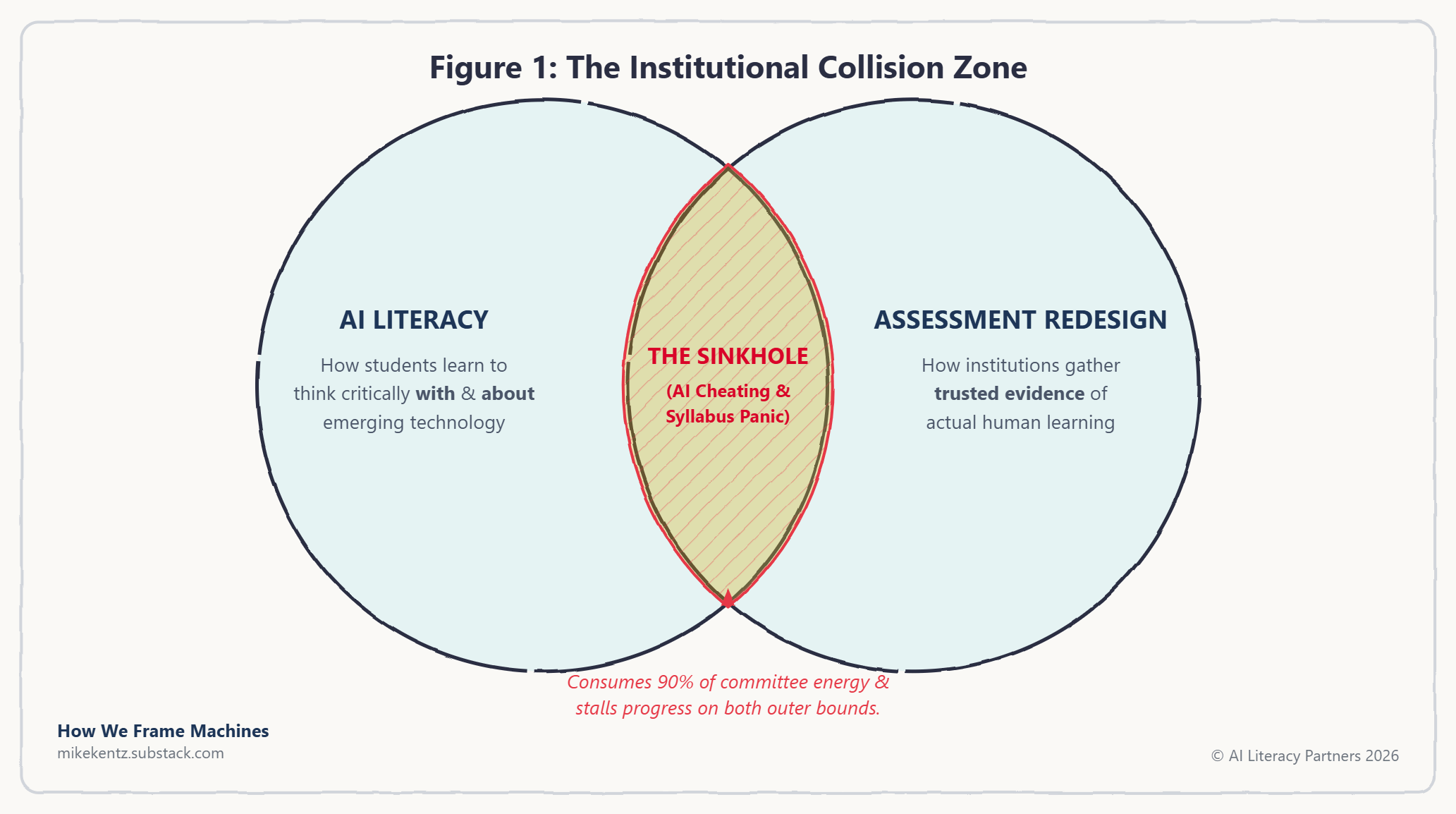
When an institution mashes these two domains into a single task force, the overlap area (AI Cheating) becomes a sinkhole.
The immediate friction of academic dishonesty demands absolute attention. As a result, the committee spends most of its energy writing syllabus permission statements, debating detection software, and litigating honor code wording. All important, but also a hindrance on true exploration of either domain.
By staying stuck in the middle, faculty fall into a state of paralysis:
It fails at Assessment Redesign because it stays defensive, trying to guard traditional take-home tasks rather than rethinking what constitutes trusted evidence of learning.
It fails at AI Literacy because it reduces literacy to policy compliance, never designing a real, developmental curriculum.
Often times, this leads to individual educators leaving the meeting and exploring on their own, sometimes losing faith in the process of discourse around these problems. Innovations happen in silos, and if they continue to be shared with the “gravitational middle” pulling folks away from the individual discussion, progress stalls.
When you split these two conversations into separate rooms with separate charters, things get really interesting. The panic diminishes and the questions change entirely.
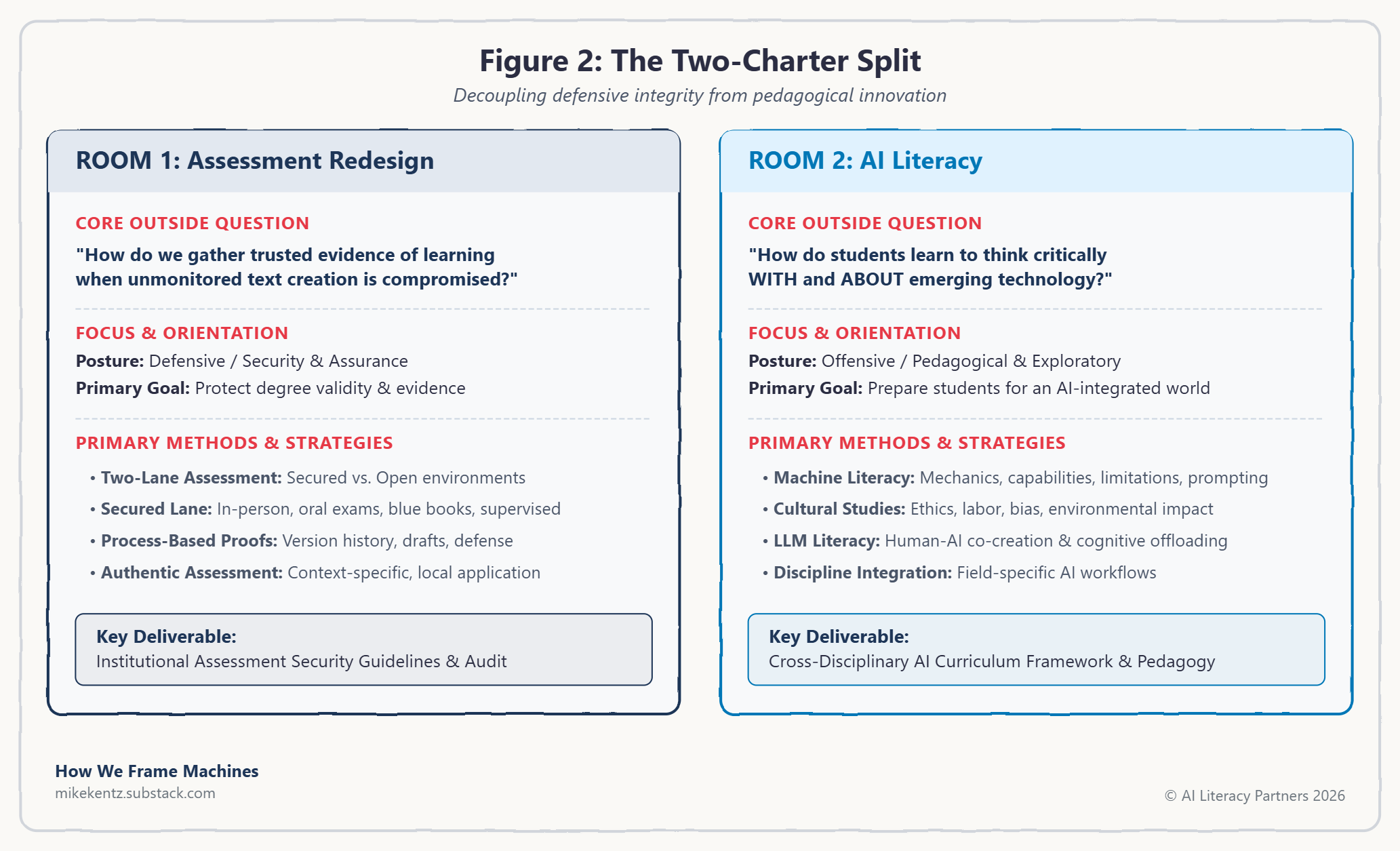
One of the beauties of this split is that it allows “Room 1” to grapple — in a straightforward manner — with the realization that assessment redesign need not focus on AI at all.
When you remove the imperative to “solve AI,” assessment stops being a defensive game of cat-and-mouse. It returns to a fundamental, decades-old pedagogical question: What were we trying to measure in the first place, and what is the most reliable way to capture evidence of it?
We can look to practitioners who are already mapping this outer bound. Dr. Ruth Slotnick, Director of Assessment at Bridgewater State University, led the Massachusetts Department of Higher Education’s working group to publish the GenAI in Assessment Guidebook. By focusing specifically on assessment methodologies rather than policing student behavior, her team demonstrated that institutional evaluation can evolve thoughtfully without waiting for campus cheating policies to resolve.
Similarly, the University of Sydney pioneered institutional clarity through their Two-Lane Assessment Framework. Authors Danny Liu and Adam Bridgeman explicitly acknowledged that take-home, unmonitored assignments can no longer serve as secure evidence of individual mastery. They split assessment into two deliberate lanes:
Lane 1: Secured Tasks (Assessment of Learning). Supervised, in-person, or highly controlled settings designed specifically to validate that a student possesses the required skills.
Lane 2: Open Tasks (Assessment for Learning). Unsecured, authentic, process-driven tasks where AI engagement is assumed, scaffolded, and integrated.
In a room dedicated solely to evidence, faculty can explore rich, human-centered evaluation modes without needing a consensus on software or prompt design:
Interactive Oral Defenses: Short, structured conversations where students explain their reasoning and defend their choices.
Process Artifacts & Reflections: Evaluating student transcripts, revision histories, and metacognitive logs that show how a thought evolved.
Live Applied Performance: Studio work, lab simulations, improvisational problem-solving, and board work where “the doing” is the evidence.
Comparative Analysis: Having students audit, annotate, or critique an AI-generated baseline to demonstrate their own domain mastery.
When you refocus on evidence, your most valuable committee member might be the veteran professor who has run oral exams for thirty years and has never touched ChatGPT.
The same creative variance occurs when “Room 2” separates into its own silo. While the Assessment group secures evidence, the AI Literacy group focuses on curriculum design.
Most campus AI literacy efforts currently begin and end with syllabus disclaimers. But true literacy (AI or otherwise) is not a policy statement; it is a multi-tiered discipline.
This aligns directly with global frameworks like the OECD’s AILit framework, which emphasizes that literacy extends far beyond using a tool. The OECD highlights domains such as understanding human logic behind AI design, evaluating broader societal impacts, and building critical judgment alongside technical execution.
I introduced a framework for AI literacy as a distinct discipline two years ago on Michael Spencer’s AI Supremacy Substack. I’m republishing it below because the institutional need for alignment has only grown sharper, and treating AI literacy as a multi-tiered domain remains the cleanest way out of syllabus-policy purgatory.
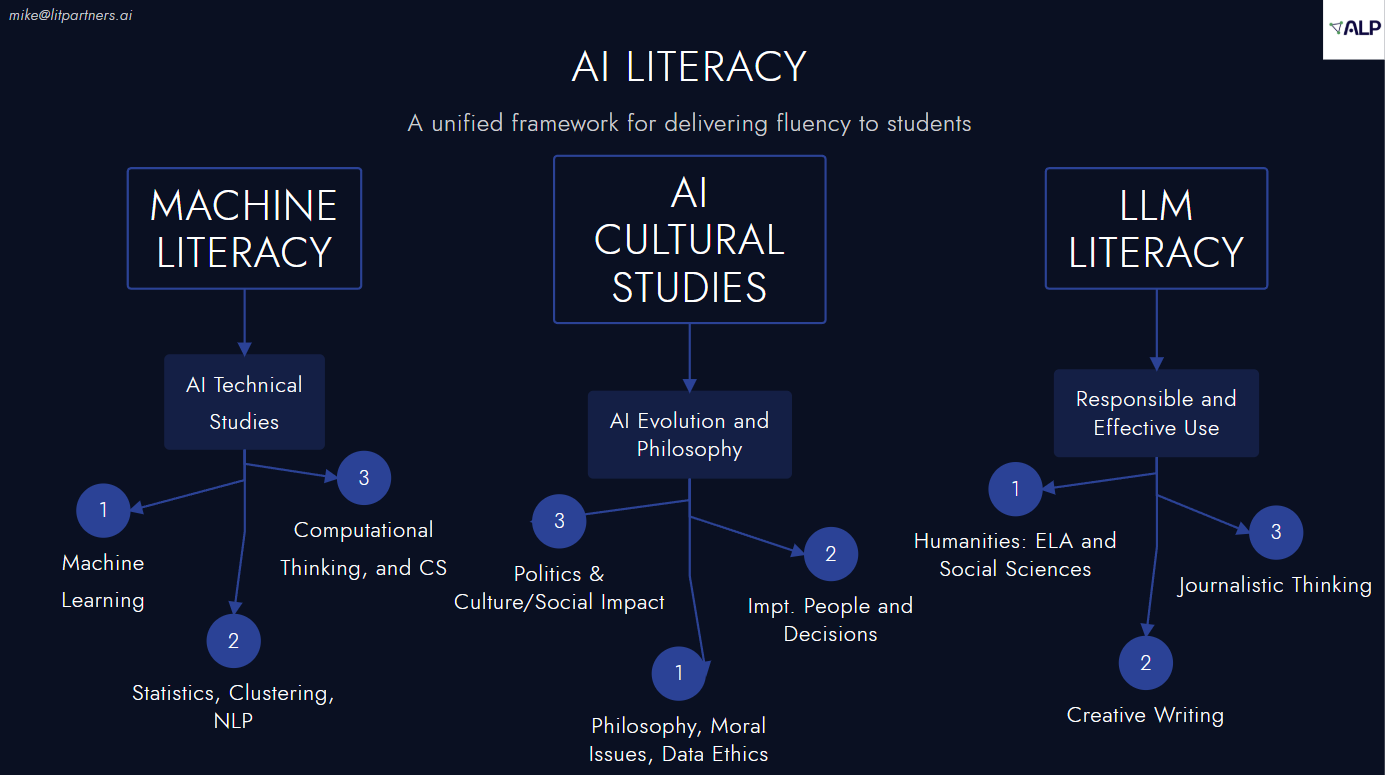
When you break AI literacy down into its structural pillars, it becomes clear why a single policy committee stalls:
Machine Literacy (The Mechanics): Understanding how probabilistic models, natural language processing (NLP), clustering, and machine learning architectures function under the hood. This is rooted in computer science, statistics, and computational thinking.
AI Cultural Studies (The Impact): Analyzing the societal, political, environmental, and ethical footprints of automated systems. A course examining data bias, intellectual property law, labor shifts, or the philosophical implications of artificial mind requires no active interaction with a chatbot. It is classic American Studies, Sociology, or Philosophy.
LLM Literacy (Applied Fluency): Learning how to co-reason, critique, edit, and direct large language models within specific disciplines, from journalistic investigation and creative writing to scientific literature reviews. I recently explored this third pillar in a chapter for Elsevier’s GenAI in Higher Education, detailing how we can move beyond surface-level prompting to teach true conversational AI literacy in the chat interface itself, focusing on maintaining student metacognition during real-time interaction.
Once this structure is clear, the literacy working group can stop writing permission slips and start answering real curricular questions: Is this a general education requirement or embedded in the major? What does a sophomore need to master before their senior capstone? How does AI literacy in Nursing differ from AI literacy in History?
If your institution is stuck in the loop, don’t try to pass a massive new university policy. Reorganizations take a year you don’t have.
Instead, execute a simple Five-and-Five Split for the upcoming semester:
Identify 10 Faculty: Find 5 colleagues whose eyes light up when you say “evidence of human learning,” and 5 who light up when you say “teaching students to think with new tools.”
Form Two Independent Working Groups:
Group A (Evidence): Tasked with mapping 2–3 gateway courses into Secured vs. Open lanes and identifying non-digital evidence modes.
Group B (Capability): Tasked with mapping where Machine Literacy, Cultural Impact, and Applied LLM skills belong across a single department’s curriculum.
Keep Them in Separate Rooms Until December: Separate agendas and separate deliverables allow for more nuanced, deep conversations in the specific domain.
When both groups meet at the end of the semester, they won’t be trapped in a circular argument about blue books and cheating. Both groups will arrive at the table with concrete, built artifacts.
I am currently partnering with leadership teams and academic units to put this exact framework into practice, helping campuses set up parallel, non-colliding working groups that unlock real progress without the friction.
If you want to restructure your campus AI strategy or adapt these frameworks for your faculty, let’s connect at www.litpartners.ai.
Comments
Nothing yet. Say the first thing.
Sign in to join the conversation.