
We are living through a strange moment in the history of human creativity. If you scroll through your social media feeds or check your inbox, you have likely noticed a shift - a peculiar inflation in the marketplace of ideas. Suddenly, everyone seems to be a prolific author. Everyone is a thought leader. The quiet colleague who struggled to write an email six months ago is now publishing daily essays on complex philosophy.
In the modern digital ecosystem, we are witnessing a disruption in the creative timeline. Where expertise and authorship once required a visible trajectory of growth - the slow, painful climb of learning, drafting, failing, and refining - we are now observing a sudden influx of content creators who seem to have materialised instantly.
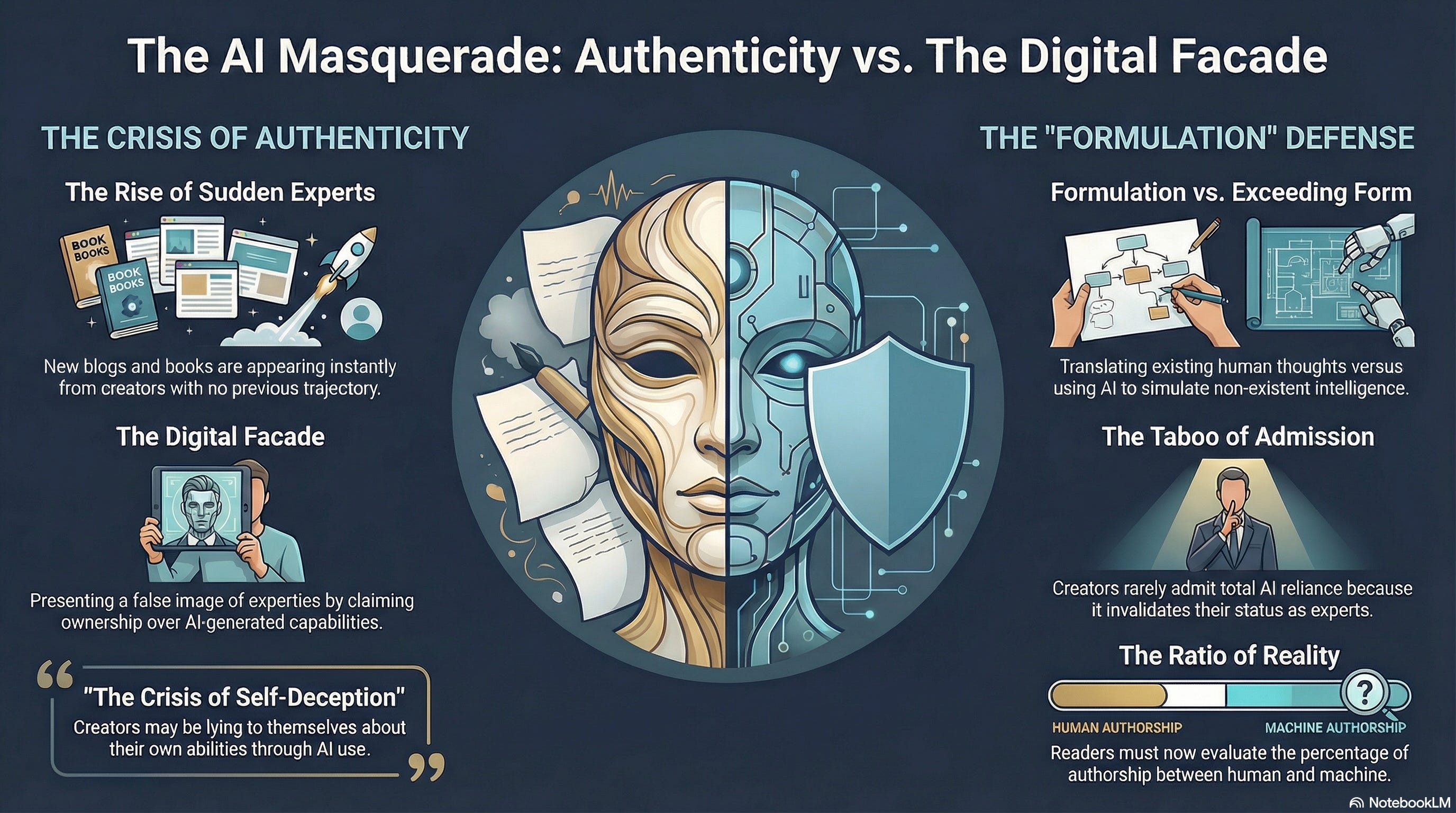
Take a look around. What do you see? There’s new blogs appeared from nowhere, accompanied by a flood of new newsletters and new books and documentation that appears from someone, out of nowhere. It is an explosion of competence that feels unearned, a library built overnight without a single brick being laid by human hands.
This phenomenon forces us to confront a difficult and intrusive question about the nature of this output: Are we looking at genuine human capability, or a digital facade?
The Crisis of Self-Deception
The core of this issue is not merely about the volume of content - spam has existed as long as the internet has. The issue is about the honesty of the creator. We must explore the idea and question as to whether people are kidding themselves regarding their own output.
This is a crisis of identity. In the past, if you bought a ghostwritten book, there was a transactional cynicism to it. You paid someone, they wrote it, you slapped your name on it. But the relationship with AI is more intimate and more confusing. It goes beyond simple impostor syndrome; it is a question of whether creators are lying to themselves and others, about their abilities by using Ai to produce something that just isn’t their own.
When a person prompts an AI to write a sonnet or a code documentation file, and the AI delivers a perfect product, a psychological transfer occurs. The prompter feels the rush of creation without the labour of execution. They begin to conflate the ability to ask for a thing with the ability to make the thing.
This distinction is vital. If a creator utilises a tool to generate work that exceeds their actual skill level, they are presenting a false image to the world. They are building a reputation on a foundation of sand. They are claiming ownership over a capability they do not possess.
Consider the implications for the “expert” class. If a consultant uses AI to generate high-level strategy documents that they themselves could not intellectually formulate, are they a fraud? If a novelist uses AI to write scenes with emotional depth they have never personally experienced or understood, are they an artist?
As this article suggests, in a rather point blank way, rarely people will admit this. The admission of total reliance on AI is taboo, as it invalidates the author’s status as an expert. To admit that the machine did the heavy lifting is to admit that you are interchangeable - that you are not the source of the value, but merely the switch operator.
The “Formulation” Defense
When creators are pressed on their usage of these tools, they often retreat to a standard, acceptable defense. They may agree to the least of ‘using Ai to help them formulate’.
This phrasing is strategic; it implies that the core ideas, the intellect, and the “brain” are human, and the AI is simply the scribe organising those thoughts. It is a safe harbour. It suggests: I am the genius; the computer is just my typewriter. It frames the AI as a cleaner, a spell-checker on steroids, or a polite editor that fixes grammar.
However, we must scrutinise this defense. We have to ask: is it true they’re using Ai to be lazy and be better than they are in human form, or are they using Ai to help them formulate their brain on to the page?
This is the crux of the modern creative dilemma. There is a profound difference between these two realities:
1. Formulating the Brain: The AI acts as a translator for existing human thoughts. In this scenario, the human struggles to find the right words for a complex idea they already possess. The AI helps unlock the syntax. The “soul” of the piece remains human.
2. Exceeding Human Form: The AI acts as a prosthetic that simulates a level of intelligence or creativity the human does not actually possess, effectively allowing them to be “better than they are” through laziness rather than effort.
The latter is where the danger lies. We are seeing a generation of creators using AI to be better than they are in human form. This is not augmentation; it is replacement. It is the difference between using a calculator to speed up a math problem you understand, and using a calculator to solve a problem you cannot read.
If you are using AI to produce insights you didn’t have, to make connections you didn’t see, and to write with a vocabulary you don’t own, you are not formulating your brain. You are wearing a mask.
The Laziness of “Better”
Why do we do it? Why is the temptation to let the AI take over so strong? I think there is a dark motivation: using Ai to be lazy.
Laziness here isn’t just about avoiding work; it’s about avoiding the vulnerability of mediocrity. Being human is often disappointing. Our first drafts are bad. Our thoughts are disorganised. Our vocabulary is limited. The AI offers an immediate upgrade to a “Premium” version of ourselves. It is seductive to look into the digital mirror and see a reflection that is smarter, faster, and more eloquent than the reality.
But this laziness comes at a cost. When we bypass the struggle of articulation, we atrophy our own ability to think. Writing is not just the recording of thought; it is the process of thinking. By offloading the formulation to a machine, we are offloading the cognitive workout required to grow. We become flabby thinkers, hiding behind the muscular prose of a large language model.
The Ratio of Reality
Ultimately, as we read these new blogs and books that have appeared “out of nowhere,” we are left with a lingering doubt. The contract between reader and writer - a contract based on the assumption that I am listening to you - has been broken.
We must constantly evaluate the ratio of authorship. We read a paragraph that sings with insight and wonder: Did a human suffer to find that truth? Or did a probabilistic algorithm predict that those words usually follow these words?
The pressing question for every reader today is simple: Is that blog, Ai, or is it the person. How much is each.
We are entering an era of the cyborg author, where the percentage of humanity in any given text is a sliding scale. Is it 90% human, 10% AI polish? Or is it 10% human prompt, 90% AI generation?
Until creators are willing to move beyond the safe admission of formulation and honestly address whether they are using AI to mask their own limitations, the authenticity of digital content will remain in question.
We need to demand a new kind of honesty. We need to normalise the idea that it is okay to be human, to be messy, and to be imperfect. Because if we continue to lie to ourselves about our abilities, pretending that the machine’s output is our own, we risk losing the very thing that makes art worth consuming: the connection between two human minds.
So, the next time you see a brilliant newsletter appear “out of nowhere”, ask yourself: Is this a voice I trust, or is it just an echo from the machine? And to the creators: Are you formulating your brain, or are you just trying to be better than you actually are?
No posts
Comments
Nothing yet. Say the first thing.
Sign in to join the conversation.