
The plane carrying Tommy McClelland and his family from Sugar Land Regional Airport outside of Houston landed at Purdue at 11:18 a.m. on Wednesday.
After the white-with-gold-trim Hawker Beechcraft arrived at Purdue Aviation, McClelland, his wife (Jessica Stokes), and sons (Lawson and Grayson) exited. They stopped and posed for a picture taken by a university photographer before jumping into a grey SUV headed for campus.
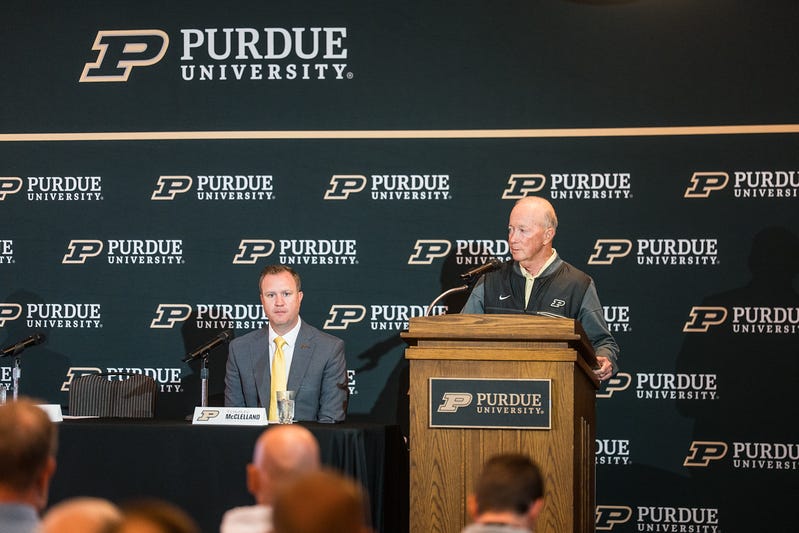
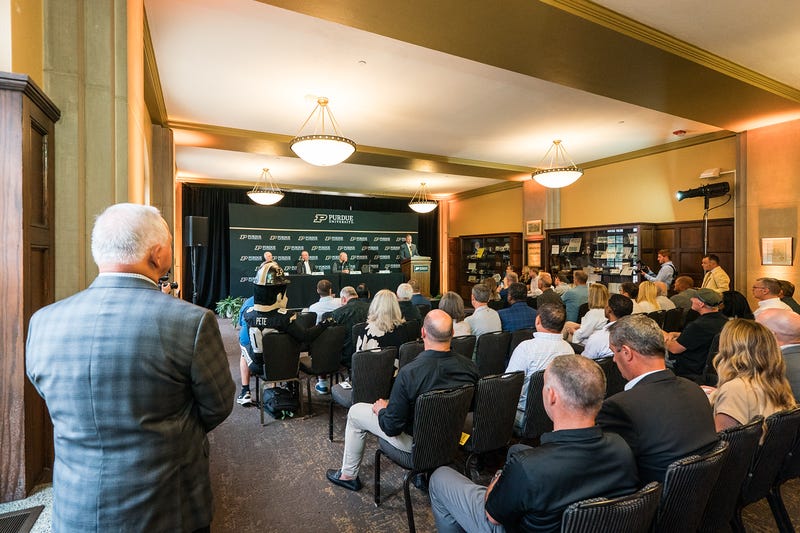
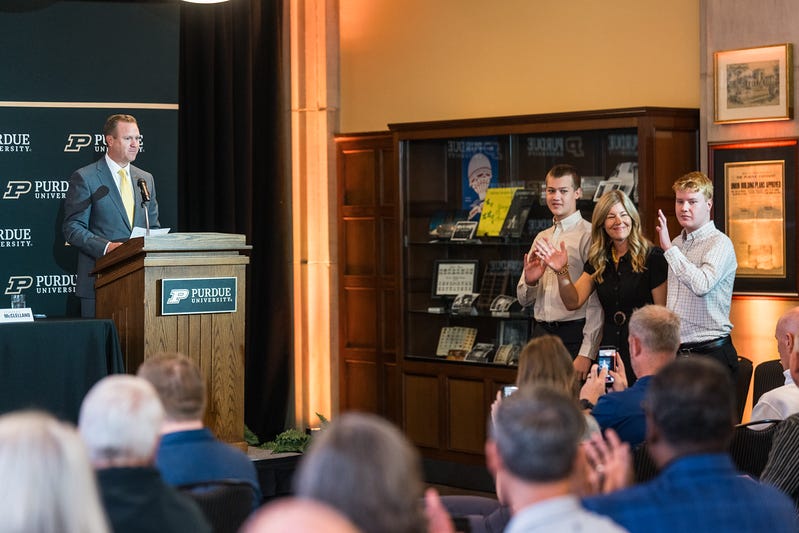
Roughly 24 hours later, McClelland addressed numerous Purdue coaches, athletic and university personnel, along with the fan base via YouTube to begin his tenure.
He recapped his time as a football player and javelin thrower at Northwestern State, highlighted key moments in his career path, including becoming an AD at 26, and shared part of his vision for the future of Purdue athletics in a 30-minute press conference.
Here are five takeaways:
When Mitch Daniels and the Board of Trustees conducted the search that brought Mike Bobinski to West Lafayette 10 years ago, the college athletic landscape and Purdue’s needs at the time were different.
Fast-forward to the recent search where 44-year-old-old McClelland emerged from a pool of diverse candidates to become the school’s fifth full-time athletic director since 1942 and 10th overall.
McClelland has two decades of experience as an athletic director and will replace Bobinski, who is retiring at the end of the year.
Following the press conference, Daniels said he learned “a ton” throughout the process of Zoom calls and in-person interviews, some of which were conducted in Indianapolis.
“Ten years ago, we weren’t looking for a revenue generator. Nobody even used the term,” said Daniels, who returned to Purdue as interim president and will remain until a permanent one is hired. “If they had said, ‘Oh, you’re just trying to get money from donors.’ These days, it means business ingenuity. I learned a lot about how creative many departments, including Tommy in his previous job, are.”
Daniels is referring to McClelland’s initiatives at Rice and Vanderbilt.
McClelland was at Rice for three years and helped develop the Gateway Project, which will connect the university to the Rice Village and modernize Rice Stadium to host community events beyond football games.
As a deputy athletic director at Vanderbilt, he oversaw a campaign that raised more than $300 million to improve and expand athletic facilities to help increase revenue outside of the traditional methods.
“We need somebody who can succeed while maintaining standards that some people are prepared to weaken or overlook,” Daniels said. “Well, Tommy is at the front edge of people who are finding ways to generate revenue through athletic affiliations - that’s revenue that we would not raise in any other way.
“What’s always troubled me was I did not want to see money that should go to help a student get here, afford to get here, help build our research excellence cannibalized, so we can succeed athletically. I really think that he’s one of this new breed of ADs who will find ways to do that. Money that would never find its way to Purdue in any other way that we can use to up our game competitively.”
Michael Klipsch, the board’s vice chairman, has been a trustee since 2015. He wasn’t as deeply involved in the search 10 years ago, but the two landscapes separated by a decade were completely different. He did his own research to fully understand what Purdue needed from an athletic director in this era that changes by the minute.
“The type of people we targeted was very different,” Klipsch said. “Ten years ago, a traditional AD was pretty much what you looked at. We looked at professional sports people; we looked at a lot of Deputy ADs that are younger and maybe more on the front line of dealing with this new stuff
“There was probably a wider variance of types of people to look at and sort through in your mind to find the right answer. But this was a pretty intense six weeks.”
How long will McClelland be haunted by one of the comments he made during his opening remarks?
“We will develop championships in the fullest sense. Young men and women who compete in their sport, in the classroom, and in life, and who will lead Purdue prepared to lead and serve and change the world.
“Every recruit, every current student-athlete will hear this message repeatedly. We are here to win championships. If you don’t want to win championships, go to Indiana. Purdue may not be the place for you.”
Was McClelland trying to hit a home run with the fan base and spice up the Purdue-Indiana rivalry? If so, his jab fell woefully flat since the Hoosiers won college football’s national championship in January.
Unfortunately, those comments became the headline throughout the state and across the country. McClelland will recover, but it will be hard to shake in the short term.
While McClelland swung and missed on the IU comment, he nicely tied together his time at Rice, the school’s iconic football stadium and Purdue’s Cradle of Astronauts tradition.
Rice Stadium, which hosted Super Bowl VIII, is the location where President John F. Kennedy proclaimed in 1962 that the United States was going to the moon.
“I didn’t think of it at the time, but I spent years transforming the very ground where America’s giant leap was first promised,” McClelland said.
Knowing the university’s history in sending graduates to the moon, McClelland circled back to connect the moments.
“Purdue has always believed in giant leaps,” he said. “Purdue’s own Neil Armstrong is the man who delivered on the promise a young president once made on the 50-yard line of a football stadium in Houston, the state, the same stadium that I have spent the last few years helping to transform.
“I have stood on the very ground where that promise was made, and now I am blessed to stand on the ground where the promise was fulfilled by Neil Armstrong. The next great opportunity for Purdue athletics is standing right in front of us.”
McClelland’s dinner was already planned on Wednesday after spending the day around the athletic department. McClelland and university personnel dined at Boilerhouse Prime.
However, second-year football coach Barry Odom offered another suggestion.
“Coach Odom sent me a text (Wednesday) night,” McClelland said. “He said, ‘I don’t know where y’all are having dinner, but this is what we had in the spring.’
“And he sent me a picture of a bunch of crawfish, boiled crawfish. He kind of had me at hello.”
McClelland responded: “This is amazing.”
He informed Odom that he owns a rice/crawfish farm in Louisiana and “I will supply next spring. We’re going to have a large crawfish boil up here, and we’re going to do it right. He knew how to speak to my heart.”
McClelland’s answer was part of a question dealing with the importance of football and what it means to the financial health of the athletic department and the university.
He’s eager to interact with all of the athletes, but the success of the football program is paramount in the big picture.
“In this industry, we have to understand the importance of football,” McClelland said. “We have to understand how that impacts financially. It’s a rising tide. If we want to accomplish the things that we need to on the tennis court, we’ve got to have a healthy and robust football program.”
McClelland met with Odom’s players on Wednesday night.
“I told (Odom) last night, as a former football player, I know how nervous you can be when you introduce your team to someone and allow them to speak to them (that) you’ve never met. That’s a dangerous proposition,” McClelland said.
“I simply told them: I know what it’s like to be in a locker room. I don’t know what it’s like to be in this locker room, but I’ve been in a football locker room. I know that brotherhood, and I know what it takes.”
How McClelland divides revenue-share and increases the funds for Name, Image and Likeness is an area everyone around the department will be watching.
“It is vital,” he said.
Without financial support to compensate athletes, coaches can’t attract high-level recruits and transfers. That’s how the system works today.
“Now we’re going to be tethered to our values, but we will be relentless in our pursuit to make sure that they have the necessary resources to compete,” McClelland said.
He mentioned being creative. He said there are no bad ideas. He’ll look under as many rocks as possible to find additional revenue to support Purdue’s programs.
Whether the revenue-share cap increases if the Protect College Sports Act is passed, either this year or in the future, the pursuit of those dollars doesn’t change.
“This goes back to this question here about the modern athletic department,” he said. “We have to be so relentlessly focused on how are we monetizing what we do, the venues that we have? How can we monetize them outside of athletics?
“I’ve lived in Houston, Texas, the last three years, and part of the driving factor to redo Rice Stadium was because there is a great need in that community for an additional venue beyond Rice football. We have to think of it that way.”
West Lafayette isn’t Houston with its sprawling population, and Purdue sits between Chicago and Indianapolis, two major cities that consistently attract non-sporting events.
But McClelland doesn’t seem deterred, convincing Daniels and the Board of Trustees that he can make it work.
“Is this an opportunity to generate (revenue) when we design a new building, or we renovate a space?” he said. “There has to be a component in addition to the fan experience, the student-athlete experience, whatever that primary purpose is. How is this also going to help us generate revenue?
“It doesn’t matter whether you’re above the cap or below the cap. If you have more money, you have a chance. What I believe is that we have an incredible opportunity here … to give the coaches what they need in order to be successful.”
Comments
Nothing yet. Say the first thing.
Sign in to join the conversation.