
First and foremost, I’d like to apologize for the lack of newsletters lately. I had hoped to get at least one a month out regularly, but sometimes life happens at a faster pace than you can keep up with. I could come up with a myriad of excuses, whether it be a lack of inspiration, a lack of discipline, or just plain laziness, but one of the biggest hurdles I face with this newsletter, along with anything I do creatively, is allowing myself to become completely overwhelmed by the seemingly endless possibilities. Decision paralysis is a very real thing for me and I have often found myself sitting down with the intention to write, only to stare at a blank screen, praying for some kind of clarity in the jumble of ideas, thoughts, anecdotes, and tall tales swimming around my noggin. I’ve recently struggled with this in other areas of my work and creative life, and even in my personal life, and one of the ways that I have found to help get myself thorough it, is to forcibly limit my options.
I’ll come out and say it. I have chronically bad GAS. Not the bodily kind (although my family may argue that), but an affliction commonly known as Gear Acquisition Syndrome (G.A.S.) In an age where we are constantly being bombarded by algorithms feeding us exactly what our heart desires most, my social media feeds tend to be bursting with hundreds of amazing guitars a day. And I fall for it every time. To the point where I find myself obsessing over finding the perfect version of whatever instrument I happen to be currently lusting after and won’t rest until I make it mine. So, what’s the problem? Well, for starters, guitars are expensive. Entirely too expensive these days, but that is a rant for another time. But the real problem is, I already have too many guitars. Way too many. Now, I can make a good argument that I have a lot of guitars because I often need to cover a lot of different sounds when I’m playing on other peoples music. In the past few weeks, I recorded a gentle acoustic spot for an insurance commercial, a fuzzy “Blur” style Brit-Pop track for a cartoon, a Spaghetti Western style baritone track, a Motown inspired soul track and an Allman Brothers-esque slide solo for different artists. All of these things require different sounds and approaches, right? So it makes some sense to have enough instruments to cover different styles, and I do. And then some. So, why do I keep looking for more if I’ve got it all covered? Because I’m ill, that’s why. I keep looking for the incremental difference in a new instrument. That extra 5% that makes one guitar more suited to a particular task, or easier to play, or I think sounds slightly better. Or, let’s face it, maybe I see one that looks cooler than any of the ones I have. Or, I think it’s cooler because someone I think is cool is playing one. But do I really need them all?
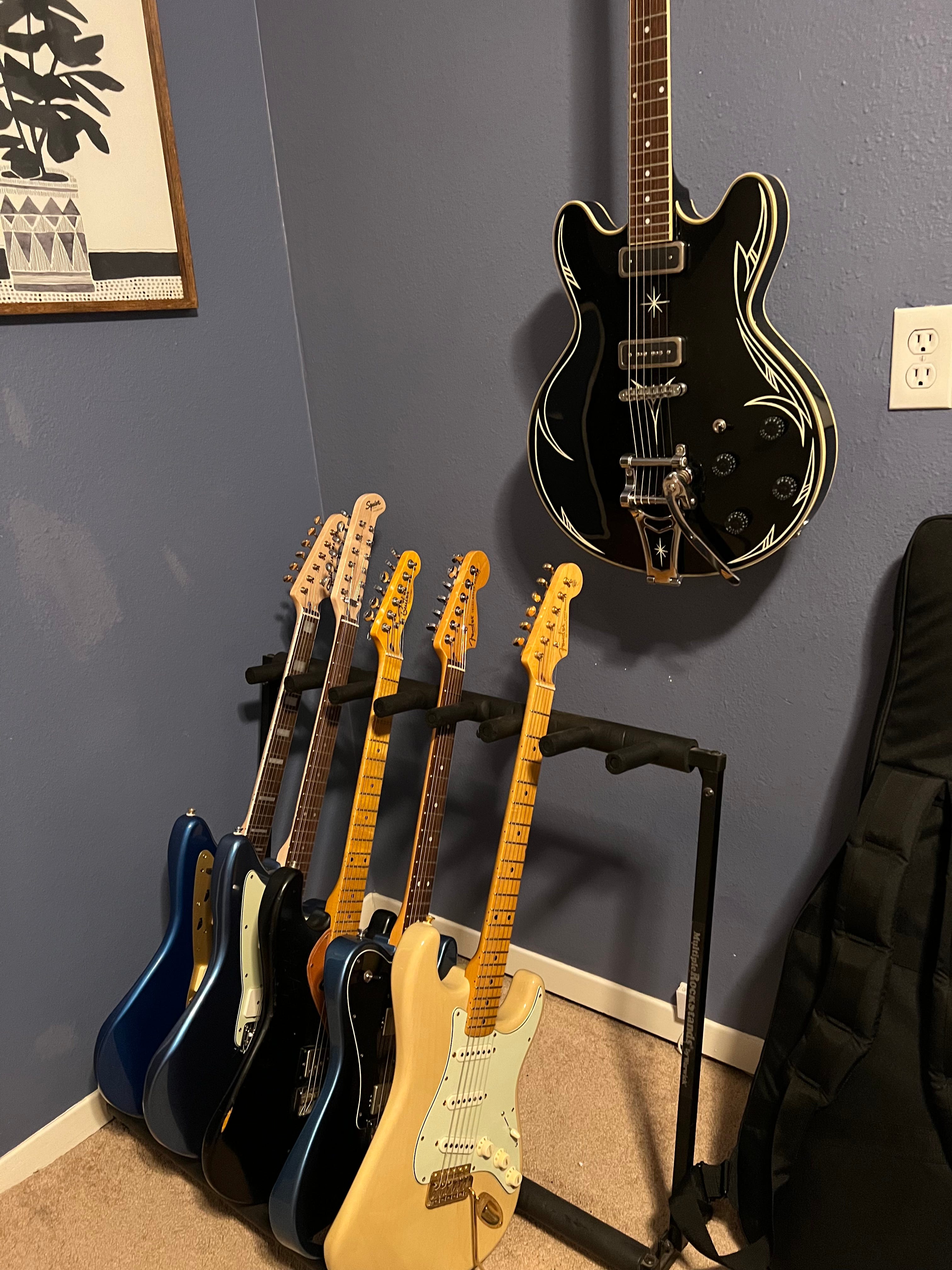
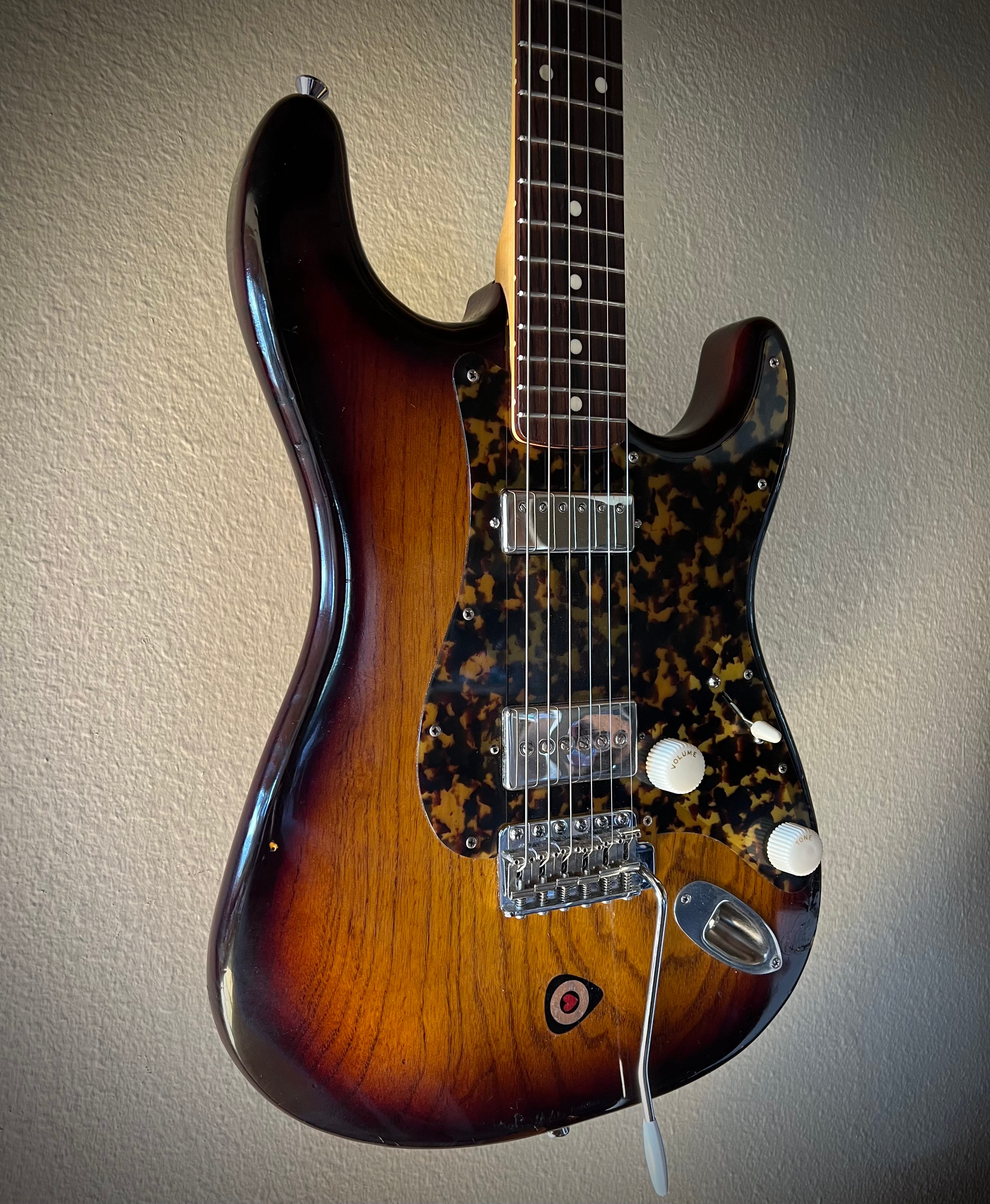
In my studio, I had a seven space guitar rack filled with various guitars, with another three or four leaning up against walls or behind chairs. Also, a bass, a mandolin, a lap steel and a couple of keyboards. That doesn’t include the several guitars hanging throughout my house and even a few in cases under beds. And you know what? I never played them. Instead of playing them, I spent time looking for others to add to the pile that I also would likely not play. Recognizing that was a bit of a problem, I made a drastic decision and took all of my guitars out of the studio except for one. Completely away, out of sight, in cases, in another room. I kept out the one guitar I use most when I play gigs, a mongrel Strat style guitar I pieced together out of various parts I had laying around I affectionately call “The Mule”. I set it up on a single stand, plugged into a small practice amp, right next to my desk, and a strange thing started to happen. I started to actually play it. Now, when I’m waiting for files to download, or a track to bounce, instead of heading to Craigslist or Reverb to pass the few minutes, I pick up my guitar. By un-cluttering the space and only having one option, I found myself much more drawn to it. I also discovered something else. That maybe I really didn’t need all of those other guitars after all. With the exception of the acoustic track, all of the sessions I mentioned above were done with just that one guitar. Even the “Baritone” track was the same guitar with the low strings tuned down. Because I didn’t have all the other guitars handy (and I’m too lazy to go pull them out again), it forced me to be more creative in getting the right sound with the guitar I had on hand. In the end, they all sounded great and appropriate for the music.
So, am I going to sell all of my other guitars and never shop for another one? Hell no. I love guitars! Each one has its own personality and can inspire creativity in different ways. But, when I do decide to pull out a different one, I feel like I can appreciate it a bit more than I did before.
I think setting limitations for yourself can help breed creativity, even if it’s arbitrary. I often find myself sitting in my car, about to drive somewhere, searching endlessly for the perfect thing to listen to, only to get frustrated and end up playing the same thing I’ve listened to a thousand times because its easier than searching the entire history of recorded music that we have available to us at any given time. But what if I randomly narrowed the search field. What if I searched for only songs that were released in 1972? Or go further and say the top 10 from 1972? I can guarantee there would be some great songs and it would take me down another path I wouldn’t normally go on.
The same goes for mixing. I’ve talked about this before, but I have hundreds of plugins in every category, but in order for me to be efficient and focused on the actual mixing part, and not get bogged down in unimportant decisions, I’ve needed to build a template that limits my options. I can’t start with a completely blank canvas every time or I’d never get anything done. And it applies even more so when recording. The beauty of recording on analog tape was the fact that you had to commit to decisions. You only had so many tracks to work with, so you had to prioritize ideas. If you thought you could play a solo better, you better be absolutely sure because in order to do it again, you had to erase the take before it to save tracks.
I have been given sessions to mix with over a hundred tracks in Pro Tools, and every time, I think it would have been a better production with half the tracks. Or less. Just because we can do something, doesn’t always mean we should.
We live in a weird time. We’ve never had so much access and abundance in our history. From music to movies and entertainment to food, we have pretty much everything at our disposal, and now with AI, we can even create things with a few keystrokes that could not even be imagined a few short years ago. But is that a good thing? Maybe I’m just the old guy rambling on about “the good old days”, but I don’t think it is. At least not for art. I think great art often comes from a lack of abundance. Making something beautiful out of nothing. I think art is at its best when it transcends its limitations, by making something greater than the sum of its parts. At least for me anyway.
As always, thank you for reading and subscribing. I’ll do my best to keep these coming more regularly in the future. Take care everyone.
-Mike
Mike Butler is a professional mix engineer, guitarist and producer currently based in Southern California. His list of credits range from The Rolling Stones, Phoebe Bridgers, The Pretenders, The Shins, Ray LaMontagne, Five For Fighting, Reba McIntire, Fleetwood Mac, The Doobie Brothers, Eminem and many more. He’s recently mixed music for the hit HBO animated series, “Batwheels”, has composed and produced music for commercial clients including Netflix, Shure Microphones and Progressive Insurance.
Comments
Nothing yet. Say the first thing.
Sign in to join the conversation.