
Aging Against My Will was founded on a simple principle: I never agreed to any of this. Not the wrinkles, the disappearing hair, the mystery noises coming from various joints, or the growing number of body parts that strongly object when I try to use them. So you would think I’d be a natural for anything labeled “anti-aging.” In fact, I should be their ideal customer, unofficial spokesman and easiest mark.
The problem is that anti-aging apparently does not mean being against aging at all. It means buying a cream, swallowing a supplement, sitting under a red light or paying someone several hundred dollars to say “rejuvenation” without laughing. Which raises the question: If none of this actually stops aging, reverses aging or even seems to inconvenience aging, what the hell does “anti-aging” mean—and why won’t it leave me alone?
I can’t escape it. Every damn day, I’m bombarded with anti-aging something. My email is stuffed with subject lines screaming about:
“This 87-Year-Old Great-Grandma Got BANNED from Her High School Reunion for Looking Too Young”
The internet serves me ads for youth-restoring dryer sheets and longevity-boosting USB cables. There are anti-aging vitamins, age-defying diets, youth-preserving workouts, longevity-focused meditation, rejuvenating sleep strategies, wrinkle-fighting breathing techniques, and probably age-reversing toilet paper if I looked hard enough. It’s everywhere, this anti-aging industrial complex, and it’s making me nuts.
Not because I don’t want solutions to getting older—hell, if someone invented a pill that kept me feeling fifty forever, I’d give away my firstborn. If I had one. (I wonder if adoption is still a possibility.) But after years of being pelted with these promises, I still have no clue what “anti-aging” actually means.
If I’m anti-aging, does that mean I don’t want to get older? Because that sounds suspiciously like I want to die right around NOW, and I’m definitely not pro-death. I’ve got plans, dammit. Vague, poorly thought-out plans, but plans nonetheless.
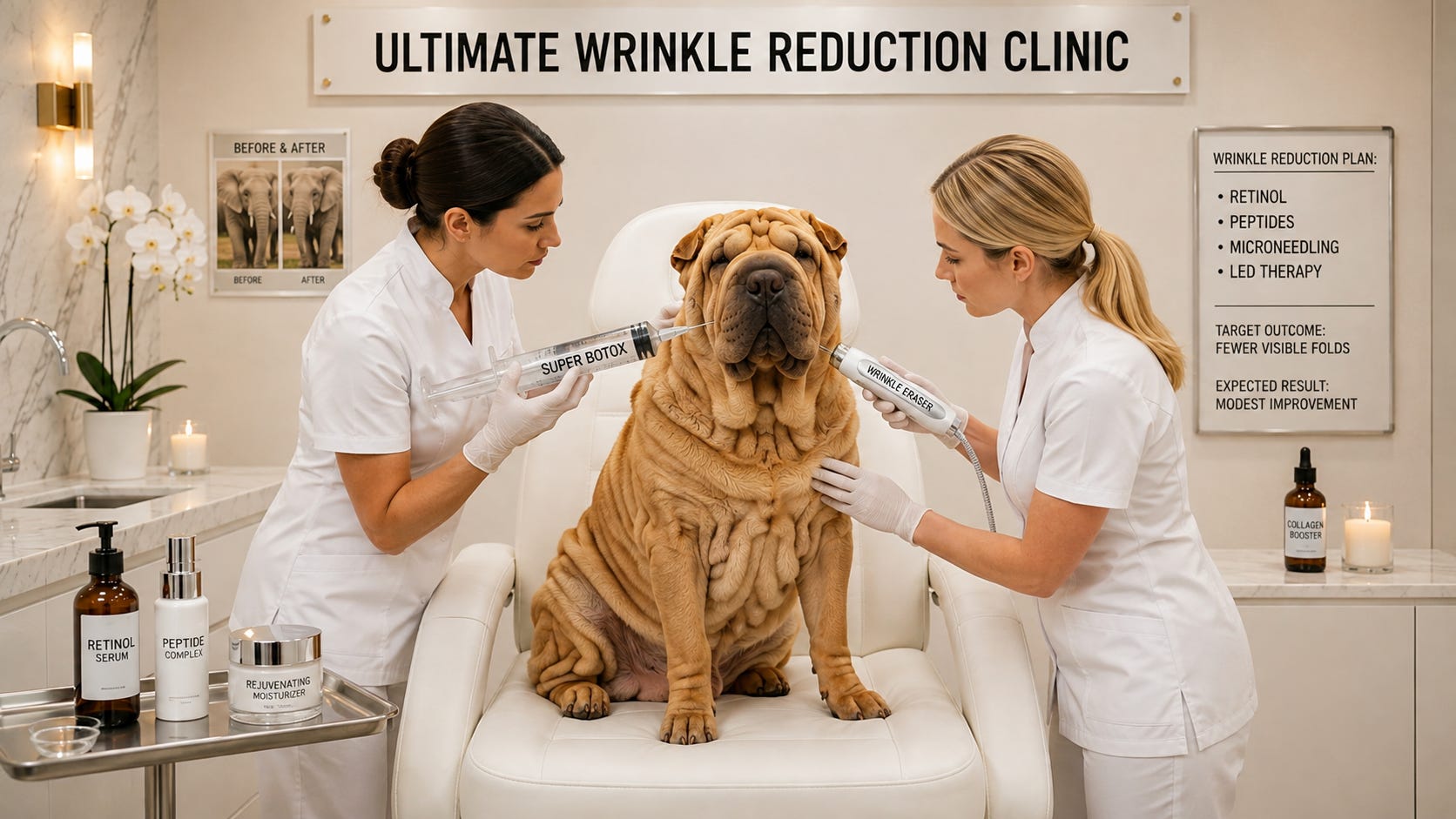
I can’t possibly be pro-aging after all my ranting and raving, can I? I don’t want more wrinkles than a Shar-Pei, and I certainly don’t want everything that’s still mostly in place, or at a minimum still hanging in there, to start migrating south. And I really don’t want to develop that old-person shuffle that makes me look like I’m perpetually searching for a bathroom. But if I’m not pro-aging, and anti-aging makes no logical sense, where does that leave me? Am I pro-anti-aging? That sounds like I’m in favor of being against aging, which brings us right back to the original problem. Or maybe I’m anti-pro-aging, which would make me against people who are in favor of aging?
Whatever we call this, I am still aging against my will. But as so many people have pointed out, it’s better than the alternative. And whether they are right or wrong, I have no idea how to oppose a biological process that has been operating continuously since the day I was born.
But you know who never loses sleep trying to figure this out? The anti-aging industrial complex.
The Marketing Behind Our Linguistic Nightmare
The beauty of the term “anti-aging,” from a marketing perspective, is that it’s complete BS wrapped in hope and sold at premium prices. It’s a marketer’s dream: it promises the impossible while making customers feel as though they’re doing something about the inevitable—that they still have some say in the matter. More important, “anti-aging” does not have to mean anything specific. It only has to suggest that something beneficial is happening.
It can mean whatever the customer most desperately wants it to mean—prevention, concealment, improvement, maintenance, reversal, renewal, or any of a dozen other outcomes biology has no intention of delivering. A cream cannot stop aging, but it can be anti-aging. So can a vitamin, a pillowcase, a meal plan or a light bulb. Apparently, anything that can be put in a box and sold with the word “rejuvenating” on it qualifies. Nobody has to explain which part of aging is being opposed, how much opposition is occurring, or whether aging has bothered to notice, let alone respond.
Somehow, they’ve convinced a gazillion people that they can be “anti” one of the most fundamental processes of being alive. The industry has created an entire vocabulary of denial: “age-defying” makeup, “youth-restoring” serums, “time-reversing” treatments. It’s like we’re at war with our own biology, armed with nothing but overpriced lotions and the desperate belief that if we just buy the right products, we can fool Father Time into thinking we’re still thirty. Father Time isn’t buying it. Unfortunately, we are.
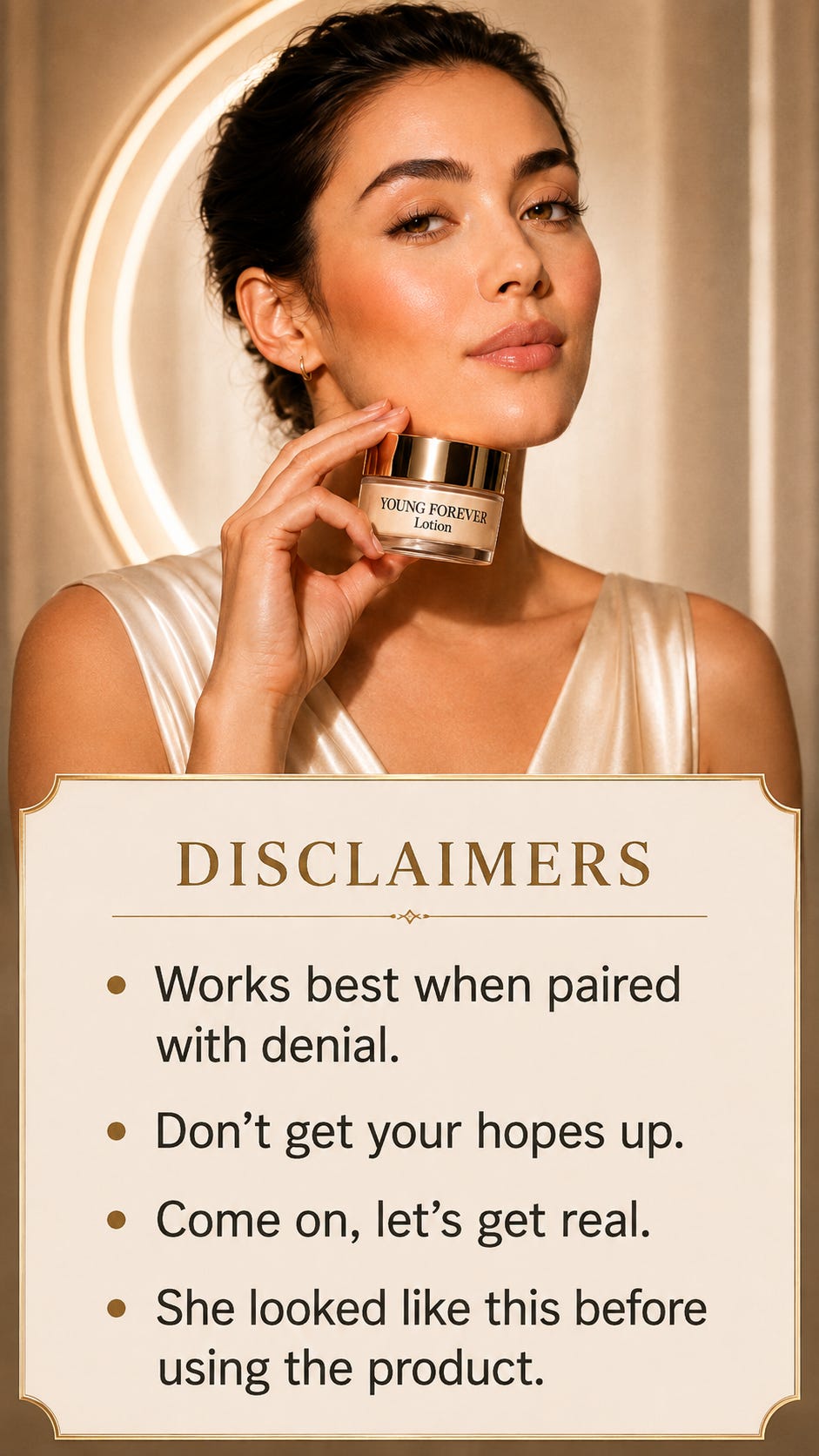
Many anti-aging ads feature strikingly beautiful young women who have defeated aging by not having started yet. Other ads feature strikingly beautiful older women with nearly perfect skin—older in advertising terms, meaning somewhere in their forties, still gorgeous and apparently born without pores—which may be the more effective con because at least these women appear to be evidence. In either case, she is simply holding the product, which is apparently all the evidence we are expected to require.
The ad never says she uses it, nor does it claim that the cream made her look like that. It just puts her face next to the jar and lets us make the connection: use this and you could look younger again. Not necessarily like her. Of course, nobody said that. Nobody said anything, actually, which is the beauty of it. The company supplies the model—our desperation does the rest.
If these products were even the slightest bit honest, the ads would say:
“Because dim lighting can’t do all the work.”
“Helps you look slightly less like your driver’s license photo.”
“If it doesn’t work, you didn’t use enough. If it works, you can never stop.”
Denial, combined with a guarantee that failure is always the customer’s fault, may be the entire business model.
The Absurdity of Choice
What really gets me is that the anti-aging industry has managed to turn aging into a lifestyle choice, as if getting older is something I can opt out of like a timeshare presentation or a high school reunion. “I’m sorry, Biology, but I don’t remember ordering the aging package. Is there somewhere I can return it?”
The implicit message behind anti-aging is that aging is a failure of willpower. If I just try harder, moisturize more consistently, and consume enough antioxidants, I can politely decline the whole aging process. My cells will look at my skincare routine and think, “Wow, this guy’s really committed. Let’s give him another decade of collagen production.” The message is never that I look older because time passed. It’s because I chose the wrong moisturizer, slept on the wrong side of my face for forty years, or at some point while eating a sandwich, allowed inflammation to become chronic.
The thing is, I understand exactly what they are doing. I see the trick, resent the attempt, and hold corporations, advertisers, and marketing people in a permanent state of disdain and contempt.
Then I look in the mirror, wonder for a second who that old guy is, and finally understand The Scream—the painting with the terrified figure holding both hands to his face. The poor bastard had also just seen his reflection.
Then I think, what the hell do I have to lose?
Don’t get me wrong, I’m not trying to look young—that would require a time machine, not a serum. I’m trying to look less old—to hide some of the evidence while my hair disappears and my skin slowly melts off my face. If something has legitimate support behind it, I’ll try it. I’m not opposed to vanity, artificial assistance, or fighting back. I just want some reason to believe the weapons aren’t loaded with blanks.
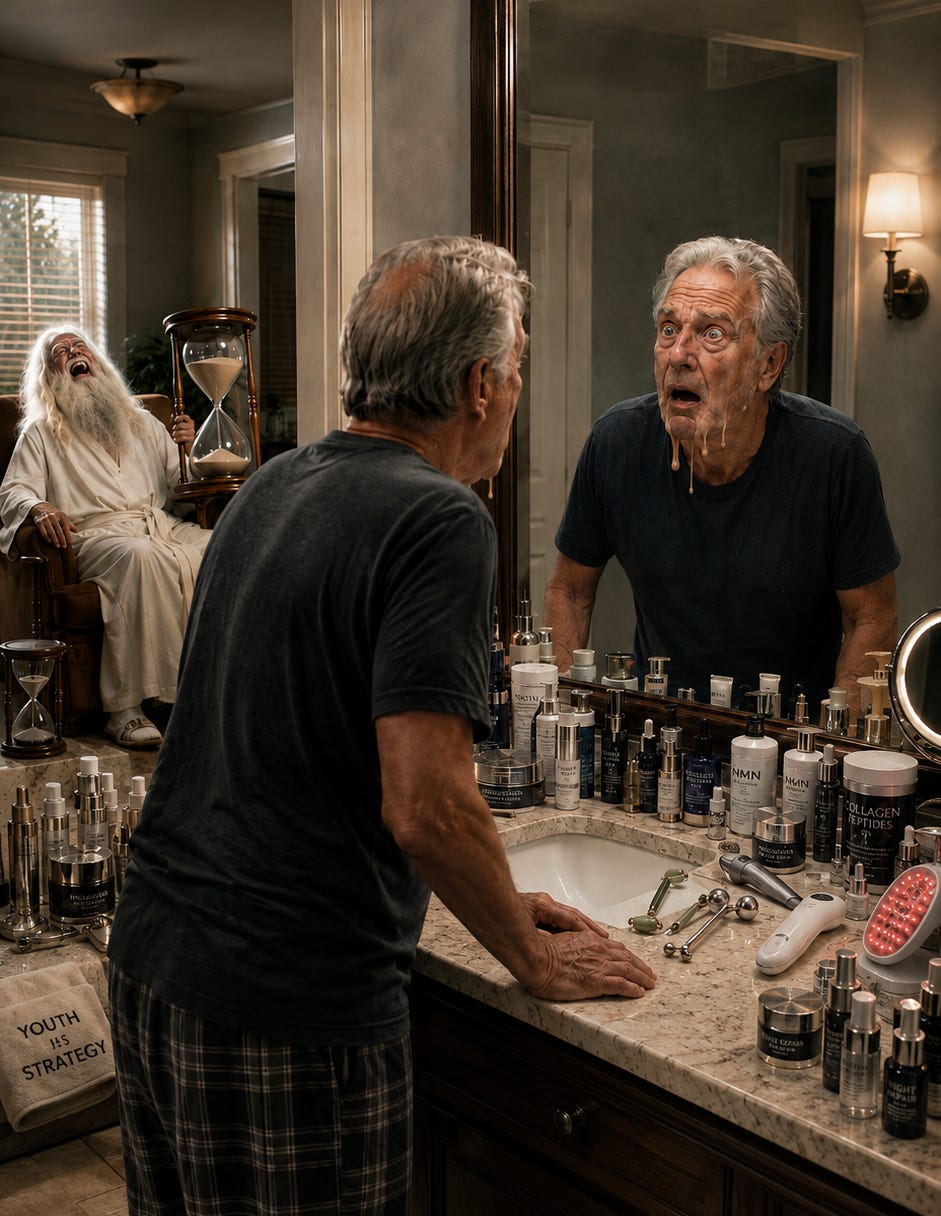
The problem is that I may never get that evidence, because I look at my face every day and the deterioration is being delivered in teensy-weensy installments. Maybe the product helped. Maybe it did nothing. Maybe without it my face would now look like one of those melting clocks in the Dalí painting.
I know things are going to keep getting worse. The only question is whether anything I’m doing is slowing them down even a little. For me, that’s enough reason to keep trying.
Aging isn’t a matter of opinion or personal preference. It’s biology—the rent we pay for staying alive another year.
I know I’m not reversing time—I have mirrors. But that doesn’t mean I’m canceling my next dermatologist appointment.
For the record, I am still not happy about this whole aging thing. But the only anti-aging treatment with a 100% success rate has a side-effect profile I’m not prepared to accept.
After all, I have too many complaints left about getting old.
*****
What’s the dumbest anti-aging product or treatment you’ve ever tried—and did you keep using it anyway?
PLEASE SHARE: If you know someone who understands that none of this is stopping aging but keeps buying the stuff anyway, please share this with them. Denial is more fun in groups.
Comments
Nothing yet. Say the first thing.
Sign in to join the conversation.