
I want to thank all those who have recently become subscribers to Night Beat. I also want to thank Elaine for encouraging readers to take that step. After I get settled into my new abode here in Fort Worth—furnishing the place, deciding what records and books to bring in from Elaine’s home—I will be embarking on a new personal narrative line: The Albums Part Two. To be truthful, I never saw this trajectory coming when I started Night Beat. I will do my best to make the challenge candid and interesting. I expect to discover a lot along the way.
(This full Clash post can be found at the Substack link that appears here)
IN THE UNITED STATES, Epic Records decided not to release The Clash (“They figured it wasn’t fit for human consumption,” Jones said), and insisted on a more polished effort before presenting the band to American tastes. (Though the Clash had been assured of creative control with CBS, it wasn’t always to be the case; the label could still decline to release their recordings.) Strummer had daydreamed of John Lennon as a producer, but instead the Clash accepted Sandy Pearlman, known for getting a forceful but clean sound with Blue Oyster Cult. By this time drummer Topper Headon had replaced Terry Chimes in the band. Pearlman marveled at Headon’s abilities—especially when the drummer played a complicated pattern backwards with ease. (“Nobody else has ever been able to do that since,” Pearlman told Mojo in 2003. “I could only do it now with technology.”) Through rehearsal, recording and mixing sessions that stretched through much of 1978 in London, San Francisco and New York, Pearlman and the Clash layered a sound that was less frantic than the first album’s, but that was also anything but clean; rather, it was a dense blare. Mick Jones—who was already feeling hemmed in by the punk dogma of rigid harmonic and rhythm constructions (“There’s no room for instrumental excess,” he had complained) —worked overtime with Pearlman to build the new album’s titanic roar. “There are more guitars per square inch on this record,” Pearlman told critic Greil Marcus, “than in anything in the history of Western civilization.”)
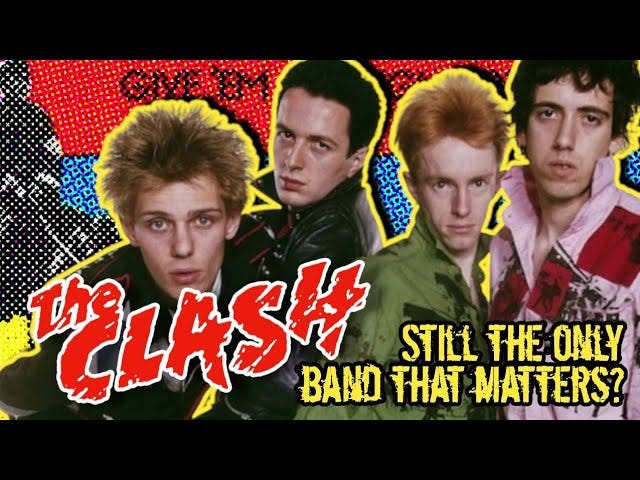
The finished work, Give ’Em Enough Rope, was released in November 1978. It soared to number two in the UK album charts, but despite Epic’s insistence on more professional production, it didn’t even penetrate the Top 100 in America (the Clash’s first album eventually fared much better in the U.S.) The slow-to-warm American reaction certainly had something to do with how punk was still regarded as an anomalous insurrection in the U.S., though it may have owed as well to the album’s cover image, depicting a Chinese Communist troop advancing on horseback to the body of a dead American cowboy. (CBS UK initially worried that the Chinese government might sue over the use of the image). The illustration wasn’t simply a taunting poke at what the Clash saw as America’s imperial hubris. It also proclaimed that the band’s writers, Strummer and Jones, were expanding their gaze beyond the confines of British society and politics. They were now considering a world full of fearfulness and deathly struggle, and they were acknowledging the difficulties and contradictions involved in a rock & roll band’s hope to affect that world. The realities depicted in songs like “Tommy Gun” and “Safe European Home” were complicated and dangerous. In “Guns on the Roof,” Strummer sang: “A system built by the sweat of the many/Creates assassins to kill off the few/Take any place and call it a court house/This is a place where no judge can stand.”
Some British critics—not conservatives, but fans of the band—took issue with lyrics like these and with Strummer’s fondness for wearing T-shirts on stage that seemed to advocate the IRA and other various armed rebellion movements, like the Italian Red Brigade. Didn’t Strummer worry, one interviewer asked in 1978, that he might seem to advocate violent terrorist acts? “They’re doing it for everybody,” Strummer replied, “trying to smash the system that has broken everybody.” Then he backed off a bit: “I’m impressed by what they’re doing, and at the same time I’m really frightened by what they’re doing. It’s not an easy subject.” Mick Jones didn’t share Strummer’s ambivalence. During a similar discussion with another interviewer, Mick Jones interrupted Strummer and said, “I don’t support this killing stuff.” (After an armed loyalist faction in Ireland threatened to kill Strummer if the Clash ever performed there, he became more circumspect about the advisability of violent revolt.)
In truth, the Clash’s political stance not only helped secure their place in rock & roll history—and to uphold punk’s legacy—but it also proved prescient. A few months after Give ’Em Enough Rope, Conservative Party leader Margaret Thatcher came to power as Britain’s Prime Minister by supplanting the sort of mean-spirited anti-immigration, pro-law and order and nationalist sentiment advanced by the National Front. In “White Man in Hammersmith Palais” (perhaps the Clash’s best song), Strummer confronted the indomitable power that political-minded insurrectionists now faced: “It won’t get you anywhere/Fooling with your guns/The British Army is waiting out there/An’ it weighs fifteen-hundred tons.” Margaret Thatcher wasn’t afraid to use that sort of power to drub down youth, workers and protesters and to reassert state authority. History, of course, steps back and forth. Thatcher’s time came and went, and though one could say the same for the Clash, their truths still resonate. In the mournful “English Civil War,” when Strummer asked, “Who got caught unawares/When the New Party Army came marching right over our heads,” some Clash critics cited his imagery as portentous hyperbole. Today, nearly fifty years later, the song’s apprehension could just as readily apply to the American political realities of 2026.
BY THE TIME GIVE ’EM ENOUGH ROPE came out, punk no longer existed as the same sort of insurgent experiment. In January 1978, the Sex Pistols toured America and then fell apart, leaving Johnny Rotten embittered. (“It made us feel a bit lonely, somehow,” Paul Simonon said about the Pistols’ end. “There was nothing left to chase.”) In the Pistols’ wake, a number of bands would forswear the hard, guitar-dominated, backbeat-driven sound that a band like the Clash still exemplified—now disparaged by some as “rockist”—in favor of the looser and more abstruse postpunk music that Johnny Rotten (who resumed his given name, John Lydon) would make with former Clash member Keith Levene in Public Image Ltd.
The Clash, though, weren’t anxious to heed anybody else’s directions, and this included the supervision of manager Bernard Rhodes. For some time, Mick Jones had been growing wary of Rhodes’ instincts and demands—especially after Rhodes’ insistence, at a band meeting, that he be granted “complete control.” Jones was surprised when Sex Pistols guitarist Steve Jones began appearing at shows, asking to perform with the band. He worried that Rhodes might be seeking to replace him, so Mick struck first: In October 1978, the Clash served notice to Rhodes that they no longer desired his representation. Rhodes tied up the band’s earnings and fired back with graceless comments. “I took them off the streets,” he said in a press release, “and made them what they are!” He later told interviewer Pat Gilbert (the author of Passion is a Fashion: The Real Story of the Clash): “I didn’t realize that Joe was such a coward. Mick I didn’t realize was such an egomaniac.” However, Strummer—who seemed to need a fatherly guidance even as he deprecated authority—had misgivings about Rhodes’ dismissal. “Bernie imagined the Clash,” Strummer said in 1991, “and he built it to fit the specifications of his vision. The Clash wouldn’t exist without Bernie’s vision.” (Rhodes himself later claimed he’d written the first Clash album.)
Rhodes won a court order that in effect tied up the band’s earnings, and the band’s interim manager, Caroline Coons—a journalist who had championed the early punk scene—turned to Epic Records to finance the band’s first U.S. tour. The label still had little faith that the band could attract any substantial Stateside following, though in the end the company agreed to put forth a modest budget. This sort of continuing disregard couldn’t help but rankle and hurt a band as proud as the Clash, and when they finally arrived on American stages, they played with an exceptional fury. Only Bruce Springsteen aimed for the same sort of nightly heroic enactments, and though he had a social and historical vision that rivaled the Clash’s, Springsteen wasn’t speaking to an emerging body politic, or taking the front of a cultural revolution, as the Clash was. “Listening to them,” Tom Carson wrote of the band’s 1979 New York show, “one not only believed in the world at war that they sang about, but also wanted to enlist, on their side, on the spot.”
Though the Clash opened their American shows with “I’m So Bored with the U.S.A.,” they were nonetheless fascinated with the myths and music of the land they were traveling. This was, after all, a country with remarkable musical legacies—scary and radical folk songs; blues full of both doom and resilience; Hank Williams’ wit and heartbreak; New Orleans jazz and R&B; liberating Southern soul and triumphant Motown—the land that had delivered rock & roll in the 1950s. Punk claimed to have sprung self-willed in Year Zero, but the Clash knew that they weren’t without essential precursors. “When you’ve been into American music as long as I have,” Strummer said in Westway to the World, “to go there is a trip. To ride across the country—even better, on a bus—is another trip. It was fantastic. I got endless amounts of inspiration from it.”
The band mined the American influences—along with furthering their devotion to Afro-Caribbean music—for their next album, the groundbreaking London Calling. This time out the band worked with Guy Stevens, who was respected for his work with Procol Harum and Mott the Hoople, but also known for drunken and unpredictable behavior (he had once set fire to a studio during a Mott the Hoople session). Don Letts’ documentary about the recording of the album relates accounts of Stevens swinging a ladder over the heads of the musicians, pouring red wine across the keyboard of an expensive piano that Strummer was playing and getting into wrestling matches with engineer Bill Price, all to realize the sound the producer wanted. (Stevens would die in August 1981, due to an overdose of a drug he was taking to control his alcoholism.)
What resulted was one of rock & roll’s most prodigious works. London Calling, released in the UK in December 1979 and in the U.S in January 1980, opened with the doomful undertow of its apocalyptic title track and closed with the surprising ache of Mick Jones’ “Train in Vain.” In between were seventeen other tracks that displayed growth—songs about defiance, revolution, war, apocalypse, death, but also about the freedom to allow delight, vulnerability, doubt and courage in the same breath. “I have lived that kind of day,” Mick Jones sang in the album’s most affecting verse, “When none of your sorrows will go away/It goes down and down and hit the floor/Down and down and down some more/Depression/But I know there’ll be some way/When I can swing everything back my way.”
Which is what the Clash had done: They made a masterpiece on their own terms. London Calling has often been cited as the best album of the 1980s, but we wouldn’t need a historical reassessment to tell us what was so evident in the moment: The Clash had seized an ambitious creative momentum that nobody since the Beatles had accomplished. They had done it despite a hostile press at home and a suspicious music industry, and they had done it in the face of the worsening conservative temperament of their times. By 1980, they were already called “the only band that matters,” and though the Clash is now long gone, nobody has said that about any other band since.
SO FAR THIS MAY SEEM LIKE A STORY of hard-fought idealism—and in many ways, of course, it is. The members of the Clash genuinely shared the political ideals they expressed, and no matter what happened in the years that followed, they never relinquished those beliefs. But accord need not be the same thing as unity or compatibility. The Clash was not, after all, an integral partnership like the Beatles, who had grown up together with common experiences and mutual history. There had been differences and unease among the Clash since their earliest days—mostly small strains based on aesthetics and personal manner, or due to the unavoidable stress from working and traveling so intensively in such a short period of time. In particular, the relationship between Strummer and Jones was often an embattled one. “We have rows almost every day,” Strummer said in early 1978, “and we break up almost every day.”
Sometimes those tensions flared in ugly ways. Backstage at a Sheffield, England show in January 1980, Mick Jones told Joe Strummer he wouldn’t play “White Riot” for an encore; he was tired of the song. The refusal turned into a shouting match, with Jones throwing a vodka and orange juice into Strummer’s face. Joe punched Mick, “hard in the middle of the head,” Strummer admitted in 1999. “There was real savagery in the attack,” one witness said. “Mick was crying his eyes out.” The band went back on and played “White Riot,” but midway through Jones set down his guitar and left the stage. Years later, Strummer remained unapologetic: “You’re like a team going onstage, and no one lets anyone down. When that happens, you have to resort to violence between each other, punch people. It’s beyond discussion.” Even so, there was a lot of affection between these men, and respect for one another’s talents. “Mick was my best friend at one time,” Strummer later told music journalist Robert Hilbur
n.
No posts
Comments
Nothing yet. Say the first thing.
Sign in to join the conversation.