
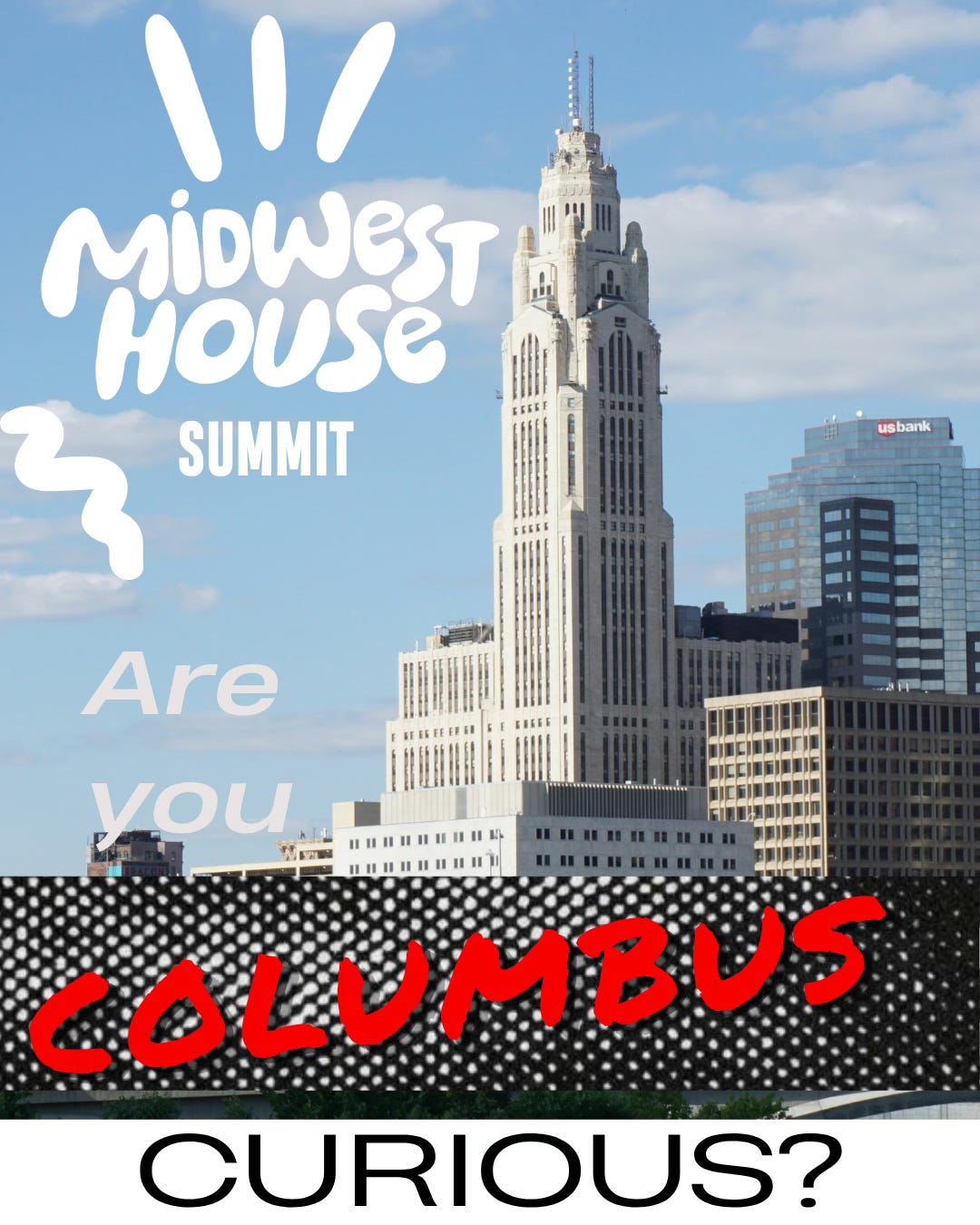
We’re 3 weeks out from the Midwest House Summit Ohio and we’re announcing new speakers daily. Including:
Alex Husted — Partner, OH.io Landon Campbell — Chicago GM, Drive Capital Wolf Starr — CEO, The Venture Atlas Justin Turk — CEO & Co-Founder, ConStrat AI Donna Harris — CEO & Founder, Builders + Backers Brian Brackeen — Managing Partner, Lightship Anchor Fund Shannon McGhee — CEO, SEED SPOT Kris Rockwell — President, Kris Rockwell Foundation Debbie Irwin — Executive Director, Lighthouse Network Kamel Greene — Co-Founder, FibrX Kim Patel — JPMorgan Alex Frommeyer — Founder & CEO, Stack Health Julia Dewey — Chief Partnerships Officer, Rev1 Ventures Tim Grace — Managing Director, Techstars Columbus Mickayla Rosard — Partner, Groove Capital Chelsea Toler — Co-Founder, Logictry & Family Foundation President Jason Mejeur — Co-Founder & CEO, Coya Michelle Murcia — Founder & CEO, Book + Street Suresh Rachuri — Exited Founder, Maven Brian Folmer — Managing Partner, FirstLook Ventures
For the next 24 hours we’re offering a 3 weeks the discount code: 3WEEKSTOOH26 for 50% off y’alls tickets at the link below.
If you’ve been following my writing/thinking at all the last few months - and honestly I’m barely following my own writing/thinking so no worries if not - then you know that I’ve got this general sense that the Midwest is well positioned for the way the world is shifting. From our infrastructure to our climate to our expertise, it sure seems like we’ve got a lot of the things the world is going to value over the next few years.
A lot of the reason that I feel that way is because of the people I get to talk to in this role of mine. So I thought it might be fun to start interspersing some interviews in here with smart people who are thinking/building/creating here in the Midwest
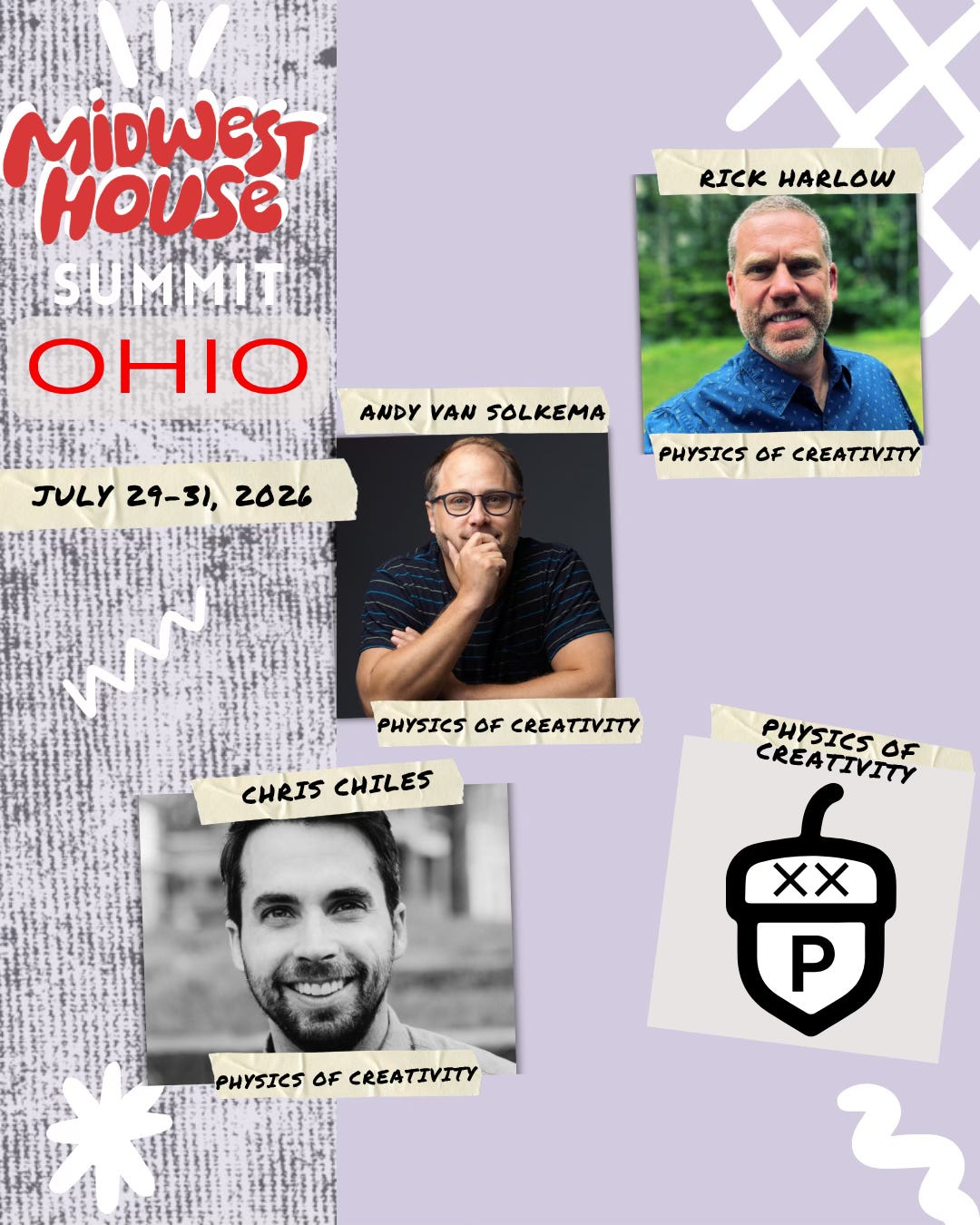
First up: Andy Van Solkema, Chris Chiles, and Rick Harlow from Physics for Creativity — a Michigan firm doing design, growth innovation, and capital, often all at once.
This conversation has been condensed and edited for clarity.
Ted: Tell me how Physics came together. Because the three of you come from pretty different places.
Andy: After working in our previous design studio and combining that with a larger consulting firm, I had been studying innovation and venture models, working in commercialization and university research, since leaving that role. We thought — there’s got to be a way to build a co-founding model without starting as a fund. We didn’t want to just raise capital and deploy it. We wanted to be in the work.
Rick: We have worked together in various ways for 25 years. We crossed paths while I was working at a larger consulting firm — all of us had been touching companies going through real change, market invention, innovation. And at some point we looked back and realized that between us, we’d been involved in companies that collectively generated something like $3.7 billion in exit value over the years. We wanted to help others build their businesses and at times be a sort of co-founder with others, not consultants.
Chris: The name came from thinking about what actually drives creativity. If you strip it down — the scientific method applied to market invention. You’re not starting with an answer. You’re running experiments. That’s the physics of it.
Ted: What does that look like practically? When a company comes to you, what are you actually doing?
Andy: The first thing we do is try to identify the riskiest assumption they’re navigating. Not their biggest challenge. Their riskiest assumption — the thing they’re betting on being true that might not be.
Chris: And then we figure out the fastest, cheapest way to test it. Design thinking without making things is just sticky notes that go nowhere. You’ve got to build something real, put it in front of real people, see what happens.
Rick: The other thing we push hard on is market first. Always. We’ve seen companies fall in love with their technology before they understand who actually needs it and why. That’s how you end up with a great product and no business.
Ted: Can you walk me through what that looks like with a real client?
Chris: Coya is a good one. They came to us initially for UX help — they had a wearable tech product, the design needed work. But pretty quickly it became clear that the UX wasn’t the problem. Their market was the problem. They were trying to sell to and engaged user base, but the buyer was not ready, the real opportunity was somewhere completely different: entrepreneur and executive coaching. That’s a different buyer, different use case, different positioning. We helped them see that, pivot toward it, rebrand, rebuild the web presence, do real product innovation. That was four years of work.
Andy: CleanBotixs is a different kind of story. Family-owned product engineering company building a robot to address the labor problem in food sanitation. When they came to us they had a good vision and technical products and weren’t sure what to do with it commercially. We worked with them on their services model, software vision, pricing, packaging — and eventually helped them strategically with a Series A. Not through traditional VC. Through industry private equity, which is actually a better fit for where they are.
Ted: What’s the moment — the trigger — when companies usually reach out to you?
Andy: It varies, but there’s usually something that cracked them open. We worked with a multi-billion dollar Midwest company — not one we can name — and the owner came into our initial session expecting to talk about product innovation. Like, what new things can we make. Half a day in, he stopped and said: “I thought I was coming to hear how you’d help us innovate products. Now I’m thinking I’m not sure there’s a company here in the future.”
That’s the moment. When someone is big enough that they feel safe, but honest enough to look at where the market is going and realize they can’t just wait it out.
Rick: Then there was silence for a few months. And they came back. And we’ve been working with them for a year.
Ted: How do you think about the difference between a company that needs to innovate internally versus one that needs to spin something new out?
Andy: The acorn and the oak tree. Same DNA, completely different jobs. An oak tree doesn’t do what an acorn does. A spin-out needs a totally different environment than an internal innovation program — different culture, different risk tolerance, different timelines, different metrics. If you try to run them the same way, one of them dies.
The question we always ask is: where is this company in its lifecycle, and what does that actually require? Because a $2 billion incumbent and a three-year-old startup are not solving the same problem, even if they’re building the same technology.
Ted: Is the Midwest a specific kind of challenge for this work? Or is it an asset?
Chris: Mostly an asset. Relationships here are real. People mean what they say. When you’re working with a family-owned company that’s been around for sixty years, there’s a different kind of trust that gets built — and a different kind of commitment.
Apple’s retail group told us something that stuck with me. They said the average tenure of a designer working with them on the West Coast is eleven months. Our team had been on a project with them for three years. They said it like it was unusual. For us it’s just how we work.
Andy: The mid-size companies — the “boring” ones, as people say — they’re waking up. They built real things for decades and the last wave of the tech economy kind of passed them by. Now they can see what’s coming and they’re not interested in waiting for it to arrive.
Rick: Which is actually an advantage. They don’t have as much to unlearn.
Ted: What are you seeing right now? If you had to name what’s different about this moment?
Rick: The AI gap. Everybody wants to use it. Very few companies are doing it well. There’s a huge distance between the desire and the execution. And the timeframes are shrinking — bets that used to be twelve-month commitments are now six weeks. Plan the inning, not the game.
Chris: I keep saying: everyone is building right now. Which is great. But it’s also a little chaotic. There’s a lot of movement and not always a lot of intention. The question I want more people to ask is — is this the right thing to build? Not just, can we build it.
Andy: Three forces are collapsing at the same time. Technology advancement — AI obviously, but also manufacturing tech, materials, biotech. Generational shift — who’s running companies now, who’s starting them, what they believe is possible. And market disruption, the Schumpeter thing — the next wave of creative destruction accelerating faster than anyone expected. A company like CleanBotixs can move faster than a $2 billion incumbent. That wasn’t true ten years ago and we helped them validate their ideas in half the time.
Those three things together are what make this moment feel different. It’s not just a technology cycle. It’s a restructuring.
Ted: Last one. What does the Midwest need to do with this moment?
Andy: Frame it. That sounds soft, but it’s actually strategic. The Midwest has been telling a story of catch-up for a long time — we’re behind, we’re trying to close the gap. That’s the wrong frame. The right frame is: we have infrastructure that nobody else has, we have relationships that nobody else has, and the future is going to be built on exactly those things. Framing is a competitive advantage. Build to frame, make and test, see what’s true.
Rick: And move. Stop waiting for permission.
Chris: Yeah. Build the thing. Figure out if it was right later.
Andy Van Solkema, Chris Chiles, and Rick Harlow are the partners at Physics for Creativity, a West Michigan firm working at the intersection of design, growth strategy, and capital. Learn more at physicsofcreativity.co.
No posts
Comments
Nothing yet. Say the first thing.
Sign in to join the conversation.