
“It’s the same old, same old,” the psychic said as she divined the tarot cards I had chosen. A small table between us held a bag of crystals, a box of Kleenex, and a flickering candle. She was talking about someone important in my life but couldn’t be more specific, other than to say this relationship had “too much energy to be new.” Perhaps seeing the look of consternation on my face, she quickly added, “It’s a minor boredom, nothing that major.”
Obviously, she was referring to my husband. He was an important person in my life who was boring me, a little. We had walked a long road together, and after more than thirty years the scenery was starting to look very familiar.
We met at university in the mid-1980s. I had a limited dating history because I was both commitment-phobic and picky, but I knew he was the one even before the term ended. He had all the qualities I desired: smart, well-rounded, kind. He was physically my type too with his dark curly hair and runner’s build. We lived at kitty corners of a downtown park. Within weeks I routinely walked to his place after dark, often with a bag of croissants I picked up en route. A kaleidoscope of butterflies fluttered in my stomach as I climbed the short steps to his first-floor apartment and knocked on the door. In the morning, he would heat the croissants in a pot and serve them to me with his mother’s homemade strawberry jam.
A year later, I moved into his apartment. We traded his single bed for a double futon and his two cats also became mine. We established joyful domestic routines like Saturday morning trips to the farmers’ market; even trips to the big-box grocery store were fun. We snuck items into the cart to make the other laugh: Cheez Whiz, Cocoa Pebbles, Pudding Pops. This was funny only because we didn’t take culinary shortcuts back then. He made pasta from scratch; I carved up pumpkins for pie.
Decades later, we still made each other laugh, but things we found funny would not have been funny before, like the cartoon he showed me in the New Yorker depicting a middle-aged couple staring blankly at each other in their living room. “100% recycled conversation,” read the caption. We still had lively conversations, but there was less reason to talk when we could just as easily read each other’s mind. Our sex life, once spontaneous, felt a little recycled too. How did we arrive at a place where I asked my husband questions like “Should we have sex tonight or tomorrow?” to which he would observe, not unkindly but with little enthusiasm, that I sounded like I was asking his advice on when to mop the floors.
A friend, happily married for forty years, was adamant that those early-relationship butterflies don’t disappear. “It’s just that they are so crazy when they leave their cocoon,” she said. “They need a rest.” The psychic offered a similar insight. Working on my relationship wasn’t the cure for my ennui. “Put your energy elsewhere,” the psychic said, “Finding energy in your own pursuits will feed your relationship.”
Since the start of our relationship, it was my husband’s pursuits that formed so much of my identity. This was not something he expected or even wanted, but his accomplishments, like his cats that were once his alone, became mine too. At university, he won scholarships and awards, while I skipped classes. I felt smart by association. After law school, he took the lowest paying job in the area of social justice, something helped by my higher-paying job in the corporate world. He wanted to make the greatest difference in people’s lives. I wanted that for him too, because my values were more aligned with his work than my own. I lit up when I talked about his work and changed the subject when people asked about mine.
The decades passed, each one bringing different kinds of joy, no more so than the decade when one son was born, quickly followed by another. When I think back to those kid years, the image that springs to mind is a road trip. When I turned to look at my sons in the backseat, with our dog contently lying between them, I said to my husband, “Everything that matters most in this world is in this small space.”
By the time I reached my fifties, our sons were university graduates and living on their own. Becoming empty-nesters was the natural order of things (and liberating in some ways) but also robbed me of my “wife and mother” identity.
My children didn’t need a mother who was as present in their lives, and as far as the wife bit went, I was beginning to think the best years were behind me too. If I was being honest with myself, I didn’t have a lot to show for my life that wasn’t tied to my husband’s and sons’ passions. I had rarely felt like I was in the right place: not in the right program at school, not in the right career, and now not in exactly the right place in my marriage.
I started with night classes in writing at a nearby university where I was the age of the other students’ moms and even older than the instructors. A friend in one class was applying to a graduate program and insisted I do the same. I threw in an application at the last minute, not really expecting to get in. Perhaps my maturity compensated for my dismal academic transcript from the 1980s (something I hid from my husband), because I was accepted.
The program began with an on-campus residency in Halifax, a plane ride away. I had spent little time on my own since meeting my husband. I arrived on campus and settled into a tiny room in a dormitory that looked out over the quad. The next day I walked to my first lecture, butterflies in my stomach, equal parts excitement and trepidation.
Many classmates were published authors or had distinguished journalism careers. I felt like an imposter but the vulnerability of sharing our writing in small groups was a great equalizer. My classmates wanted to make a difference in people’s lives and understand their own lives better too — not through actions but through words. I yearned to do the same.
The imposter syndrome didn’t disappear. My first research essay compared the memoirs of a 60-something established writer with one written by a 20-something ingenue. I argued the older author was like mimolette and the early-stage author a young cheddar.
But when the professor shared the essays on the class portal, I read one proper research essay after another, complete with citations — and definitely no cheese analogies. I cried with shame. A few weeks later, I got an email with my mark: A+. My husband beamed with pride as tears welled in his eyes.
I was energized by my work in ways I had never experienced. I didn’t have a natural gift for writing but I kept at it because it felt so good. I got better at the craft with every draft but what improved the most was my sense of self. I loved telling people I was a writer. There was no longer an awkward pause when people asked what I did. I gradually began to feel less like an imposter in my life and more like who I was meant to be.
It wasn’t just my identity that changed. My husband loved telling people he was married to a writer. While he had always respected my previous career, it spoke to him as little as it had spoken to me. His eyes now lit up when he told people about my writing, in the way mine did when I spoke about his career. That light in his eyes made him more attractive to me too.
People talk about new-relationship energy and how the early flames of a relationship grow dimmer as time marches on. It’s hard for a longstanding marriage to compete with a newer one. I never considered solving the ennui in my marriage by having an affair or opening up our marriage. A therapist friend once said, “One step away from a marriage leads to another step away.” I not only liked the husband I had, but I also loved him very much. It just took some time to realize that feeling more passionate about myself made us more passionate about each other.
My husband is both a voracious reader and also an excellent writer with many serious publications in his field (the kind that uses the sort of citations I didn’t use in my essay on cheese). My becoming a writer has given us another shared interest; our conversations have become less recycled. He reads and provides feedback on everything I write, including this essay. There are many weeks where his work has spilled over to working long hours on the weekend too, but he has never said he was too busy to read a work-in-progress.
A few Saturday nights ago, he came into my office and peered over my shoulder as I was working on a draft. He questioned my punctuation in the first paragraph, and fifteen minutes later we were still debating. I got a text from one of my sons, wanting to see if we could FaceTime. “Not now,” I responded. “Mommy and daddy are having comma time.”
My husband had waited patiently for decades to have a partner who was as passionate about her work as he was about his own. “The chrysalid kept hanging on the branch,” he said, “but I can finally see the beautiful wings of the butterfly in there.”
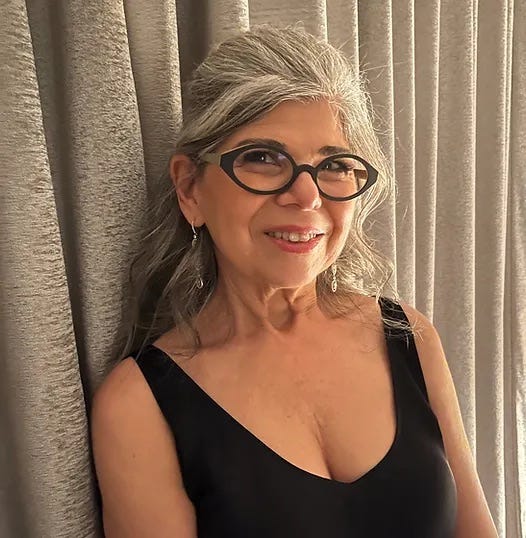
I am an Ottawa-based memoir writer. My personal essays have been published in Prairie Fire, the Globe and Mail, Tablet, Kveller, and other places. I am a board member of the Creative Nonfiction Collective, and a member of the Writers’ Union of Canada. I have an MFA in Creative Nonfiction from the University of King’s College. My investigative memoir, My Father's Other Women: A Daughter's Search for the Meaning of Monogamy" will be published by Thornapple Press in 2028. — Sue
No posts
Comments
Nothing yet. Say the first thing.
Sign in to join the conversation.