
Yesterday I hosted a live workshop for Midstack about monetization. Dozens of you showed up, and we had a real conversation, not just me talking at a screen. And then, in the most on-brand way possible, I forgot to hit record.
So instead of a replay, you’re getting this: a written recap of what we covered, and what’s happening next.
I opened the workshop with this: I’ve never had a real paid tier. Not until now. I’ve written about going paid, thought about offering ongoing benefits for paid subscribers, half-built a paid tier more than once. If you’ve been circling this decision for months (or years), I wanted you to know you weren’t circling it alone. I was doing it too.
That’s really what this whole workshop turned out to be about: not marketing tactics, but the quiet assumptions that keep smart, capable midlife writers like us from just... starting.
Myth 1: Paywalling your posts is the best way to monetize. It isn’t, or at least not on its own. Readers don’t pay for more words; they pay to stop having to solve a problem themselves. And they really don’t like teaser paywalls. The paid tiers that work tend to offer something genuinely different, not just the same writing with a lock on it.
Myth 2: You need a big, established audience before you can charge. Some of the most reliably paid publications aren’t the biggest ones. You don’t need a viral moment. A small, well-known audience converts steadily, and being early is often an advantage because it’s easier to know and serve people well when the group is small.
Myth 3: Charging money makes the relationship transactional. A paywall isn’t a betrayal; a lot of readers themselves describe it as an invitation, once your free work has already shown them who you are. And a real chunk of what people pay for on other publications isn’t a “deliverable” at all; rather, it’s just the satisfaction of supporting work that matters to them.
Myth 4: You have to pick ONE way to monetize. You don’t. Community, access to you, events, digital products …. Most paid tiers that work are a mix of two or three of these, not just one thing. The mix should align with your readers and your actual strengths, not a template you saw someone else use.
Myth 5: You have to already be an established expert to charge for your work. This might be the one that runs deepest for a lot of us. But readers pay for someone who’s solved the specific problem in front of them, not necessarily the most credentialed voice in the room. Underpricing yourself while you wait to “feel ready” is one of the most common, costly mistakes creators make. Lived experience counts.
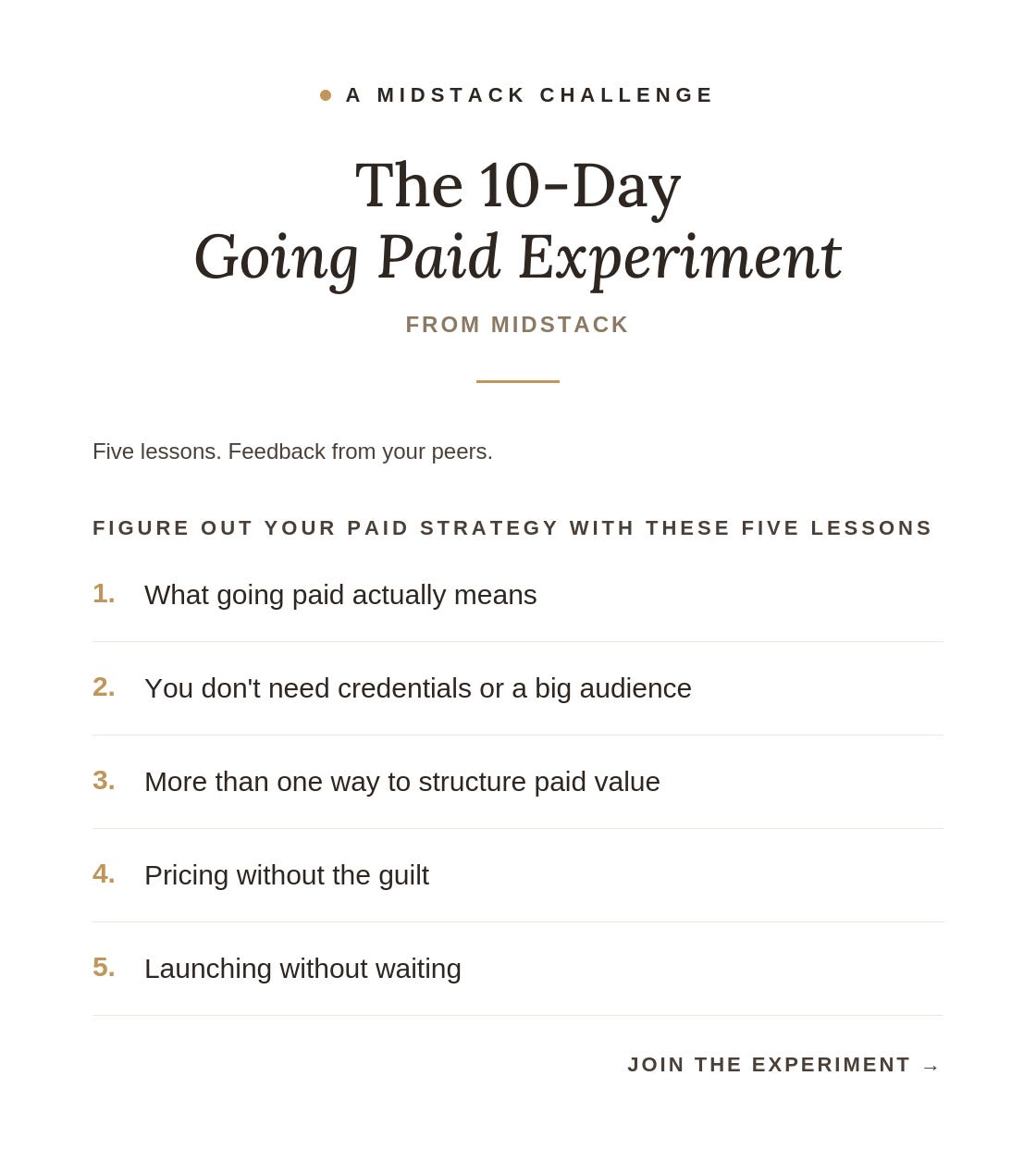
Going Paid is a 10-day cohort running July 20–31, for paid Midstack subscribers. Five lessons, five days of implementation, and one clear assignment after each lesson that you’ll post for real feedback from other writers in this community, not “homework” you do alone and never look at again.
By the end, the goal isn’t a generic paid tier. It’s one that actually feels like you.
You can find the link to sign up for the 10-Day Experiment right HERE on Midstack’s Perks page. If you’re not a paid subscriber, you can unlock the link by upgrading your subscription.
** You need to access Perks from your desktop, not the Substack App. If you are a paid subscriber and want to access the link to the cohort directly, you can go HERE.
I hope to see many of you in the cohort. And those of you who showed up yesterday and let me talk you through my own uncertainty and hear from other Midstackers about all of this, thank you for a wonderful conversation.
No posts
Comments
Nothing yet. Say the first thing.
Sign in to join the conversation.