
[Iran / United States] - [Security]
The war between the United States and Iran continues to escalate as the confrontation just entered its sixth consecutive night on Friday. Early on Sunday, the Islamic Revolutionary Guard Corps’ (IRGC) navy announced that the Strait of Hormuz would be closed until further notice, conditioning its reopening on a halt in US attacks. President Donald Trump embarked on a week-long series of threats against Tehran, ranging from warnings of possible attacks on Pickaxe Mountain (location), an underground Iranian nuclear facility, to strikes on Iran’s power grid, after he reimposed a blockade on Tehran’s ports on Monday. Notably, for the first time, the US military used one-way sea drones in an attack on the port of Bandar Abbas (location). American points of interest in Gulf states such as Bahrain and Kuwait continued to be targeted by Iranian missiles and drones, while two tankers were hit in the Strait of Hormuz on Monday, killing one and wounding eight. Importantly, Jordan becomes increasingly a direct target on Iran’s radar, rather than a transit area for attacks on Israel. The authorities in Amman announced the interception of multiple incoming missiles. While talks and diplomatic initiatives are most likely taking place behind closed doors, no major breakthrough took place this week. On Friday, Iranian state media claimed, in a sign that war may expand territorially, that the military struck eastern Syria, in first such attack. According to a source cited by Reuters, Iran carried out an attack near the al-Tanf military base (location), from where the US troops officially withdrew earlier this year, but it had not hit the base itself.
This newsletter is free. You can support my work by making a donation. Thank you!
🟠 Why it matters — With no clear end in sight, the new round of military confrontations between Iran and the US brings back on the table not only the usual exchange of threats, but also the numerous problems with which the entire world was confronted starting from February this year, in terms of the impact of the war on the global markets and the price of oil and natural gas. However, this time, at least for now, there appears to be no Israeli involvement, although Prime Minister Netanyahu warned Iran against attacking his country, and the attacks are strictly carried out between Iran and the United States. Furthermore, as attacks on Gulf states continue, the regional powers continue to work to strengthen their security and defense cooperation beyond reliance on American assets. Finally, the Yemeni front (discussed below) receives increasing attention as a possible ace up Iran’s sleeve.
[Yemen] - [Security]
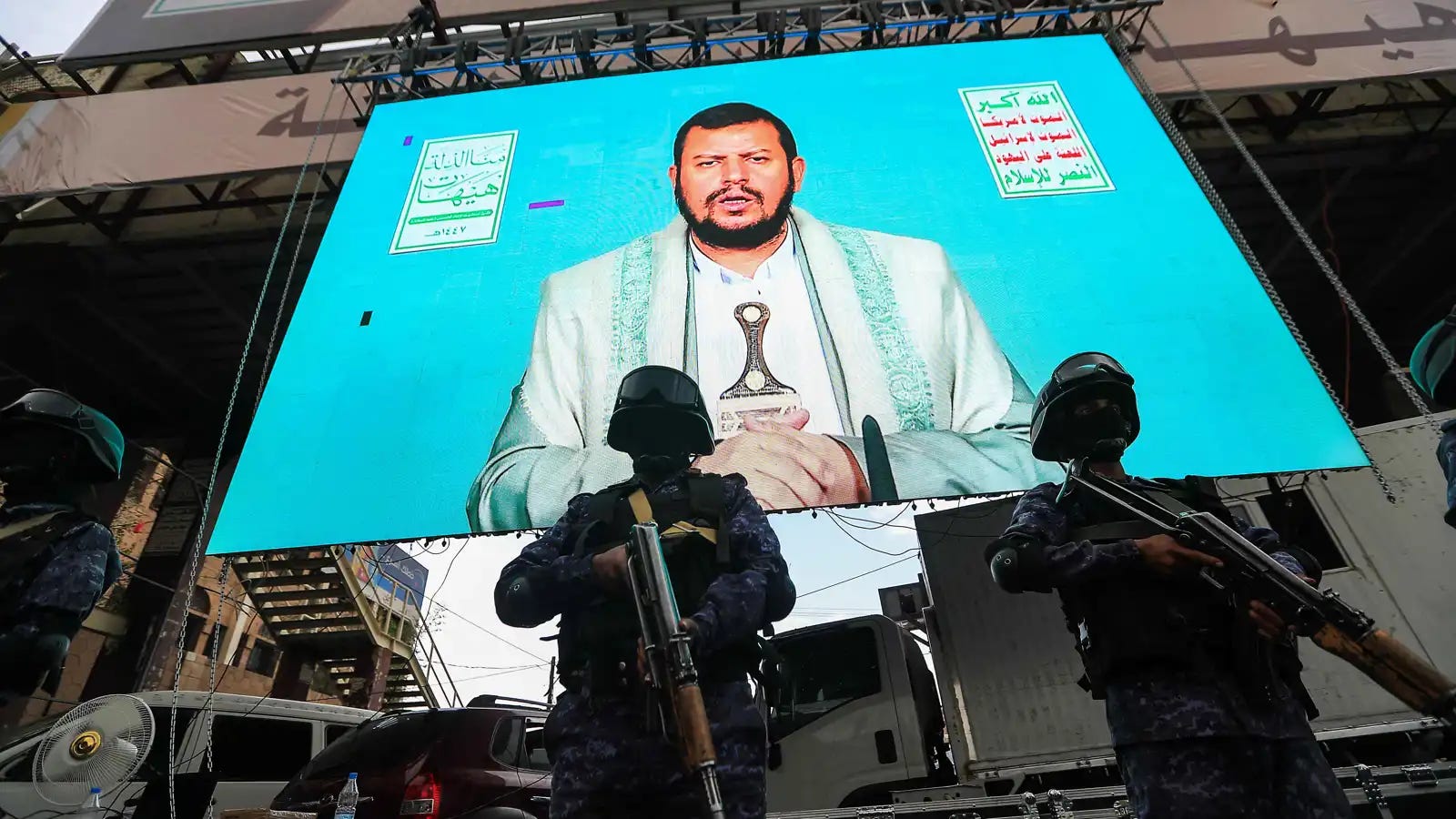
After a series of internal military confrontations between Ansar Allah and governmental forces, the Yemeni organization launched an attack against Saudi Arabia’s southern region on Monday. Turki al-Maliki, the spokesperson of the Coalition to Restore Legitimacy in Yemen, announced that Riyadh intercepted several ballistic missiles and threatened to respond with “firmness and unprecedented forces.” The attack came as a response to an attack carried out by the Saudi-backed, Aden-based Yemeni government on the Sana’a International Airport (location), which the Defense Ministry claimed was needed to prevent the landing of an Iranian aircraft. The government’s aviation authority announced on Monday the closure of all airports, as Ansar Allah claimed on Wednesday that the airport in Sana’a had resumed full operations. Internal confrontations continued as the Yemeni army said on Wednesday that it had repelled an attack by the Iranian-backed group in the province of Al-Jawf (location), northern Yemen (location). The organization escalated its threatening rhetoric through the voice of its leader, Abd al-Malik al-Houthi, who warned on Thursday that if Saudi Arabia resumes attacks on Yemen, the group will consider all the kingdom’s “oil facilities and vital installations” as targets for its missiles and drones. A chemical tanker was boarded by armed individuals off the coast of Yemen on Friday as it was transiting the Gulf of Aden (location), but it is not clear at the moment of writing this newsletter who are they. According to Ambrey, a British maritime security firm, Somali pirates are believed to be responsible.
Thanks for reading Middle East Politics Newsletter! This post is public so feel free to share it.
[According to three sources cited by Reuters, Iran has asked Ansar Allah to prepare to close the Red Sea oil route if the United States launches attacks against Iran’s power infrastructure. A source close to the organization said that it completed preparations for conducting attacks against vessels by deploying missiles and drones near the Bab al-Mandeb strait (location), the gateway to the Red Sea.]
🟠 Why it matters — The situation in Yemen is closely related and at the same time influenced by the evolutions in the confrontation between the United States and Iran. On one hand, there is no doubt that Ansar Allah has the capacity to severely disrupt maritime traffic through the Bab al-Mandeb strait and, if until now it was kept by Iran as a last resort option, preparations appear to be underway for its deployment. If Washington decides to exponentially escalate its attacks against Iran by striking the country’s power grid or, even worse, by signaling the intention of a ground invasion, it is likely that Ansar Allah will use its capabilities. On the other hand, Iran’s attempts to preserve its air routes into Yemen, in order to supply the group with military equipment and expertise, can lead to a more active involvement of Saudi Arabia in trying to disrupt Tehran’s ability to deliver capabilities that can be used, including against Riyadh, leading to a significant escalation and a restart of the war in Yemen.
[Iraq] - [Diplomacy / Security]
Iraq’s newly-appointed Prime Minister Ali al-Zaidi arrived in Washington on Monday in his first official foreign trip since taking office less than two months ago. He met with President Donald Trump on Tuesday, who told the reporters during a joint press conference that the United States will pursue a series of major energy and trade agreements with Iraq, as the American leader explicitly focused on the country’s oil resources. The Iraqi prime minister reiterated that the US troops “will be out of Iraq” by September 30, “while US companies will be inside Iraq,” confirming a 2024 agreement to end Washington’s mission against the Islamic State.
🟠 Why it matters — Ali al-Zaidi’s visit to Washington carries important significance for at least two reasons. First, as the deadline for the withdrawal of what is left from the American military contingent approaches, the new prime minister, a businessman himself, seeks to facilitate a transition in the relationship between the two countries from a military one to one dominated by economic and business initiatives. Second, however, a major impediment may spoil al-Zaidi’s attempts: the armed groups present in Iraq. As Baghdad has also set September 30 as a deadline to bring all the groups’ weapons under state control, this is highly unlikely to happen. Several factions already issued demands for their disarmament that would guarantee their future security and political status. However, many of them categorically reject giving away their weapons under any circumstances.
[Lebanon / Israel] - [Diplomacy]
Lebanon and Israel concluded another round of US-brokered talks on Wednesday, with sources and representatives stating that the discussions resulted in progress on implementing a plan that could see the beginning of the Israeli troops’ withdrawal from parts of southern Lebanon. The withdrawal from one of the two so-called ‘pilot zones’ is expected to begin within a week, although it is not entirely clear how the main point of contention, namely Israel’s insistence on having the right to verify that the area where the Lebanese army is meant to deploy is free of Hezbollah fighters and weapons, before completing the agreement. According to an American official, the talks resulted in positive outcomes, while adding that the discussions would move to a technical phase regarding the implementation of the framework agreement signed on June 26. Neither Lebanese nor Israeli officials commented publicly on the status or outcome of the talks. However, the Lebanese army began, this week, stepping up its military and security activities in an area proposed for inclusion in one of the pilot zones and announced deployments across multiple towns in Bint Jbeil (location), Tyre (location), and Nabatiyeh districts (location).
Share Middle East Politics Newsletter
🟠 Why it matters — With the Lebanese army’s movements on the ground, it appears that the implementation phase of the framework agreement begins to move further, but there continue to be numerous unknown details regarding the planned withdrawal, among which is Hezbollah’s position in this equation. At the time of writing this newsletter, there was no official response to the Rome talks from the organization, but its general stance is in complete opposition to the agreement. The discussions are significant, and if Lebanon can secure the Israeli withdrawal from the pilot zones, the deployment of the army, and the return of the civilians, this would be a major sign of progress. At the same time, Donald Trump appears to be ready to pressure Israel into withdrawing from Lebanon, as indicated by several American and Israeli officials. The talks and their outcomes are also important for the Lebanese government’s ability to detach Lebanon from the situation in Iran, which in itself is something significant, especially in the light of renewed military confrontations between Washington and Tehran.
[Palestine] - [Security / Diplomacy]
As for the time being Israel stays away from the US attacks against Iran and the diplomacy regarding South Lebanon advances, it escalates its attacks in the Gaza Strip in stark violation of the ceasefire agreement. At least a dozen Palestinians have been killed in Israeli airstrikes on different areas of the territory throughout the week. In one instance, on Wednesday, Israel killed seven people in an attack on a police station, among them being a senior officer, located in the Jabalia area (location) of northern Gaza. On Thursday, five more Palestinians died in air and artillery attacks in areas of Gaza City (location) and Khan Younis (location). The escalation comes as Hamas and Gaza ceasefire mediators reached, according to Hamas sources cited by Asharq al-Awsat, a broad agreement on a proposed roadmap during meetings in Cairo attended by a delegation of members of the organization, led by Khalil al-Hayya. The delegation is expected to meet again with the mediators in Turkey for talks regarding disarmament and the future Palestinian elections.
[According to local sources cited by Anadolu, Israeli military vehicles advanced during the night between Wednesday and Thursday near the Gaza Strip’s Dawla Junction (location), moving dozens of meters toward Salah al-Din street and pushing to the West the concrete barriers marking the so-called Yellow Line, therefore expanding the army’s area of control. Moreover, the witnesses stated that several families fled the area under Israeli shelling and gunfire.]
🟠 Why it matters — The Israeli army intensified this week not only the bombardment of the Gaza Strip, but appears to be moving toward expanding its area of control in the Palestinian territory. While the Yellow Line initially placed approximately 53% of the terrain under Israeli control, according to the UN, it now occupies at least 65% of Gaza, including humanitarian facilities, food and health services, and water and sanitation infrastructure. This is in line with reports from late May, according to which Israeli leaders ordered the expansion of the areas under direct Israeli control to cover up to 70% of the enclave. When it comes to apparent progress in discussions with Hamas, Israel remains intransigent regarding the group’s weapons, and despite attempts by the organization’s leaders to signal openness to discussions by, for example, taking steps to give up the governance of Gaza, it is unlikely that Israeli leaders will renounce conditioning basically any step forward on Hamas’s disarmament.
Also watching
[Israel] Israel set the date for parliamentary elections on October 27 after the exact date had been unclear since the Knesset voted in May to disband. Successive polls show that Prime Minister Benjamin Netanyahu’s far-right coalition would lose the ballot, although its political rivals have no clear path to power yet. On Friday, the Knesset voted its official disband, heading to recess until the next parliament is sworn in following the election.
[Morocco] Morocco signed on Wednesday an agreement to join the International Stabilization Force (ISF) in the Gaza Strip by deploying senior officers to the ISF joint command. The deal was signed following a meeting in Rabat between Morocco’s Foreign Minister Nasser Bourita, Defense Minister Abd al-Latif Loudiyi, and the Board of Peace’s Envoy for Gaza Nikolay Mladenov.
[Syria] Syria’s new parliament held its first session last Sunday, marking the launch of the first legislative body in the post-Assad era. During the session, the lawmakers elected the parliament’s speaker, Abd al-Hamid al-Awak, who, according to the temporary electoral law, will invite President Ahmad al-Sharaa to address the parliament in a future session to outline the state’s priorities for the next phase of the transition. On a different topic, the Ministry of Interior announced on Thursday the foiling of an attempt to smuggle a large amount of advanced weapons from Iraq to Lebanon, a shipment destined for Hezbollah.
This weekly brief is free. If you enjoyed reading it, feel free to subscribe and share it with a friend.
No posts
Comments
Nothing yet. Say the first thing.
Sign in to join the conversation.