
Issue 520 - August 2, 2026
The city of Middleton’s active transportation plan (ATP) is currently being subjected to public scrutiny for feedback before a final version is to be presented to the common council for approval. (See below for public engagement information.)
The plan has been created under the leadership of the pedestrian, bicycle and transit committee (PBTC) and the planning department, and consolidates the traffic-related aspects of over a dozen other city plans, policies and standards, including the ‘complete streets’ policy, which dates from 2022 and has been frustratingly slow to implement, not least because of a remarkable degree of inertia shown by the public works department’s (old) leadership and the (old) public works committee (PWC). But attitudes are changing, albeit slowly, and the PWC collaborated with the PBTC on certain aspects of the plan. The ATP will also replace the 2009 ‘bike and pedestrian plan’.
(The document is written in that curious mix of bureaucratese, technical jargon and marketing phraseology that administrators, middle managers, public relations agents, consultants, government officials and other corporate communications experts inevitably seem to slip into whenever they try to explain something to common mortals - separating fluff from substance takes some effort, as does actually understanding that substance.)
The ATP defines ‘active transportation’ as ways of getting around that prioritize walking, biking, rolling and other human- powered travel, along with supportive transit connections. It focuses on designing streets, sidewalks, paths and crossings that are safe, comfortable and convenient for people of all ages and abilities. They are designed and built for people, not just for cars.
It would be easy, and it is indeed very tempting, to dismiss the ATP as yet another in a long line of city plans with visions of an idealized Middleton, this time depicting a future where people cheerfully walk and bike on wide, well-maintained trails shaded by mature, well-pruned trees; where buses are frequent and punctual and on useful routes; where pedestrians and bicyclists and motorists respect each other and follow the rules of the road; where electric-powered scooters and (motor-)bikes are not a menace to pedestrians; where everybody lives within a reasonably walkable or bikeable distance from shops that provide at least basic necessities. In short, wishful thinking (or worst nightmare, depending on one’s opinion on transportation).
That, however, would be doing it an injustice. It certainly contains elements of enthusiastic optimism (a sort of ‘build it and they will come’ type of attitude), but for the most part it is grounded in a realistic view of what may or may not be achievable (not least funding-wise), and, in fact, it sometimes falls short of its own ambition by not challenging the status quo of existing city policies and practices.
The ATP describes itself as a strategic framework to understand how individual initiatives and programs advance the
city’s active transportation goals. This plan proposes many policy updates and procedural changes that reflect the integration of ‘complete streets’ principles into capital projects and everyday operations. Recommendations were developed to be implementable through existing city processes including corridor studies, capital planning, development review, annual work programs, and more. It also identifies missing program areas that need to be established. Most notably, the city is in need of a comprehensive trail maintenance plan and an ADA [Americans with disabilities act] study for the city’s parks and paths that will prioritize maintenance needs for existing paths and improve ADA access for those facilities.
It also states what it is not: This plan is not a comprehensive capital budget. Many recommendations within this plan are part of existing or soon-to-be established capital/operating budget programs, and this plan defers to those processes for determining costs and relative prioritization of needs. This plan also does not delve into site-specific engineering concepts. Rather, it is intended to provide planning-level analysis (…).
Before getting to the plan’s active transportation goals, the city spends a few pages patting itself on the back for what it has already achieved since the 2009 ‘bike and pedestrian plan’. This includes the ‘road diet’ on Gammon Road and Park Street (‘road diet’ is actually a misnomer: It implies that the road surface is reduced – it isn’t. What is reduced is the number of lanes for car traffic, but the terminology shows how deeply we identify roads and streets with cars. Hence the – by American standards – revolutionary nature of a concept like ‘complete streets’ and the uphill battle it faces even in a seemingly enlightened community like Middleton). It also includes filling in some gaps in the pedestrian and bicycle infrastructure (most notably the North Mendota Path), designing a trail network through and connecting existing and future subdivisions (for example in Misty Valley, Redtail Ridge, Belle Farm and Pheasant Crossing on the city’s northwest side), and using bridge underpasses to make trail connections).
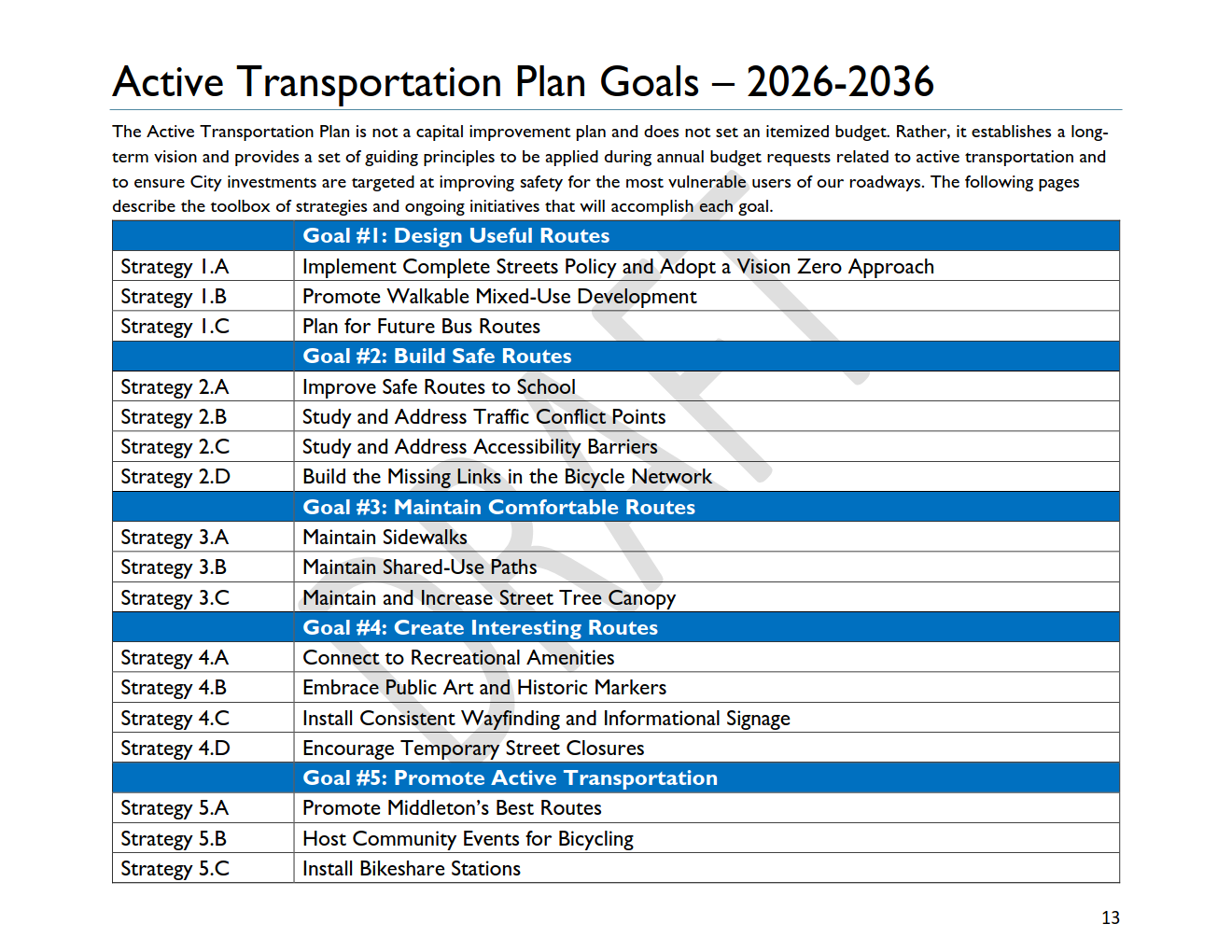
The ATP sets five goals for the next ten years: 1. ‘design useful routes’; 2. ‘build safe routes’; 3. ‘maintain comfortable routes’; 4. ‘create interesting routes’; 5. ‘promote active transportation’. In order to achieve these goals, three or four ‘strategies’ have been devised for each one (see table and maps).
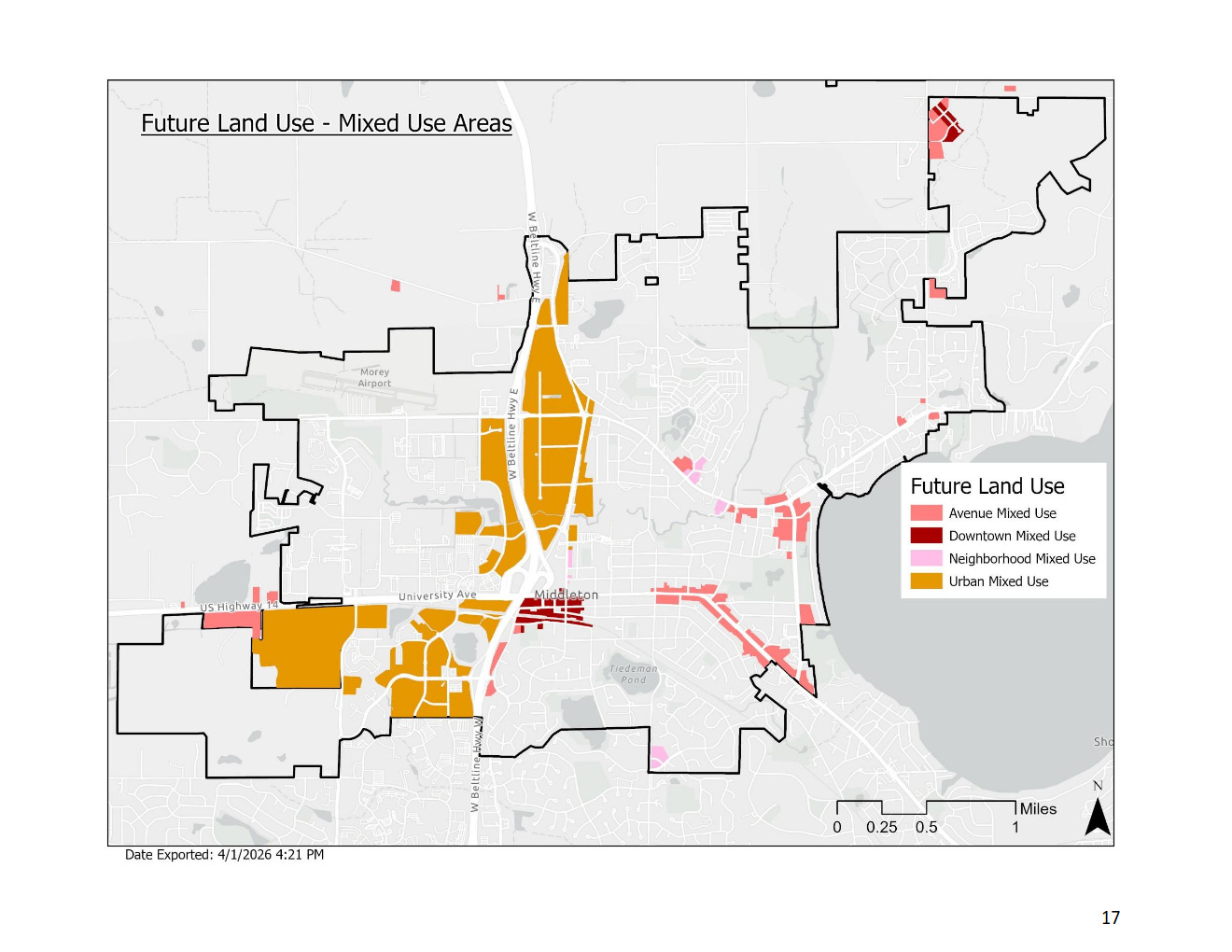
Thanks to decades of land-use segregation through zoning and planning, most residential neighborhoods lack easy access to all basic necessities. The new zoning code does not fundamentally change that.
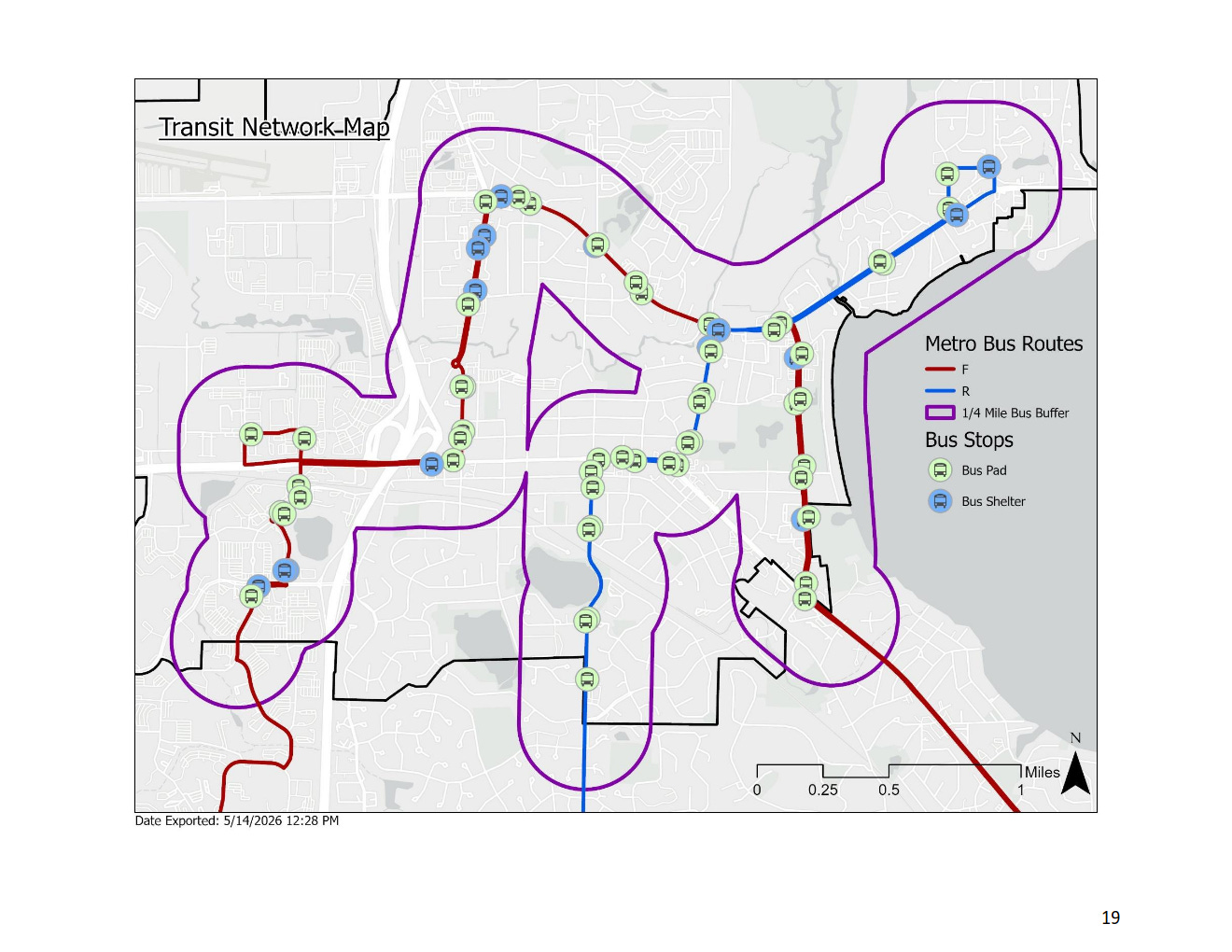
The ‘quarter-mile bus stop buffer’ is misleading since it does not take into account the turns and twists of streets, and therefore underestimates the distances people really have to walk to actually get to a bus stop. Most people in Middleton do not live anywhere near within a quarter mile of a bus stop.
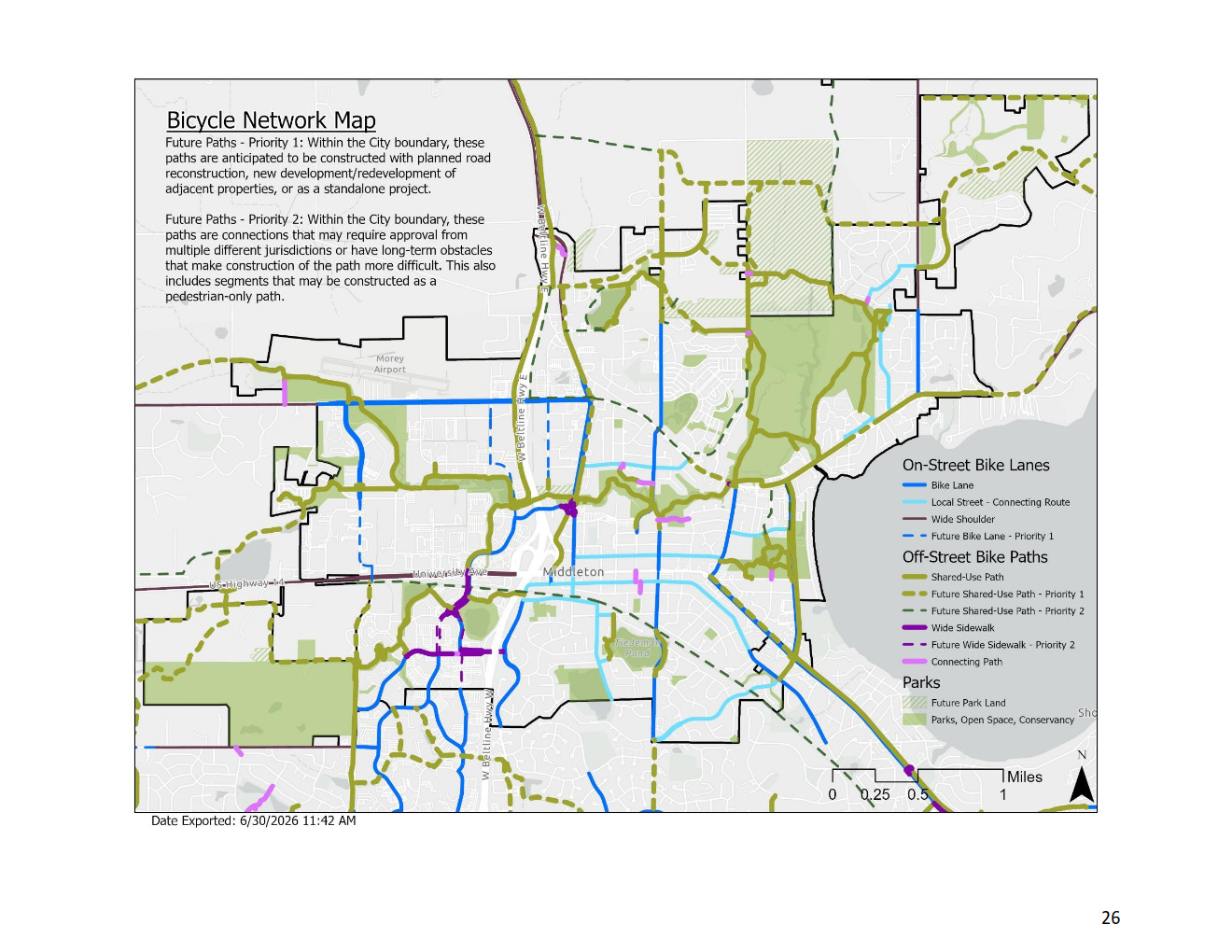
As indicated earlier, the ATP does not challenge the status quo of existing city policies and practices. This is a missed opportunity because one of these city policies is the single biggest obstacle to filling the sidewalk gaps: Making property owners pay for the construction, repairs and maintenance of the sidewalks adjacent to their land. From a budgetary standpoint, construction and maintenance are two different topics (the first is capital spending, the second operational), but the signal the policy sends is unmistakable: Sidewalks are not part of the public transportation infrastructure, like roads and trails and paths, for which the city, i.e. the whole community pays, but a private luxury. ‘Complete streets’ does not extend to sidewalks. It makes acceptance of retrofitting existing neighborhoods with sidewalks an uphill battle, and the city has regularly abandoned such plans in view of residents’ opposition.
While adapting the infrastructure could be comparatively easy (provided, the funding is there), undoing the damage done by decades of city planning will be harder, although probably not as hard as changing people’s mindsets about getting from A to B. More and more people do indeed embrace walking and bicycling, but for recreational purposes. Getting them to leave the car at home, and walk or bike or take the bus to work or to the grocery store or to the restaurant (and back), will be a different challenge altogether.
’Build it and they will come’ works for sports and entertainment and leisure, but not necessarily for daily routines – unless we’re talking about more car lanes.
Open houses will take place at Northside elementary school on Wednesday, August 5, and at Parisi park on Monday, August 10, both from 18:00 to 19:00. An online survey is open until August 16.
No posts
Comments
Nothing yet. Say the first thing.
Sign in to join the conversation.