
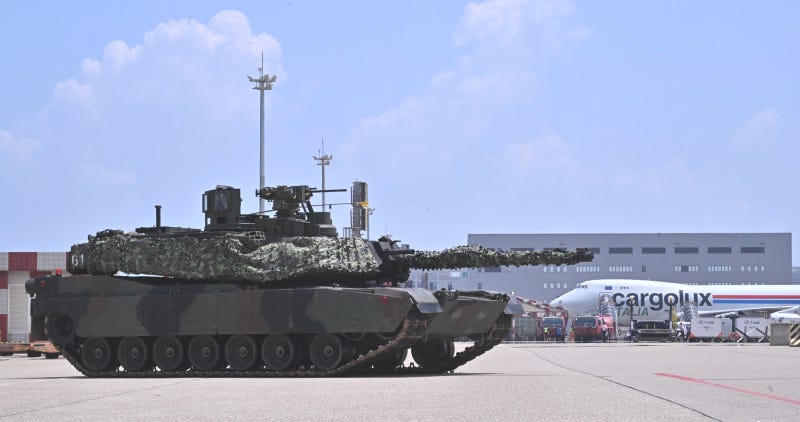
The 42nd Han Kuang Exercises represent a significant improvement over previous iterations of Taiwan’s most important military drills. It was longer, more realistic, less scripted and, crucially, placed much greater emphasis on the whole-of-society dimension of Taiwan’s defense. Mor Sobol, Taipei Times
Between 5 and 14 August 2026, Taiwan ran the forty-second iteration of its annual Han Kuang exercise, and for the first time it did so as a proper whole-of-society mobilisation. This is an activity that also aims to message Taiwanese readiness to Chinese military planners, and ensure that every morning, President Xi looks in the mirror and thinks “not today”. At the same time, the exercises like this send a message to national will to defend Taiwan to countries like the United States. The aim of this exercise is to explore how this iteration of Han Kuang was more ambitious than many previous versions, how the military were just one of many components, and how Western nations should be observing and learning from the whole-of-society drills the ten-day Han Kuang exercise incorporated.
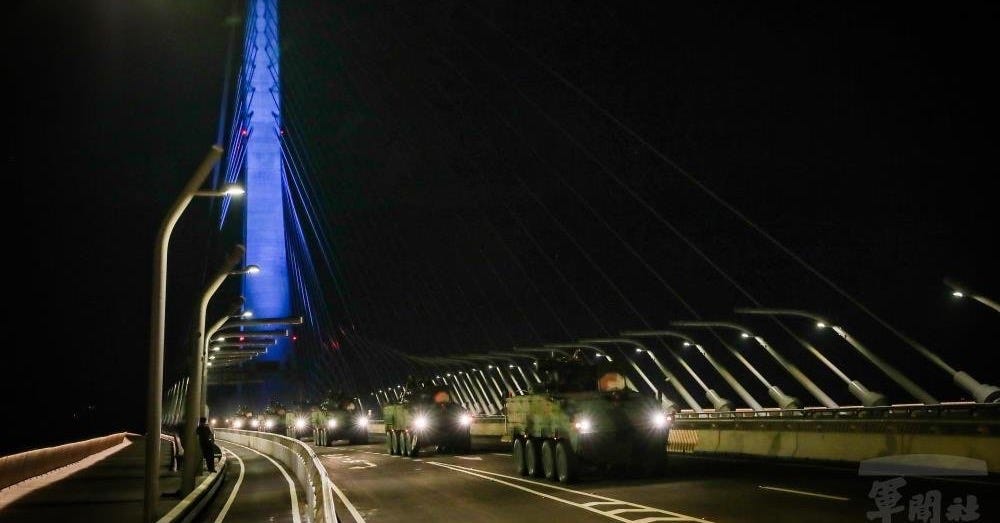
The military rehearsed the familiar list of missions: air defence and maritime targeting with an expanded set of missile systems, theatre fires kill-chain drills, an anti-airborne-assault exercise at Taoyuan International Airport with the newly delivered M1A2T Abrams tanks and Clouded Leopard infantry fighting vehicles, counter-mobility works by army engineers along the key approach routes to Taipei, a tunnel blockade drill at the Hsuehshan Tunnel in Yilan, and a first closure of the Danjiang Bridge in the north to test defensive blockades.
The Littoral Combat Command exercised its consolidated set of anti-ship missiles, coastal forces, sensors and unmanned platforms in Penghu. President Lai Ching-te was moved by armoured vehicle to the National Political and Military Operations Command Centre in an anti-decapitation drill designed to test continuity of government.
As Taiwan analyst Tristan Tang notes:
Recent Han Kuang exercises also suggest a greater emphasis on reinforcing northern Taiwan, including the movement of multiple brigades from the south toward the capital region. These reinforcements would make a successful PLA surprise attack more difficult and help maintain a dense defensive force around Taipei even if other parts of the island were penetrated. The construction of actual defensive positions and field fortifications further demonstrates how seriously Taiwan’s military treats this scenario.
Mor Sobol has written about military aspects of the exercise in the Taipei Times as follows:
The 42nd Han Kuang Exercises also demonstrated more layered integration of drones, greater attention to preserving command-and-control continuity under disruption and a more realistic approach to “gray zone” scenarios. The increase in use of decentralized command and off-script scenarios was particularly welcome. Exercises should not be choreographed demonstrations designed to show that everything works. Their purpose is to discover what does not.
But as I described in my most recent weekly update, this exercise was very ambitious in scope. It incorporated elements of its design that extended considerably beyond the military-centric exercises conducted by most Western militaries.
Exercises that engage everything from the political decision-makers to civil agencies to citizens themselves are very complex to plan and execute, not to mention expensive.
But an exercise of this complexity and expense is an indication of the willingness of Taiwan to defend itself. Importantly, the exercise and its outcomes should be noted in capitals from Tokyo to Washington DC and beyond. If Western governments are clever and humble enough to have observers present, there are many insights exercises like Han Kuang might provide about their own mobilisation and national resilience planning.
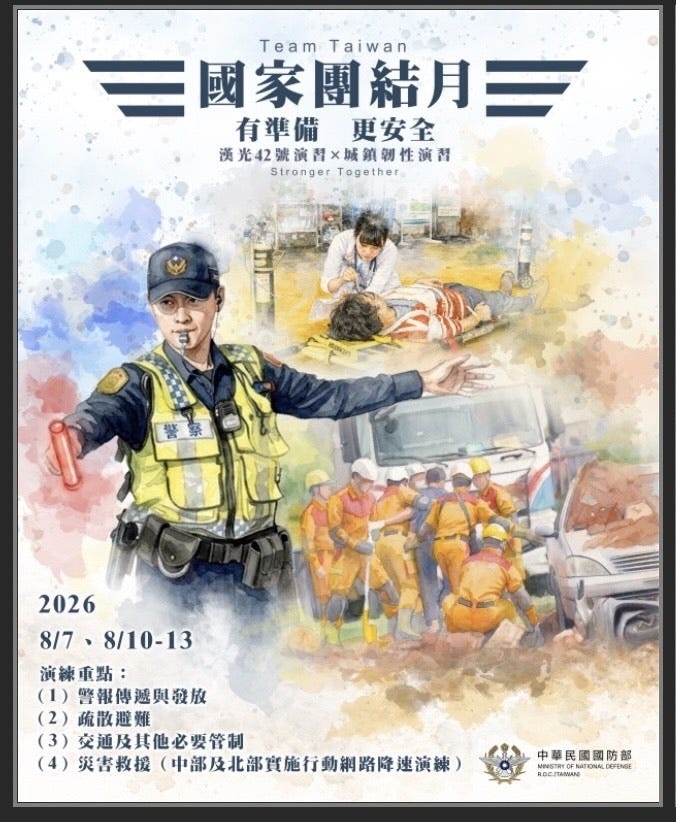
The most important aspect of Han Kuang 42 lay beyond the purely military elements. Han Kuang 42 featured the full integration of urban resilience exercises alongside live-fire military drills, an approximately 20,000-reservist mobilisationexercise, the introduction of unscripted decentralised training that is based on a US model, and the deliberate mobile-network slowdown across fourteen administrative regions to test civilian and command communications under attack.
Civil participation was crucial. Local governments activated emergency operations centres, medical stations, relief centres and supply distribution hubs. Underground medical operations, civilian evacuations by mobile-broadcast vehicles, joint logistics, drone-based resupply and requisitioning of civilian trucks for military transport were all rehearsed as parts of a single scenario. Commercial flights continued to arrive and depart at Taoyuan while the tanks and engineers dug in around it. For the first time, the civil and the military elements of the exercise were employing the same overall scenario with military liaison officers stationed inside civilian emergency operations centres.
Activities Included in Han Kuang 42
Rehearsal of air defence and maritime targeting using various missile systems.
A counter-air assault/airland training exercise at the Taoyuan International Airport to defend the airfield from potential Chinese air assault and air land operations at the beginning of any invasion. These build on the lessons from Ukraine’s denial of Hostomel as a Russian forward base in the early days of its full-scale invasion in 2022.
Air defence drills as multiple locations.
Rehearsing theatre fires kill chains.
Counter mobility activities with army engineers.
Civilian evacuation drills in several locations including one executed by the 5th Theatre of operations that employed mobile broadcasting vehicles to disseminate evacuation instructions and guide civilians away from threatened areas.
CBRN response drills at critical infrastructure locations.
Cross-regional redeployment and reinforcement rehearsals for ground forces.
Wartime logistics and medical activities including movement of ammunition and refuelling.
Transition from peacetime to wartime judicial conditions.
The approach taken in this exercise by the Taiwanese highlights an important gap in Western defence planning. This is the persistent tendency to treat deterrence and preparation for war as a military-first problem. Civil defence, industrial mobilisation, information resilience and continuity of government are treated by governments (and citizens) as second-order imperatives which can be developed when a crisis is near or after it arrives.
But the war in Ukraine since the full-scale Russian invasion in February 2022 has demonstrated the profound importance of planning and resourcing the preparations for all kinds of civil defence in the physical, information and cognitive domains.
Comments
Nothing yet. Say the first thing.
Sign in to join the conversation.