

Overnight, Ukraine and Russia traded large scale strategic drone and missile strikes. At least seven were injured in Kyiv as ballistic missiles and drones hit the Ukrainian capital. More Ukrainians were killed and injured in Russian drone and missile attacks in southern Ukraine in the preceding 24 hours. At the same time, Ukraine has responded with large scale attacks inside Russia, with images emerging of a massive blaze at a Wildberries depot near Moscow.
During the week, Ukraine also conducted what looked like a proof of concept for an all-robotic amphibious landing of a ground combat vehicle. While it is a fascinating concept, and likely to feature in all kinds of future conflicts, I am sure there are a few technical and doctrinal issues to still be resolved.
South of Ukraine, the truce between Washington and Tehran, sealed by a memorandum of understanding on 17 June, has collapsed. The United States resumed strikes on Iranian military sites this week, hitting dozens of targets over consecutive nights, while Iran struck commercial shipping in the Strait of Hormuz and formally declared the peace framework voided on 15 July, saying it was now fighting an “existential war.” Overnight, Iranian attacks on American bases in the Middle East have killed two and injured others.
The effect of these resumed hostilities is a second American war against Iran drawing on the same finite pool of interceptors, munitions and political bandwidth that Ukraine depends on, just as Kyiv confronts its own crisis of civil-military trust.
Welcome to this week’s edition of The Big Five.

Defence minister Fedorov sacked – Ukrainians take to the streets. The big story in Ukraine this week has been the political fallout from President Volodymyr Zelenskyy’s dismissal of Defence Minister Mykhailo Fedorov on 15 July, after just six months in the appointment. Fedorov, previously Ukraine’s digital transformation minister, had become defence minister in January and quickly built a reputation as the most consequential reformer in the ministry’s wartime history. He apparently persuaded Elon Musk to restrict Russian military access to Starlink, drove competitive tendering through a notoriously corrupt procurement system, and gave partner nations access to a captured-weapons database to accelerate countermeasures.
His dismissal followed months of conflict with Commander-in-Chief Oleksandr Syrskyi, described by Ukrainian reporting as a clash between a “data-driven” technocrat and a general accused of Soviet-style micromanagement, high personnel losses and resistance to reform. Zelenskyy sided with Syrskyi. At least for now.
In a press conference this week, Fedorov outlined 11 issues that he believed were preventing the Ukrainian military from fighting and operating at its full potential. These issues included constant replacement of commanders, fighting tactically, isolation and toxic treatment of successful commanders, the inability to use Corps appropriately, and others. You can read the full list of Fedorov’s issues with the Ukrainian Ministry of Defence at this link.
The reaction from Ukrainian civil society was immediate. Protesters gathered in Kyiv on three consecutive evenings, 16 to 18 July, with crowds exceeding five thousand on Ivan Franko Square by the second night and solidarity rallies in Lviv, Kharkiv, Odesa, Dnipro and more than a dozen other cities, plus demonstrations abroad in London, Prague, Vienna, Brussels and Sydney.
Placards with slogans such as “Bring Misha back” and “You cannot win a war in 2026 with the Soviet system,” provided a summary of the protestors’ argument: Ukraine’s asymmetric, technology-led approach to the war is under threat from an entrenched command culture. Demands quickly expanded from Fedorov’s reinstatement to Syrskyi’s dismissal. Zelenskyy has so far offered process rather than a reversal, appointing former SBU Alpha special-operations chief Yevhen Khmara as acting defence minister and Oleksandr Poklad, a figure associated with the 2025 pressure campaign against Ukraine’s anti-corruption bodies, as acting SBU chief.
However, Zelenskyy has in the past 24 hours issued social media updates that he has held discussions with Fedorov. There is also speculation that Zelenskyy is casting about for a replacement for the Ukrainian commander in chief. The Military Land site has offered a list of contenders, but my sense is that there is a fair bit of water to pass under the bridge with this issue yet. And, if Syrskyi is replaced, he will be the third Ukrainian Commander in Chief since the Russian full-scale invasion in February 2022.
The civil-military tension underlying this episode is not new but has not been this exposed since the 2024 removal of the previous Commander in Chief, General Zaluzhnyi. Fedorov’s tenure coincided with a shift in the war’s trajectory, including an improving exchange ratio, a stronger long-range strike campaign and a defensive line that has held against a stalled Russian offensive.
Much of the commentary this week credits that shift, at least in part, to the minister’s reforms and to the model of centralised data management, drone procurement and mobilisation reporting he pushed against institutional resistance. Even on the most contentious issue of the war, mobilisation, Fedorov had commenced an audit of battlefield losses and a new voluntary contract system aimed at the root causes of the manpower crisis: poor conditions inside infantry and assault units, rather than the headline count of men in uniform.
Removing him now, critics have argued, risks handing Moscow a battlefield advantage just when Ukraine has seized the strategic initiative. Analysts in European publications have framed the sacking as evidence of Zelenskyy’s pattern of removing officials who become politically popular ahead of an eventual election, rather than those who under-perform.
The ripple effects moved quickly through the wider reform programs that Fedorov had built. Ukraine’s Air Force deputy commander, Pavlo Yelizarov, announced his resignation in protest at the dismissal, while Serhii Sternenko, one of the country’s leading drone volunteers, stepped down from his advisory role at the ministry. Not everyone left: Serhii “Flash” Beskrestnov, another prominent technical advisor closely associated with Fedorov’s reforms, chose instead to accept a new role as the president’s personal advisor on defence technologies, arguing that “only the enemy benefits” from qualified people walking away in protest.
The implications extend beyond Ukraine’s domestic politics. NATO and EU officials publicly reacted to the dismissal. The dismissal will probably unsettle Ukrainian partners who had come to see Fedorov as a reliable interlocutor on technology transfer and procurement reform, at a moment when Ukraine most needs to project institutional stability to sustain Western support. Presidential Office advisor Serhii Leshchenko has drawn a deliberate parallel with the mass protests of summer 2025 that forced Zelenskyy to reverse legislation gutting the independence of Ukraine’s anti-corruption bodies, suggesting the president expects, and may eventually accommodate, a similar climbdown this time.
And, it goes without saying that just as Zelenskyy appears to have achieved a minor miracle in stabilising his relationship with the US president, he may well have done something that again gives Trump cause to doubt Zelenskyy’s leadership.
There is sure to be more to come in this saga - watch this space.
The 40-day campaign. Against the background of this political turbulence, Ukraine’s deep-strike campaign has continued to expand. In late June, Zelenskyy approved a forty-day operation run by the Security Service of Ukraine, a coordinated series of strikes on oil refineries, military facilities and logistics hubs intended to compel Moscow toward negotiations through attrition of the war economy. By early July, Ukraine’s General Staff claimed to have disabled more than forty percent of Russian refining capacity, which is a striking figure representing eight refineries hit in a month and cumulative industry losses estimated at $13.5 billion since August 2025.
The campaign has continued through the past week, with strikes on the Yaroslavl oil refinery and pumping station and a further attack on an oil depot at Noginsk, fifty kilometres east of the Kremlin, on the night of 17-18 July, alongside fires at logistics warehouses in Elektrostal and Tambov Oblast. Moscow Oblast oil depot, warehouse reportedly set ablaze as Kyiv launches hundreds of drones towards Russian capital (Kyiv Independent, 18 July 2026); Ukrainian Drones Breach Moscow’s Air Defenses to Strike Oil Depot 50 km From the Kremlin (United24 Media, 18 July 2026). Fuel shortages have forced Moscow to extend export bans and sales restrictions across more than forty regions.
Over the past 24 hours, the Ukrainians have also struck a Russian ‘Wildberries’ depot. Located near Moscow, the strike has resulted in a massive blaze with smoke visible many kilometres away.
The mid-strike campaign. Running in parallel to the deep-strike effort is what Ukrainian officials call the middle-strike, or interdiction, campaign, launched in early April by the Unmanned Systems Forces and scaled up through Fedorov’s “Logistical Lockdown” programme, announced on 27 May. Its targets include bridges, railway junctions, fuel depots and the highway corridor linking Rostov-on-Don to Simferopol and Sevastopol, the so-called Highway of Death that supplies Russian forces in Crimea and southern Ukraine.
Ukrainian officials have claimed that the campaign has quadrupled the destruction of Russian logistics infrastructure, warehouses and command posts in occupied territory, and it remains one of the more under-reported elements of Ukraine’s wider offensive design, precisely because its effects show up as delay and shortage rather than dramatic footage. Taken together with the deep-strike effort, Ukraine’s General Staff reported this week that its drone units have struck more than one million targets since the start of 2026, including close to two hundred thousand Russian troops, with unmanned systems now accounting for roughly ninety percent of all Russian targets hit.
Switching off Crimea. The most visible expression of the Ukrainian interdiction campaign has been Ukraine’s strikes against Crimea’s energy and logistics grid. The Unmanned Systems Forces struck the Kuban-Crimea power bridge, the peninsula’s main link to mainland Russian electricity, along with eleven further energy hubs on 12-13 July, part of a broader effort that hit fifty energy facilities in occupied territory between 1 and 8 July.
The stated objective is not simply disruption for its own sake but the collapse of Russia’s military rear services on the peninsula: degraded air defence, exhausted fuel stocks, and isolated logistics that gradually turn Crimea, in Fedorov’s own words before his dismissal, into “an island.” The human effect inside occupied Crimea has been severe, with petrol prices reported at roughly six to seven times mainland Russian rates and the Kerch Strait closed to Russian shipping with no announced reopening date.
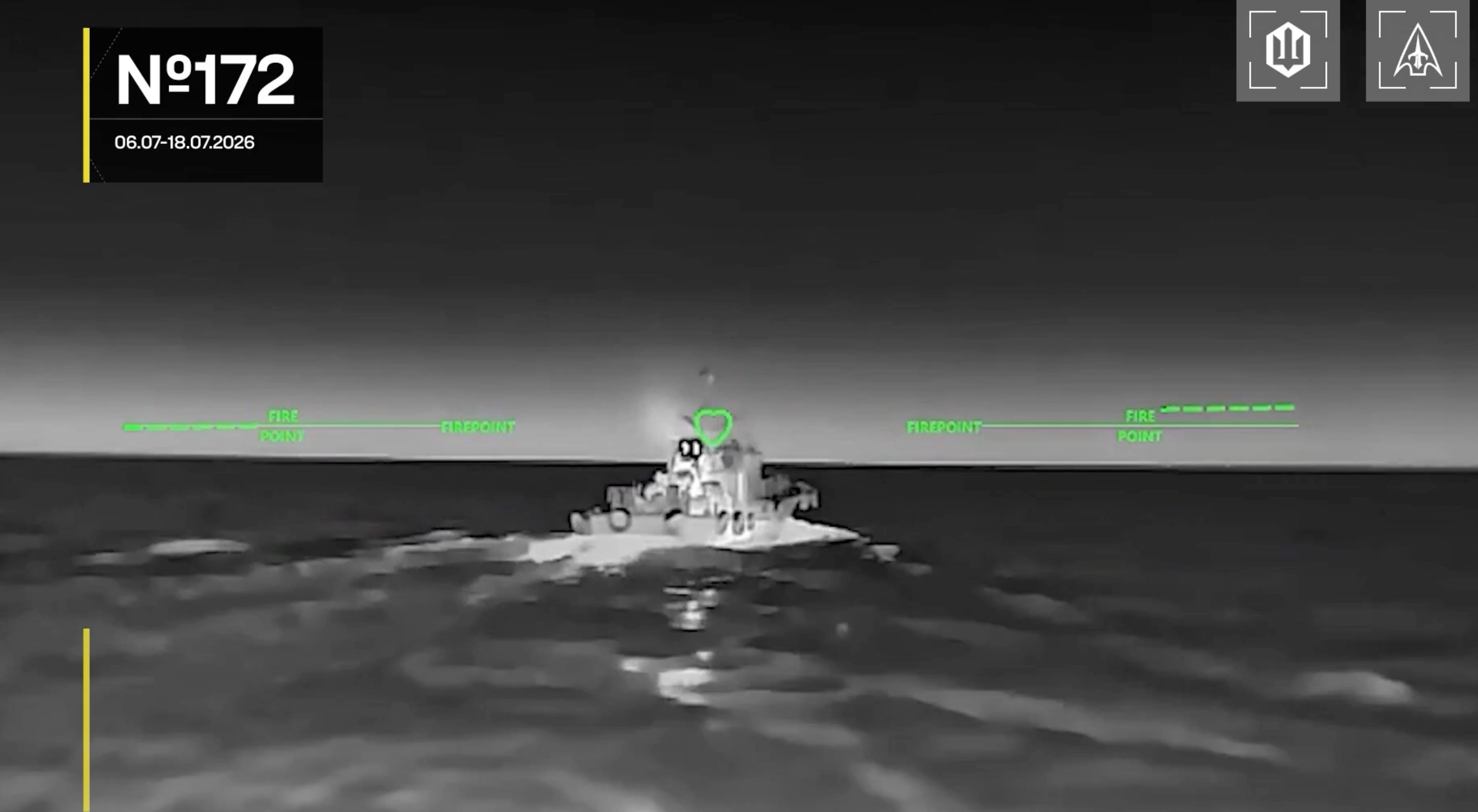
The Black Sea and Sea of Azov Strike Campaign. The most recent addition to Ukraine’s unmanned campaign is a large-scale anti-ship effort in the Black Sea and Sea of Azov, under the codename Operation MoLoCHKa, a Ukrainian acronym roughly translating as “Moscow will fall because of Crimea.” Commanded by the head of the Unmanned Systems Forces, the operation has now (as of 19 July) struck 172 vessels of Russia’s sanctions-evading “shadow fleet”.
Russia has responded by pulling its most capable drone-warfare unit, Rubicon, deploying up to two hundred groups partially off the front line to guard tanker traffic, alongside elements of the 51st Air Defense Division and a Black Sea Fleet anti-aircraft regiment, and has suspended navigation through the Don-Azov Canal while halting new applications for Kerch Strait passage. Analysts covering the campaign describe it as making the Azov basin “too dangerous for Russia” to operate the shadow fleet that funds a meaningful share of the Kremlin’s war chest. The campaign is squeezing Russia on yet another front to add to the increased pressure it is feeling at home and Crimea.
The Ground War. During the past week, the frontline has remained dynamic but with minimal gains in territory by either side. There were limited Russian gains in the Kostyantynivka-Druzhkivka tactical area and in northern Kharkiv Oblast, and a small Ukrainian advance near Oleksandrivka. Russian recruitment is reportedly failing to offset casualties from these costly, marginal advances.
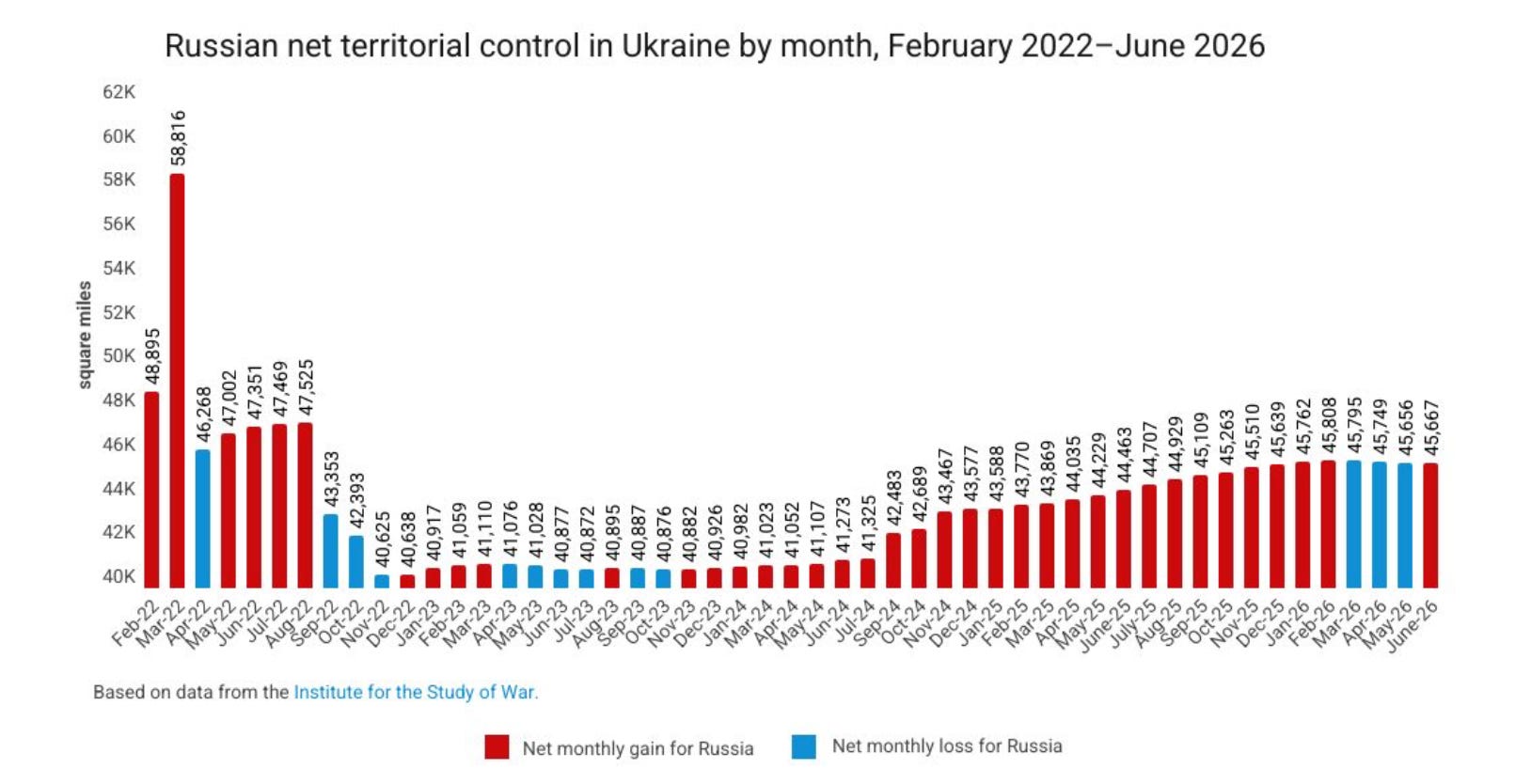
The most recent update from Russia Matters notes that Russia gained somewhere between 5 square miles (ISW assessment) and 15 square miles (DeepState assessment) of Ukrainian territory in the past month.
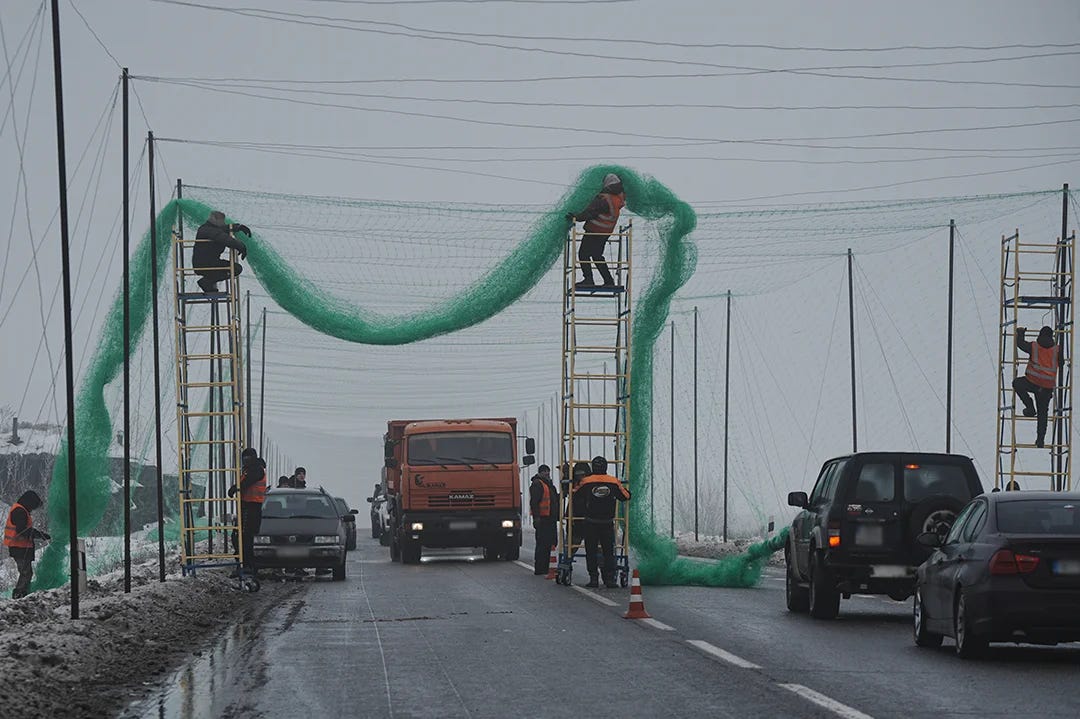
Road Netting. This week, Euromaidan published an interesting story about the netting of roads in Ukraine. This has become a common feature in areas that are proximate to the frontline, to protect military convoys but also protect civilian road traffic as well. You can read the full story at this link.
The renewed war between the United States and Iran remains a concern for Kyiv. Patriot interceptors, already scarce, are being consumed on two fronts at once, with production still lagging consumption. Reporting this week noted that depleting the global Patriot stockpile in the Iran war leaves fewer interceptors available for Ukraine precisely as Russia intensifies ballistic missile strikes on Kyiv.
Trump’s announcement at the Ankara NATO summit that Washington would license Ukraine to build its own Patriot systems was billed as a watershed, though production timelines for allied Patriot lines elsewhere suggest any real capacity is years away, given Japan needed three years to build its own factory and Germany has yet to produce a single missile despite starting its line in 2022.
The more immediate risk is one of attention. The American president is now again managing an active war with Iran and has even less bandwidth than normal, and Congress less appetite, for paying attention to the war in Ukraine. Despite Russia’s current vulnerabilities, fuel shortages, elite discontent and a stalled ground offensive, this is the wrong moment for Western resolve to soften.
Jamestown analyst Pavel Baev notes that elite discontent in Moscow is now spilling into public view, citing debate over a widely reprinted essay by billionaire Andrei Melnichenko questioning Russia’s war course, and escalating repression against business figures including the Rotenberg family, evidence that the strain of fighting two fronts, the battlefield and the economy, is being felt at the very top of Russian society even as Washington’s attention shifts back to the Gulf.
Ukraine now faces Russia in a war it is slowly winning but a home front it is mismanaging. The dismissal of Fedorov, whatever its domestic political logic, has removed the figure most associated with the reforms that produced this year’s military gains and replaced him with officials whose reputations are, at best, unproven and, at worst, tied to earlier attacks on anti-corruption institutions.
This is a self-inflicted wound at the exact moment Ukraine’s strike campaigns have put Russia in a strategic dilemma. Moscow cannot simultaneously defend Crimea, its shadow fleet, its refineries and its own capital from a widening Ukrainian campaign of drone and missile threats without drawing forces away from somewhere else, and this week showed all four under pressure at once, with the Rubicon unit’s withdrawal from the front line the clearest evidence of the pressures of that trade-off.
The reallocation of scarce Western interceptors to a reignited Iran war narrows Ukraine’s margin for error just as its own political cohesion is fraying. The protest movement itself is a new factor, however. Unlike previous issues, this one has fused frustration over a single personnel decision with a broader generational argument about how the war should be fought, technology and transparency against mass and hierarchy. Zelenskyy cannot easily dismiss it without alienating the volunteer, veteran and technical communities that have driven much of the innovation in Ukraine’s recent gains. The war Ukraine is winning technologically could still be lost politically, both at home and among the partners now watching Kyiv’s internal disputes with new concern.
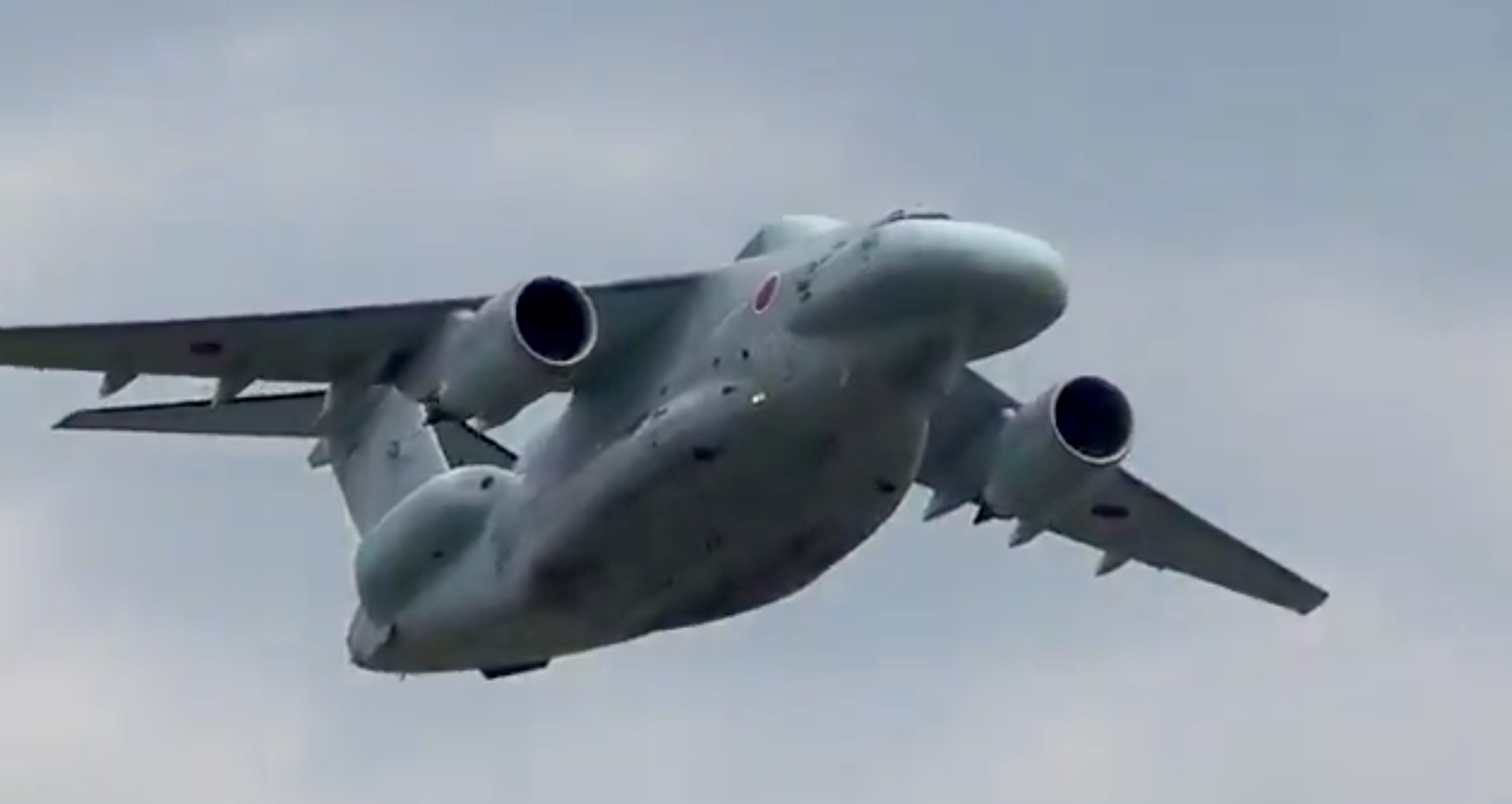
Taiwan hardens its defences. Taiwan spent the past week working through the consequences of a legislature that has repeatedly cut the government’s special defence allocation even as President Lai Ching-te insists the threat from China is accelerating. Speaking during an inspection of the National Chungshan Institute of Science and Technology on 17 July, Lai warned that a NT$470 billion cut to the original NT$1.25 trillion special defence package in May had left the military with funds for US arms purchases but almost nothing for developing indigenous uncrewed systems, and he urged the legislature to pass a further NT$210 billion allocation as a standalone special budget. Lai urges quick drone budget approval.
Lai pointed directly to the lessons of Ukraine, the Israel-Arab conflicts and the US-Iran war in making the case for drones as “the quintessential asymmetric warfare capability.” Separately, Taiwan’s Ocean Affairs Council announced plans to acquire twenty-five unmanned surface vessels and two underwater drones, developed jointly with the US firm Maritime Tactical Systems, explicitly citing the study of Ukraine’s sea-drone campaign against Russia’s Black Sea Fleet as a model for countering China’s growing maritime pressure. Taiwan plans 27 maritime drones to strengthen Coast Guard.
Taiwan and the United States also confirmed a deal to jointly produce the domestically developed Mighty Hornet I attack drone, already in service with Taiwan’s Marine Corps. These moves came alongside a five-day joint defence exercise mobilising Marine Corps units into the Taipei metropolitan area, simulating the detection of hostile vessels entering Taiwan’s territorial waters and testing decentralised command-and-control arrangements, treated as final preparation ahead of Han Kuang Exercise No. 42, Taiwan’s largest annual training event, which begins on 5 August.
Taiwan’s National Security Council also warned this week that Chinese naval mobilisation has risen sharply during the peak exercise season, with more than 110 People’s Liberation Army Navy and coast guard vessels now deployed along the First Island Chain.
Pacific Logistics. This week, American drone manufacturer Saronic (who also builds the Corsair attack boat used against Iran) announced that it will build a new shipyard in Texas that is capable of building large, uncrewed cargo vessels. This is a crucial capability for the US military should it be required to undertake large scale operations in the Pacific. In the Second World War, and in the modern world, merchant shipping carries the overwhelming load of logistics in the Pacific. The ability to expand the cargo fleet using uncrewed vessels will be crucial to Pacific Command operations, along with those of its allies, in any conflict with China or Russia or both.
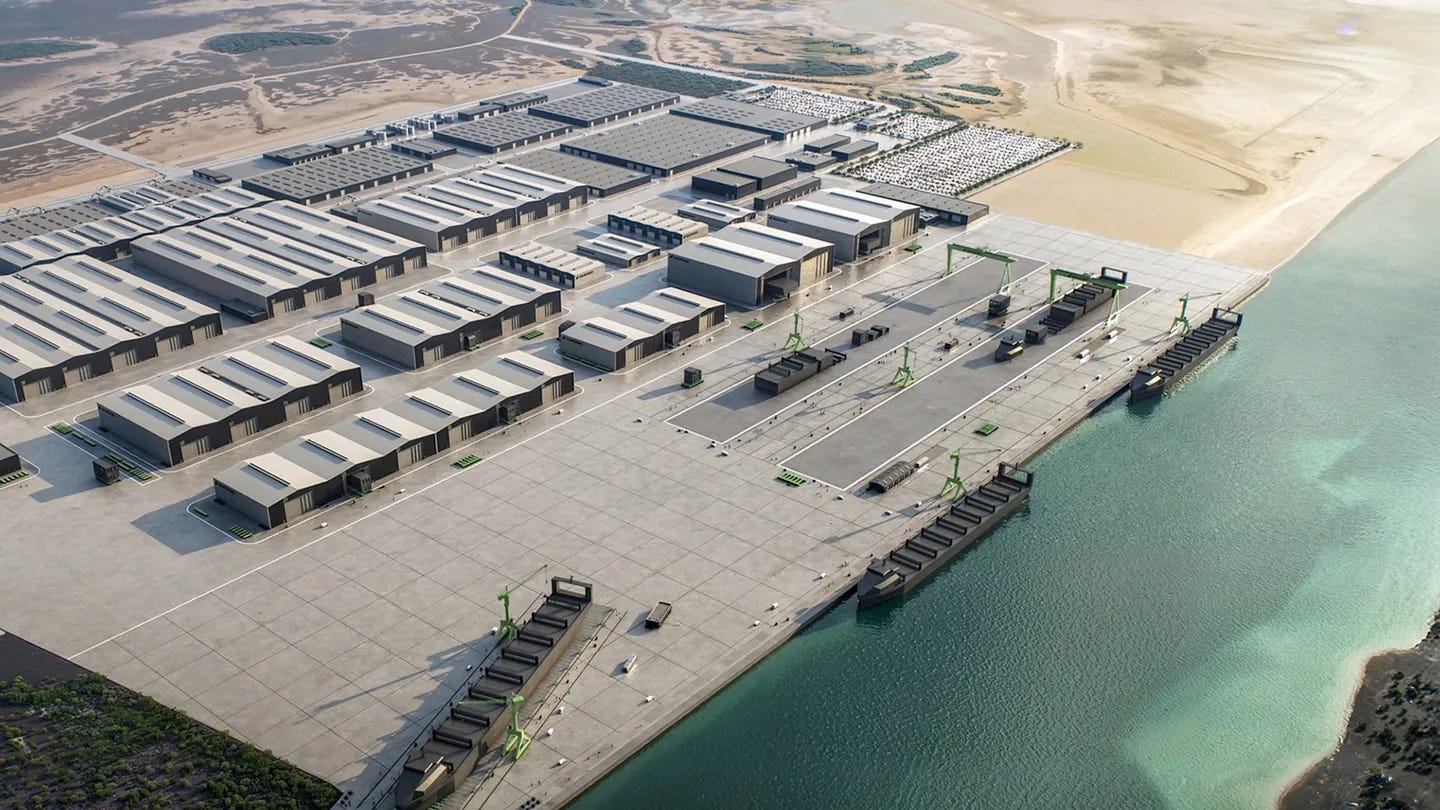
For a comparison with the Liberty and Victory ships built in World War Two, and the new era Saronic ships, the Victory ship was about 450 feet long and could carry over 10,000 tons of cargo. The Saronic ships could, in theory, be much larger if the new yard pumps out ships of up to 850 feet in length.
Beijing’s pressure against PNG. China’s coercive diplomacy against Taiwan’s international presence saw an escalation this week when Papua New Guinea ordered the closure of Taiwan’s representative office in Port Moresby on 15 July, citing its commitment to the “one China” policy. Taiwan rejected the decision, is reviewing its liquefied natural gas purchases from PNG, which account for roughly a third of the Pacific nation’s LNG exports, and accused Beijing of political and economic coercion. The US State Department called the move “deeply concerning” and “yet another example of Beijing’s intimidation campaign against Taiwan and its supporters around the world.”
Pushing Back Against China. On 12 July, fourteen nations including the United States and Britain, alongside a separate EU statement, marked the tenth anniversary of the 2016 South China Sea arbitral ruling by reaffirming its validity and rejecting Beijing’s “destabilising” actions in disputed waters; China again dismissed the ruling as “waste paper.” Combined with the Chinese recent SLBM test’s disregard for international notification norms and the PNG office closure, China continues its pattern of willing to bypass established rules and institutions wherever they constrain its freedom of action, whether legal, diplomatic or nuclear.
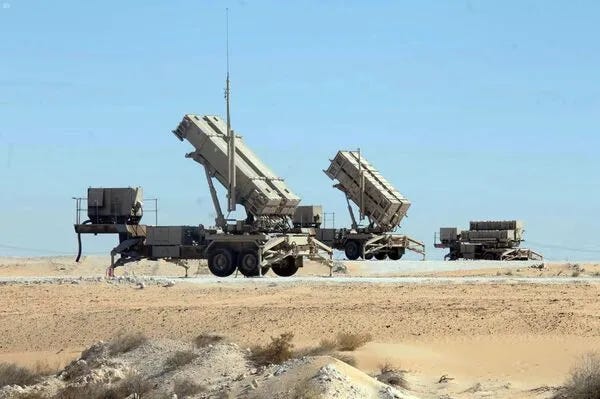
Since the collapse of the Iran-US truce in early June, three theatres once analysed separately have become visibly linked through the finite pool of Western military and political capital. The resumption of American strikes on Iran has drawn down the same Patriot interceptor stocks Ukraine needs against Russia’s intensifying ballistic missile campaign, even as Washington licenses Kyiv to build its own systems, a solution that is probably years from delivering real capacity.
Having observed the Ukrainian and Russian strategic strike operations for years, Iran is clearly learning. In the most recent series of strikes against American bases in the Middle East, Iran appears to have employed ballistic missiles that have manoeuvrable warheads. This makes them very difficult to track and intercept. The most recent ISW report on Irannotes that:
The People’s Republic of China (PRC) and Russia are likely supporting Iranian efforts to target US bases in the region. US officials told the Wall Street Journal on July 18 that they are concerned that the PRC and Russia are supporting recent Iranian targeting of US assets.
This should not be a surprise. The authoritarian learning and adaptation block, explored in my Adaptation War report, has seen a growing collaboration between Iran, China, Russia and North Korea. China has watched both wars closely while testing the boundaries of its own coercive toolkit, timing its 6 July submarine missile launch into the South Pacific to coincide with allied exercises and to signal alignment with Moscow through the concurrent Joint Sea exercise, a reminder that Beijing reads Western distraction as opportunity.
The past week has again illustrated the instabilities that are now inherent in the global security environment, underpinned by the following: limited American bandwidth, declining munitions stockpiles with rising consumption, and political attention being drawn in three directions at once. Authoritarian adversaries in Europe, the Middle East and the Pacific appear increasingly conscious of, and willing to exploit, this overstretch.
**********
It’s time to explore this week’s recommended readings.
This week’s recommendations include a good article that looks at China’s “new normal” for maritime operations east of Taiwan. There is a useful update on the US Navy’s employment of uncrewed surface vessels against Iran, and a good piece on institutionalising better adaptation cultures and processes. Finally, there are two articles on China: one on its view of American cognitive warfare, and another about how China’s effort to re-shape the strategic environment is eroding the global trading environment.
As always, if you only have the time available to read one of my recommendations, the first is my pick of the week.
Happy reading!
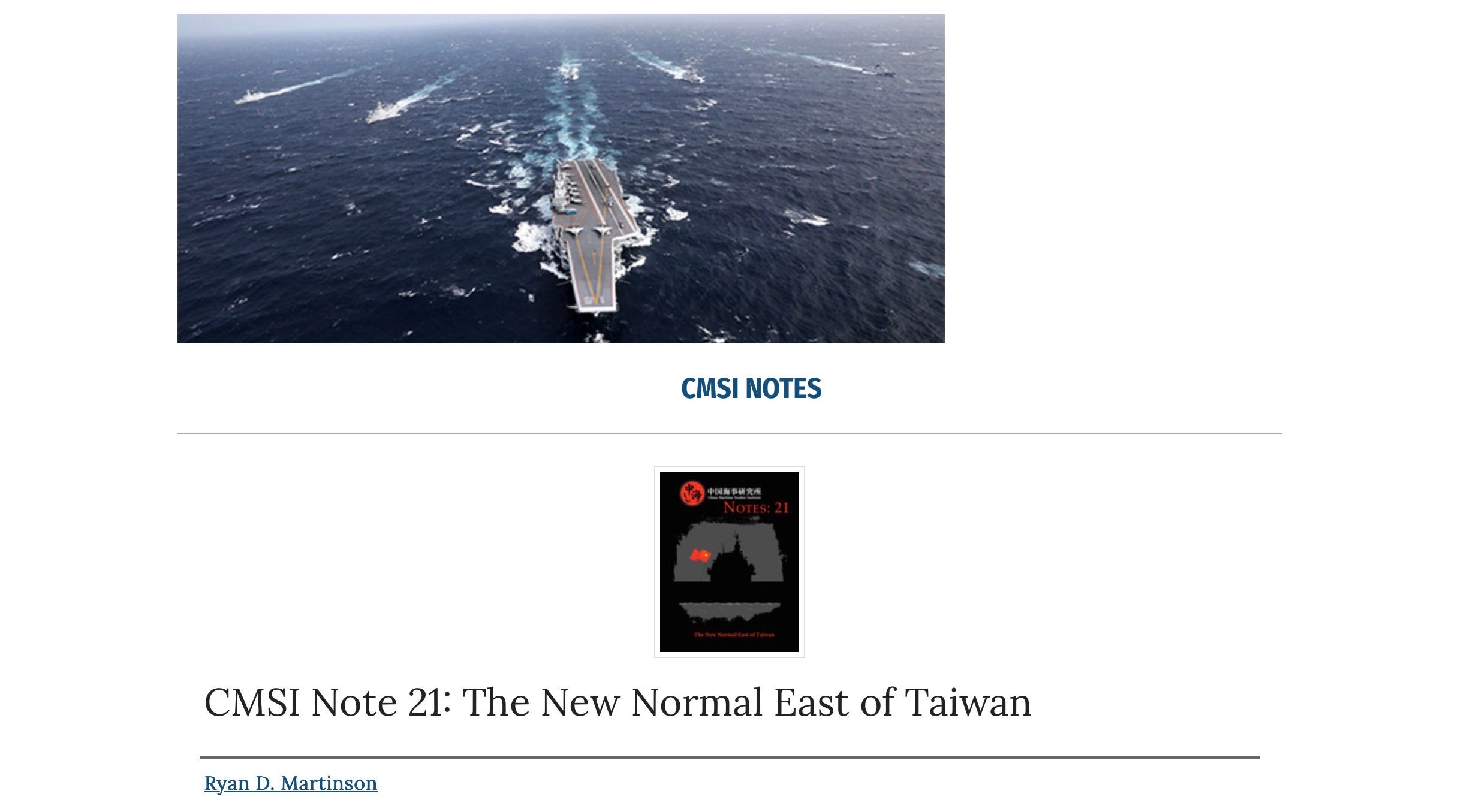
Ryan Martinson’s latest CMSI Note describes how the China Coast Guard has now held a continuous presence east of Taiwan since early June, ostensibly in response to a Japan-Philippines boundary statement, but with its 4 July rotation of cutters suggesting Beijing intends this presence to become permanent rather than episodic. Martinson’s point is that a normalised CCG posture east of the island gives China the option of accelerating far more quickly into quarantine-style operations than a standing start would allow. Read it here.
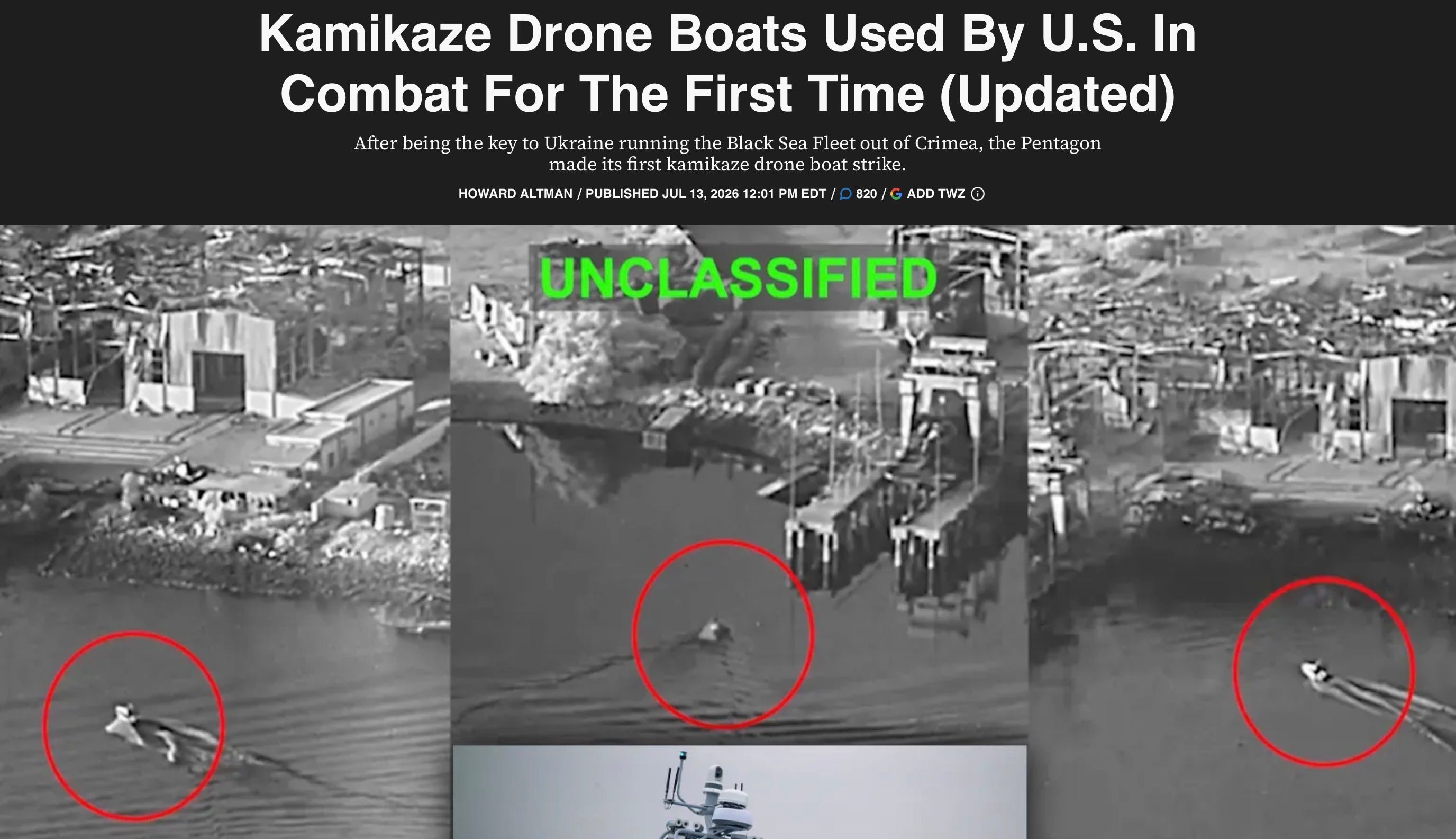
Howard Altman at TWZ reports on the first-ever US combat use of an uncrewed surface vessel as a strike weapon, three Saronic Corsair drones hitting a submarine and ship-maintenance facility at Iran’s Bandar Abbas naval base on 12 July. The article acknowledges that American forces are still catching up to lessons Ukraine’s navy has been teaching the world in the Black Sea for two years. You can read the full piece at this link.
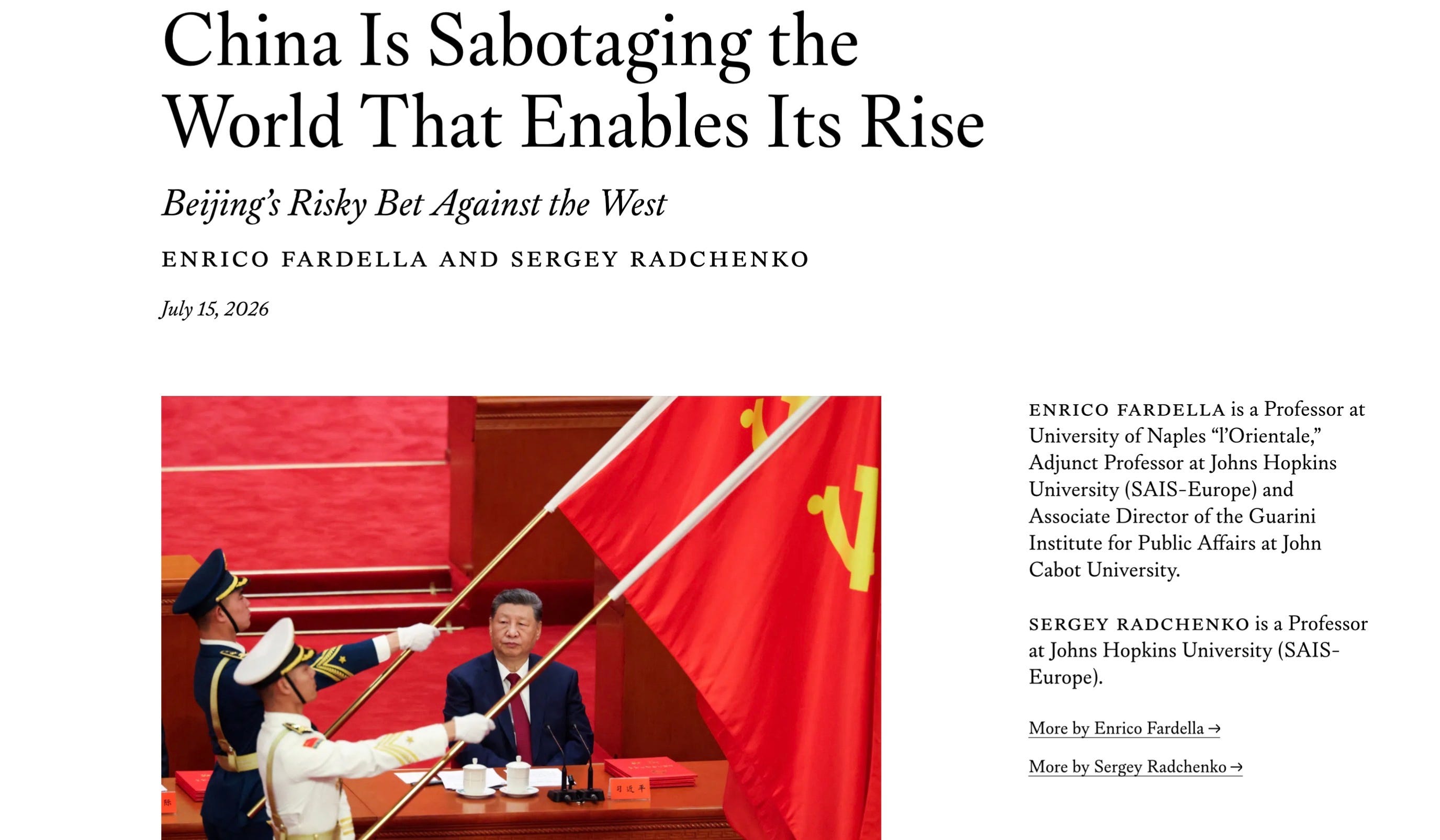
Enrico Fardella and Sergey Radchenko offer a useful argument in Foreign Affairs that Beijing’s own trade and economic coercion are eroding the very international system that made its rise possible. Their history lesson is that great powers get into trouble when they mistake the product of contingency and hard work for the unfolding of historical destiny. Read it here.

Russell Howard’s Small Wars Journal essay argues that Beijing has quietly waged a whole-of-society campaign across twelve fronts, from rare earth coercion to overseas police stations to crop pathogen smuggling, while Washington debates definitions. It offers a valid challenge to contemporary Western institutional thinking on cognitive warfare and can be read at this link.

Jeff DeGraff’s Modern War Institute piece asks a simple, uncomfortable question of every defence institution that claims people and adaptability as its edge: where is that claim visible in the budget? His Nokia case study, a company that believed itself innovative right up until the smartphone proved otherwise, is a cautionary tale for any organisation that mistakes admiring a capability for building it. The full piece is available at this link.
Comments
Nothing yet. Say the first thing.
Sign in to join the conversation.