
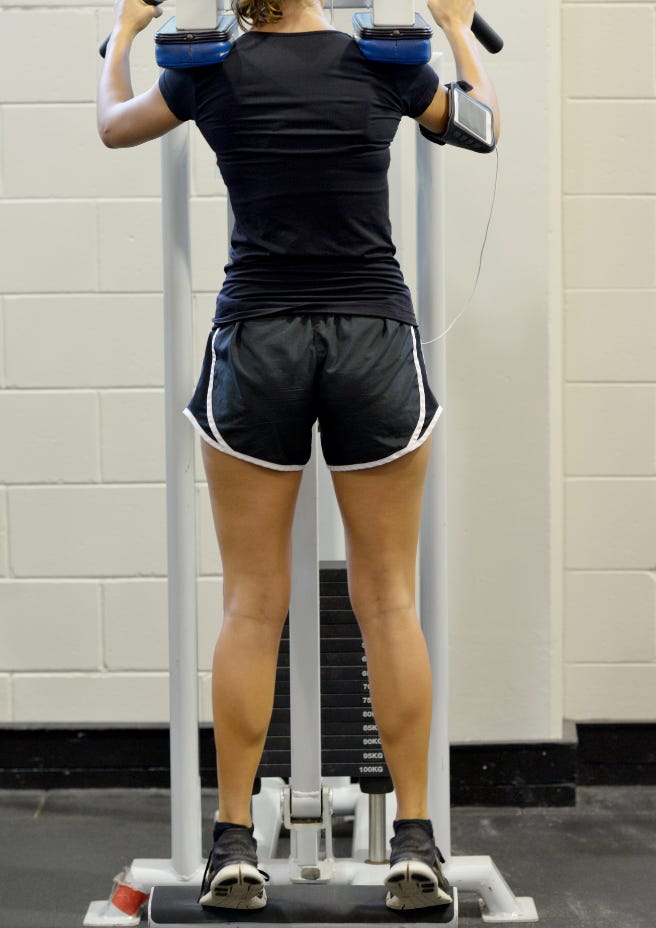
For twenty years, the ACL conversation has been a knee conversation.
We rebuild the ligament. Then we spend the next nine months chasing the quad. And rightly so. The quadriceps weakness after ACLR is real, it’s stubborn, and it’s well documented. So the protocols pile up: leg extensions, blood flow restriction, NMES, squat progressions. Then we bolt on the hamstrings, the glutes, the trunk. We tick the boxes. We hit our symmetry numbers. We send them back to running.
And then, weeks into the running program, the phone calls start.
Calf tightness. Achilles niggles. Ankle stiffness. Shin pain. Something that “isn’t the knee, but it’s on the same side.” We treat the symptom, load-manage the running, tell them it’s normal to be a bit sore coming back.
But what if it isn’t the running that’s the problem? What if we simply sent them out to run on a calf we never trained?
Here’s the thing we’ve been slow to accept. An ACL reconstruction doesn’t just weaken the knee. It reorganises how the whole leg works.
The brain, after a knee injury and surgery, changes its recruitment strategy. It stops trusting the limb. It turns things down. We’ve long known this happens to the quad. What we’re now realising is that it doesn’t stop at the quad.
The signal to the calf gets turned down too. And that’s a problem, because the calf is the muscle that actually gets you off the ground and absorbs you back onto it.
Think about the order of operations in a hop, a jump, or a stride:
Foot hits the ground → calf absorbs → calf pushes → you go.
The calf is the first thing to touch the floor and the last thing to leave it. It is the workhorse of every foundational movement we ask for in late-stage rehab such as running, hopping, jumping, bounding, cutting.
If it’s quietly under-performing, the rest of the leg has to cover for it. And covering for it is what produces the niggles.
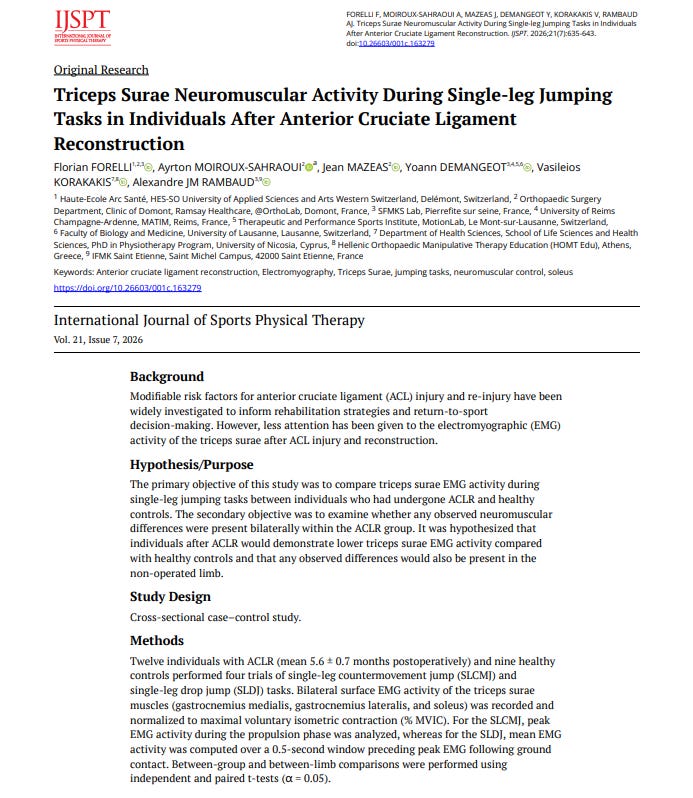
A French research group (Forelli and colleagues, published this month in the International Journal of Sports Physical Therapy) put EMG electrodes on the calf muscles of a group of ACLR patients and compared them to healthy people.
Who: 12 recreational athletes about 5–6 months after ACL reconstruction, and 9 healthy controls. Importantly, every one of the ACLR group had already passed return-to-running criteria and was running without symptoms. These weren’t struggling patients. These were the ones we’d be pleased with.
What they did: Two single-leg jumps. One slow and controlled (a single-leg countermovement jump). One fast and reactive (drop off a 15 cm box, rebound immediately).
What they measured: How hard the three calf muscles were actually firing; the two gastrocnemius heads and the soleus underneath them.
That’s it. No complicated protocol. Just: are these calves working as hard as they should be?
Across both jumps, slow and fast, the deep calf muscle was firing significantly less in the ACLR group. Not marginally. Significantly, and in every task they tested.
The soleus is the muscle nobody trains. It’s under the gastroc, it doesn’t show, it doesn’t get a hard bulge on the calf raise machine. It’s also the muscle doing the bulk of the work when you’re running, and the one that stabilises you when the knee is bent - which is to say, in every position that actually matters in sport.
Here’s the finding that should change how you test. The gastrocnemius medialis looked fine in the slow, controlled jump. It only fell apart in the fast, reactive drop jump.
Read that again. If you had assessed these people with a slow heel raise or a controlled jump, you’d have concluded the gastroc was fine and sent them on their way. The deficit only appeared when the task demanded speed and stiffness, which is exactly what running is.
Slow testing hides fast problems.
This is the one I’d tattoo on the inside of every clinician’s eyelids.
There was no meaningful difference between the operated leg and the “good” leg. The calf was under-firing on both sides.
Which means: if you are assessing the calf with a limb symmetry index; comparing the surgical side to the other side, you will find nothing wrong.
You’ll get 95%, 100%, and you’ll pass them. But 100% of a reduced baseline is still reduced. You’ve measured a shortfall against a shortfall and called it recovery.
The good leg is not a control group. It never was.
We stop treating the calf as an afterthought and start loading it the way we load the quad: early, progressively, and with intent.
This is not exotic. It’s just being done properly, and being done on time.
The best-kept secret in early ACL rehab is that the calf can be trained hard while the knee is still fragile. Plantarflexion loading doesn’t threaten the graft. There is no reason to wait.
Seated (bent-knee) calf raises. This is your soleus lever, and it’s knee-safe. Start bilateral, get to single-leg, add load. This should feel like a real strength exercise, not a warm-up.
Isometric calf holds: both straight-knee and bent-knee, 30–45 second holds. Cheap, tolerable, effective.
Ankle range of motion, particularly dorsiflexion. Everything downstream depends on it.
Train the other side too. Both calves are affected. Both calves get loaded.
This is where most programs quietly drop the calf to make room for squats and hamstring work. Don’t.
Single-leg heel raise to failure, straight-knee and bent-knee. Metronome, controlled range, count the reps. Write the number down. This is your key measure, and it’s an absolute number, not a percentage of the other leg. Most healthy adults should be well north of 20. Most of your patients won’t be close, on either side.
Loaded calf raises: dumbbells, machine, whatever you have. Progressive overload. Close to failure. The calf is a high-work-capacity muscle; it will not respond to two sets of fifteen at bodyweight.
Keep training it twice a week, minimum. It’s fatigue-resistant and it needs volume.
Strength is not stiffness. A calf that can do 25 slow heel raises can still be useless at absorbing a footstrike. This is the gap the study exposes, and it’s the gap that gets people hurt when they start running.
Pogos. Double leg → single leg. Short ground contacts, minimal knee bend, all ankle. This is the single best calf-stiffness drill there is.
Low-level hopping: in place, then forward, then side to side. Build tolerance to repeated impact before you build running mileage.
Drop jumps and rebounds, when they’re ready. The exact task where this study found the gastroc failing.
Then, and only then, start adding running volume and speed. Not the other way around.
“Your calf is the first thing that hits the ground and the last thing that pushes you off it. If we don’t rebuild it, your knee and your Achilles will do its job for it, and that’s when things start hurting for no obvious reason.”
I want to be straight with you, because I don’t want to oversell a study that happens to agree with me.
This is a small study, just 12 ACLR patients and 9 controls. It measured muscle activation, not muscle force or strength, and it didn’t track anyone forward to see who got hurt. So it cannot tell us that a quiet soleus causes re-injury, and it doesn’t prove that prioritising the calf improves outcomes.
What it does do is add another brick to a wall that’s been going up for a while: the calf is measurably compromised at precisely the moment we start asking these patients to run, hop, and jump for real - and our standard side-to-side testing is blind to it.
That’s enough for me. Load the calf. Load it early. Load it on both sides. And test it fast, not just slow.
Honestly, the fact that you’ve read this far means a lot. That’s the whole point of the ACL Hub - a place to think out loud about this stuff together, and it’s free, and it always will be.
But every so often someone asks me where they can go deeper, so I’ll mention it once and then leave it alone.
Over at learn.physio there’s a fairly hefty ACL library with 14 ACL masterclasses (35+ hours), 10 practicals (12 hours), 7 lectures (7 hours), and a 1-hour roundtable. If you’ve got the itch to really dig in, it’s there.
And if you don’t, that’s genuinely fine. I’m just glad you’re here.
Thanks as always for reading.
Mick Hughes
Full text reference:
No posts
Comments
Nothing yet. Say the first thing.
Sign in to join the conversation.