
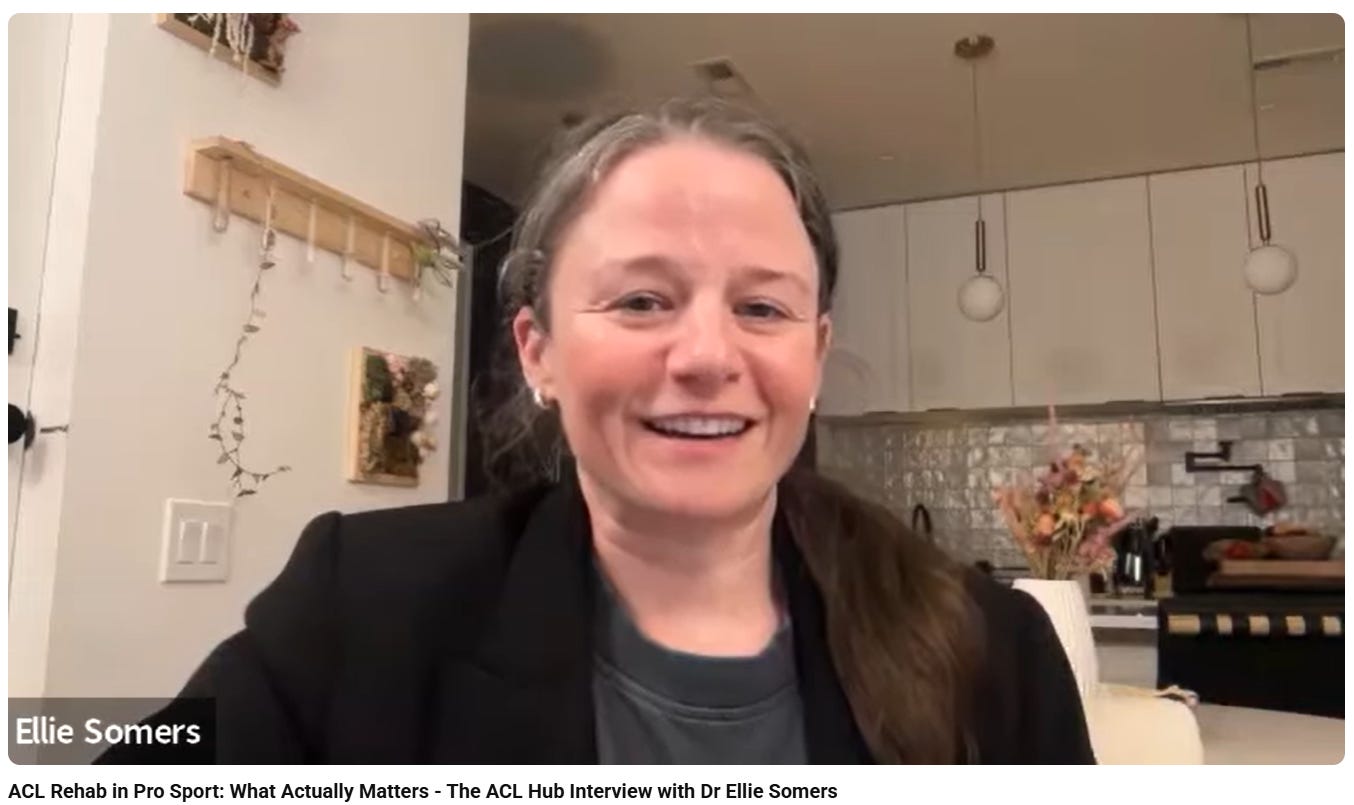
Every now and then I have a conversation that makes me want to write a short apology letter to every patient I’ve treated in my first three years of practice.
This was one of those.
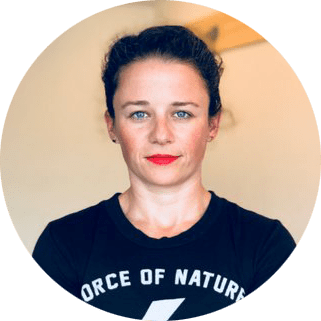
I sat down with Dr Ellie Somers, who has quietly assembled one of the more interesting CVs in sports physio. High school ACL injury. Division I soccer at Saint Louis University. Private practice in Seattle, where she founded Sisu. Then the NWSL with OL Reign and the Chicago Red Stars. And now the WNBA, as Director of Athlete Care and Performance with the Washington Mystics.
So when Ellie says something about ACL rehab, I tend to shut up and take notes. Which, if you watch the full interview, you’ll see me doing with varying degrees of subtlety.
Here’s what I love about talking to people at the very top of the profession: their answers are almost always more boring than you expect. In the nicest way possible of course.
I asked Ellie what her non-negotiables are in the first six weeks after an ACL reconstruction. Not “what’s the secret sauce in the WNBA”, but just, what actually has to happen.
Range of motion. Walking. Quad recruitment.
That’s it. That’s the list.
No proprietary protocol. No blood flow restriction wizardry at day four. Three things that every single one of us learned in our first year out, done relentlessly well.
She was particularly firm on knee extension, and made a great case for NMES, and not just for waking the quad up, but because it seems to help shift swelling too. Less swelling, better quad. Better quad, less swelling. A rare moment in rehab where the feedback loop works for you instead of against you.
We got onto return-to-sport testing, and there was a lovely moment of mutual confession: we’ve both largely moved on from the big hop test battery.
Not because hop tests are useless - Ellie still pulls them out as a light gauge - but because force plates and handheld dynamometry give you cleaner information for less faff. She’s running isokinetic testing roughly every three months, with other testing monthly or in six-to-eight week blocks depending on the sport and the calendar.
But the line that stuck with me was about what happens after the test. Getting a number is easy. Knowing what that number means for Tuesday’s session is the actual job. As Ellie put it, holding a rigid line rarely works and the quality of the movement and how the athlete responds tells you more than whether they scraped over an arbitrary threshold.
Which is either deeply reassuring or mildly terrifying, depending on how much you like spreadsheets.
We also talked about resourcing in women’s professional sport, and Ellie was refreshingly honest about it.
Early in her career: two medical staff for twenty-six players. She described a stint at a club where the women were doing their prep in a high school classroom, in conditions you wouldn’t accept for a local Saturday side, while the men’s setup was a different world entirely.
Today, in her current role, it’s four medical staff and three performance staff for thirteen athletes.
That’s real progress, and worth naming. It’s also a reminder of how recently it wasn’t the case.
For young clinicians desperate to get into pro sport: be patient. These jobs are volatile and none of them are permanent. Go and make your mistakes somewhere that will forgive you for them, because pro sport won’t.
For anyone currently in the thick of ACL rehab: keep showing up. Do the boring work. The people who quit are the ones who end up with knee problems a decade later.
Simple. Not easy. Never is.
I’ve put the full, raw, unedited 1hr interview up at The ACL Hub.
No clever editing, no tidy soundbites, just the actual conversation including the tangents, the “hang on, let me rephrase that” moments, and the bits where we both got a bit nerdy about force plates.
I reckon it’s better that way. You get to hear how someone at that level actually thinks, not just the conclusions.
Head to The ACL Hub to watch it in full.
And go follow Ellie at @drelliesomers on Instagram; she’s one of the clearest voices going on ACL rehab, and on doing better by female athletes.
Your quads will thank you. Eventually.
No posts
Comments
Nothing yet. Say the first thing.
Sign in to join the conversation.