
In 2025, the best design teams prototyped with AI. In 2026, they’re already pushing to production. The code crossed the quality threshold — but the real bottleneck was never the tooling. It’s how much your org is willing to trust.
Here’s the framework for where your team is, and why the gap between designers’ readiness and org permission is the biggest untapped leverage in product right now.
For 15 years, the designer–engineer workflow looked like this:
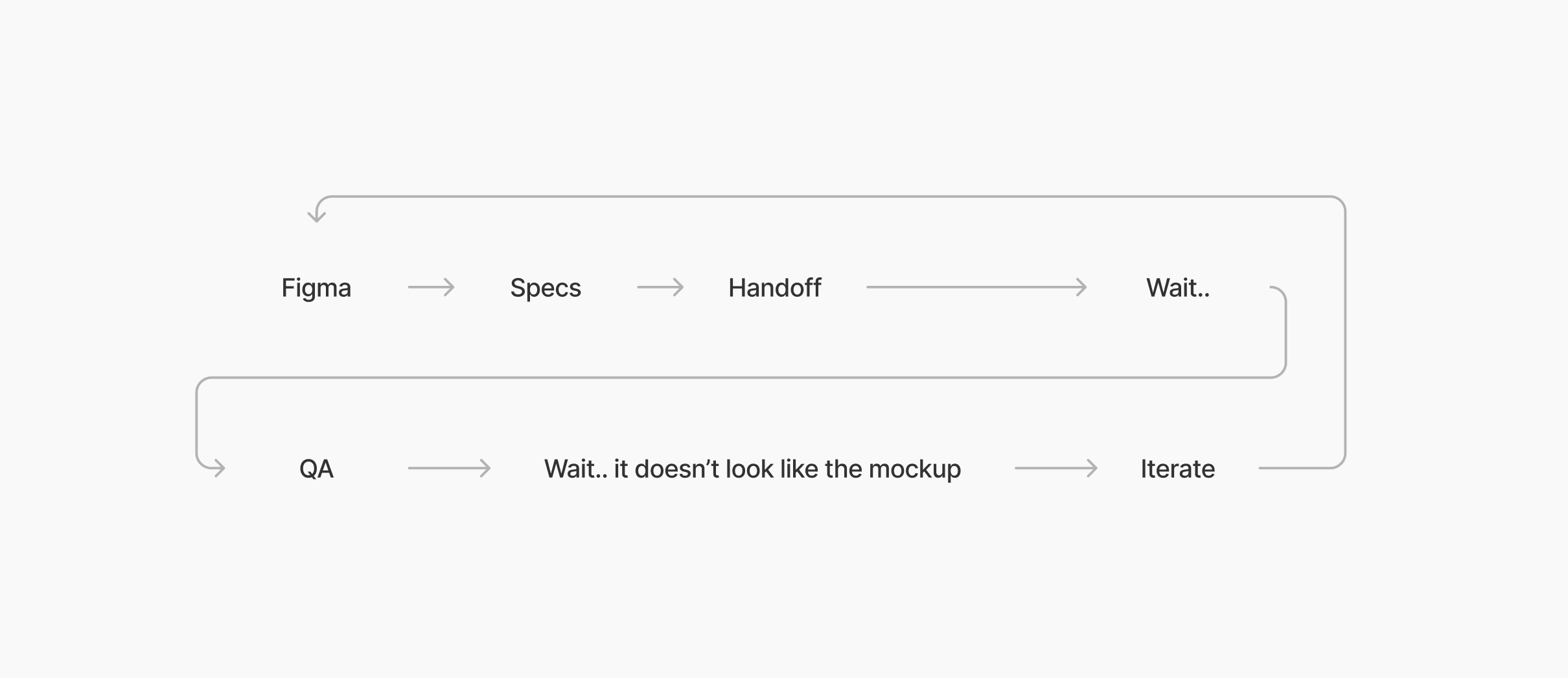
The friction was structural. Different tools, different mental models. Every cycle cost days and eroded momentum and quality. Designers optimized for clear specs and quality handoff.
AI coding tool don’t speed up this mess. It collapse it.
In 2025, AI-generated code impressed us but remained messy. Great for prototyping, not ready for production. The output needed so much cleanup that traditional handoff to engineers was still the default path. We had to recreate everything in Figma still.
In 2026, the generated code is reviewable, mergeable, shippable. Tools like Claude Code and Codex crossed the quality threshold.
This changes who can build, who can ship, and what being a “designer” means inside a product team.
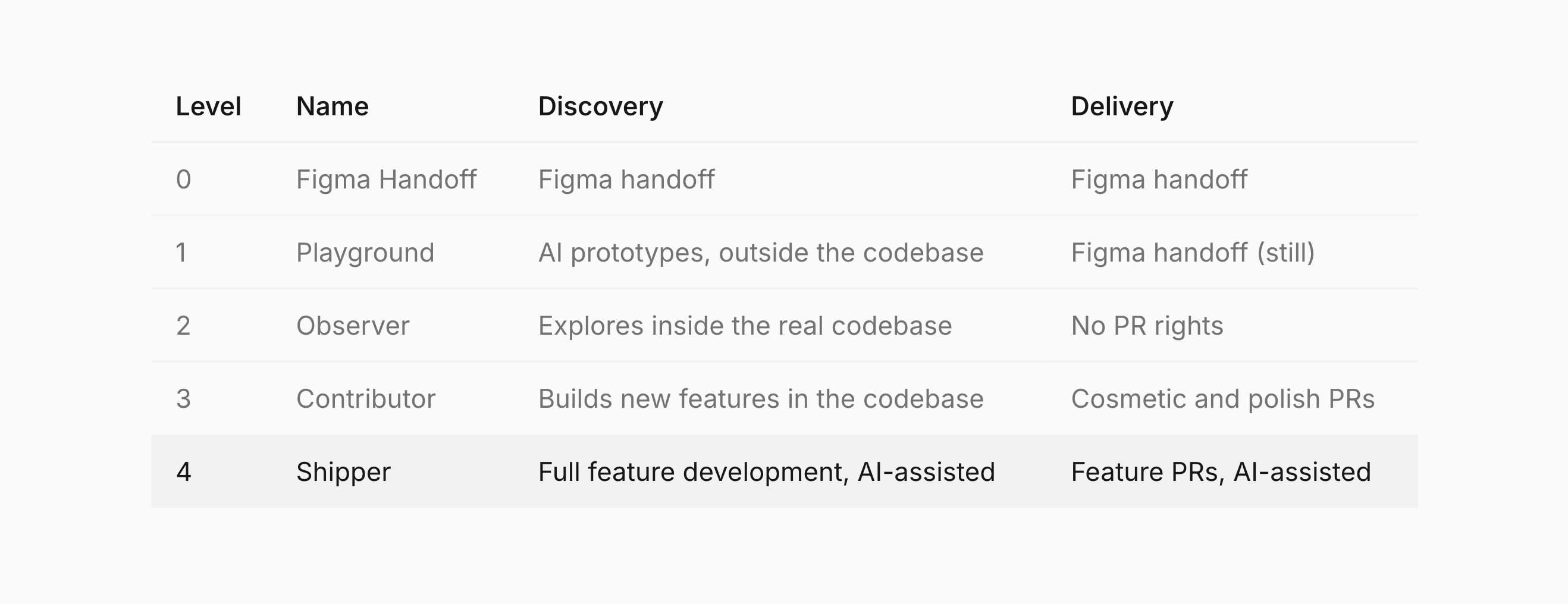
Teams don’t jump from handoffs to designer-shipped PRs overnight. They progress through milestones — I’ve been crossing different levels in recent months.
Two axes define the progression:
Discovery — How teams explores, prototypes, and validates ideas.
Delivery — What the designer is trusted to ship to production.
Discovery: Figma handoff
Delivery: Figma handoff
Designer and engineer are separate roles, separate tools, separate timelines. AI might help generate mockups faster, but the gap between design and production is unchanged. You know how things work here.
Discovery: AI prototypes, outside the codebase
Delivery: Figma handoff (still)
The team starts using AI coding tools to build prototypes, POCs, standalone experiments — but none of it touches the real codebase. It’s a playground.
Exploration gets 10x faster. The team shows working prototypes instead of static mockups. Conversations shift from “is this feasible?” to “is this the right approach?”
Delivery hasn’t changed yet. The org hasn’t opened the gate.
This was the frontier in 2025.
Discovery: Explores inside the real codebase
Delivery: no PR rights
This is the trust inflection point. Designers works inside the actual codebase — pulling real components, real data structures, real constraints.
On the delivery side, they can run things locally but they’re not shipping. Read-access to the codebase as a design tool.
The edge cases surfaces more easily. Engineers begin seeing Designers as someone who speaks their language. Designers can learn from the codebase with AI.
Trust signal the org is watching: Does Designers understand the codebase well enough not to break things?
Discovery: Builds new features in the codebase
Delivery: Cosmetic and polish PRs
The designer is shipping — but scoped to what’s safe, visible, and low-risk. UI polish, spacing, copy, animation tweaks, design tokens. They own the last mile of visual quality directly. Finally.
Meanwhile, in discovery, they’re already exploring full features with AI assistance. The org or product just isn’t ready to unlock that for production.
The feedback loop is instant — Designers sees real results, in real context, and fixes it themselves. No ticket needed.
Trust signal the org is watching: Do Designer’s PRs pass review without introducing overhead?
Discovery: Full feature exploration, AI-assisted
Delivery: Feature well scoped PRs, AI-assisted
The designer builds and ships features end-to-end.
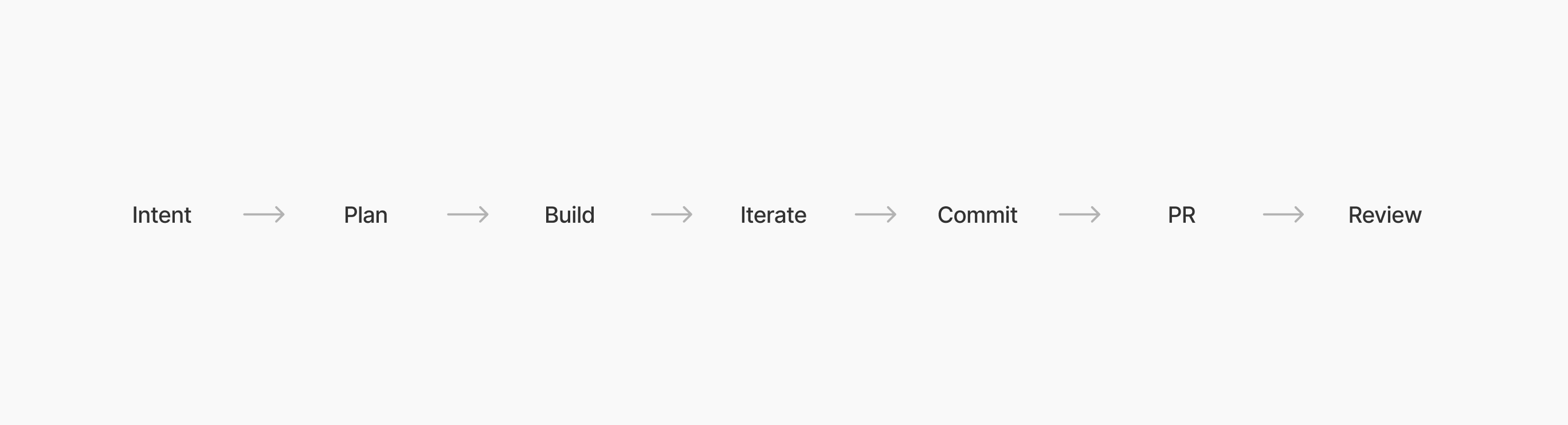
Design and implementation become one continuous act.
This is the 2026 frontier.
That’s the old framing. The designer isn’t becoming a junior engineer. AI is the execution layer. The designer’s job is:
Creative direction — Knowing what to build and why.
Intent clarity — Describing requirements precisely enough for AI to execute (more on that for another time)
Taste — Recognizing when the output is right and when it isn’t.
The skill shifted from pixel-pushing to directing code agents. It's no longer about "should designers code", but whether designers should design in code.
Don’t wait for permission. Start at Level 1 on your own time. Build something real with AI tools. That’s your proof of concept — and your leverage.
Keep your design confidence. Your taste is the moat. AI handles execution. You handle judgment. Just learn the ropes of being a junior engineer with your team.
Ship carefully, incrementally. Start with cosmetic PRs. Earn trust through small, clean contributions — not a big bang feature. Every clean PR is a trust deposit.
Choose where you work accordingly. In 2026, the best designers will pick companies that let them ship. If your org won’t move past Level 0, that’s a ceiling on your impact — and your career.
Let designers and engineers explore together. We’re all navigating this new workflow.
Everyone is shipping faster in 2026. Designers included. This is not optional — it’s the new baseline.
If your team’s pace hasn’t 2x this year, you have a problem. Your competitors’ has. The talent and the tools are there. The question is whether your org structure lets them move.
Trust is the unlock, not tooling. The tools are ready today. The question is whether you’ll open the gate or keep designers in Figma while the market moves without you.
This framework applies to product surface work: UI, interactions, frontend features, design systems. That’s already a massive surface area.
The spectrum also assumes a codebase that’s reasonably well-structured. If your repo is a mess, Level 2+ becomes painful for everyone, not just designers.
The bottleneck isn’t the designer’s skill. It’s the org’s willingness to trust.
Most designers are ready for Level 3 today. Most orgs are stuck granting Level 2.
That gap is either your biggest untapped leverage — or your competitor’s biggest advantage.
Which level is your team at? Which level should it be?
The distance between those two answers is where the opportunity lives.
This newsletter is my attempt to deliver exclusive frameworks and actionable insights for entrepreneurs and designer to harness design as their strategic advantage.
If you haven’t seen on LinkedIn, I’ve started my own Fractional Product Design studio claritystudio.design – An AI-native, taste-led, business-driven product design studio, helping startups ship with clarity, conviction, and focus.
I’m also starting to be more active on X, and LinkedIn.
Remember, this is your journey as much as it is mine. If you feel this isn't what you're looking for at any point, please feel free to opt out–there will be no hard feelings.
If you have any suggestions on how I can improve the format, reply to this email with your feedback, and I will personally reply to all emails.
Take care,
If you find this post helpful, consider sharing it with a friend using the button below
Comments
Nothing yet. Say the first thing.
Sign in to join the conversation.