
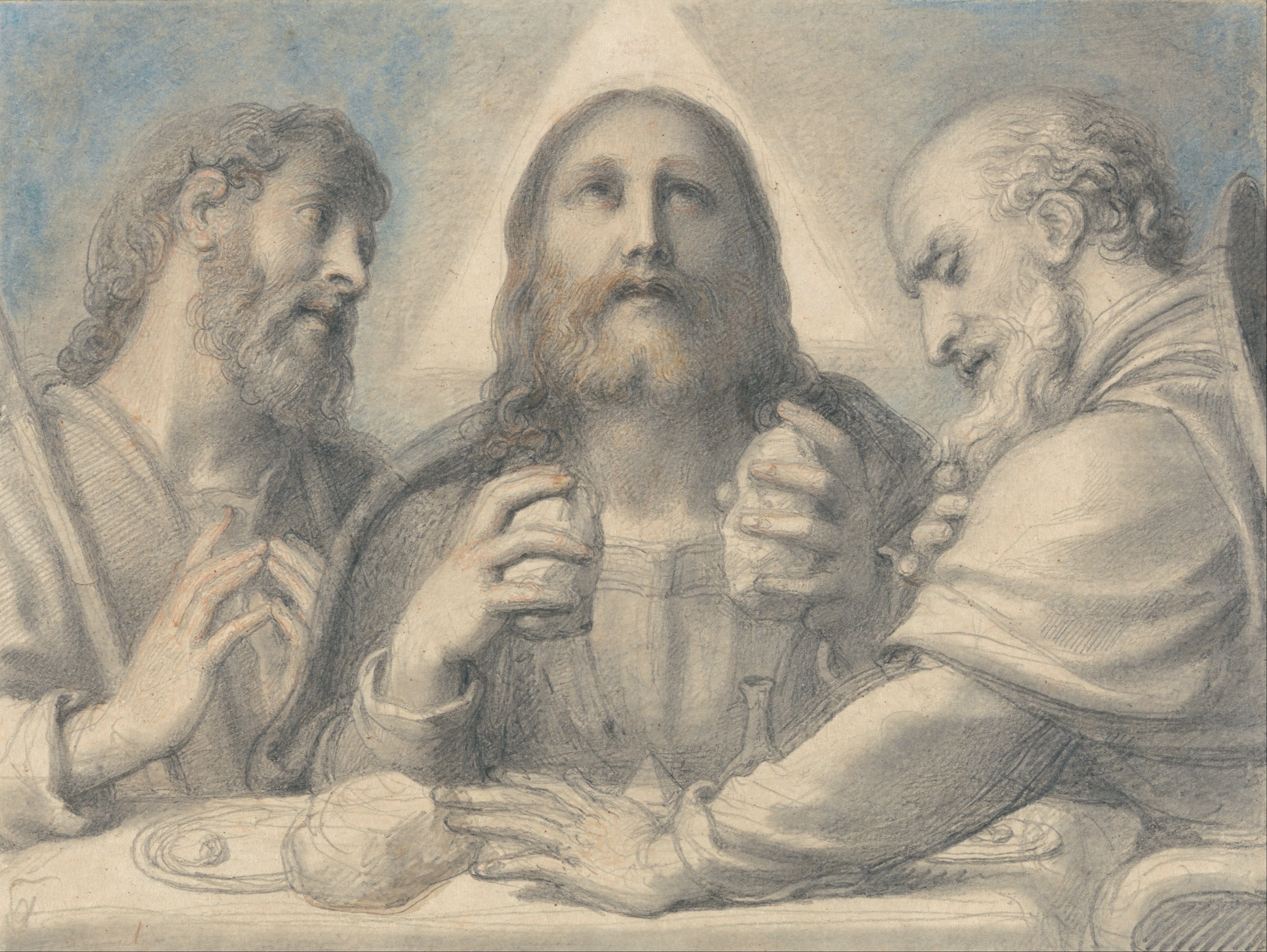
We recently relived the resurrection of Jesus at God’s Feast of First Fruits, and we look forward to His next feast, Pentecost/Shavuot/Weeks on June 8. We are in that in-between period called the Counting of the Omer (or “sheaf”) that we read of in Leviticus 23:15–16:
You shall also count for yourselves from the day after the Sabbath, from the day when you brought in the sheaf of the wave offering; there shall be seven complete Sabbaths. You shall count fifty days to the day after the seventh Sabbath; then you shall present a new grain offering to the Lord.
We are in the midst of the fifty days for which Pentecost is named and the weeks for which the Feast of Weeks is named.
Jesus was active on earth throughout the first forty of the fifty days between First Fruits and Pentecost. On the fortieth day, He ascended to His Father, but before that, He taught His disciples. “To these [the apostles] He also presented Himself alive after His suffering, by many convincing proofs, appearing to them over a period of forty days and speaking of the things concerning the kingdom of God” (Acts 1:3). Here are His appearances:
He appeared to Mary Magdalene (Mark 16:9; John 20:16–18), other women (Matthew 28:5–10), Peter (Luke 24:34; 1 Corinthians 15:5), two on the road to Emmaus (Luke 24:13–35), the twelve disciples (Mark 16:14; Luke 24:33–39; John 20:19), the twelve again (John 20:26), Thomas (John 20:24–29), and again the disciples (John 21:1–14), five hundred (1 Corinthians 15:6), James (1 Corinthians 15:7), and, at His ascension, the apostles again (Acts 1:1–11).
We can think of this as a “season of new understanding” because Jesus used this time to open the eyes of the understanding of the disciples to those things about Himself that they did not understand. He enlightened the eyes of their hearts to prepare them for ministry. I pray that the eyes of your heart may be enlightened (Ephesians 1:18).
We see this as Jesus teaches the two returning from Jerusalem on the road to Emmaus: “Then beginning with Moses and with all the Prophets, He explained to them the things written about Himself in all the Scriptures” (Luke 24:27).
Then He appeared to the other disciples:
Now He said to them, “These are My words which I spoke to you while I was still with you, that all the things that are written about Me in the Law of Moses and the Prophets and the Psalms must be fulfilled.” Then He opened their minds to understand the Scriptures and He said to them, “So it is written, that the Christ would suffer and rise from the dead on the third day, and that repentance for forgiveness of sins would be proclaimed in His name to all the nations, beginning from Jerusalem.” (Luke 24:44–47)
Jesus preached the gospel to the disciples using nothing but Moses, the prophets, and the Psalms (or the Tanakh—Torah, Nevi’im, Ketuvim).
But oddly, many during this period did not recognize Jesus. Let’s look at the origin of the word recognize. It means “to come to know again.” Re-cognition. Ginosis in Greek, “to come to know.” From re- "again" and cognoscere "to know." Recognizing is a process of coming to know again something we knew before.
Paul writes in Acts 13:27: “For those who live in Jerusalem, and their rulers, recognizing neither Him [Jesus] nor the utterances of the prophets which are read every Sabbath, fulfilled these [utterances] by condemning Him.” The rulers did not recognize that they were part of the fulfillment of prophecy, such as we find in Psalm 22:14–18:
I am poured out like water, And all my bones are out of joint; My heart is like wax; It is melted within me. My strength is dried up like a potsherd, And my tongue cleaves to my jaws; And You lay me in the dust of death. For dogs have surrounded me; A band of evildoers has encompassed me; They pierced my hands and my feet. I can count all my bones. They look, they stare at me; They divide my garments among them, And for my clothing they cast lots.
We have another example of a deliverer not being recognized in the story of Joseph. Joseph’s brothers did not recognize him when they came to plead for relief from the famine in Israel when Joseph was powerful in Egypt. But when Joseph made the decision to reveal himself, their eyes were opened:
Then Joseph could not control himself in front of everyone standing before him, and he shouted, “Have everyone leave me!” So there was no one with him when Joseph made himself known to his brothers. Then he wept so loudly that the Egyptians heard it, and the household of Pharaoh heard about it. And Joseph said to his brothers, “I am Joseph! Is my father still alive?” But his brothers could not answer him, for they were terrified in his presence.
Then Joseph said to his brothers, “Please come closer to me.” And they came closer. And he said, “I am your brother Joseph, whom you sold to Egypt. (Genesis 45:1–4)
It was grievous for Joseph’s brothers to recognize Joseph because it meant facing their sin. But they repented and were forgiven:
And now, please forgive the offense of the servants of the God of your father.” And Joseph wept when they spoke to him. Then his brothers also came and fell down before him and said, “Behold, we are your servants.” But Joseph said to them, “Do not be afraid, for am I in God’s place? As for you, you meant evil against me, but God meant it for good in order to bring about this present result, to keep many people alive. So therefore, do not be afraid; I will provide for you and your little ones.” So he comforted them and spoke kindly to them. (Genesis 50:17–21)
Similarly, Jesus’s brothers in the flesh did not recognize Him, and many still don’t to this day. Just as Joseph looked to his brothers like an Egyptian, many of Jesus’s brethren in the flesh today see Jesus in the disguise of a Gentile. They do not recognize that He is one of their own and is for them.
When Mary Magdalene saw the risen Jesus outside the tomb after His resurrection, she did not recognize Him. She thought He was the gardener:
When she had said this, she turned around and saw Jesus standing there, and yet she did not know that it was Jesus. Jesus said to her, “Woman, why are you weeping? Whom are you seeking?” Thinking that He was the gardener, she said to Him, “Sir, if you have carried Him away, tell me where you put Him, and I will take Him away.” Jesus said to her, “Mary!” She turned and said to Him in Hebrew, “Rabboni!” (which means, Teacher). (John 20:14–16)
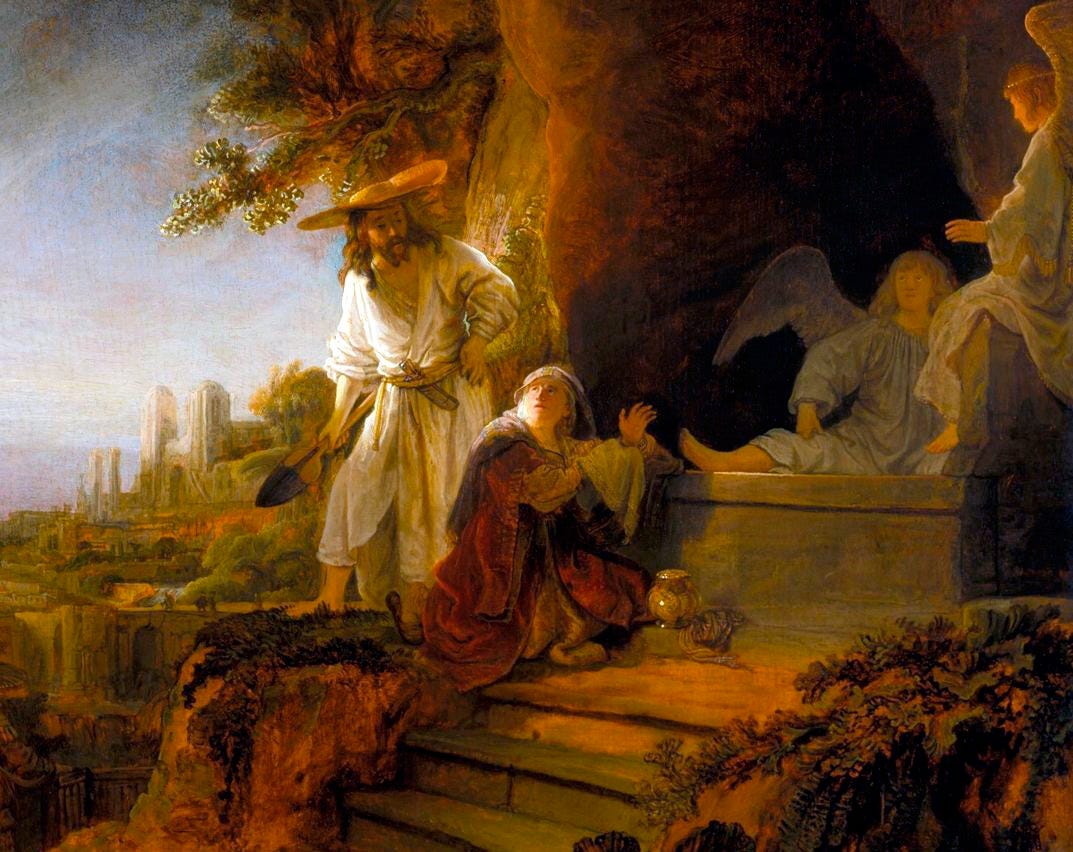
When He spoke her name, she knew it was Him. “The sheep hear His voice, and He calls His own sheep by name and leads them out. When He puts forth all His own, He goes ahead of them, and the sheep follow Him because they know His voice” (John 10:3–4).
When the disciples were fishing after having twice seen the resurrected Jesus, they did not recognize Him when He appeared on the beach. Even when they deduced it was Jesus and they gathered around His fire to share His fish and bread, “none of the disciples ventured to question Him, ‘Who are You?’ knowing that it was the Lord” (John 21:12).
The two on the road to Emmaus didn’t recognize Jesus. They were so taken with Jesus’s words that they invited Him to come stay with them. The moment He took bread, blessed it, broke it, and began giving it to them, their eyes were opened, and they recognized Him. The breaking of the bread caused them to recognize Him. We read that Jesus’s teaching had caused a burning in their hearts, and they were so excited they ran back to tell the other disciples. The disciples initially had to overcome unbelief, and then they rejoiced in the resurrected Messiah.
What was it about the breaking of bread that opened the eyes of these two to recognize Jesus? Jesus didn’t just eat the bread; “He took the bread and blessed it, and breaking it, He began giving it to them. Then their eyes were opened and they recognized Him.”
This is also the purpose of the mass: to make us truly experience bread and wine as body and blood—not two meanings in one but one meaning together. The mass is a kind of poetry, or vice versa. The purpose of both mass and poetry is to remeld the world of flesh and spirit, of things and meaning, into one experience. (Andrew Klavan podcast)
WE CAN DEDUCE: The glorified Jesus does not look the same as the Jesus who first walked the earth. How are we to understand this?
All flesh is not the same flesh, but there is one flesh of mankind, another flesh of animals, another flesh of birds, and another of fish. There are also heavenly bodies and earthly bodies, but the glory of the heavenly is one, and the glory of the earthly is another. There is one glory of the sun, another glory of the moon, and another glory of the stars; for star differs from star in glory.
So also is the resurrection of the dead. It is sown a perishable body, it is raised an imperishable body; it is sown in dishonor, it is raised in glory; it is sown in weakness, it is raised in power; it is sown a natural body, it is raised a spiritual body. If there is a natural body, there is also a spiritual body. So also it is written: “The first man, Adam, became a living person.” The last Adam was a life-giving spirit. However, the spiritual is not first, but the natural; then the spiritual. The first man is from the earth, earthy; the second Man is from heaven. As is the earthy one, so also are those who are earthy; and as is the heavenly One, so also are those who are heavenly. Just as we have borne the image of the earthy, we will also bear the image of the heavenly. (1 Corinthians 15:39–49)
Paul says: “Therefore from now on we recognize no one by the flesh; even though we have known Christ by the flesh, yet now we know Him in this way no longer” (2 Corinthians 5:16). Now we are called to recognize Him with a new spiritual understanding—a new set of eyes.
God works in our spirits to grow us, remove our blinders, and correct our misconceptions about Himself. Our vision is impaired by our expectations of what Jesus is supposed to look like. Eternity is in our hearts, but we have to relearn it. “He has made everything appropriate in its time. He has also set eternity in their heart” (Ecclesiastes 3:11).
I have my own story of not recognizing Jesus. I grew up with the assumption that Jesus was not for me. His story was not my story. It was a story for Gentiles. I associated with Jesus all the ugly persecution of Jews since His death that has been committed in His name, including the Holocaust (or Shoah), from which my own mother escaped. When I married a Gentile, my mother asked me to promise her I would never become a Christian—a promise I was able and willing to make and keep for decades. I didn’t recognize Jesus as being Jewish in any way that would have meaning for me, and I had no motivation to correct my misconceptions. But gradually, Jesus opened my eyes to be able to recognize Him. He is sovereign and opens eyes to recognize Him according to His perfect will.
What expectations of God do we have that cripple our ability to see Jesus—not as we think He should be but as He truly is? Like Joseph’s brothers, are we harboring unconfessed sin that prevents us from seeing Jesus clearly?
We can look forward to a day when Jesus’s brethren, the Jews, will indeed recognize Him, and we can pray for that to come soon:
And I will pour out on the house of David and on the inhabitants of Jerusalem the Spirit of grace and of pleading, so that they will look at Me whom they pierced; and they will mourn for Him, like one mourning for an only son, and they will weep bitterly over Him like the bitter weeping over a firstborn. (Zechariah 12:10)
Let’s use these fifty days to come “to know again” our Savior, His gospel, and the treasure He has for us in the promised gift of the Holy Spirit that we anticipate for Pentecost. Let us purify our hearts, confess sin, receive the cleansing forgiveness of Jesus, and prepare our hearts to be enlightened by the only one who sovereignly shows us who He is. “Was blind but now I see.”
Comments
Nothing yet. Say the first thing.
Sign in to join the conversation.