
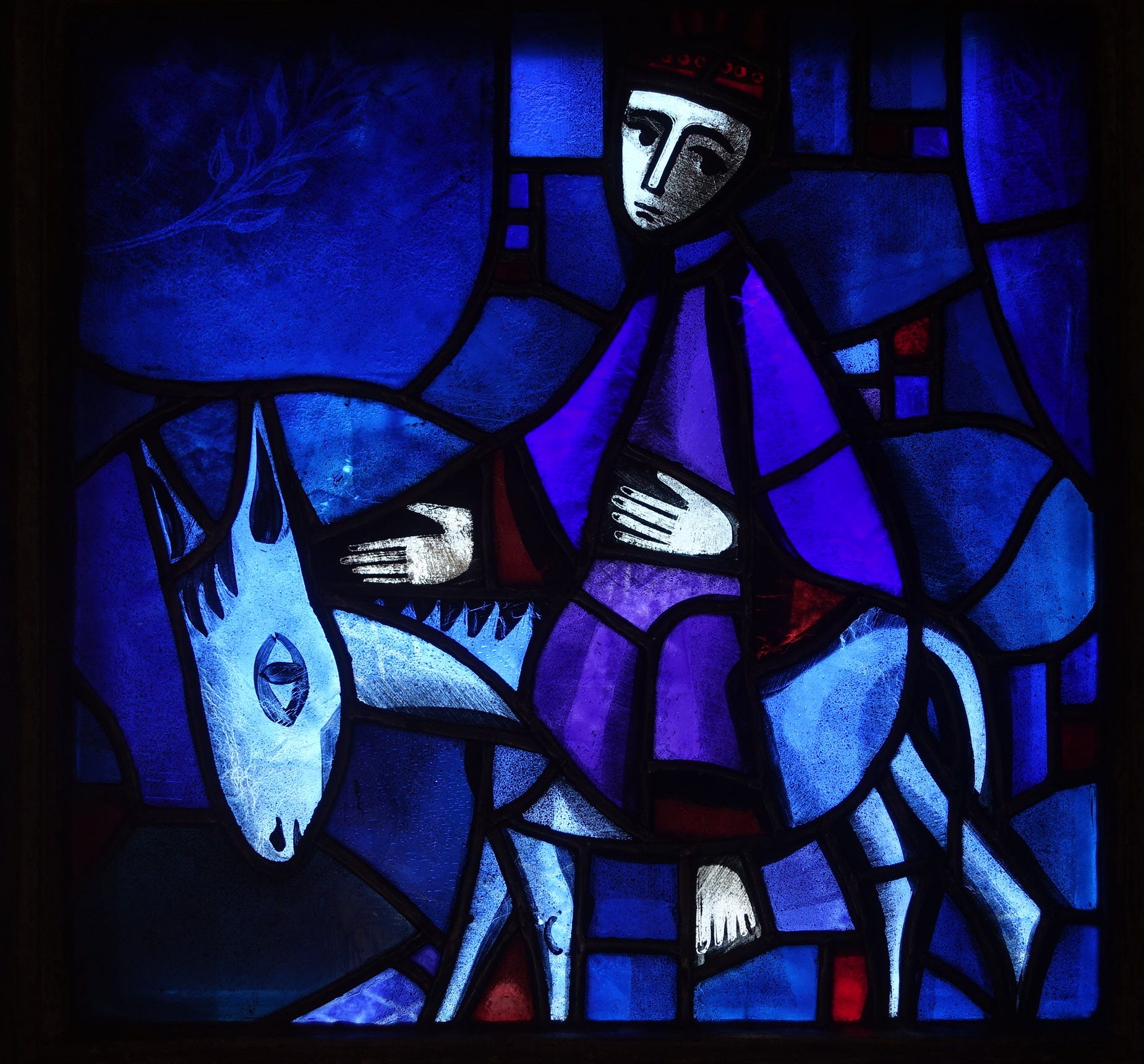
Bleiglasfenster von Frère Éric der Versöhnungskirche in Taizé: Christi Einzug in Jerusalem
Biblical history presents a pattern that recurs throughout the ages. It is the story of love, loss, and restoration of what was lost. We see the pattern as early as the second chapter of the Bible. God loves His human creation—the ones privileged to bear His image. But the fellowship He has with Adam and Eve is lost because of their sin. God spends the rest of the Bible anticipating through various methods of intimation that He is going to restore back to Himself the fellowship with humanity He lost.
God tells Abraham to offer up as a sacrifice his son whom he loves. Abraham loves Isaac, but he is willing to obey God. “Figuratively,” he loses Isaac, and Isaac is restored to him.
Hebrews 11:19 He considered that God was able even to raise him from the dead, from which, figuratively speaking, he did receive him back.
Jacob loves Joseph. He loses Joseph when Joseph’s brothers sell him into slavery and tell Jacob Joseph is dead. After many years, Joseph is restored to his father.
Genesis 45:27–28 But when they told him all the words of Joseph, which he had said to them, and when he saw the wagons that Joseph had sent to carry him, the spirit of their father Jacob revived. And Israel said, “It is enough; Joseph my son is still alive. I will go and see him before I die.”
Jochebed, the mother of Moses, sets her beloved Moses in an ark and releases him onto the waters of the Nile. But she receives him back when her daughter, Miriam, manages to get her mother hired as the child’s wet nurse. Jochebed receives back her son until he is weaned but also receives him back as her and all Israel’s deliverer.
Exodus 2:9 So the woman took the child and nursed him.
Hannah, a barren woman, prays to God for a son, and God hears her prayer and gives her Samuel. She releases this beloved child into the care of the priest Eli. Then she and all Israel receive Samuel back as the nation’s great prophet.
And so, we come to this holy week, and here we find the pattern repeated. Jesus enters the city as a beloved, welcome Messiah. He is adored by the people. They lay down palm branches before Him as He enters Jerusalem. But that heightened expectation of His triumphal entry is dashed when He is imprisoned, scourged, and finally crucified. As in the other examples, we lose our beloved.
But that loss is not the end of the story. Following the pattern, we receive our beloved Savior back again at His resurrection. And again following the pattern, through Jesus’s sacrifice and all that it means for the human condition, God receives us back again as His forever family.
What is Palm Sunday? It is the first day of holy week, the week that commemorates Jesus’s entry into Jerusalem and all the events that lead up to and include His passion, death, burial, and resurrection. This day starts the most holy time of the entire year. Palm Sunday is the day that Jesus made His triumphal entry into Jerusalem. It refers to the palm branches that were laid at His feet as He was hailed as the King of Israel by those who did not understand that this King must soon die a humiliating death. Hundreds of thousands of people were in Jerusalem for the Feast of Passover.
John 12:12–16 On the next day, when the large crowd that had come to the feast heard that Jesus was coming to Jerusalem, they took the branches of the palm trees and went out to meet Him, and began shouting, “Hosanna! Blessed is He who comes in the name of the Lord, indeed, the King of Israel!” Jesus, finding a young donkey, sat on it; as it is written: “Do not fear, daughter of Zion; behold, your King is coming, seated on a donkey’s colt.” These things His disciples did not understand at the first; but when Jesus was glorified, then they remembered that these things were written of Him, and that they had done these things for Him.
We see references in this passage to Old Testament prophecies that were fulfilled when all these events took place during Jesus’s passion week. That fulfillment is one way we see God making things come alive, in that the words of the prophets are seen to come true in the living form of Jesus, the God-man. Let’s look at those prophecies.
We read that the crowd took palm branches. Branches of palms were used in celebrating the Feast of Tabernacles, according to Leviticus 23:40 (“Now on the first day you shall take for yourselves the foliage of beautiful trees, palm branches and branches of trees with thick branches and willows of the brook, and you shall rejoice before the Lord your God for seven days”), but they eventually came to be part of other feasts, including Passover.
The cry “Hosanna” means “save now,” or “save, we pray.” The people were gathering around the One they hoped would be their Savior. This was before some called for Jesus’s crucifixion, and it was before others suffered the devastating disappointment of His cruel death. The triumphal entry was a moment of hopefulness of salvation, perhaps without an understanding of the cost of salvation. It was a time of naïve hope, one that could only happen if they had not been listening to Jesus’s own words. He was consistent in explaining that He must die.
Matthew 16:21 From that time Jesus began to point out to His disciples that it was necessary for Him to go to Jerusalem and to suffer many things from the elders, chief priests, and scribes, and to be killed, and to be raised up on the third day.
Luke 18:31–33 Now He took the twelve aside and said to them, “Behold, we are going up to Jerusalem, and all the things that have been written through the prophets about the Son of Man will be accomplished. For He will be handed over to the Gentiles, and will be ridiculed, and abused, and spit upon, and after they have flogged Him, they will kill Him; and on the third day He will rise.”
Going back to the triumphal entry scene, the crowd began shouting, “Blessed is He who comes in the name of the Lord.” This is from Psalm 118:
Psalm 118:26 Blessed is the one who comes in the name of the Lord.
Who is this “one who comes in the name of the Lord”? Reading more in Psalm 118, we learn that this one is “my strength and song, and He has become my salvation” (v. 14). He is “the stone which the builders rejected [who] has become the chief cornerstone” (v. 22). He is the one whose “mercy is everlasting” (v. 29). This One is God’s Messiah.
Going back to the triumphal-entry scene, we read, “As it is written, ‘Do not fear, daughter of Zion; behold, your King is coming, seated on a donkey’s colt,’” which comes from Zechariah 9:9:
Zechariah 9:9 Rejoice greatly, daughter of Zion! Shout in triumph, daughter of Jerusalem! Behold, your king is coming to you; He is righteous and endowed with salvation, humble, and mounted on a donkey, even on a colt, the foal of a donkey.
The John 12 passage says that the disciples did not even understand at first what was meant by the events at the triumphal entry of Jesus. But they remembered later, when Jesus was glorified, that these things had been written about Him in the Old Testament and that Jesus was fulfilling prophecy on Palm Sunday. Those things that were lost to memory were restored.
Let us enter into this holy week with the assurance that what is loved and lost can be restored. The “Christ our Passover also has been sacrificed” (1 Corinthians 5:7b). But death cannot hold Him. Jesus tells us through the apostle John:
Revelation 1:17–18 Fear not, I am the first and the last, and the living one. I died, and behold I am alive forevermore, and I have the keys of Death and Hades.
God is intent on restoring that which He lost—that is, His beloved family. Holy week is the culmination and fulfillment of the pattern that God broadcast to humanity throughout the ages, that we might know that crucifixion is not the end of the story. Resurrection is coming. Our Beloved is coming back to us. We can expect life to spring from death and our lost relationship with God to be fully and lovingly restored.
Comments
Nothing yet. Say the first thing.
Sign in to join the conversation.