
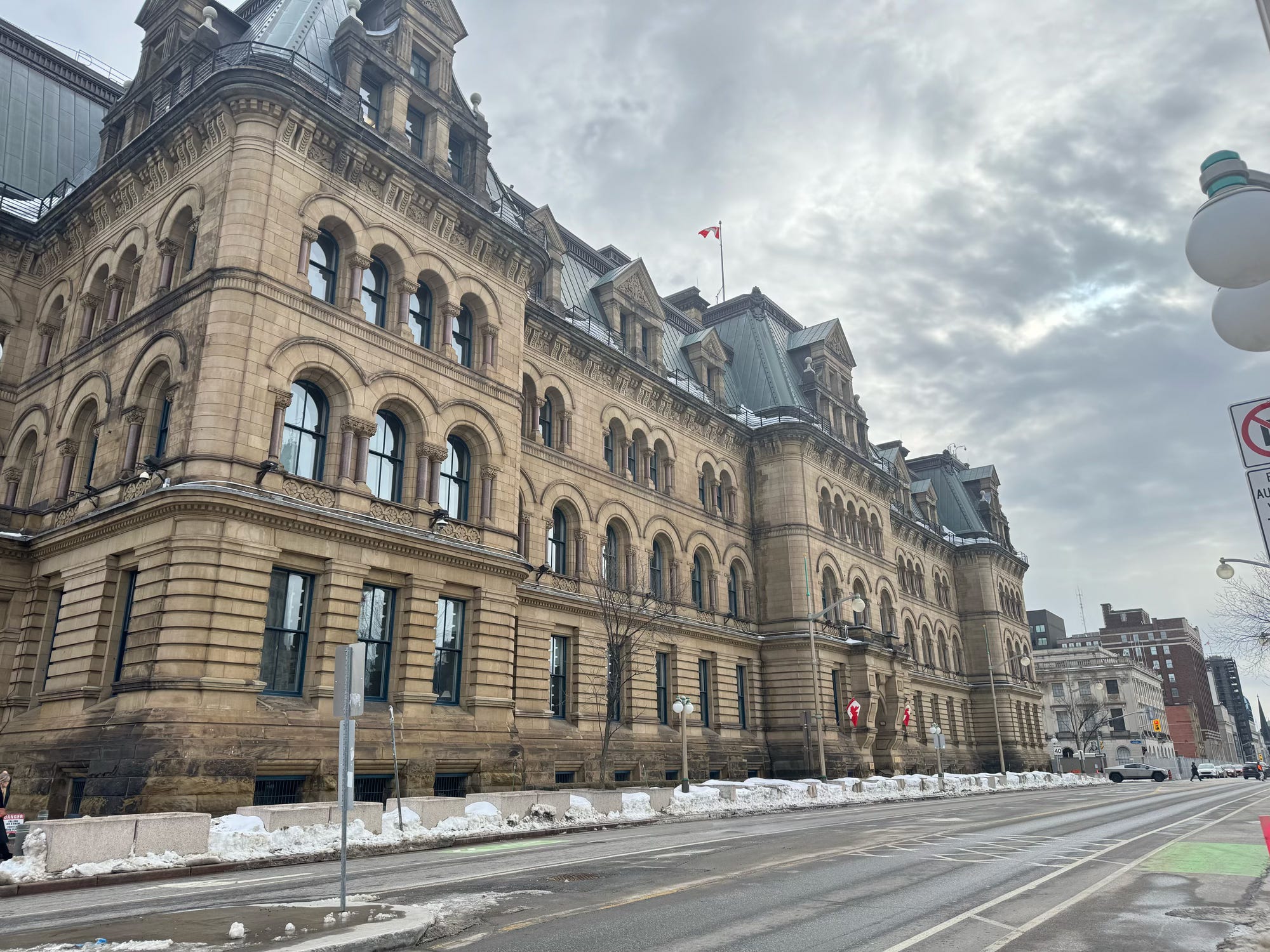
In the parking lot outside the pizza joint where my most recent local election victory party was being held, I made a promise to my husband and my long-suffering chief of staff.
I would proceed with my new mandate under a set of three ground rules.
My primary objective would be an outstandingly effective advocate for my constituents. I would do everything possible to promote stability within the party and the caucus. And I would not compromise the first objective while attempting to accomplish the second.
Up until April of this year, staying true to that course felt relatively simple. We had held the Liberal Party to a minority government, which meant opposition members like myself had a big tool belt of Parliamentary procedural leverage: the ability to amend legislation, compel information from the government, and use other parliamentary tools to hold them to account. Our caucus had welcomed a large cohort of new, energetic and talented rookie MPs. A minority meant also that our party would have some measure of control over when the next election would be, and in all likelihood it would not be several years before we would take another crack at forming government.
So while my party had once again lost the general election, there were many causes for optimism.
But these circumstances probably also extended the first stage of grief that happens after any loss - denial. For me, anyway, this became apparent on the day in April when Canada’s federal Liberals contrived a majority government through floor crossing. In one instant, advancing policy from the opposition benches became a far heavier lift. And the realization that the Liberals would now govern for several more years, and the impact that would have on Canada, weighed heavy on me too.
Judging from the tone of the public discourse that has been taking place between some luminaries of Canada’s political right since the Liberals solidified their majority, not everyone is moving through the stages of grief of this loss on the same timeline.
But in political leadership, there are no allowances made for the self-indulgences of denial, anger, bargaining, and depression. There is only an expectation to brush off the dust and get back in the saddle. That is the right path, and is the reality of accepting a job where millions of people are counting upon you to deliver for them.
And so, the wrong path for our movement to take after this loss is descending into yet another round of prolonged, grief-driven, frustrated, and puerile inward tent pissing.
More bluntly put, we must accept that we lost, and continue getting on with the business of winning.
It is worth spelling this out, because after a decade in opposition, it is easy to forget this foundational principle: the top objective for the Conservative Party is to form government. The entire point of a political movement’s existence is to form government and advance the priorities and interests of the members. There is too much at stake to believe otherwise; even some longtime Liberals will quietly agree that allowing the Liberal Party to reign unchecked has massively negative consequences for the country.
Sure, there’s honour in the duty of being a member of His Majesty’s Loyal Opposition, and a democracy requires both government and opposition. But no principle - no matter how strongly held - can be widely implemented from the low ground. Principles without power are just speeches. The high ground of government must be taken to effect widespread change. So while some activists-turned-pundits are still focused on re-interpreting auguries as to why the Conservative Party lost the 2025 general election, we should instead address the only two questions that really matter for the future. How do the Liberals keep winning? And, how can Conservatives win instead.
I’ll begin with the former.
For starters, it’s worth stating the obvious once again: political parties win when they are focused on winning.
At present, the Liberals’ entire decision making apparatus is focused around this singular principle. They are ruthlessly intolerant and seek to politically eradicate anything or anyone that could derail their chances of winning, and they govern themselves accordingly. Over the past decade they have used the levers of government like legislation, regulation, political appointments and taxpayer funding to build a machine designed for one purpose: perpetual power. If you have ever watched any Star Trek this analogy will resonate - the Liberals have become the Borg collective of Canadian federal politics.
So is resistance futile, as the Liberal apparatus would have the Canadian public believe?
Of course not. The first step to winning for Canadian conservatives is believing that winning is possible. And it is.
Right of centre Canadians - even those who aren’t politically active in the traditional sense - are the drivers of Canadian progress. We invent things. We build things. We grind. We protect rather than restrict freedom. We reject homogeneity of thought. If every Canadian who identifies with these characteristics were truly activated to reject Liberal ideology that enriches technocrats, cancels speech and snuffs out builders, a right of centre victory would be certain.
The new voter coalition that came out for the Conservative Party in the 2025 proved that on this front, progress is eminently possible. I am proud of the foundation that was built.
But progress and victory aren’t the same thing.
It cannot be overemphasized that the Liberals win because their political party is now the outcropping of a much more expansive political apparatus. For the conservative movement in Canada to win, and win repeatedly, the Conservative Party cannot be viewed as the singular vehicle by which the movement takes power.
Canada’s centre-right needs dozens of credible think tanks churning out public policy to counter the dogma of the Liberals. We need hundreds of credible independent media outlets to question the pro-Liberal spin of the Canadian Broadcasting Corporation. We need our own credible recognitions to counter the Liberal’s dominance within civilian award organizations. We need our own credible NGOs to advocate and organize for positions that counter those of the Liberals. We need book clubs, dinner parties and salons that establish the constructive side of our movement as a normative, upwardly mobile mainstream view. We need credible right of centre thinkers in the judiciary and in all manner of political appointments. We need like-minded people to own businesses and run educational institutions to teach and employ our people, instead of feeling that they have to be apologists for Liberal Party ideology in order to get ahead. We need singers, songwriters, fashion models, sports legends, scientists, and poets to send cultural signals that make liars out of the Liberals’ apparatus, which presently broadcasts on repeat: we are cool, they are not.
But we need people to actually do these things and fill these roles. This means eradicating the mindset that has normalized familicide amongst activists in our movement. The Liberals only have one purity test: if you want the Liberals to win, welcome to the team. When was the last time a senior Liberal activist took even semi-public ad-hominem shots at another? When was the last time a former Liberal staffer, activist, or defeated Member of Parliament ever had trouble finding a job? The answer to both questions is never. Like it or not, the Liberals have de-risked being part of their political infrastructure, while handing us the rope with which to do the opposite to ours. There are too many people who work too hard in the Canadian conservative movement to allow this to continue happening. We must fight the Liberals, not aid them, in their effort to get us to shoot at each other instead of doing the work of defeating them.
But there are two additional issues our movement must confront in order to win.
The first is the assumption that the tactics and policies that worked two decades ago to attract a broad voter coalition will work again in the future.
Take, for example, the incremental style of policy advancement that was a hallmark of former Prime Minister Stephen Harper’s government. To illustrate, imagine you are me in 2013: a newly minted cabinet minister in his government. By all major metrics back then, the country was largely on the right path. Politically, the Liberal party was firmly in third place, and Tom Mulcair hadn’t yet lost the plot for the NDP. After successfully emerging from the 2008 financial crisis, most of Harper’s cabinet managed with a governing philosophy that minor tweaks were all that really were needed. And this was the right approach for that time in Canadian history.
Now imagine 2026 me crashing through a time portal to deliver the news: over the next 13 years, the Liberals would take power and effectively legalize hard drugs, more than double the federal debt, nearly double the non-citizen share of the population, systematically erase or dilute many of Canada’s longstanding national symbols, and actively support legal challenges to established property rights. Tariff-free North American trade would appear on the brink of collapse, antisemitism would be rampant, legislators would shut the country down for nearly two years during a pandemic, housing prices would nearly triple, artificial intelligence would likely reach singularity, an active secessionist movement would emerge in Alberta, and major kinetic wars would be raging.
2013 me would have (rightly) assumed 2026 me had experienced a psychotic break. But if 2013 me tried to convince anyone today that the incremental policies of yesteryear could still make voters swoon the next time an election rolls around, she would (rightly) be considered a relic of the past.
The reality is that the steady-as-she-goes approach of Stephen Harper’s deliberately boring government, coupled with a more centrist NDP and a Conservative election campaign that rested on its laurels and promised more of the same, was precisely the runway a much farther-left Liberal Party needed paved to seize power in 2015. The Liberals saw a fertile field of Canadians, tilled by a decade of pro-growth Conservative policies, who could afford to take a gamble on a new government, and they presented a bold, alluring, and sharply different vision of the future.
We must do the same, but out of the ashes of a decade of Liberal ruination.
To win today, the conservative movement must accept that the political conditions and approaches to developing public policy that defined Canada during the heyday of the Harper government no longer exist in the same form that they once did. Too much has changed since then, and even in the best of times, for the most part voters don’t care about what a political movement has done in the past, only about what they’re going to do for them in the future. Canada’s conservatives need to carefully, consistently, and quantitatively assess who our potential voter coalition is, how we speak to them, and what we are offering them. We started that in 2025, and we need to even push harder now.
For example, much of the Conservatives’ new voter coalition in 2025 supported the Party because it focused on changing the Liberal status quo and making life more affordable. But for many of those voters under 35 who have grown up under a decade of federal government that now feels ubiquitous, the old message framing of “smaller government” isn’t guaranteed to carry the same punch in perpetuity. For them, the size of government or the deficit probably matters far less than what that government and its spending are actually used for, and who benefits or falls behind as a result. And so a necessary detour for the conservative movement on the path towards “we will cut wasteful spending and balance the federal budget” may be “we are going to first change how this money is spent to make sure you directly benefit”. In some conservative circles today, even suggesting this as a possible shift in approach would be considered an abomination. But getting to a more effective government for Canada requires less pearl-clutching, more openness to new framing, and a greatest tolerance for the movement to play with new ideas.
But boldness for the conservative movement does not simply mean changing our approaches to certain issues. In some cases the political context has changed so dramatically that it means leaning harder into positions we’ve long held and going further than we have before. The Liberals have big vulnerabilities. Their farther-left flank will not allow them to touch issues with deep cultural roots, but failing to address them risks driving away more centrist voters. For example, a decade of bringing in too many people too quickly for housing, health care, and jobs to keep up has left less capacity for newcomers to integrate into Canada’s economic and social fabric. The same applies to deeper questions about what cultural values define Canada as a people, and how those values should shape immigration and social policy. There is not only a political opportunity for the right-of-centre movement to offer bold answers on these questions, but also a moral imperative to do so.
This is my no means an exhaustive list of action items. But perhaps the most important change needed is how the movement views the role and function of political party leaders.
Strong political party leadership is essential to give a movement order and the discipline needed to maintain it. At the same time, a sustainable, long-term political movement cannot be built around the belief that leaders are infallible. For progress to be made, a movement owes grace to a leader who decides to, in turn, show humility and discipline after a setback.
This bargain has created examples that provide ample grounds for optimism.
After the 2004 election loss, Stephen Harper absorbed the hard lessons of a rookie campaign. Over the following year he imposed strict discipline on himself and his caucus, avoiding the kind of high-profile gaffes that had previously undermined Conservative momentum. Harper kept his focus - and that of his team - relentlessly on the Liberals’ emerging sponsorship scandal, steadily building the case that Paul Martin’s Liberal government lacked the moral authority to govern. When Jean Brault’s explosive testimony before the Gomery Commission in April 2005 shifted public opinion, Harper’s Conservatives were ready. The resulting surge in the polls was not accidental; it was the product of a full year of disciplined opposition that allowed Harper and this team to capitalize on Liberal weakness and ultimately win government in 2006. He exhibited humility, adaptability, and personal discipline, the movement rewarded him with grace, and we won and governed for a decade.
After the 2012 Alberta provincial election, Danielle Smith spent years sitting with hard lessons learned from her loss at the helm of the Wildrose Party. She worked hard to demonstrate the adaptability required to regain the credibility to lead after a major setback. So when the leadership of the UCP came open in 2022, Smith returned and used those lessons to successfully knit together Alberta’s right-of-centre coalition after it had been strained by pandemic policy. By maintaining focus on winning and capitalizing on the moment, she won the party leadership in 2022 and delivered a majority government in 2023.
For my part, I will do everything in my control to enable another prominent example of similar success to prove true in the future. This point matters. While at the end of the day the accountability for a political party stops with its leader, our movement shouldn’t expect our leaders to carry the full pressure of winning - and the full weight of the Liberal machine that they’re up against - all by themselves. The Liberals sure don’t. Helpful criticism that offers real solutions, and constructive ideas, must be welcomed by our leaders - especially when problems are obvious. But the opposite is also true: baseless fatalism and lazy, ad-hominem, fame-seeking potshots should not be received with anything other than the dismissive eyerolls they rightly deserve.
So the path towards winning - and keeping the promise I made on election night - perhaps is summed up best in a recent tweet posted by The Atlantic’s Nicholas Thompson:
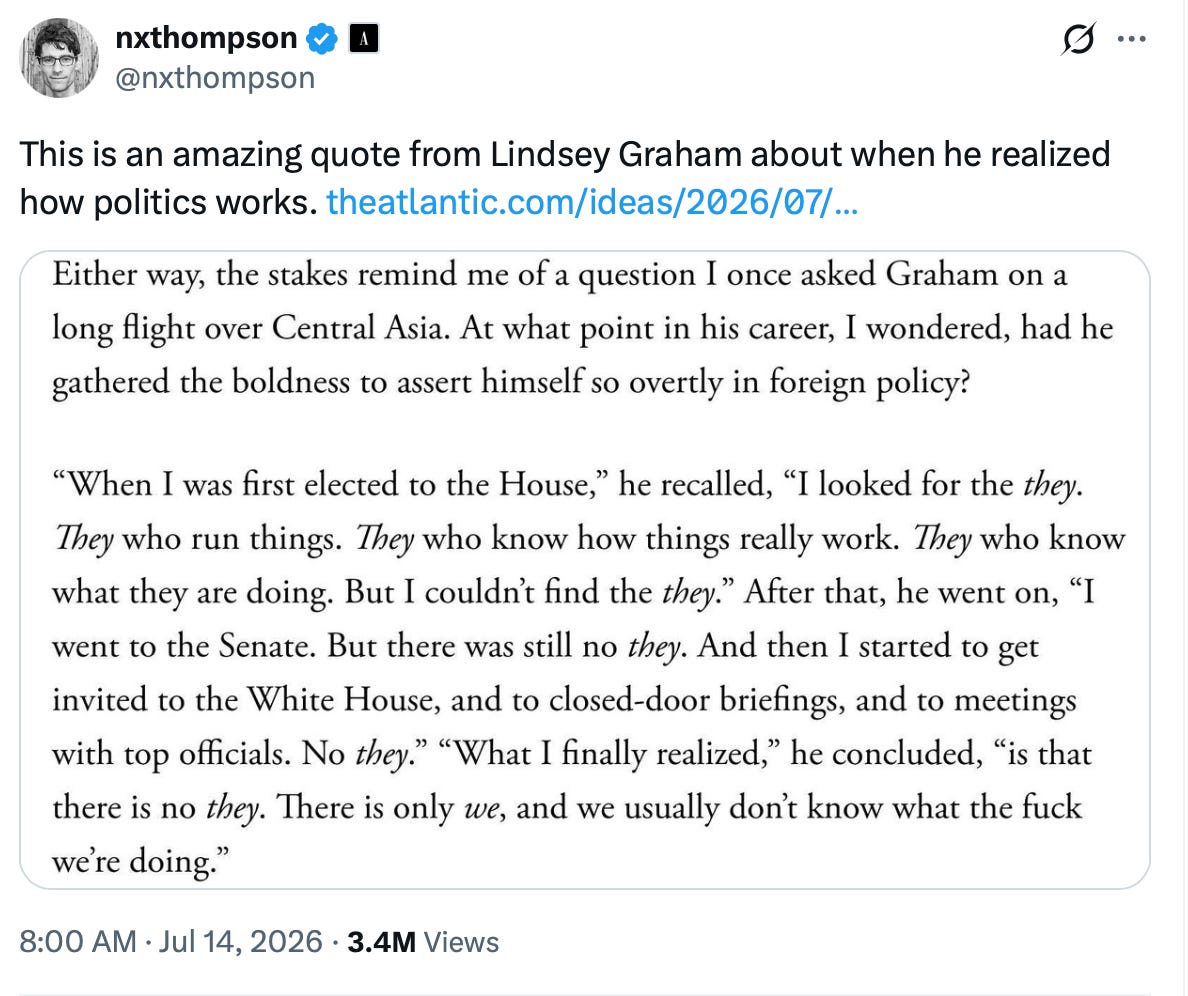
There is no “they” in a political movement. There is only you, and we. And yes, most of the time - no matter what the political stripe - there is a lot of adaptability, creativity, and courage required to set a forward path.
I choose to view this operating reality not as an indictment of the political process but rather as an invitation to build, and a reaffirmation that any Canadian conservative can (and should) just do helpful things.
Consider this a formal invitation to do the same, and a note of gratitude if you already are.
See you on the flip side, winner.
Share this post, it’s important.
Comments
Nothing yet. Say the first thing.
Sign in to join the conversation.