
In March, Prime Minister Mark Carney announced that after a decade of Liberal policy that allowed Canada’s military to atrophy, Canada has hit NATO’s two percent of GDP target for defence spending.
But that pronouncement has left many wondering how he reached that conclusion - especially given that the Canadian military is now living with the consequences of a decade of abject neglect by the Liberal government.
But that pronouncement has left a lot of people wondering how he had arrived at that conclusion, particularly as the Canadian military is experiencing the realities of a decade of abject neglect on the part of the Liberal government.
Understanding Canada’s defence spending and its persistent shortfalls is a complex, policy-heavy topic that rarely receives the attention it deserves. Yet with conflicts raging around the world and growing questions about where tax dollars are actually going, Canadians deserve a clear and straightforward breakdown of how defence spending is calculated, what it is truly being used for, and how it compares to previous governments.
How much are the federal Liberals actually spending on defence right now? Has Canada actually met its NATO defence spending commitments?
The Liberal’s spring economic update certainly didn’t provide any hard evidence that Canada has actually reached its two percent NATO defence spending commitment.
Nor did it provide any details on how that money would be spent.
But the reason why Mr. Carney made the mission accomplished claim that he did begins with the publication of this year’s NATO Secretary General’s annual report.
Buried within the tables is the figure that Canada supposedly spent about $63 billion on national defence in 2025. NATO uses an estimated total GDP figure for 2025 but based on that ($3.169 trillion CAD), $63 billion is approximately 2 percent.
The problem is that the $63 billion figure doesn’t match Canada’s own fiscal records.
Canada’s Estimates publications (this is where the government reports its expenditures to Parliament) shows that in 2025-26 spending at the Department of National Defence only reached about $47.8 billion (according to the Supplementary Estimates C). Not $63 billion.
So, what explains the discrepancy between Canada’s books and NATO’s?
Simply put, the answer is creative accounting.
Back in 2017 the government said in its defence policy that as a result of consultations with NATO, “future reporting will now include defence spending from other government departments”. This includes:
· payments made directly to veterans;
· peacekeeping and humanitarian operations;
· direct information technology support to defence;
· centrally funded defence personnel costs; and
· direct program support to defence.
Conservatives have had their eye on this definition-testing listing of expenditures for many years now. The Parliamentary Budget Officer first reported that this new calculation automatically added $7 billion to Canada’s defence spending overnight. Subsequent order paper questions filed by Conservative Shadow Minister for National Defence James Bezan had this figure rising to $10 billion (Q-359) and then $14.6 billion (Q-198).
Said differently, this means that 22 percent of Canada’s “defence” spending now comes from other government departments.
But isn’t it okay to count non-core military expenditures in Canada’s NATO defence targets? Other countries do it too, right?
Some may argue that funding from other government departments should count as defence spending. But experts say otherwise.
For example, at least $2.66 billion in the Coast Guard’s budget is now being counted towards Canada’s NATO defence spending target but Vice-Admiral Angus Topshee, Commander of the Royal Canadian Navy, has said “I don’t see any real reason to go through fundamentally changing the character of the coast guard and arming it.” In a similar vein, the commissioner of the Coast Guard Mario Pelletier told the Defence Committee last October that “Right now we’re not looking at defending, because we’re not looking at being in a theatre where there would be confrontation.” The government has confirmed that the Coast Guard “remains a civilian organization” (Q-199).
The government also refused to provide details on another $3 billion “for reasons of national security and operational integrity” (so much for government “open by default”).
It’s true that all NATO countries are now able to count typical “non-defence” spending for the purposes of their reporting. However, given the state of neglect that Canada’s military currently finds itself in, one has to wonder if Canada should be following suit. This is particularly true when the current global threat environment is considered. Not to mention the existential pressure being applied by the current American administration.
The fact is that many other NATO countries have responded to all these pressures by raising their NATO defence spending. Canada has not done the same. Even with Mr. Carney’s announcement and all that creative Liberal accounting, when compared to all NATO countries Canada is still tied for dead last for defence spending, alongside Albania, Belgium, and Spain.
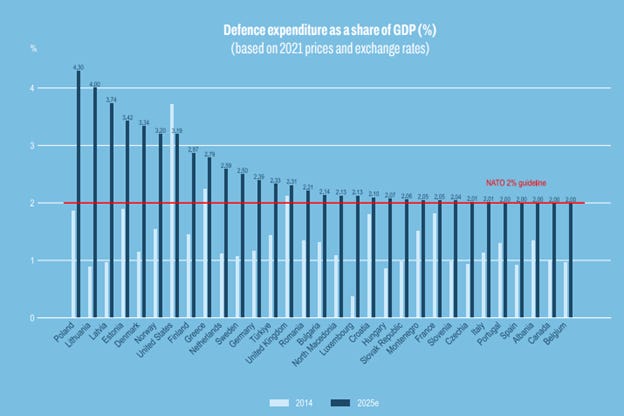
Source: Page 25, NATO Secretary General’s Annual Report (2025)
But wait, hasn’t every Canadian government since the 1980s failed to meet two percent defence spending?
The Liberals would like Canadians to think it’s an apples to oranges comparison, but it’s not.
That’s because in 2014, along with setting the two percent goal, NATO also revised its methodology for calculating each nation’s defence spending.
Using 2014’s defence spending (under the Harper government) as the baseline, if the $14 billion spent by other government departments (adjusted for inflation) were added to the official defence budget, it would rise from roughly $20 billion to $30.7 billion, or about 1.55% of Canada’s GDP.
Conversely, if $14 billion was subtracted from 2025’s defence spending (under the Liberal government), and using the same NATO measurement that the Harper government was subjected to, the Liberals would not be anywhere close to two percent, but rather about 1.52% of GDP, or less than what was being spent on NATO qualified categories over a decade ago.
In short, Canada has not come as far as Mr. Carney would have you believe.
But at least the Liberals are trying, right?
It depends “trying” is defined.
It’s important to recall the political climate regarding defence spending that the Liberals fostered during the former Conservative government. Former Liberal leader Michael Ignatieff regularly criticized former Prime Minister Stephen Harper for “prioritizing planes”, a blatant and ongoing politicization of military procurement that defence analyst Richard Shimooka has rightly described as a “catastrophe.” Liberals also at one point took extreme issue with the decision to purchase a fifth C-17 Globemaster strategic airlift craft.
In short, Liberals never would have supported Canada spending NATO’s two percent of GDP on defence during the Harper years. And, given their present-day creative accounting for what they’re considering to be a NATO defence contribution, it’s hard to make the case that they do now, either.
It’s also one thing to announce new projects and goals, but it is another to deliver. And when it comes to delivering the actual equipment and resources that Canada’s military needs, performative nonsense doesn’t outfit a soldier.
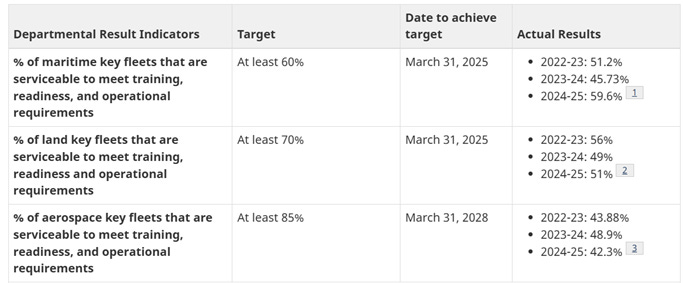
Case in point, over the past decade the Liberals have created all sorts of new government agencies, committees, and advisory groups that pertain to defence spending, but the actual readiness of our Armed Forces is still, putting it mildly, severely lacking. For example, DND’s Departmental Results Report shows that on average, only about half of our maritime, land, and aerospace key fleets are serviceable to meet training, readiness, and operational requirements:
The government’s Defence Industrial Strategy also states that they will soon “publish a framework for the identification and onboarding of select Canadian defence firms as key strategic partners”. With everything Canada knows about how Liberals direct taxpayer funds to firms they deem “friendly”, it does not take much imagination to see how this process, and the billions in spending behind it, will one day become subject of a chapter or two in an Auditor General’s report.
So, is Canada equipped to defend its interest in the era of modern day warfare?
Nope.
The world is a more dangerous place now than it’s been since the end of the Cold War. It is encouraging to see the Canadian public acknowledging this and saying as much to their elected representatives.
But while war never changes, how nations wage war is constantly changing. There are legitimate questions being raised as to whether the age of the aircraft carrier is over. It is also now obvious that using Patriot missiles that cost in the millions to shoot down drones that cost $20,000 (or less) is simply not sustainable. These are just a couple examples of how the future of warfare is evolving.
As part of our re-arming strategy, Canada must adapt to the new realities of drone warfare and artificial intelligence. We have a world-class tech sector that could be tapped into if given the proper incentives. But most of all we need a government that is both willing and capable to follow up on its announcements and deliver results for our Armed Forces…while ditching the creative accounting.
Contributed by Sean Phelan, Senior Policy Advisor to the Leader of the Official Opposition and former Director of Issues Management to the Hon. Rob Nicholson, Minister of National Defence (2014).
Follow him on X @ST_Phelan and check out some of his music on Bandcamp
Comments
Nothing yet. Say the first thing.
Sign in to join the conversation.