
Being unrecognized and especially not being identified with a particular style allows us to make the work that matters to us, irrespective of whether it would sell.
A quote from Sally Mann’s book, Art Work, On the Creative Life. This statement reminds me of my own artistic life and that I’m not beholden to anyone for the work I do in the studio. I paint what I want to paint, when I want to paint. I do have a style, but I am not recognized by anyone who will keep me from doing my own thing. I make work that matters to me, regardless of whether it is sellable.
I did not know of Sally Mann or her work prior to buying this book at a local bookstore. I was intrigued by the title, her photography throughout the book, and the reviews. Books about the interweaving of art and life are always on my radar.
Ms. Mann’s irreverent humor, her frankness about the art world, and how artists choose to maneuver it, or not, was an easy connection for me. She talks about questioning her value as an artist and always wondering whether her work was/is good enough.
Many artists/creatives I have come across, myself included, have asked this question at one time or another: Why do we do this? Why do we torture ourselves when what we are and what we do is devalued or relegated to the leisure category of life? Why are we shoved into specific art world silos that are unsustainable and unrealistic? Why is success tied to selling? Is any of it worth our time and energy?
Most artists I know and admire are not robots that can be manipulated to fit a certain stereotype. They consider art their means of survival. Our love of art as a means of expressing or revealing truths is stronger than any external threats of uniformity or societal assumptions.
This is not to say we do not occasionally bow to the gods of marketing and the business of art in order to pay the bills and provide a living for ourselves and others in our sphere. Taking on jobs that don’t compromise our artmaking is a gift if we can manage it.
I often imagine a world in which more people are able to take advantage of opportunities that require finding solutions through creating a life that does not involve selling our souls. We have all either experienced or seen people suffer through the vicious cycle of work, with no time for family, friends, or passionate endeavors. This issue is not just about artists.
My daughter has been through hell in her young life as addiction took hold of her, keeping her captive for about ten years. Since removing drugs and alcohol from her life, she wants little to do with the capitalism and greed that have greeted her. She has witnessed what our society has done to people like her and a majority of the population.
My daughter has also been asking a lot of whys. Once out of her addiction fog, she was gobsmacked by the reality of why she went dark in the first place. The unrealistic expectations of a white girl living in a homogeneous Midwest town who was marked as having it all, but secretly feeling unsupported, unseen, and underestimated. She was bullied in a way that seemed harmless, harassed in a way that was considered normal, and underestimated because she was female, pretty, and Midwest-friendly.
And although the grass is not greener on the other side, what eventually saved her, and me, was moving away from the constraints of normalcy in the place where we grew up. There is a time when one must move on to gain new perspectives, experience the unfamiliar, seek unknown adventures, and struggle with what is uncomfortable in order to find ourselves.
Artists do this every day because we are uniquely attuned to the perpetual changes in our environment, and our job is to adjust creatively.
As I have witnessed my daughter make her way from addiction to recovery, she has taught me more than I could have ever imagined. This is what our children do: they reveal to us what is real, what is important, what we need to pay attention to, and what we may have forgotten over the years. They remind us that if we’re not careful, we will fall behind and into the trap of ambivalence.
This is also how artists take on the world. We ask the whys, we question the status quo, we resist what passes for normal.
My daughter has reminded me over and over again why creating is part of my persona, my DNA. It is how I make sense of the world, even when it is not immediately clear. Eventually, because all good things take time, the clarity will come, and my soul will be rejuvenated for another go-around.
I only hope that my daughter’s questioning and curious mind will take her places that give her hope, value, and purpose. She has never considered herself an artist, but she most certainly is. Being an artist is about turning convention on its head and approaching problems from different angles.
My daughter understands this manner of being quite well, especially when she was in her addiction. In her teenage years, she struggled, and most people around did not see her, I mean, REALLY see her. She was denied the respect, love, and compassion she needed to feel supported. It was worse when her addiction was revealed. Few people knew what to say, felt uncomfortable, and saw her as flawed or a failure. Others would simply respond with unsolicited advice or question how she could be addicted, especially as someone who appeared to have everything going for her.
She was forced to find ways to exist and survive beyond society’s preconceptions and criticisms.
It’s infuriating, just as living as an artist has provoked spoken and unspoken criticism. Not being taken seriously or valued for the contributions creatives make to society sparks the fire and rage I feel deep in my soul. Luckily, that rage is channeled through my work, well, most of the time. Those of you who are creatives know what I’m talking about. Our passion for what we do most often outweighs any criticism, even when we feel like giving up.
Doing the work, retaining that passion with tenacity, and, hopefully, negating the judgmental critics who bark from the sidelines is how we maintain our authenticity. This is not just for the artists in the crowd.
I count myself lucky to have creatives and my daughter as partners in this quest.
I highly recommend Sally Mann’s book: Art Work: On the Creative Life
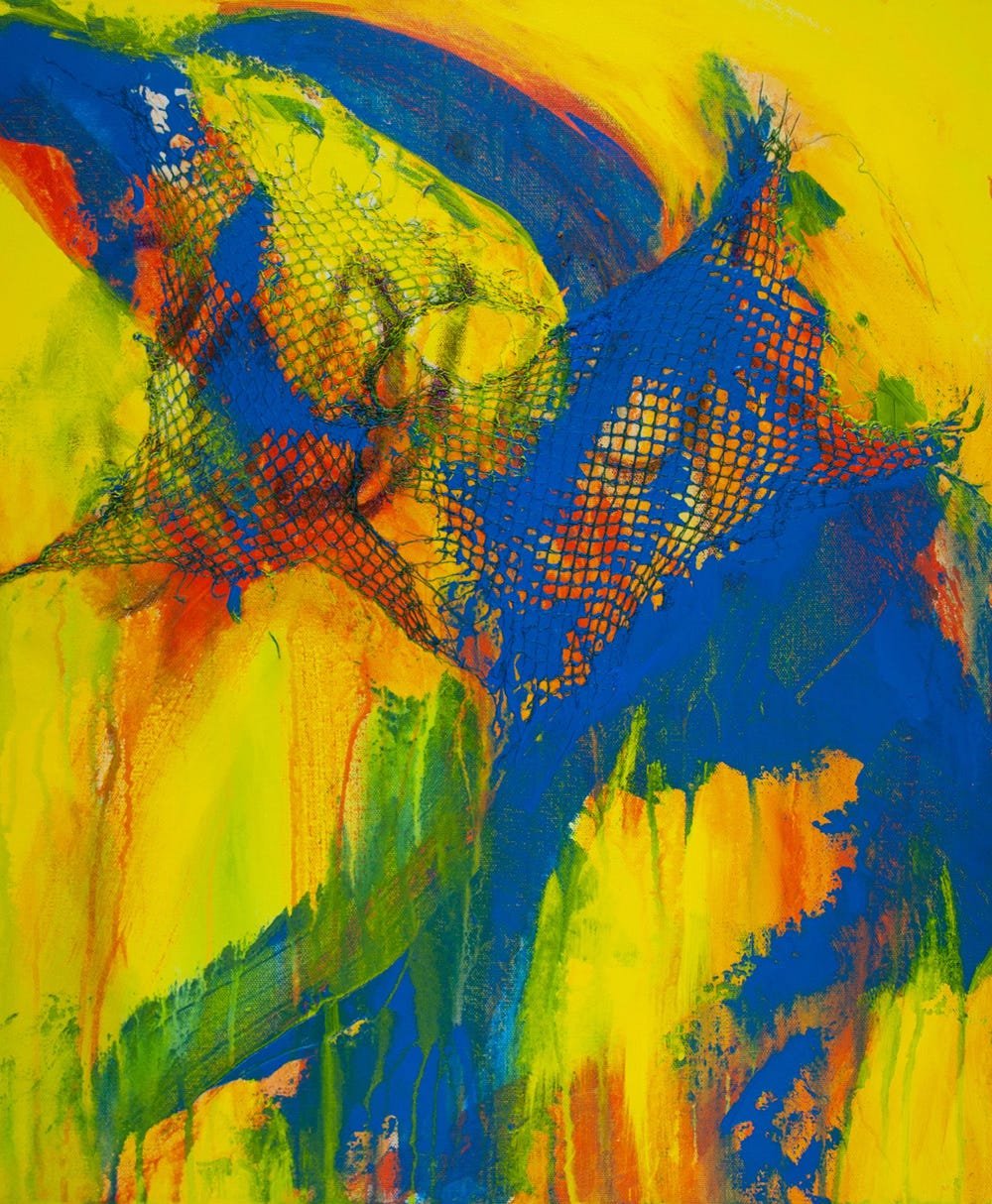
Image: Resist, mixed media on canvas. This work began with the word prompt “Resist.” I used actual mesh material, which I realized could represent a sense of restriction. My energetic, thrusting marks seemed to break through that cage, releasing what turned out to be an abstracted figurative or winged image. The colors are intense, emphasizing the act of resistance.
Michelle
I have a favor to ask: please read, like, share, and/or comment on my posts through the Substack app. This helps the algorithm send my stories further, connecting me with new readers not on my email list.
Thanks for reading M. Lindblom - An Artist's Journey! This post is public so feel free to share it.
Comments
Nothing yet. Say the first thing.
Sign in to join the conversation.