
As I do when I travel, I learned some Slovene before visiting Slovenia. After my discovery in Japan of the most important word to know when traveling, I even went to the trouble of learning the Slovene word for delicious: okusno, according to Google Translate.
The word I failed to learn was abundance.
Which, it turns out, is a word Slovenia taught me to understand in a way I never had before.
When I told you about Slovenia’s the car train in my last Substack article, I failed to mention, for reasons that will soon become obvious, the moment of collective inhale from our car as we were tugged through the Julian Alps and caught sight of a waterfall across the valley.
“Beautiful!” we cheered.
And then we turned our attention to the upcoming farm to see if the farmers, like apparently Slovenians everywhere, had a beehive.
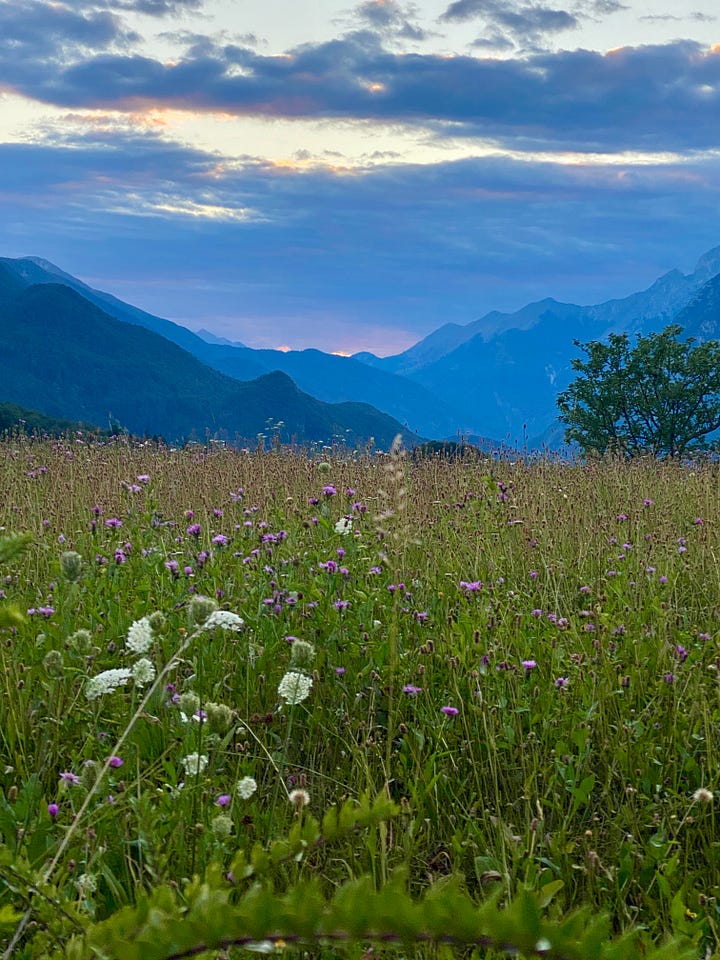
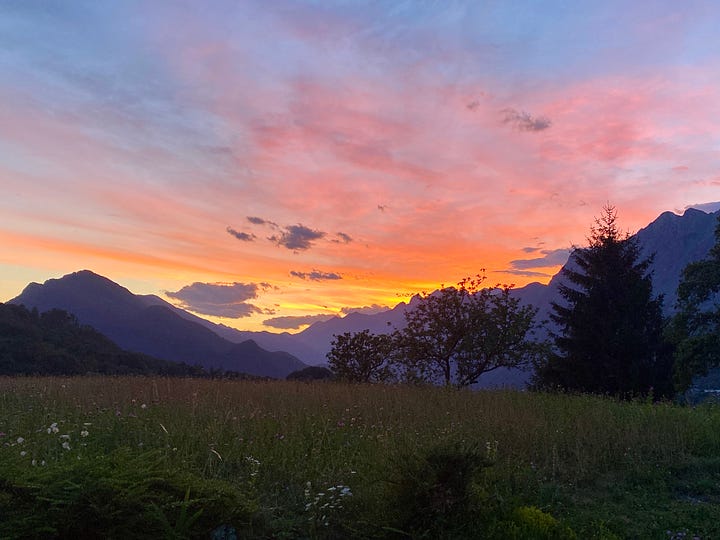
That remembered glimpse of waterfall was quickly overshadowed as we pulled up to our little cottage. We’d rented it for its proximity to the Soča River, where we planned to kayak, swim, and generally cavort, so we were struck dumb by the non-water beauty of our new environs (photos below).
Well, that’s not strictly true. Eventually, we did go wandering through the fields to a stand of trees and discovered that the rushing, burbling sound was indeed a river, far below us.
But for that moment, as we turned slowly to drink in the fields of wildflowers, the lines of lavender humming with bees, the surround-sound mountain peaks, and…was that a church in the distance? We heard the answer drifting toward us.
Church bells.
Drifting from blossom to blossom.
You’ll forgive me when I tell you I was probably not the greatest Airbnb guest in that moment, because I did not want to come inside and learn about the induction range.
No. I wanted to be left to float, fairy-like, like those bells, from blossom to blossom.
Luckily, I heard our hosts talking about welcome drinks and perked right up to took my place in the lineup.
They had three kinds of home-infused spirits: one steeped with gentian (funnily enough, a clue in my soon-to-launch cozy mystery, Unearthed in Aramezzo), one with mountain herbs, one with chamomile.
Our hosts raised one eyebrow when I accepted a glass of mountain herb spirit rather than waiting for them to uncork the flowery one.
Then they raised both eyebrows when talk turned to how we could tune into the US-Belgium World Cup game and I mentioned I’d be waking up at 2:00 to watch.
Yes, I nodded. I drink the strong spirits and I watch the football.
We all laughed, the sound drifting from one American to a Slovenian, to another Slovenian, to another American. Connecting us all in a moment of shared mirth, shared experience.
Also, those spirits were pretty strong.
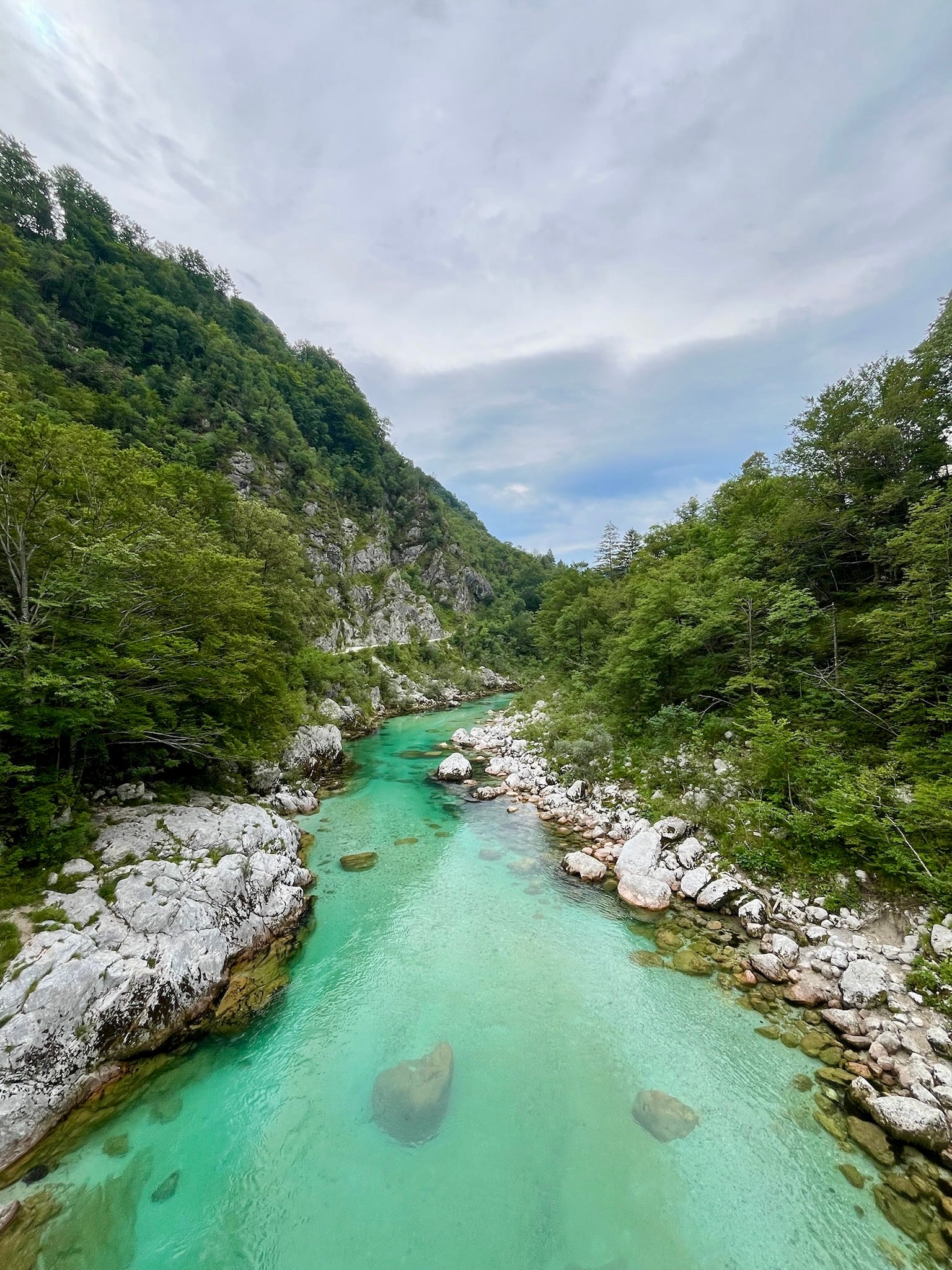
The next day we ventured out for our kayaking trip, our drive taking us past a river so blue that the water looked like a cartoon version of the Caribbean.
I shook my head.
If I didn’t know better, I said, I’d think Slovenians came out at night and dropped blue food coloring in the water.
Once outfitted for our trip, we tumbled into a van with our guide, who pointed out the mountain that separated us from Italy.
Funny that we were so close to this country I now have citizenship, but seemed a world away.
Did the wildflowers end at the border?
A weird and irrational thought, but it turned out a few days later that I’d find the answer was yes. In fact, the wildflowers also seemed to end at the Croatian border.
This neck of the woods—or perhaps, more accurately, this neck of the Adriatic—may share much culturally, historically, and even culinarily—honey, for instance, is a rich commodity at all these borders. But perhaps only Slovenia has made such an effort to protect the wildflowers that sustain its bees. Or at least enacted the laws to force that preservation.
In any case, the following can be explained because I had wildflowers and honey on my mind, or perhaps because our guide told us that our kayak trip would take us past the place where The Chronicles of Narnia: Prince Caspian was filmed (the Soča Valley stood in for the Fords of Beruna in the film), and my favorite Narnia story is The Voyage of the Dawn Treader, when Reepicheep the mouse searches for the end of the earth because of a song a dryad once sang him:
“Where sky and water meet,
Where the waves grow sweet,
Doubt not, Reepicheep,
To find all you seek,
There is the utter East.”
Well, those film producers might have lucked into filming in actual Narnia.
Because I discovered from my kayak that the water of the Soča Valley is sweet.
Literally, sweet.
Our guide caught me slurping up handfuls, unbelieving of what I was tasting, and laughed as he told our gang of four that the water was incredibly clean and, yes, could be sipped.
Or gulped, as I decided I preferred.
As we kayaked through rapids—yes, Class I and II rapids, but rapids all the same—and glided past mountains, I couldn’t shake the feeling that we’d stepped through some closet door and wound up in a land where abundance is ordinary and even the water is honeyed.
Our guide pointed out one waterfall after another.
Slap, they’re called in Slovenia.
Because of course they are.
We decided to hike to a slap the following day, needing to spend more time rubbing shoulders with that mystically blue Soča River.
As we hiked, we noted fantastical wildflowers, twisted tree limbs, and water so incredibly clear that from a cliffside high above the river we spotted trout swimming along the riverbed.
I shook my head.
Narnia.
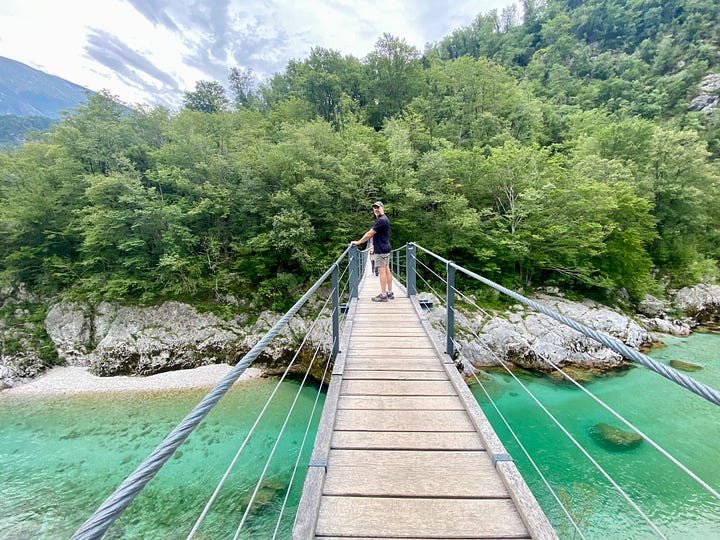
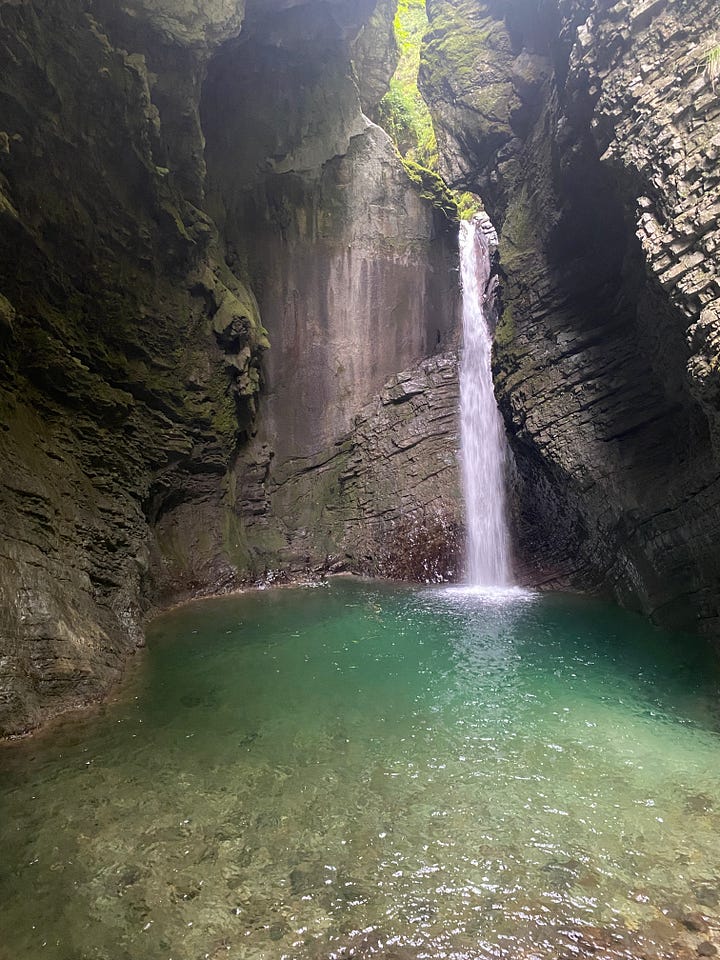
At the end of the hike, we climbed stone steps, crossed boardwalks out of a Disney movie, skirted a sudden shallowing of the water to a bare blue ribbon over white rocks, and arrived at Kozjak Waterfall, or known to locals, Church Falls.
There are all kinds of good architectural or geological reasons to call this cave a church, but to my mind, it’s a church because it just plain feels hushed and holy.
The water tumbles into a cave-like chamber surrounded by emerald water. The light shifted, quickened, paused.
And then we learned its history was even stranger. You see, during periods when authorities cracked down on goat grazing, local families hid their goats behind the waterfall. The name eventually became Kozjak—roughly, Goat Falls.
We returned to our cottage tucked into wildflowers, and that night after dinner we uncorked more spirits and sat outside as the sky put on the most ridiculous display of reds and oranges.
Just when we thought it couldn’t get any more vivid and surreal, our hosts pulled up to offer us warm štruklji.
Štruklji are Slovenian dumplings made from rolled dough and filled with sweet or savory fillings. There are dozens of variations, and these were more like dumplings in the potsticker sense than the cinnamon-roll shape I’d seen elsewhere.
We played cards by candlelight, savoring every bite, wondering what was in these glorious treats.
Brown sugar and apples and maybe walnuts and raisins?
Plus something else.
I fell asleep that night dreaming of Aslan the Lion splashing in a slap.
The next morning, our friend got up early to go for a run.
Over breakfast, he said that before we headed out for lunch in Trieste followed by a couple of days in what we called O-town because we could never remember the Croatian name—Opatija, thanks Google Maps—we needed to see what he found beyond the church, beyond the little school.
Why had it never occurred to me that children would be going to school here?
I pictured them, all like Heidi mixed with the Pevensie children, braided and radiant.
We packed up reluctantly and then nosed our car through town, to the end of the road.
I looked up at a sign cluttered with arrows directing hikers to one slap after another.
Can you imagine?
Bare days before, we’d been flabbergasted at the sight of one waterfall across the valley.
And here we were at an intersection that would direct us to so many, they blurred together: drops of radiance drifting from one tumbling fall to another.
Had this been here the whole time?
What else had we missed?
It seemed that Slovenia was full of looking glasses to wander through, to discover, breathe in, and be rocked back on our heels.
I will need to go back, to rap against the back of the closet, to see if I’ll once again fall into a fairyland of abundance.
PS: If you’ve ever wondered how I seem to stumble on staying travel moments like raking olives for Italian harvests and falling into Narnia, The Traveler’s Guidebook is my attempt to answer that question. It’s my thank-you gift to paid subscribers, a way to teach a more intentional, vibrant, meaningful way to move through the world.
Comments
Nothing yet. Say the first thing.
Sign in to join the conversation.