
“This is no time for a child to be born,
With the earth betrayed by war & hate …
Yet Love still takes the risk of birth.”
— Madeleine L’Engle, “The Risk of Birth, Christmas” (1973)
Ever since we learned that we were pregnant, we’ve been deep in thought about how to explain this world to Ada in a way that protects her innocence without hiding the truth. Ada’s almost five, now. And we still struggle to explain the harsh reality that she’s inherited.
It’s easier to ignore the broken promises we’ve accepted when there’s no one left to introduce them to. But when you become a parent, you have to translate every contradiction as if it’s your first time thinking through the dissonance.
When we drive to school in the morning, Ada and I see an unhoused man standing in the median, holding up a sign and asking for spare change. Sometimes I have cash to give him. Sometimes I don’t. But every day, he’s standing on the median.
I still remember the first conversations we had about him—
“Daddy, why is that man standing in the middle of the road? Is he lost?”
“No, he’s standing there because needs money for food, water, and maybe somewhere to stay for the night.”
“Why he doesn’t he go lay down in his bed?”
“He might not have one.”
“Shouldn’t everyone have a bed?”
“They should. But not everyone has the things that they should have.”
“Why not?”
Ada has asked me this question in many different ways, many different times. But none of my responses have felt sufficient.
Why doesn’t everyone have a bed?Explaining capitalism and oppression to a four-year-old is even harder than it sounds.
Some days, I find myself wishing for a more adultier adult—someone who could explain things like this to me, too. Because the questions don’t stop. And the more questions that my daughter asks, the more I find myself questioning everything with her.
Is he going to be ok?
Why can’t he come home with us?
Are there other people who don’t have beds?
Is God going to help them?
Ada asks me a lot of questions that I don’t know how to answer. Sometimes I don’t know how to answer because I genuinely don’t know what the answer is. But other times, I struggle to think of a response that is honest without chipping away at the sense of hope and optimism that I want my four-year-old daughter to have, even if it’s just for a bit longer.
This world will reveal its painful truths to her in due time. But in the meantime, I want her to savor the peace that comes with not knowing what she doesn’t know.
That choice comes with a cost.
If I protect her from the reality of that man on the median—if I keep her believing that everyone has what they need, that God is watching, that things will work out for the good—then I’m raising a daughter who will one day wake up in a world she doesn’t understand. Who will be blindsided by cruelty. Who won’t have the language or the framework to recognize injustice when she sees it.
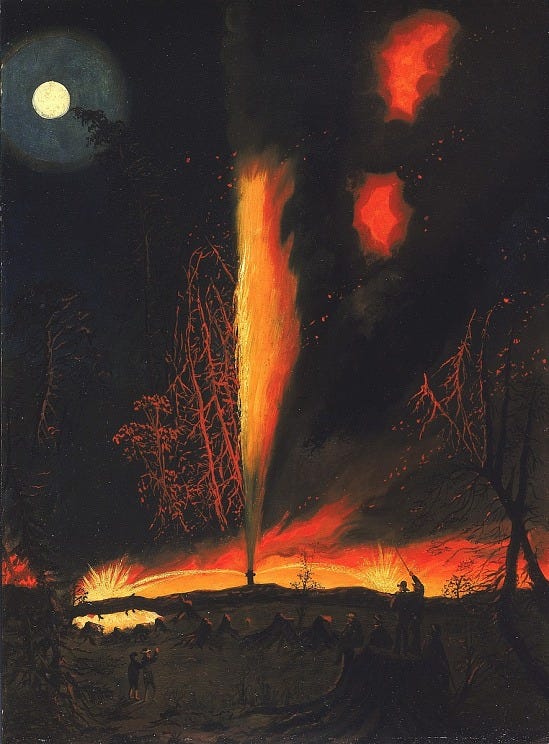
But if I tell her the truth right now—if I explain that the systems are rigged, that God might not be coming to save anyone, that the world is burning and we’re all just trying to survive it—I rob her of the thing I’m desperate to give her.
That small, fleeting sense of peace.
The sense that there’s still goodness worth believing in.
My daughter doesn’t know that the world is burning. And that’s the way it should be. But I don’t know how to prepare her for the moment when she realizes how long I’ve known. How long I’ve been lying by omission. How long I’ve been choosing her happiness over her readiness.
Maybe I’m naive to think that sustaining her innocence is serving her.
Or maybe I’m cruel to think that stripping it away would serve her better.
Ada thinks I have all the answers, but I’m figuring everything out in real time just like her. When she asks me about the man on the median, she asks with the expectation that I’ll be able to make everything make sense in less than ten seconds.
Her faith—and with it, her hope—must be built on the reality she’s inherited, not on a lie that makes me feel better in the moment. She can’t rely on myths that promise the world will be gentle with her.
But myths are exactly what I’ve been handing her. I’ve just been calling them faith. They aren’t the same inheritance.
A myth tells her that rescue is on the way, so she’s free to look out the window and wait. The faith I was raised in told me something heavier. It told me that rescue arrives through people—that the help would always have hands. And that someday, some of those hands would need to be mine.
I forgot where I learned that. I had to write this essay to remember.
When Ada and I talk about the man on the median, I feel like the first parent in my family to ever face this dilemma. But that feeling is its own lie of omission — one I’ve been telling myself, this time, about the two people who raised me.
My parents raised two Black boys in America. They did not have the luxury of debating whether the truth would cost us some happiness. In their world, unreadiness could cost us our lives.
And here’s what I keep forgetting: they never actually hid the fire from me.
The evening news played in our living room every single night. My parents watched ABC-7 faithfully. 6PM, every night. When the broadcast showed war, famine, funerals, and everything else this world produces, there was no algorithm to lighten the mood. Nobody changed the channel. Nobody sent me out of the room.
My parents couldn’t control my exposure to the burning world. Nobody could. So they controlled the one thing they could: my company while I watched it.
I never watched the world burning alone. My brother and I watched it from a plaid couch, sharing a room with two people who had survived more of the fire than they ever fully explained—my father, raised by sharecroppers in the South, who became an officer in the United States Army; my mother, who graduated from high school at sixteen to escape Chicago and take control of her fate.
They didn’t narrate every horror. They didn’t have a syllabus to shape my experience. They simply refused to let the world introduce itself to me while I was by myself.
Church taught the same lesson in a different environment. When somebody in our congregation lost a spouse, or a job, or a child, their grief echoed throughout the sanctuary. I learned that suffering was real because suffering sat beside me on Sunday mornings. And I learned that suffering could be survived because I watched a room full of people refuse to let anyone carry it alone.
Their answer to my question had a name I didn’t learn until I became a father myself: presence.
But their answer also came with a gospel of its own—the one delivered in four words that nearly every Black child of my generation received in some form: twice as good. My parents loved me with the intentionality and the fear that was inevitable for people who knew exactly how this country greets Black boys. Readiness was their love language, and I’m alive partly because they spoke it fluently.
I received their wisdom.
I also received the weight of their understanding.
Their preparation kept me safe. It also taught me to move through the world braced for impact.
I learned to be excellent not as an act of joy, but as an act of survival.
And now, twenty years later, I catch myself teaching Ada to do the same thing—to perform readiness before she’s learned to play.
So no, I can’t hand Ada everything they handed me. But I don’t have to.
Honoring the past doesn’t require being constrained by it. We can build on the foundation we were given while renovating what no longer serves.
I’m keeping the company. I’m releasing the pressure.
Ada will know that this world is unfair. Ada will also grow up free of the belief that she has to be twice as good to deserve her place in it. Both of those sentences can be true in the same house.
My parents bent their generation’s arc as far as their arms could bend it. This is me, hoisting my daughter onto my shoulders the way they hoisted me onto theirs—so she can see further, and carry less.
I hold this part of Ada’s inheritance with more care than any other, because the word itself is contested ground.
The loudest voices saying “God” in this country right now are using that name to sanctify the same fires I’m trying to explain to my daughter. She’s going to grow up hearing God invoked by people who would step over the man on the median to get to the microphone.
So before I can teach her anything, I must separate the God I keep hearing about from the God I actually met.
The God I keep hearing about in the news is a God of judgment, of borders, of blessing privileged people and abandoning the oppressed.
The God I actually met in my parents’ living room and in the third pew was something completely different: a God who never asked me to earn my place, but simply refused to let me face the burning world alone.
And underneath all the noise, there is one thing the third pew taught me that I have never been able to shake:
Every time I saw God show up, God showed up looking like somebody.
God looked like ushers steadying the elders on the way to their seats. God looked like deacons hauling folding chairs, like covered dishes appearing on the porches of grieving families, like my mother filling our whole house with the smell of Sunday dinner while Donnie McClurkin played. When the widow wept in the second row, the help that arrived came up the aisle in low heels and sat down beside her.
The help always had hands. The help had a car, a casserole dish, and a free Tuesday evening.
I don’t know how to explain the Trinity to a four-year-old. But I can explain that.
So the next time Ada and I drive past the man on the median, and she asks me: “is God going to help them?” I finally have an answer that is honest in both directions—one that doesn’t chip away at her hope, and doesn’t set her up to be blindsided:
“I think so. God’s help almost always looks like people. Sometimes it looks like us.”
I am deeply thankful for your support. If my words have helped you in some way, please consider sharing them with others. If you have the means to do so, you could also support my work directly by buying me a coffee.
Comments
Nothing yet. Say the first thing.
Sign in to join the conversation.