

“Rage is not a tantrum. It is data. It is grief with nowhere to go. It is the sound that our spirits make when we are finally honest about what hurts, and why.”
I don't like most of my writing from 2024 right now.
It's not because of the words I used, nor is it because those words came from a dishonest space—it’s because my quest for peace made people think that I am incapable of war. People read my reflections on healing and assume that I don't carry rage in my bones.
Here's what they don't understand: my healing hasn't pacified me. It hasn't taught me to look away. Healing has compelled me to look closer. Healing has prompted me to make more space for other people's pain. Healing has helped me to see the world for what it is—in other words, healing has radicalized me.
I wasn't always like this—I grew up in a home where public displays of anger were reserved for authority figures, not children. When I felt angry, I treated it like a dirty little secret. I buried it in the dark recesses of my mind, never to be acknowledged or discussed. I tried to convince myself that it didn't exist. I didn't know how to release it safely, so I let it fester.
And even when it was impossible to ignore, I refused to call it by its name.
I'd convince myself:
"You're just tired."
"You're just having a bad day."
Even as I grew older, I was afraid to hold space for my own anger because of how it had been wielded against me.
I'm 35 years old, now. I've been an adult for almost half of my life—and to this day, I still wield my own anger with caution. I know my power. I know my capabilities. And I know that my anger is a fiery emotion that will burn me before it singes the hairs on anybody else's neck.
But I've learned that my relationship with anger mirrors our collective resistance to acknowledging it. Just as I was taught to fear and suppress my own fire, we've been collectively conditioned to see anger as inherently destructive rather than potentially transformative.
Fire is a dangerous, destructive force of nature. If you saw it with no context, but felt its heat and watched it incinerate everything in its path, you might question its necessity. You might not even begin to consider its purpose.
Before you zoom out, it's hard to look at fire as anything but a threat. But it has a purpose. When you take a step back, the role of fire in natural ecosystems becomes clear.
Without fire, dead vegetation chokes out new growth. Invasive species destroy native ecosystems.
Without fire, nutrients never get recycled back into the soil where they're needed most.
Without fire, what should be a thriving ecosystem becomes stagnant, overgrown, and vulnerable to the devastation that is inevitable when forces of nature are suppressed for too long.
Anger is fire. And just like fire, anger is a dangerous force of nature—but follow-up questions are necessary:
Dangerous to who?
Dangerous to what?
In a world where innocent people are massacred, the ultra-wealthy prey on the most vulnerable, and basic human dignity is treated as a luxury, anger is justified. And it should be dangerous—dangerous to the people who create and benefit from this world's inequities. Dangerous to the systems that uphold these inequities.
When I encounter people who question my right to be angry, I wonder if we're inhabiting the same world. When people tell me that I need to heal because I’m frustrated with the way this world functions, I realize that we define healing differently.
It didn't have to be like this. We didn't need the world to turn into this.
Nobody needed a world where colonialism and capitalism are the dominant forces shaping billions of people's lives. Nobody needed a world where we're too numb for connection, too exhausted for empathy, and too overwhelmed for nuance.
And yet, here we are.
This is the world that we are surviving—which begs the question: what are we going to do about it?
For too long, I bought into the false choice between healing and fighting. I thought I had to choose between inner peace and outer resistance, between self-care and system change.
But that binary thinking is part of the problem—it keeps us fragmented when we need to be whole. It keeps us choosing between tending our wounds and wielding our power, when the truth is...we need both.
We need to heal, not so we can retreat from the world's pain, but so we can engage with it more fully. We need to get strong enough to stay angry without being consumed by it.
I believe that healing is the prerequisite to the awareness and capacity required for collective action. Real healing doesn't numb us to injustice—it makes us strong enough to face it without breaking. It teaches us to channel our rage into precision rather than destruction. It helps us sustain ourselves for the long fight ahead.
My anger is no longer a secret I bury or a fire I fear. It is data. It's a compass that points toward what must change. It's the energy that moves me from witnessing injustice to confronting it, from feeling overwhelmed to taking action, from whispering quietly to screaming out loud. It's what compels me to write words that might wake someone else up.
This is what I want people to understand when they read my work: I'm not writing from a place of unhealed trauma. I'm writing from a place of healing that has brought clarity. The difference is that my healing journey has taught me to see clearly enough to be appropriately outraged—at systems that prioritize profit over human dignity, and at structures that pit oppressed peoples against each other instead of against oppression itself.
We need more people willing to feel the full weight of this moment. We need collective anger that leads to collective action such as mutual aid networks, community organizing, and direct action. We need healing practices that prepare us for resistance, not resignation.
I don't want wellness practices that teach me to be at peace with an inequitable world. I need practices that help me to stay sane while doing my part to fight against the inequities. If it makes you compliant to injustice, it's not healing—it's sedation.
It's meditation that builds my capacity to witness suffering without turning away. It's therapy that helps me untangle my personal wounds from systemic ones so I can respond strategically instead of reactively. It's community care that sustains me for long-term resistance instead of burning out in a blaze of self-righteous fury.
The world doesn't need more people who've learned to pretend that everything is okay.
It needs warriors who've learned to transform their pain into power, their rage into resistance, and their healing into fuel for the change that we desperately need.
That's the kind of healing I'm interested in.
That's the kind of peace I'm fighting for.
I am deeply thankful for your support. If my words have helped you in some way, please consider sharing them with others. If you have the means to do so, you could also support my work directly by buying me a coffee.
I’m Michell—I’m a 35-year-old father, husband, and writer.
Starting in August, I’m launching a workshop series called EMBODIED AUTHENTICITY: Creating With Purpose In A Distracted World.
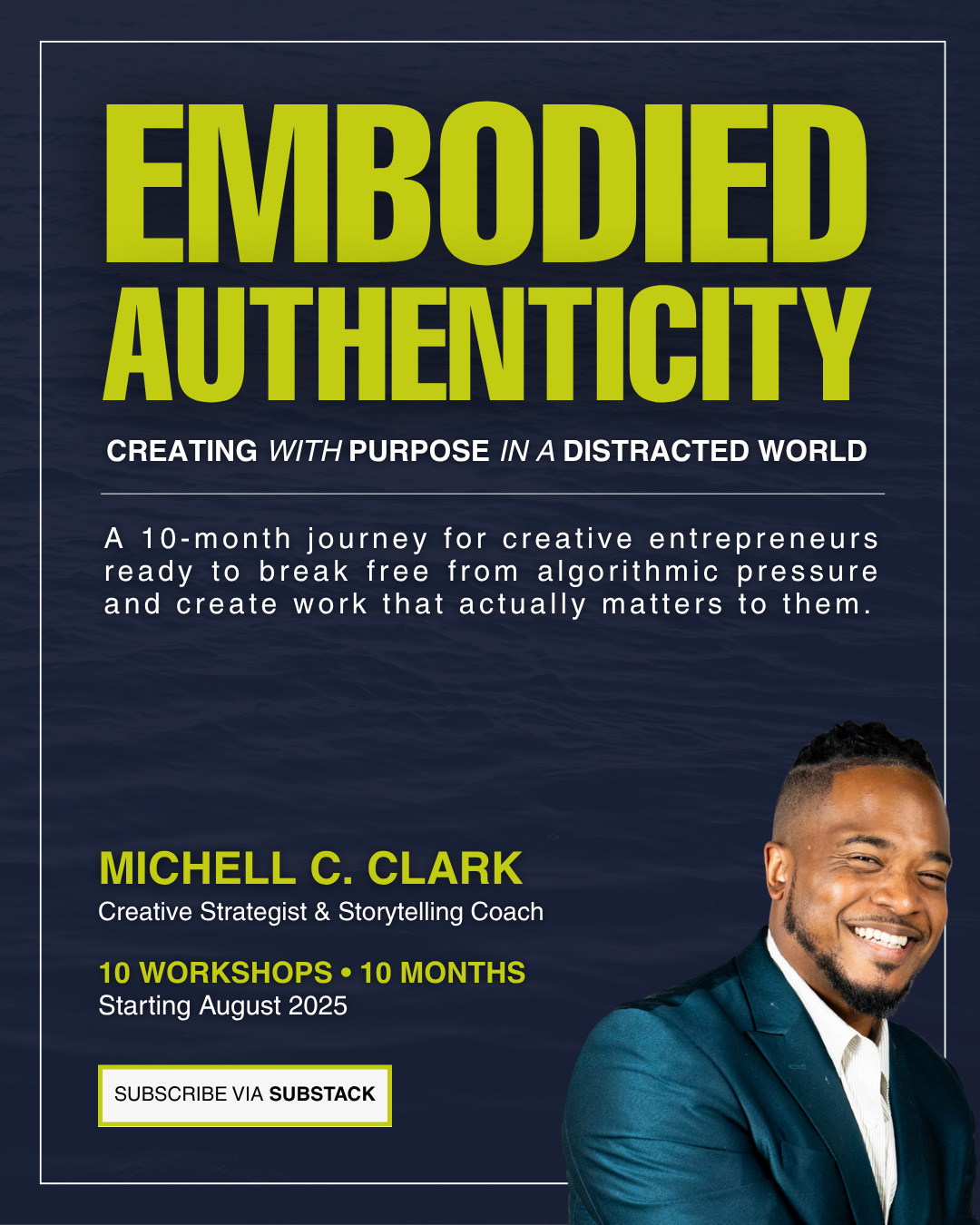
It is the culmination of what I've learned through my own healing journey, 10+ years of creating content, and a lifetime leveraging my personal struggles as fuel.
Each monthly session builds upon the previous, moving participants from understanding their authentic voice to embodying it across platforms, transforming their personal experiences into purposeful creative work, and establishing sustainable creative rhythms that honor their natural cycles.
Paid subscribers will get an invite to the live workshop every month, and access to the replay. The price is $7/month, or $60/year.
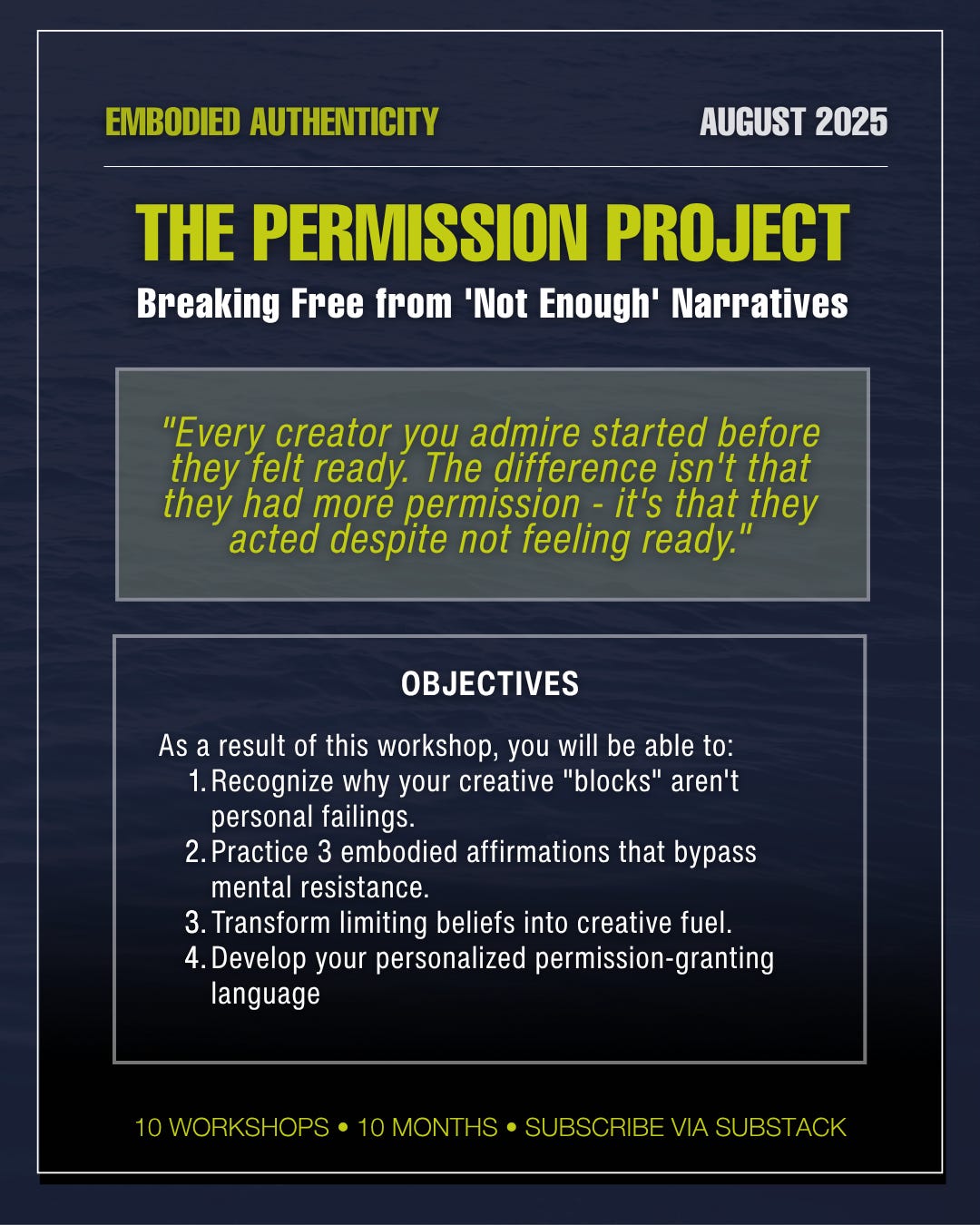
Our first workshop, The Permission Project, will hone in on tactics and habits that equip you to untether yourself from the voice in your head that whispers: “I’m not good enough.”
Why am I launching this workshop series on Substack?
Because I want to use what I’ve experienced, learned, and built to help other people.
Because I want to make my career as a writer more sustainable without putting my words behind a paywall.
Because I want to be able to make money while making my teachings accessible to as many people as possible.
If this work speaks to you, I'd love to have you along for this journey. Early subscribers (before August) will help shape how the workshop unfolds.
Comments
Nothing yet. Say the first thing.
Sign in to join the conversation.