
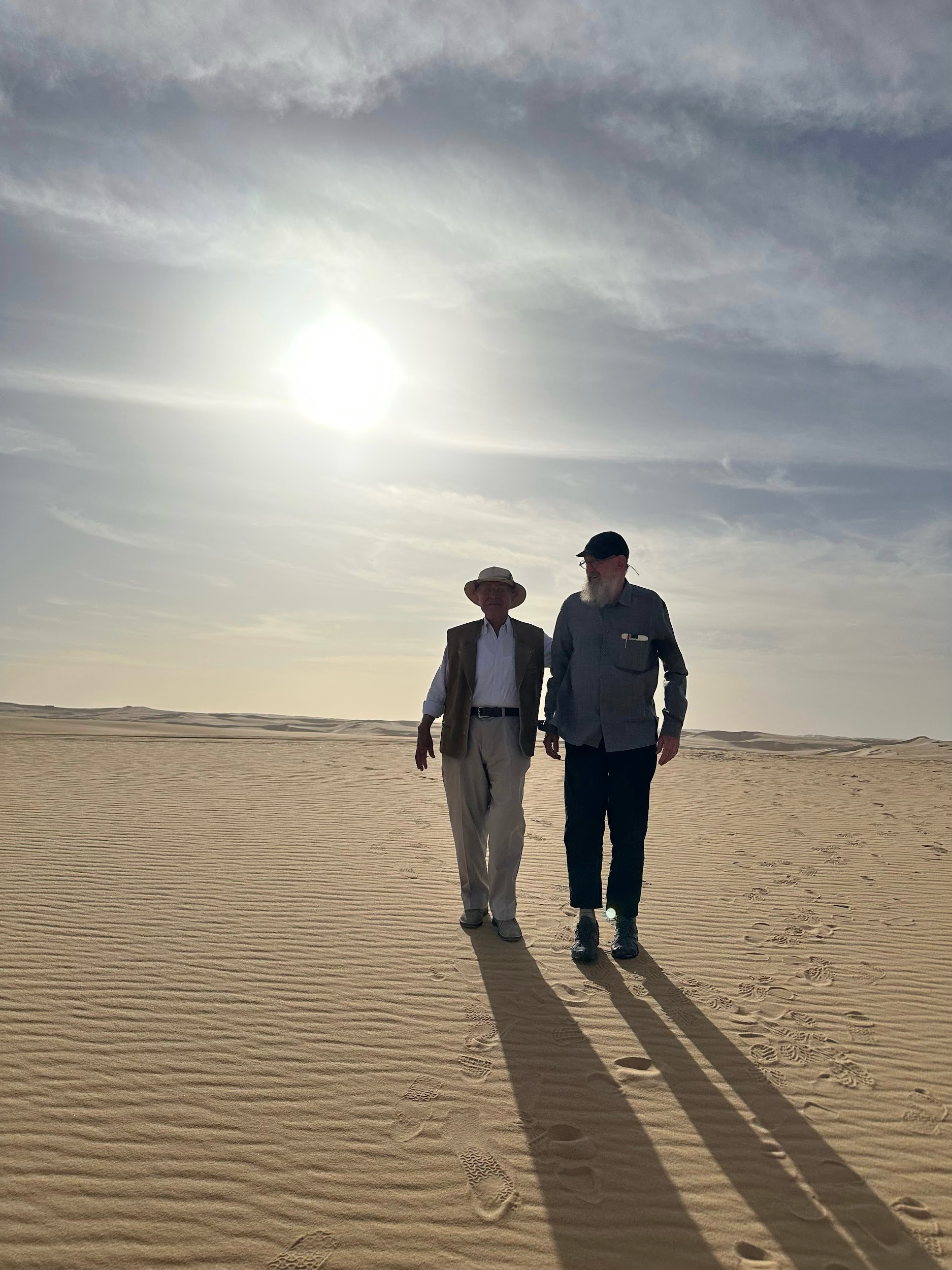
I had never considered the desert. Never even imagined it as a possible setting for my projects, as a place fit for any building, any architecture. The desert is desert: there is no life in the desert, it is not a place where plants, animals or people grow. It is desert, and in the desert nothing grows, not even ideas. Not true at all! How much light in the sun of the desert! How many illusions and how many revelations! They go forward together, deceptions and discoveries — without one, there is no other.
First of all, in the desert you can see far. The horizon surrounds you on every side, and if it doesn’t, it’s because you’re below the dunes, and you only need to climb the slope a little to return to the centre of the world. A few drops of water a day and a little manure from the stables are enough to grow a lush, well-tended vegetable garden on Mounir’s farm. It produces vegetables all year round, and the chefs at Adrere Amellal are very grateful for these first fruits that grow serenely all year, paying no respect to the cycle of the seasons.
The desert puts you in connection with the universe, especially at night. I have never seen a night sky as luminous as the one in the desert. You see the stars, the galaxies, the planets, the Milky Way; you feel as if you could grasp the celestial bodies and recompose the order of the universe with your hands. The desert is empty, but only in emptiness do you feel the fullness of the universe. In his book The Fullness of Emptiness, the Vietnamese astrophysicist Trinh Xuan Thuan reaches the conclusion that just as atoms are interconnected in the great web of the cosmos, so too is our happiness intimately bound to the happiness of others.
The desert purifies. It strips away the superfluous and erases any pretension of humanity over humanity. You are dust and to dust you shall return. You are ash and to ash you shall return. You are sand and to sand you shall return. Sand: rocks shattered, ground and grated in formidable geological events, with the power and the patience of a nature that is in no hurry. Not in our hurry. She regenerates upon herself; we don’t. We regenerate in others, in new others we do not know and will never know. And so we don’t concern ourselves with them — and let the new generations come to replace us; we shall be gone. Unaware that we are nothing else! We could achieve so much if all our knowledge and all our mistakes could become the inheritance of those who will replace us.
Water is missing. At Siwa, water is a paradox. It sits there in front of you, motionless, in this absurd mirror above the sand, surrounded by sand that is dry, hot, and salty. Salt sand that mixes with fresh, pure, ancient, fossil, precious water. The bottled water of Egypt comes entirely from Siwa. Here water is a question of levels. Almost nothing causes it to overflow, and when it does, it destroys: the edges of Adrere Amellal — once with beautiful palm groves and solid olive trees — are all dead from the recent floods. Beneath us lies a basin of water as large as an ocean. All the farms draw from below. At a hundred metres’ depth there is enough water to irrigate all of the Sahara, but it cannot be done, because so much water is unmanageable and would throw the entire planet’s ecosystem completely out of control. A few wells alone have already been enough to bring environmental disasters to the whole area. The water pumped by the farms has caused an unexpected rise in the historic shorelines of the lakes, and it has become necessary to artificially rebuild the banks of every lake in the oasis. The precarious balance between fresh and salt waters has broken too, and kilometres of pipes have had to be built to bypass the salt waters that threaten to dry out the few fertile corners.
Mounir is absolutely against drilling new wells, and he is willing to fight to slow this dangerous, uncontrolled and incontrovertible escalation. To prevent a great piece of desert from being riddled with wells, he has asked me to design monumental constructions to be set in the desert, and has given me the definitive permission to define a piece of desert to be adapted as a stage for buildings of karshif, of sand and salt and empty space. What an absurd and marvellous proposition! I could not have hoped for a more beautiful or more inspiring invitation: a paradise of imagination, more visionary, abstract and concrete at the same time. So, to please Mounir and to satisfy that part of me that builds monuments and astonishments, I have begun to think of a Desert Park, where art places before us the fullness and the emptiness of which we are made.
砂漠
私はこれまで、砂漠について考えたことがありませんでした。自分のプロジェクトの舞台として想像したこともなく、建築や構築物にふさわしい場所だとは思ってもいませんでした。砂漠は砂漠であり、そこには生命は存在せず、植物も動物も人も育たない場所だと考えていたのです。砂漠では何も育たない、ましてやアイディアなど生まれるはずがない。そう思っていました。しかしまったく違っていました。砂漠の太陽の下にはどれほどの光があることでしょう。どれほどの幻と啓示があることでしょう。それらは常にともに進みます。欺きと発見は切り離すことができず、一方がなければもう一方も存在しないのです。
まず第一に、砂漠では遠くまで見渡すことができます。地平線は四方を取り囲み、もし見えないとすれば、それは砂丘の下にいるからであり、少し斜面を登れば再び世界の中心に立つことができます。ムニールの農場では、一日にわずかな水と家畜の肥料があれば、手入れの行き届いた豊かな菜園を育てることができます。そこでは一年を通して野菜が育ち、Adrere Amellal(アドレレ・アメラル)のシェフたちは、季節の循環に縛られることなく穏やかに実るこれらの恵みに深く感謝しています。
砂漠は、特に夜になると宇宙とのつながりを感じさせてくれます。私は砂漠ほど明るい夜空を見たことがありません。星々や銀河、惑星、天の川が広がり、まるで手が届き、宇宙の秩序を自らの手で組み立て直せるかのように感じられます。砂漠は空虚ですが、その空虚の中でこそ宇宙の充実が感じられるのです。著書『空虚の充満』において、ベトナムの天体物理学者Trinh Xuan Thua(チン・スアン・トアン)は、原子が宇宙の大いなる網の中で結びついているように、私たちの幸福もまた他者の幸福と深く結びついていると結論づけています。
砂漠は人を浄化します。余分なものを削ぎ落とし、人が人に対して抱くあらゆる虚飾を消し去ります。あなたは塵であり、やがて塵へと還ります。あなたは灰であり、やがて灰へと還ります。あなたは砂であり、やがて砂へと還ります。砂とは、岩が砕かれ、削られ、長い地質的な時間の中で生まれたものです。そこには急ぐことのない自然の力と忍耐があります。自然は自らを再生しますが、私たちはそうではありません。私たちは他者の中で、私たちの知らない新たな他者の中で再生されます。しかし私たちはそれに無関心で、新しい世代にすべてを委ね、自分たちは消えていきます。私たち自身が何者であるかを理解しないままに。もし私たちの知識や過ちがすべて、次の世代への遺産となり得るのなら、どれほど多くのことを成し遂げられるでしょうか。
ここには水が欠けています。しかしシーワにおいて水は逆説的な存在です。砂の上に現れる不思議な鏡のように、静かにそこにありながら周囲には乾き、熱く、塩分を含んだ砂が広がっています。塩の砂と、清らかで古く、化石のように蓄えられた貴重な淡水が交わっています。エジプトのミネラルウォーターはすべてシーワに由来しています。ここでは水は水位の問題です。わずかな変化で溢れ出し、ひとたびそうなれば破壊をもたらします。かつて美しいヤシ林と力強いオリーブの木々に囲まれていたAdrere Amellalの周辺も、最近の洪水によってすべて失われてしまいました。私たちの足元には、海のように広大な水の層が広がっています。すべての農場はそこから水を汲み上げています。地下100メートルにはサハラ全体を潤すほどの水がありますが、それは実現不可能です。あまりにも膨大な水は制御できず、地球全体の生態系を崩壊させてしまうからです。実際、いくつかの井戸だけでも、この地域に環境災害を引き起こすには十分でした。農業用に汲み上げられた水は湖の水位を予想外に上昇させ、オアシス内のすべての湖で人工的に岸を再建する必要が生じました。淡水と塩水の繊細な均衡も崩れ、塩水が肥沃な土地を枯らすのを防ぐため、何キロにも及ぶパイプラインが建設されています。
ムニールは新たな井戸の掘削に断固として反対していて、この危険で制御不能な拡大を食い止めるために闘う覚悟を持っています。砂漠が無数の井戸で覆われることを防ぐため、彼は私に記念碑的な構造物の設計を依頼し、カルシーフ、砂と塩と空虚による建築の舞台として砂漠の一部を定義する権限を与えてくれました。なんと不思議で魅力的な提案でしょう。これほど美しく刺激的な招待を望むことはできなかったでしょう。想像力の楽園であり、同時により幻想的で、より抽象的で、そしてより具体的な世界です。そこで私はムニールの期待に応え、また自らの中にある記念碑と驚きを生み出す衝動に応えるため、「デザート・パーク」を構想し始めました。それは、私たちという存在を形づくる充実と空虚を、芸術によって目の前に提示する場所なのです。
Comments
Nothing yet. Say the first thing.
Sign in to join the conversation.