
As I have said many times, journalists have become rather like activists. They have a preconceived narrative and only report facts that fit it.
When Charlie Kirk was assassinated, I observed how the European media reacted. It reminded me of how disconnected from reality, yet simultaneously incredibly powerful, European media discourse continues to be. It is easy to lament this phenomenon over and over again when you are aware of it, but sometimes it is easy to forget how wide-ranging and damaging its consequences are.
Those of us who have seen these patterns emerge over the last ten years can now spot them immediately just by reading the title of a news article or listening to the first few seconds of mainstream TV news. Journalism has always been biased, and everyone has always known this. However, the so-called serious media organisations, particularly the public service broadcasters, still tried to be truthful to the facts, at least on most issues. Europe also had papers of record such as the Frankfurter Allgemeine Zeitung and the Süddeutsche Zeitung in Germany, Le Monde in France, and El País in Spain, which had a similar status to the New York Times and were widely trusted for their high-quality reporting, regardless of their editorial stance.
But those times are long gone. The most striking thing today is the uniformity across mainstream media outlets. It’s as if they’re synchronised by an invisible hand.
Something strange has happened, making journalists seemingly just not care about reporting the world as it is or trying to report the facts as objectively as possible, but instead primarily conveying a message that they believe will help in the fight against who they perceive as their enemies. Too many of them seem to justify to themselves leaving out important facts or completely ignoring news incidents that would normally be important to report if relevance were the primary criterion. When their primary objective is to portray those they perceive as the ‘bad people’ or ‘enemies’ in a negative light, it might simply not be opportune to report on or talk about the incident.
Consequently, one might expect trust in European public broadcasters and mainstream media outlets to have declined over the past decade. While some studies, such as one recently conducted in Germany, confirm this, others show that trust in public service broadcasters remains remarkably high, especially in northern and central European countries. In countries such as Germany, the United Kingdom and Denmark, the majority of the population still regularly obtains its news from public service broadcasters.
If most people were trained to read between the lines and be alert to possible lies, the problem would be minor, but too many people are still unaware of the extent to which what they are being told is not an attempt to describe reality, but rather a story that the media wants you to believe. A high level of trust in the media would be a good thing if these institutions were trustworthy. However, since they are largely not, people’s credulity is a big problem.
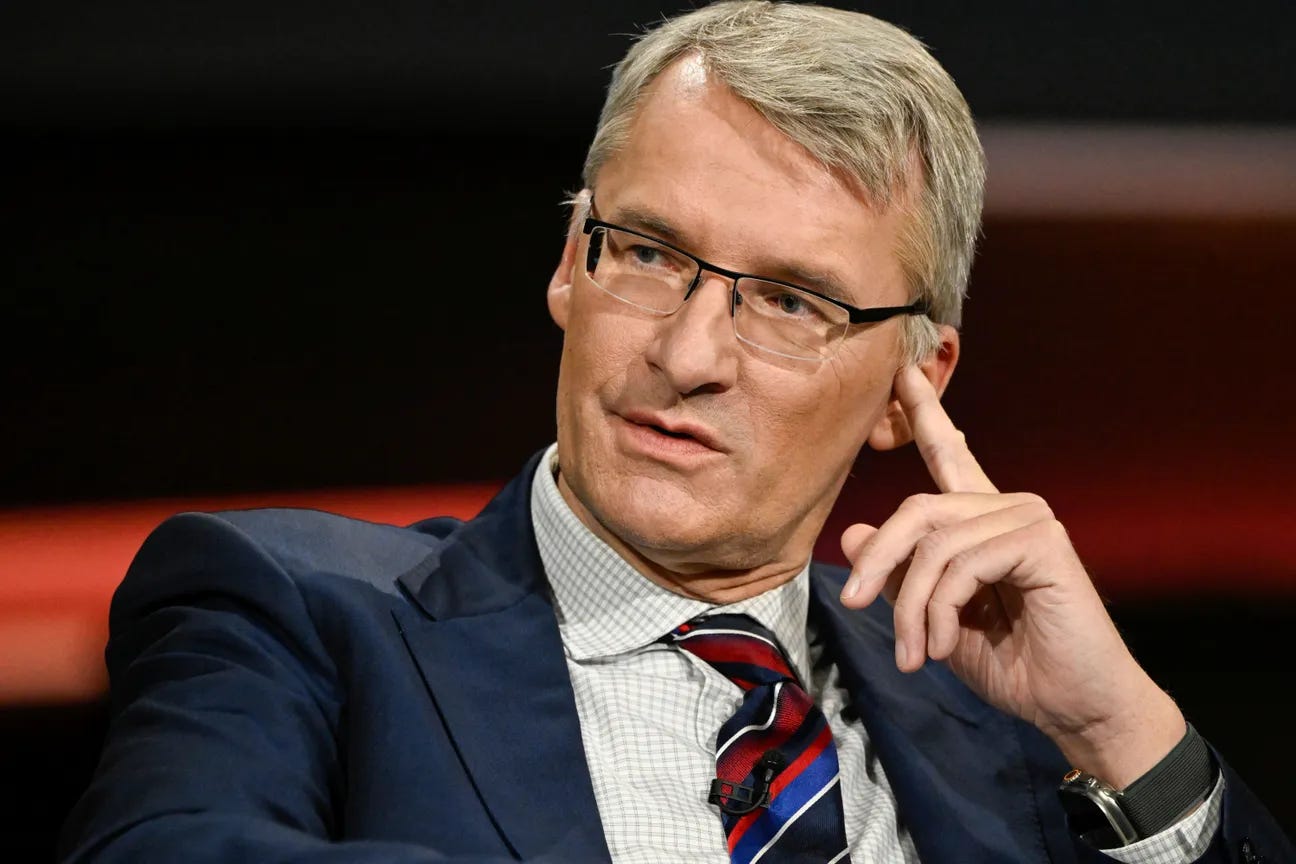
Elmar Theveßen is the head of the Washington studio of the German public service broadcaster ZDF. In theory, he is one of the top journalists in Germany when it comes to telling the German public about events in the United States. However, what he regularly reports to the German public is largely deliberate disinformation.
After Charlie Kirk’s death, Theveßen appeared live on a primetime TV political show, but not to help people understand who Kirk was and what he represented; it was exclusively to defame him with outright lies. He claimed that Kirk held extreme right-wing views, including that homosexuals should be stoned and that passengers should be afraid if a black pilot was flying their aeroplane. Kirk never said any of this. In fact, he had said the opposite about homosexuality: he had referred to the Bible to argue that it shouldn’t always be interpreted literally. He used the example of black pilots to criticise the hiring of people based on affirmative action rather than merit. He said that if you cannot be sure that a pilot has been hired because of his qualifications, but rather because of the colour of his skin, it could actually provoke racist feelings towards black people.
Theveßen may have picked up on these examples of Kirk’s alleged extremism on social media and, due to his self-righteousness and distorted view of everything related to Trump, taken them at face value without checking them.
That same evening, Dunja Hayali – presenter of ZDF’s flagship news programme ‘heute journal’ and thus one of Germany’s most influential journalists – showed similar disregard for conventional journalistic principles when she said: “The fact that there are now groups celebrating Charlie Kirk’s death cannot be justified by anything, not even his often abhorrent, racist, sexist and misanthropic statements. But it seems that the radical religious conspiracy theorist has struck a nerve with precisely that…”
Most European media outlets portrayed Kirk as an extremist and often implied that he deserved to be shot dead for the supposed hate he had spread. In reality, however, there was nothing extremist about Kirk’s views. In fact, they are shared by tens of millions of conservative and Christian Americans. If European journalists took their profession seriously, they might contextualise Kirk’s pro-life views on abortion, for example, by pointing out that American conservatives have traditionally held more conservative views on cultural issues than their European counterparts, and that Kirk was no exception. What made him special, though, was his extreme readiness to talk to anyone. First and foremost, he was a debater who reached out across the ever-widening divide between political camps, making him the opposite of a misanthrope. ‘Talk to me!’ was his message, particularly on university campuses where conservative students have been ostracised in recent years.
Tragically, Kirk’s murderer, Tyler Robinson, had been convinced by online discourse that Kirk was evil and deserved to die. Evidence strongly suggests that his growing involvement with trans ideology, coupled with the fact that his romantic partner was trans, led him to murder Kirk, as he was an important voice against this ideology. While online communities seemingly played a role in radicalising Robinson, it is difficult to imagine that Kirk would have become a target without the wider mainstream media discourse.
Over the past few years, the mainstream media in the US have successfully positioned Trump as the new Hitler, portraying his allies, such as Kirk, as the new Nazi leaders. At the same time, they have disinformed the American public about trans ideology by presenting it as a black-and-white issue: you were either pro-trans or transphobic. No conversation was allowed about trans women in women’s prisons or sports, nor about the highly problematic (if not criminal) mainstream protocols that encourage children and adolescents to transition and receive hormone treatments.
Had journalists done their job of critically reporting on this important issue and allowed debate to happen, Charlie Kirk’s murderer might not have been radicalised and Kirk might still be alive. Perhaps even more importantly, far fewer people would have believed that the trans issue was primarily about inclusivity and tolerance, and hundreds of thousands of children and women would not have had to live with the disastrous consequences.
In Europe, the mainstream media distorts the truth on many topics, including the transgender issue. However, the way in which they report, or fail to report, on anyone within the orbit of President Trump is particularly striking. It seems that the intention is to portray these individuals as either evil Nazis, stupid or crazy conspiracy theorists, and to only report or quote information that might support this portrayal.
I find the media coverage in Europe of US Health Secretary Robert F. Kennedy junior particularly revealing.
Before joining the Trump campaign and later the administration, Kennedy was a lifelong Democrat, a committed environmentalist and environmental lawyer with a long track record of successfully suing large corporations to help disadvantaged people and protect nature.
Not long ago, he was often celebrated by the left-liberal media for his work. Kennedy hasn’t changed since then, but the world has. Since he took a stand against the pharmaceutical industry and joined forces with Trump, he has been consistently portrayed as a conspiracy theorist who completely misunderstands science and harms public health and scientific progress for all the wrong reasons. The European media repeat these smears and almost never provide any context for his actions as health secretary, nor do they even mention what his goals are.
La Vanguardia is the most widely read and still highly trusted news outlet in Catalonia, where I live in Spain. It is also one of the top four news outlets in Spain as a whole. Below is a small but representative selection of headlines from La Vanguardia about Robert F. Kennedy junior from the last six months. I believe these headlines are also highly representative of how the wider European media have reported on him since he became US Health Secretary. Interestingly, none of these articles appeared under the categories of “health” or “politics”, but instead under “science denialism”, “conspiracies in the US”, and “attack on science”.
Attack on science: Trump dismantles medical research in the United States (La Vanguardia, 13 April 2025). The article argues that job cuts at the NIH, the CDC and the FDA — “headed by the controversial anti-vaccine activist Robert F. Kennedy Jr., whom Donald Trump has placed in charge of US health services” — will slow progress in important health treatments such as cancer, damaging US scientific leadership in the process.
Science denialism: Kennedy, once again against science: now he attributes autism to an “environmental toxin” (La Vanguardia, 17 April 2025)
Science denialism: Robert Kennedy Jr., a health secretary who has nothing to do with his uncle, JFK (La Vanguardia, 25 April 2025). The article states: “This insistence on endangering the health of his fellow citizens, already evident in his defence of dangerous anti-vaccine conspiracy theories, contrasts with the desire of his uncle, President Kennedy, to extend health coverage to Americans.”
Conspiracies in the US: Kennedy cancels $500 million in funding for 22 mRNA vaccine programmes (La Vanguardia, 6 August 2025)
In other news, the media has reported for many months on American scientists leaving the United States due to funding cuts and the hostile environment for scientists created by the Trump administration. According to La Vanguardia, the Catalan government is seeking to attract high-level scientists who are fleeing the US.
It all fits perfectly. Anyone who relies solely on the mainstream European press for their information is bound to believe that Kennedy is a madman hired by Trump to harm the American people and that this will have terrible consequences. I have heard several members of my family repeating these talking points about Kennedy, and they are deeply concerned. They also have no doubt that they have been informed correctly.
However, the media’s portrayal of Kennedy, his motivations and goals is completely distorted and ultimately false.
First of all, they provide no context whatsoever; if they did, the picture might look very different. News reports about Kennedy give the impression that, while the American healthcare system may not be perfect, at least everyone is trying to improve the health of the American people. Kennedy is therefore portrayed as someone who is deliberately destroying this valuable and functioning system.
But European journalists must know that the opposite is true. The main facts are not even controversial. Despite spending far more than any other country on health care (about 17% of GDP), Americans are among the least healthy in the developed world, with one of the lowest life expectancies and the highest rates of obesity (about 40%) and diabetes (about 50%). Sixty years ago, Americans were much healthier, and there was no obesity epidemic. Paradoxically, the more Americans spent on healthcare, the sicker they became.
Kennedy rose to fame in the so-called Covid resistance movement because like no-one else he knew how corrupt the entire US health system was and how it clearly doesn’t have the health and wellbeing of its citizens at heart. Instead, its incentives make people sicker and more miserable for the benefit of big corporations, particularly in the healthcare and food industries.
Millions of Americans lost all trust in science and health institutions during the pandemic because they found out that they had been lied to about the effectiveness and necessity of masks, and the safety and effectiveness of mRNA vaccines among other things. Due to the immense damage caused to ordinary people by the pandemic regime, trust in science among moderates and conservatives dropped dramatically. Following the pandemic, Bobby Kennedy emerged as a beacon of hope for many who were angry about what had happened. In fact, Kennedy is the most popular member in Trump’s cabinet — a fact that is surely difficult to reconcile with the image that Europeans have of him.
Kennedy wants to make America healthy again. It’s as simple as that. Any European journalist paying attention should have no doubt that his intentions are 100% noble. He is neither a career politician nor a narcissist seeking fame and the spotlight. He is driven by a deep sense of purpose, even though this takes a considerable toll on him. He is an extremely intelligent, capable man of the highest integrity, with unparalleled knowledge of both the administration and the industry.
Kennedy is trying to free the health agencies such as the FDA, the CDC and NIH from industry capture and perverse incentives and he is trying to restore scientific integrity in these agencies.
The claim that the significant staff cuts implemented by Kennedy and his team at the NIH, CDC, and FDA upon taking office constitute an assault on science is not journalism, but defamation. If Kennedy is to make a real difference to the health of Americans over the next four years, he needs to revolutionise the way these agencies and the entire health and food system operate. It is common knowledge that large bureaucracies are very difficult to change, especially when, as in this case, there are enormous, powerful vested interests that will oppose change at all costs.
Even though Kennedy and his closest allies in the new administration will inevitably make mistakes and may even have dismissed some valuable employees, their intentions are the opposite of an attack on science. They are trying to restore scientific rigour and trust in science. To achieve this, they must lay off compromised staff and hire new, trustworthy staff.
Furthermore, Kennedy’s decision to cancel $500 million of funding for mRNA vaccine development contracts is not based on conspiracy theories, but on valid scientific concerns. In fact, it is a massive and total failure of the entire journalistic class that began when the first mRNA vaccines were developed, with any critical discussion in the mainstream media about this new and unproven technology being suppressed and deemed a conspiracy theory. Fears that mRNA vaccines could have serious side effects and be unsuitable for young people at low risk of contracting Covid were well-founded. The high incidence of myocarditis in young men following mRNA vaccination ultimately prompted the FDA to issue safety warnings in this regard. Some scientists even believe that the mRNA platform is inherently hazardous and cannot be fixed.
As with any new medicine or technology, it is not yet possible to fully evaluate the long-term safety and efficacy of these completely novel mRNA gene therapies. The current mainstream narrative that these are highly promising, life-saving vaccines may ultimately be proven false. Science is a process in which different hypotheses are tested. Science does not mean believing in one hypothesis and dismissing all others as conspiracy theories.
European reporting on Kennedy’s interest in finding out whether, and possibly which, environmental toxins could be causing the dramatic increase in autistic children in recent years is equally disturbing. The number of children diagnosed with autism has increased from 1 in 150 22 years ago to 1 in 31 today. The claim that questioning the prevailing view that autism is primarily genetic is a denial of science is not only unscientific by definition, but also completely ignores the fact that the American health establishment has failed to halt the decline of all relevant health indicators among American citizens over the past sixty years. Therefore, it makes a lot of sense to try something new. Time will tell whether Kennedy’s hypotheses are correct, but his approach to finding out is scientific.
Europeans are generally in much better health than Americans, and we spend much less on healthcare than Americans do. Nevertheless, what happens on the other side of the Atlantic has an impact on Europe, and science is a global affair.
We need a press that is committed to the truth and vigilant in ensuring that government and science are not captured by corporate interests or harmful ideologies, such as trans ideology.
However, instead of questioning their own biases and their involvement in spreading disinformation, European news organisations have invested heavily in so-called fact-checking units whose job is to uncover and denounce disinformation among those who do not adhere to the discourse considered acceptable in polite society. These fact-checkers therefore largely fail to fulfil their stated purpose, instead building another layer of disinformation.
The extent to which the mainstream media distorts the truth ultimately leads to our democracies becoming more dysfunctional, as it becomes increasingly difficult to gain an accurate understanding of the facts that form the necessary basis for good political decisions.
It also exacerbates people’s distrust of our institutions, as over time more and more people realise that they are being lied to, and it further promotes polarisation in our societies. Instead of successfully combating the populist right, as these activists are certainly trying to do, growing distrust is driving more and more people towards the populist far right.
Journalists do not have to like Trump or Kirk, but they would be well advised to report on them fairly. But journalists with an activist mindset certainly find it easier to present a black-and-white narrative, condemning all actions of the ‘bad guys’ while praising those of the ‘good guys’. However, that is not the world we live in. It requires courageous and committed journalism to explain the world as it is, rather than portraying it in a more convenient way.
Journalists are often under pressure from their superiors to stick to certain narratives, and they also feel pressure from their colleagues, both offline and online. But none of this justifies constantly distorting reality and ultimately lying to their audience. The profession of journalism comes with a responsibility and certainly requires courage in our times. Those who are not prepared to tell the truth should do something else.
Some journalists have this courage. I wish there were more. Antoni Puigvert is a columnist for La Vanguardia. After the murder of Charlie Kirk, he wrote:
Many democrats are beginning to realise that it is time to abandon comfortable and convenient generic labels such as xenophobic, transphobic, Nazi, etc. They know that they must regain the ability to relate to the reality of American discontent. We too, the opinion makers, analysts, radio preachers, correspondents and journalists in general, must reconnect with reality, understand the causes of the unrest and explain the reasons for the exponential growth of the new populist right. Understanding and explaining is our job, not promoting for the umpteenth time the fear of the return of the barbarians.
No posts
Comments
Nothing yet. Say the first thing.
Sign in to join the conversation.