
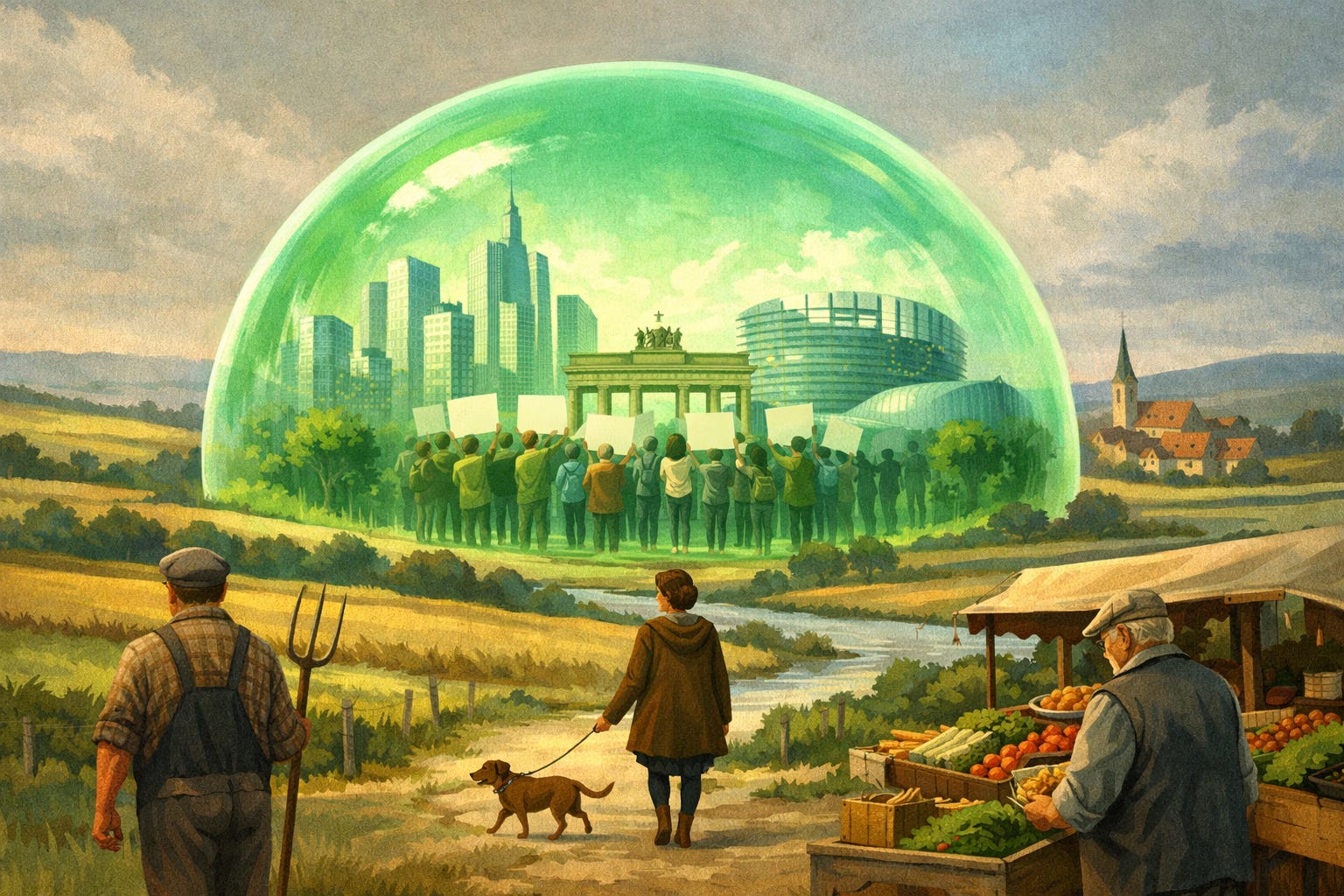
There has been a shift in European politics, and anyone paying attention can sense it. The environment, which dominated public discourse just a few years ago, is being quietly deprioritised. Centre-right parties that once embraced the European Green Deal are pulling back. Farmers blockaded capitals across the continent in protest against green regulations and won concessions. Right-wing populist parties are setting the terms of debate on energy, immigration, and the cost of living, while green parties are losing the political fight. In the 2024 European Parliament elections, green parties lost 18 seats while climate-sceptic parties gained across the board.
The picture is not uniform — Britain’s Greens are at a historic high, Germany’s still hold their urban base — but the overall direction is unmistakable. The political momentum has turned against environmentalism. Not because voters have decided the natural world does not matter, but because the people claiming to speak for it have become impossible to trust.
I say this as someone who spent over a decade working within that world. I co-developed WWF-UK's strategy on systemic approaches to consumption and production and led their programme on sustainable mobility. I founded the Smart CSOs Lab in 2011, an international network of civil society leaders, academics and funders dedicated to developing transformative strategies for the environmental movement. I believed deeply in the cause, and I still do. But I came to see, with increasing clarity, that the movement was making a series of strategic errors so fundamental that no amount of better messaging or bigger budgets could fix them.
The environmental movement has become a tribe. And tribes, by definition, exclude.
The question of why environmentalism keeps losing is gaining attention. From the left, former Greenpeace France campaign manager Clément Sénéchal published Pourquoi l’écologie perd toujours (Why Environmentalism Always Loses) arguing that environmental NGOs have become embedded in corporate and state structures, making ecology “negotiable and profitable” while legitimising the very actors responsible for ecological destruction.
Sénéchal makes a genuinely important observation. He calls the French gilets jaunes “the best ecological movement of recent history” because they confronted the question that the climate establishment refuses to ask head-on: who bears the costs? The carbon tax that triggered the Yellow Vest revolt was flat-rate, the same for a Parisian executive and a rural nurse who drives 80 kilometres to work. The NGOs were destabilised because the movement revealed that the policies they had championed for years were inequitable for the very people most affected by them.
This is a valuable insight that highlights the deeper problem. However, Sénéchal draws the wrong conclusion. He believes the movement failed because it was not radical or confrontational enough with capital, nor willing enough to embrace class struggle. He proposes a decolonial, anti-capitalist ecology as the solution. Yet the Yellow Vests were not Marxists. They were ordinary people, many of whom were rural and conservative and were rooted in their communities. They felt ignored and condescended to by a metropolitan elite who claimed to act in everyone’s interest, but who only understood their own interests. The lesson of the gilets jaunes is not that the green movement needs to be more radical. Rather, it is that the movement has lost touch with the values and lived reality of ordinary people.
This is the thread that connects every failed response. The confrontational approach of Extinction Rebellion, Just Stop Oil and Last Generation — throwing paint at masterpieces, gluing themselves to roads — alienated precisely the people whose support the movement needed, and has already faded.
Meanwhile, rather than engaging in self-examination, the mainstream environmental establishment has responded with technocratic intensification: more fact-checking, more platform regulation and greater efforts to control public opinion. The Climate Action Against Disinformation coalition now has over 90 members. The COP30 Declaration on Information Integrity commits signatories to combatting ‘disinformation’, which in practice amounts to a coordinated effort to police public discourse on climate. This approach to managing behaviour has led to proposals for personal carbon allowances, and in more extreme versions, the combination of carbon rationing with digital surveillance of consumption. For ordinary people, especially those living outside metropolitan centres, climate policy increasingly feels like a diktat from distant, unaccountable institutions that do not consider themselves answerable to the people whose lives they are reshaping.
What the radical left, the spectacle activists, and the technocratic establishment all share is the same fundamental failure: none of them takes seriously the people they have lost. The working-class families in provincial France who wore yellow vests. The farmers across Europe who blockaded capitals in protest against green regulations. The millions of voters who turned away from green parties in 2024. These are not people who need to be radicalised, disrupted, or educated. They are people who need to be heard, and whose values the environmental movement has systematically excluded.
The typical environmentalist in Europe today is urban, university-educated, culturally progressive, and politically left-of-centre. This is not a caricature; it is what the data consistently shows. In the UK, the Green Party’s membership is overwhelmingly concentrated in London and the south-east, nearly nine in ten identify as Remainers, and almost all place themselves on the political left. The pattern holds across Europe.
The problem is that a movement defined by these characteristics cannot build the broad democratic mandate that environmental protection requires. You cannot successfully steward a continent’s landscapes, waterways, soils and forests while speaking only to people who live in cities.
Yet the narrowing has accelerated. Over the past decade, environmental organisations have systematically absorbed the priorities and language of progressive identity politics, transforming themselves from single-issue movements into carriers of a comprehensive ideological worldview.
The evidence is everywhere. Greenpeace International now believes that climate justice cannot be achieved without gender justice. Greenpeace UK requires all staff to complete training titled “Towards an anti-oppressive Greenpeace” and to establish anti-racism team agreements. Many in the movement, including academic researchers, argue that masculinity is a driver of the climate crisis and that male identity and consumption patterns are environmental problems requiring feminist solutions.
In the United States, the Sierra Club — the country’s oldest and largest environmental organisation — issued an equity language guide warning employees that words such as “vibrant” and “hardworking” can reinforce racist stereotypes. According to the New York Times, the organisation lost 60 percent of the four million members and supporters it counted in 2019.
Possibly the most dramatic case in Europe is Fridays for Future. In 2023, the movement’s international account accused Israel of “neo-colonialism and apartheid” and signed off with “Yallah Intifada.” The Berlin branch called it “eliminatory antisemitism.” The German climate movement fractured along identity lines, with decolonial splinter groups emerging while the original climate mission was abandoned. Greta Thunberg’s transformation from climate icon to Palestine campaigner has become emblematic of this shift.
The logical endpoint of this capture was on display in February 2026 when the Green Party won the Gorton and Denton by-election in Manchester by running a campaign centred almost entirely on Palestine. The winning candidate distributed leaflets in Urdu showing herself in a keffiyeh in front of a mosque. The environment barely featured. A party nominally dedicated to ecological protection won a parliamentary seat on an issue entirely unrelated to its supposed mission. This is what a captured movement looks like from the outside.
But the capture extends beyond identity politics. Environmental NGOs have become broadly conformist, increasingly willing to lend their institutional weight to causes that have nothing to do with the natural world such as, for example, demonstrations, coalitions and campaigns against far-right parties. Organisations that depend on government grants, foundation funding, and access to policy processes have powerful incentives to be seen on the right side of every establishment cause. The result is a movement that has lost the capacity for independent judgment, and which ordinary people, understandably, no longer trust to speak truth to power on their behalf.
Meanwhile, an anti-humanist strain that has been present in environmentalism since Paul Ehrlich’s The Population Bomb has found new expression. A 2021 Lancet survey of 10,000 young people across ten countries found that 39 per cent were hesitant to have children because of climate change. A movement that was supposed to protect the conditions for human flourishing has produced a generation that sees humanity itself as the problem — the very opposite of conservation.
The people excluded by all of this are the very people whose cooperation is most needed: farmers, rural landowners, hunters and anglers, faith communities, small-town conservatives, and working-class families for whom energy costs are not an abstraction but a monthly crisis. These are people who often care deeply about the natural world — they live in it, work with it, and have maintained it for generations. But they have been given no reason to see the environmental movement as their ally, and every reason to see it as their adversary.
I know from conversations with people inside environmental NGOs that many of them recognise this problem. They see the narrowing of their organisations’ culture, the lack of ideological diversity in their workforce, the disconnect from the communities they claim to serve. But the internal pressure to conform is immense, and very few have the institutional freedom to say so publicly.
The environmental movement’s investment in fighting “disinformation” rests on a flawed assumption: that declining public support is an information problem. If people hold the wrong views, it must be because they lack the right information, or because bad actors have misled them.
But this is a trust problem. And trust cannot be fact-checked into existence.
The weaponisation of “disinformation” during the Covid pandemic, when credible scientific hypotheses were labelled misinformation and suppressed, and the Wuhan lab-leak theory went from banned content to mainstream hypothesis within months, destroyed the credibility of the fact-checking apparatus for millions of people. Climate science, which depends on public trust in scientific institutions, was collateral damage.
The climate community has contributed to these dynamics. Climate scientist Patrick Brown went public with how common it has become to cherry-pick data to fit predetermined narratives. Nature retracted a 2024 paper predicting $38 trillion in annual climate damages, despite peer reviewers having flagged serious errors before publication. The media’s shift from reporting on climate change to educating the public about it, with its dramatised weather maps and moralising commentary framing every extreme weather event as proof of the apocalypse, has made “climate emergency” language feel manipulative rather than urgent.
Fighting disinformation with more information is like trying to extinguish a fire by throwing paper on it. Ignorance is not the fuel. It is betrayal — both real and perceived.
Recognising that apocalyptic messaging alienates conservative audiences, a growing number of organisations have pivoted to framing the energy transition in terms of affordability and national security. But after several years of this experiment, it is not working. A 2025 Pew survey found that people on the ideological right across multiple European countries were less likely to consider climate change a major threat than in 2022. In Poland, the figure among right-leaning respondents dropped 23 points in three years.
The frame fails because it is not credible. Germany’s Energiewende has seen household electricity prices nearly double since 2007. When organisations promise that renewables will make energy cheaper and then people’s bills go up, the result is deepened cynicism, not persuasion. This is what the gilets jaunes understood before the NGOs did.
Underneath the affordability argument lies a deeper dishonesty. Germany, with about 1.5 per cent of global carbon emissions, would have no measurable impact on the earth’s climate even if it eliminated every emission overnight. When Europe acts unilaterally, shifting production and its associated emissions to countries with cheaper, dirtier energy, the net effect on the global climate is negligible or worse. Ordinary people can sense this dishonesty, even when they cannot articulate it in economic terms. They know their lives are getting more expensive without the climate getting better, and they resent being morally lectured by those who refuse to acknowledge the reality.
There is also a bitter irony that environmentalists rarely confront: the renewable energy infrastructure they champion is itself scarring the landscapes they claim to protect. Thirty thousand onshore wind turbines have transformed large parts of the German countryside. In Andalusia, vast solar farms are replacing centuries-old olive groves. In the name of saving nature, we are disfiguring it.
If the central failure of the movement is that it has lost touch with ordinary people, the first step is disarmingly simple: listen to them. This means not trying to educate them, nudge their behaviour or reframe the same agenda in more palatable language, but genuinely understanding what they value, what they fear and why they have turned away.
What you hear, if you listen, is not climate denial. It is frustration with a movement that lectures about carbon while energy bills double, that shuts down nuclear power stations on ideological grounds and wonders why electricity is unaffordable, that imposes regulations which do nothing for the environment but succeed in driving industry to China. The demand is not for less environmentalism but for more honesty and less dogmatism.
Some of the correctives are straightforward. Maintaining nuclear capacity rather than dismantling it. Acknowledging that wind and solar cannot yet reliably power industrial economies without fossil fuel backup. Welcoming technological innovation while keeping a sceptical eye on utopian promises. Being honest that unilateral European emissions reductions will have no measurable impact on the global climate in the medium term, and that any policy which merely shifts industry to China is not climate policy at all.
Also, admitting that, until we develop genuine solutions to the global collective action problem, demanding sacrifices from ordinary people whose lives are already getting harder is not moral leadership, but it is cruelty dressed as virtue. And investing at least as seriously in climate adaptation as in mitigation, because helping communities deal with a changing climate directly improves their lives rather than asking them to bear costs whose benefits they will never see. These are not radical propositions. They are common sense that the movement’s ideological commitments have made it unable to articulate.
But pragmatism alone does not answer the deeper question: why should we care about the natural world beyond what the balance sheet dictates? Purely instrumental arguments — lower bills, energy security, industrial advantage — imply that nature is worth protecting only when it turns a profit. For people in rural communities already attached to their landscapes and forests, this framing misses the point of why they care.
The most enduring answer is rooted in something older than economics: the responsibility to pass on to future generations a world at least as beautiful and habitable as the one inherited. What Edmund Burke called the partnership “not only between those who are living, but between those who are living, those who are dead, and those who are to be born.” Roger Scruton developed this with great clarity in How to Think Seriously About the Planet, arguing that authentic conservation stems from oikophilia, or love of home, rather than fear of catastrophe or pursuit of material gain.
When environmental engagement is grounded in these values, it becomes truthful. There is no need to minimise uncertainties or promise a painless transition. The obligation stems from the intrinsic worth of what is at stake, not from a cost-benefit analysis that might be revised next quarter.
This connects with sensibilities already widespread in communities the green movement has ignored — hunters and anglers who maintain habitats, farmers who care for soil across generations, faith communities that practise stewardship as a religious duty. These people do not need to be converted to environmentalism. They need to be recognised as environmentalists who were never welcomed by the movement claiming to speak for them.
I have come to refer to this orientation as post-liberal environmentalism, but the label matters less than the substance. At its core, it is the realisation that hyper-globalisation, hyper-individualism and hyper-consumerism have not improved our lives. In fact, they have made us lonelier, more anxious and more destructive of the natural world on which we depend. The path forward runs through what Burke called “little platoons” — churches, cooperatives, village societies, family businesses — the structures through which durable environmental action actually happens. Organisations like Our Common Home and the Conservative Environment Network are already showing that this works, engaging people with traditional values in stewardship across political and cultural lines.
The environmental movement faces a choice. It can continue down its current path of speaking to the converted, fighting unwinnable battles against disinformation, and imposing costs that ordinary people experience as elite indifference to their lives. This will further erode its political base and fuel the very populist backlash it fears. Or it can do the harder thing: examine its own cultural assumptions, acknowledge the people it has excluded, and build a genuinely broad coalition grounded in shared values rather than shared ideology.
This requires institutional humility — the willingness to admit that the movement’s decline is not primarily the fault of fossil fuel companies, populist politicians, or social media algorithms, but of strategic choices made within the movement itself. It requires recovering a language of stewardship, beauty, and intergenerational obligation that can speak across political and cultural divides. And it requires honesty about the collective action problem at the heart of climate policy, the real costs and limits of current technologies, and the movement’s own contribution to the polarisation it decries.
The natural world does not care about our political categories. The question is whether we can build an environmentalism worthy of it.
If you work in an environmental organisation or foundation and recognise the problems described here, I may be able to help. Through my consultancy at Protopia Lab, I work with organisations on environmental and communications strategies that reach beyond the progressive mainstream — drawing on my experience at WWF-UK, the Smart CSOs Lab, and more recently with Our Common Home, where I helped develop strategies for engaging people with traditional values in environmental stewardship across Europe. You can find out more on my website or connect with me on LinkedIn.
No posts
Comments
Nothing yet. Say the first thing.
Sign in to join the conversation.