
In 1968, biologist Paul Ehrlich published The Population Bomb, predicting that hundreds of millions would starve to death in the 1970s and 1980s due to overpopulation. He warned that England would cease to exist by 2000 and advocated adding sterilants to water supplies to prevent catastrophic environmental collapse. His solution to the environmental crisis was fewer humans.
Ehrlich was spectacularly wrong. Rather than mass starvation, the Green Revolution dramatically increased food production. Rather than population explosion, fertility rates began collapsing globally. Today, we face the opposite crisis: demographic implosion threatening the viability of entire societies. Yet the anti-humanist impulse Ehrlich represented — the conviction that humanity itself is the problem — never disappeared. It simply evolved.
A 2021 study published in Lancet Planetary Health, surveying 10,000 young people globally, found that 39 percent expressed reluctance to have children because of climate change. Some young women have gone further, choosing sterilisation out of fear for the planet’s future. This radical anti-natalism — the belief that human extinction might be preferable to environmental degradation — represents more than personal despair. It exposes how thoroughly Ehrlich’s anti-humanist framework has colonised much of environmental thought, even as his predictions proved catastrophically wrong.
The irony is devastating. Environmentalists spent fifty years fearing too many humans would destroy the planet. Now collapsing fertility threatens to undermine the very societies that could steward it. Yet rather than reconsidering the premise that humanity is the problem, much contemporary environmentalism doubles down — treating people as problems to be managed rather than as potential stewards of creation.
This anti-humanist strain runs deeper than extremist fringe movements. It permeates mainstream environmental discourse and, more dangerously, the technocratic solutions being imposed from above.
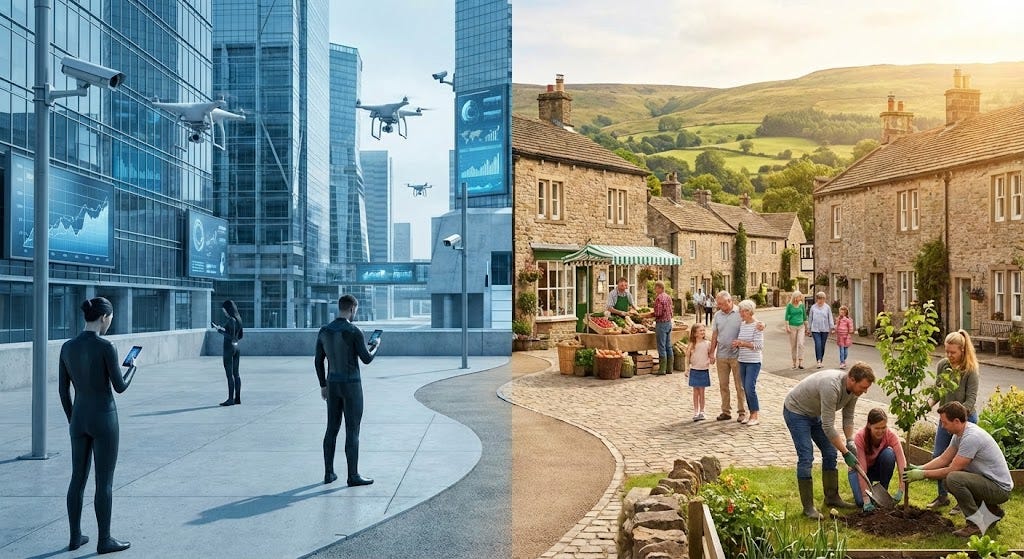
Consider the trajectory we are on. The European Union and similar technocratic regimes are constructing what amounts to a biotechnological surveillance state — a world where lives are optimized for efficiency through smart cities, where insects are approved as novel foods and promoted for sustainability, and where digital central bank currencies could one day ration carbon emissions. The EU’s Digital Services Act and similar legislation grant governments unprecedented power to police acceptable opinion. This is not a dystopian fantasy, but rather real-life examples of a worldview that has lost sight of human dignity and the common good.
Neither anti-natalist extremism nor technocratic control offers a genuinely humane path forward. Both share a fundamental misunderstanding of human nature and our relationship with the natural world. What we need is not less humanity but a recovery of what it means to be truly human — embedded in community, bound by obligations to past and future generations, and capable of both restraint and creativity in our stewardship of creation.
To understand how we arrived at this impasse, we must examine liberalism’s broken promise of freedom. The modern liberal conception of freedom stands in stark contrast to the ancient and medieval understanding of libertas. For the Greeks, Romans, and medieval Christians, liberty meant the ability to act in accordance with the common good and fulfill one’s responsibilities within a community. Freedom was not the absence of constraints but the capacity to pursue virtue and contribute to the flourishing of the whole.
Liberalism inverted this understanding. As political theorist Patrick Deneen argues in Why Liberalism Failed, liberalism conceived of humans as radically autonomous individuals in a state of nature, pursuing self-interest with minimal interference. This anthropology was wrong from the start. Human beings are fundamentally relational creatures. We are born helpless and dependent, formed by families and communities, shaped by inherited traditions and obligations.
The liberal promise was that by freeing individuals from traditional institutions — guilds, churches, extended families, local communities — we would create unprecedented prosperity and liberty. In demolishing these “little platoons” (Edmund Burke’s term for the voluntary associations that mediate between individual and state), liberalism did generate wealth and expand certain freedoms, including scientific advances that averted Ehrlich’s predicted famines. Yet these gains came at the cost of atomisation, vulnerability, and increasing dependence on the bureaucratic state and the market.
Post-liberal theorist Nathan Pinkoski describes our current moment as “actually existing postliberalism” — “a society in which governmental power, cultural power, and economic power are coordinated to buttress regime security and punish the impure.” We see this in practices like de-banking, where financial institutions close accounts based on political views, and in the fusion of corporate and state power to manage acceptable discourse. The market logic that liberalism unleashed now penetrates everything once considered sacred: surrogacy has become a global market, OnlyFans monetizes intimacy, and human connection itself is increasingly commodified. The rapid deployment of AI accelerates this alienation. By inserting synthetic agents into our creative and communicative lives, we risk further reducing human agency and distancing ourselves from the friction of real-world relationships.
After liberalism, not much remains of liberty. We have traded the organic constraints of community and tradition for the algorithmic control of platforms and the bureaucratic oversight of the administrative state. The question is whether we can recover something better — not by returning to an imagined past, but by reconstructing the conditions for genuine human flourishing.
The failure of liberalism is directly relevant to environmental politics. As Sebastian Milbank writes, liberalism’s “final triumph of state and market creates states that are unequal, unfree and soulless; where the good life cannot be pursued and where humanity is subordinated to the mindless expansion of material wealth, without concern for quality of life or the common good.”
Not all environmental thought succumbs to anti-humanist or purely technocratic traps. Ecomodernist approaches, for instance, promise decoupling economic growth from ecological harm through intensified technology, urbanisation, and efficiency. Yet such visions remain tethered to liberalism’s faith in autonomous progress and endless innovation.
Every new technology brings unintended consequences, often exacerbating ecological problems across multiple fronts including oceans, soils, freshwater and biodiversity. We see this starkly in the rise of artificial intelligence. While proponents promise it will optimise our resource usage, the reality is that AI requires enormous amounts of energy that we cannot currently produce without creating new environmental liabilities. The digital world is not physically weightless; it is built on extraction. Similarly, renewables, electric vehicles and batteries introduce their own challenges in terms of resource extraction, pollution and waste.
If we persist down the path of hyper-technological consumerism, we risk ecological collapse rather than restoration. In doing so, we erode community, virtue and natural limits instead of fostering genuine relational stewardship.
How can we address environmental degradation when we lack the social and political architecture to deliberate about common purposes? How can we practice restraint when every mediating institution that once fostered virtue has been undermined? How can we think intergenerationally when the relentless present-orientation of consumer capitalism dominates our consciousness?
The technocratic approach to environmentalism compounds rather than solves these problems. It treats climate change as a technical problem requiring expert management, more surveillance, and tighter control — never questioning whether the underlying system that produced the crisis can generate solutions. Its vision of smart cities, digital currencies for carbon rationing, and algorithmic optimisation of behavior represents not human flourishing but a further diminishment of what makes us human.
Post-liberalism offers a fundamentally different approach. It begins not with abstract individuals and technical fixes but with the concrete reality of human life: we are relational beings who find meaning in family, community, tradition, and purpose beyond ourselves. A post-liberal environmentalism would rebuild the social architecture necessary for genuine ecological responsibility.
What would a post-liberal environmentalism look like in practice? Four interconnected pathways emerge:
Environmental stewardship requires the capacity for collective deliberation and action. Yet liberal atomisation has destroyed the “little platoons” — churches, unions, civic associations, neighbourhood groups — that once mediated between individuals and the state. As Alexis de Tocqueville observed in Democracy in America (1835), these voluntary associations are the lifeblood of democratic society. Without them, centralised power inevitably expands to fill the vacuum.
Before we can seriously deliberate about living within ecological limits, we must revitalize associational life. This means supporting institutions that foster face-to-face relationships, shared purpose, and habits of cooperation. Only with rebuilt social trust can communities make the collective choices — about land use, resource management, economic priorities — that environmental responsibility requires.
Liberalism promised fulfilment through autonomous choice and consumption. It delivered restless dissatisfaction and addiction — to screens, shopping, stimulation. The environmental cost of this wasteful consumerism is staggering, but behavioural control and rationing are not the answer.
Genuine restraint comes not from external coercion but from internal formation. We practice restraint when we understand ourselves as part of something larger—a family, a tradition, a community with responsibilities across generations. As philosopher Alasdair MacIntyre argues in After Virtue, virtue is cultivated through practices embedded in communities. Temperance, prudence, and stewardship are learned in families and local institutions, not programmed by algorithms or mandated by bureaucrats.
This stewardship draws deeply from Western traditions — Judeo-Christian notions of creation, care and dominion as responsible service — offering a transcendent “why” that secular liberalism lacks. When we recover a sense of obligation to those who came before us and those who will come after, environmental responsibility becomes not a sacrifice but an expression of who we are. This is the opposite of antinatalism. Having children — in Edmund Burke’s sense of society as “a partnership not only between the living, but between the living, the dead and those yet to be born” — gives us the strongest possible stake in the future.
Writer Mary Harrington puts it plainly: “We’re only here because our ancestors had kids and passed on both their genetic and cultural legacy. Those shared aspects of our culture and everyday life will only continue to exist, if we do the same. To the extent that a community views itself as a community — a people, if you like — and values that web of connection both in the present and across time, they will feel a common obligation to ensure its continuity. That means having children.”
Liberal economics treats the market as a self-regulating mechanism operating independently of moral and social considerations. Karl Polanyi demonstrated in The Great Transformation how this “disembedding” of the economy from society produces social devastation. The environmental consequences are equally severe.
A post-liberal economics would re-embed the market in society, subordinating trade to politics and values. This means national and regional economies recovering sovereignty to protect workers, communities, and environments from the race-to-the-bottom logic of global competition. Subsidiarity — the principle that decisions should be made at the most local level appropriate — becomes paramount.
Globalisation made products cheap but created enormous waste through international supply chains and enabled exploitation through anonymous economic relationships. Shorter supply chains, regional economic resilience, and accountable economic actors who are embedded in communities they depend on — these create conditions for both economic justice and environmental responsibility.
This is not autarky or isolationism. It is recognizing that efficiency and competitiveness cannot be ultimate values when they conflict with human flourishing and environmental health. Protection of the common good—including the natural world we inhabit — must take precedence.
Post-liberalism is not Luddism. But it insists that technology serves human flourishing rather than treating humans as resources to be optimised. The technocratic vision of smart cities and algorithmic management represents technology as master; we need technology as servant.
Regenerative agriculture exemplifies this approach. It combines traditional wisdom about crop rotation, composting, and polyculture with new scientific understanding of soil microbiology. Where soil is exhausted and old methods insufficient, innovative techniques like vertical farming and hydroponics can enable human communities to flourish even in challenging environments. The key is that technology serves the human-scale goal of communities feeding themselves sustainably, not the abstract goal of maximizing industrial output.
Regenerative agriculture can restore depleted topsoil through practices that work with nature rather than against it. It can support local communities economically while building long-term ecological health. This is technology subordinated to human needs and natural limits — exactly what technocratic approaches cannot achieve because they treat both humans and nature as resources to be managed.
How do we move from theory to practice? The obstacles are formidable. As Patrick J. Deneen notes, “no serious effort to conceive a humane post-liberal alternative is likely to emerge from the rear-guard defenders of a declining regime.” Yet opportunities are emerging.
The era of hyperglobalisation is ending. Even establishment institutions now recognise that Western dependence on Chinese manufacturing creates dangerous vulnerabilities. Protectionist policies will increase. This creates space for post-liberal economic visions that prioritise worker welfare, environmental protection, and economic resilience over abstract efficiency gains.
NGOs, think tanks, and political parties should develop coherent post-liberal economic frameworks that articulate these benefits clearly. The farming protests across Europe demonstrate widespread dissatisfaction with bureaucratic environmentalism divorced from farmers’ lived reality. The pending Mercosur agreement will likely intensify this discontent while raising broader concerns about European food sovereignty.
Given this widespread opposition to unrestricted agricultural trade, post-liberal advocates should explore alternative approaches.
Food sovereignty is a reasonable aspiration for countries like Spain, Italy, and France — not autarky, but the capacity to feed one’s population without complete dependence on global supply chains vulnerable to disruption. There is real potential for collaboration between post-liberal thinkers and farming communities to develop regenerative agricultural policies that combine environmental restoration with decent rural livelihoods. However, such proposals must include protectionist measures that shield farmers from race-to-the-bottom global competition. Only within protected regional markets can regenerative practices that prioritise long-term soil health over short-term yields become economically viable for farmers.
The demographic crisis demands attention. Western fertility rates are collapsing while mass immigration strains social cohesion. The liberal establishment’s strategy — importing workers to maintain welfare systems and GDP growth — is ultimately a Ponzi scheme that erodes the shared culture and values necessary for any post-liberal project.
Some technocrats argue that AI-driven productivity gains will rescue the system, generating enough wealth to finance the welfare state even as the workforce shrinks. While AI may indeed boost productivity in the medium term, relying on it is a gamble. Distributing those gains in a way that benefits society as a whole — rather than a narrow elite — creates profound challenges for inequality that liberalism is ill-equipped to solve.
Furthermore, we cannot automate our way out of a dearth of humanity. The speed of innovation relies on a vibrant population of young, well-educated, and high-IQ individuals. As the population collapses, so too does the pool of human talent required to sustain these technological systems.
Post-liberals should champion pro-natalist policies. Hungary’s family support programs, whatever their limitations, demonstrate political will to address fertility decline and they may be more successful than is often argued. More experimentation is needed. Simultaneously, multiculturalism must be rejected in favor of robust assimilation. Lower immigration combined with cultural integration is essential for rebuilding the social trust that enables collective action on challenges like environmental degradation.
This will face fierce resistance and requires political formations capable of implementing systemic change without creating new polarisations. But the work must begin now, before social fracture makes reconstruction impossible.
Most immediately, post-liberal advocates should establish spaces for deliberation. As liberal ideology dominates almost all of our institutions and public discourse, many people are unaware of post-liberal alternatives even though they think along similar lines intuitively. We need spaces where people who are dissatisfied with technocratic liberalism can come together to explore different frameworks, such as reading groups, conferences and local associations.
The welfare state’s decline is now practically inevitable. As demographic collapse strains pension and healthcare systems beyond sustainability, the transition will be painful and could consume society’s attention with immediate survival concerns rather than environmental stewardship. Yet as post-liberal thinkers recognise, times of deep crisis also present rare opportunities to build something better from the ruins of failed systems.
Communities must begin now to develop alternative systems of mutual support before the crisis fully arrives. Working with local groups to build these capacities creates both practical resilience and laboratories for post-liberal social organisation. People learning to live virtuously within families and small communities — cultivating practical wisdom about shared resources, practicing restraint and reciprocity — develop precisely the capacities that larger-scale environmental responsibility requires.
But revitalised associational life alone is insufficient. The crisis also creates openings for better economic institutions: more localised production that reduces waste from global supply chains, cooperative structures that prioritise stability over growth, regional economies less dependent on consumerist churn. These alternatives can be more sustainable precisely because they operate at human scale, where economic actors remain accountable to communities they depend on rather than anonymous to distant markets.
We face a choice between futures. One path leads deeper into technocratic control, algorithmic management, and the biotechnological surveillance state. This is the default trajectory — not a conspiracy but the logic of systems that have lost any conception of human goods beyond efficiency and security. The other path requires rebuilding what liberalism dismantled: communities capable of deliberation about common purposes, economies embedded in moral frameworks, technologies serving human flourishing, and cultures that connect past, present, and future generations.
Anti-natalist environmentalism and technocratic management both stem from the same error: they have lost sight of what human beings are and what we need to flourish. Humans are not autonomous individuals or resources to be optimised. We are relational creatures who find meaning in belonging, purpose in obligations that transcend self-interest, and fulfilment in contributing to goods that outlast us.
Environmental responsibility, properly understood, flows from this recognition. When we see ourselves as stewards rather than consumers, as ancestors rather than endpoints, as members of communities extending across time rather than isolated individuals, we gain both motivation and capacity for genuine ecological care.
The world is too complex for technocratic certainty. We cannot engineer utopia or predict all consequences. But we can rebuild the human-scale institutions — families, communities, associations — within which people develop the practical wisdom to navigate complexity together. We can articulate a vision rooted in the enduring principles of Western civilisation: human dignity, the common good, subsidiarity, and solidarity across generations.
Post-liberalism is not nostalgia for a lost past but a project for a livable future — one where both human beings and the natural world can flourish. This vision has enormous potential to connect with ordinary people exhausted by technocratic overreach and cultural fragmentation. The task now is to articulate it clearly, build institutions to sustain it, and demonstrate through lived practice that there is an alternative to the bleak trajectory we are on.
The stakes could not be higher. We must learn as we go, building new practices of moral and intellectual inquiry that neither liberalism nor “actually existing postliberalism” permits. Rather than surrendering our humanity for managed survival, we can recover what it means to live well — together, in communities, on a planet we are responsible for stewarding. That is the promise of post-liberal environmentalism. That is the future worth fighting for.
No posts
Comments
Nothing yet. Say the first thing.
Sign in to join the conversation.