
Video version of this post here.
I previously wrote about my failed experiment as well as my enthusiasm for fast portfolio analysis via AI chat.
This is a continuation of that second part. Specifically, AI chatbots are very, very good at telling you:
Tax-sensitive ways to analyze and allocate your net worth across different portfolios, and
Exactly how much you are incurring for investment management, with implications for saving money through simpler, more passive, strategies.
I am basically astonished at how accurate, relevant, and fast (20-40 seconds) the answers are. My response to the advice is essentially “that’s exactly what I would have said to the client, except AI said it even better!”1
The punchline of this story, which I wrote for the benefit and using the precise information of one of my clients, is savings of a half a million dollars. That’s the potential cost savings over 20 years. They have paid me the tiniest fraction of that amount. So I feel confident that if they followed my advice, supplemented by AI wisdom, that they will enjoy extraordinary financial benefit.

Continuing the experiment for my client
I added to the complexity of my earlier experiment by uploading a second and third spreadsheet of the same client, portfolios that were held in tax-deferred retirement accounts. Interestingly (to me) the portfolio were in a spreadsheet that had different information, columns, labels from the first portfolio. Doesn’t matter. AI chat can handle it all easily.
In 38 seconds it integrated the two next portfolios and began to offer comprehensive tax analysis and advice.2 It’s initial analysis:
“My first impression
The new accounts actually strengthen my initial conclusion.
“The advisor appears to be using the retirement accounts differently than the taxable account.
That’s generally good practice.
For example, I can already see the SEP IRA emphasizes ETFs such as:
Emerging Markets ex-China
Equal-weight S&P 500
Developed international
Small/mid-cap enhanced equity
These are the kinds of holdings that advisors often prefer to place inside tax-deferred accounts, where rebalancing and fund distributions don’t create current tax consequences.
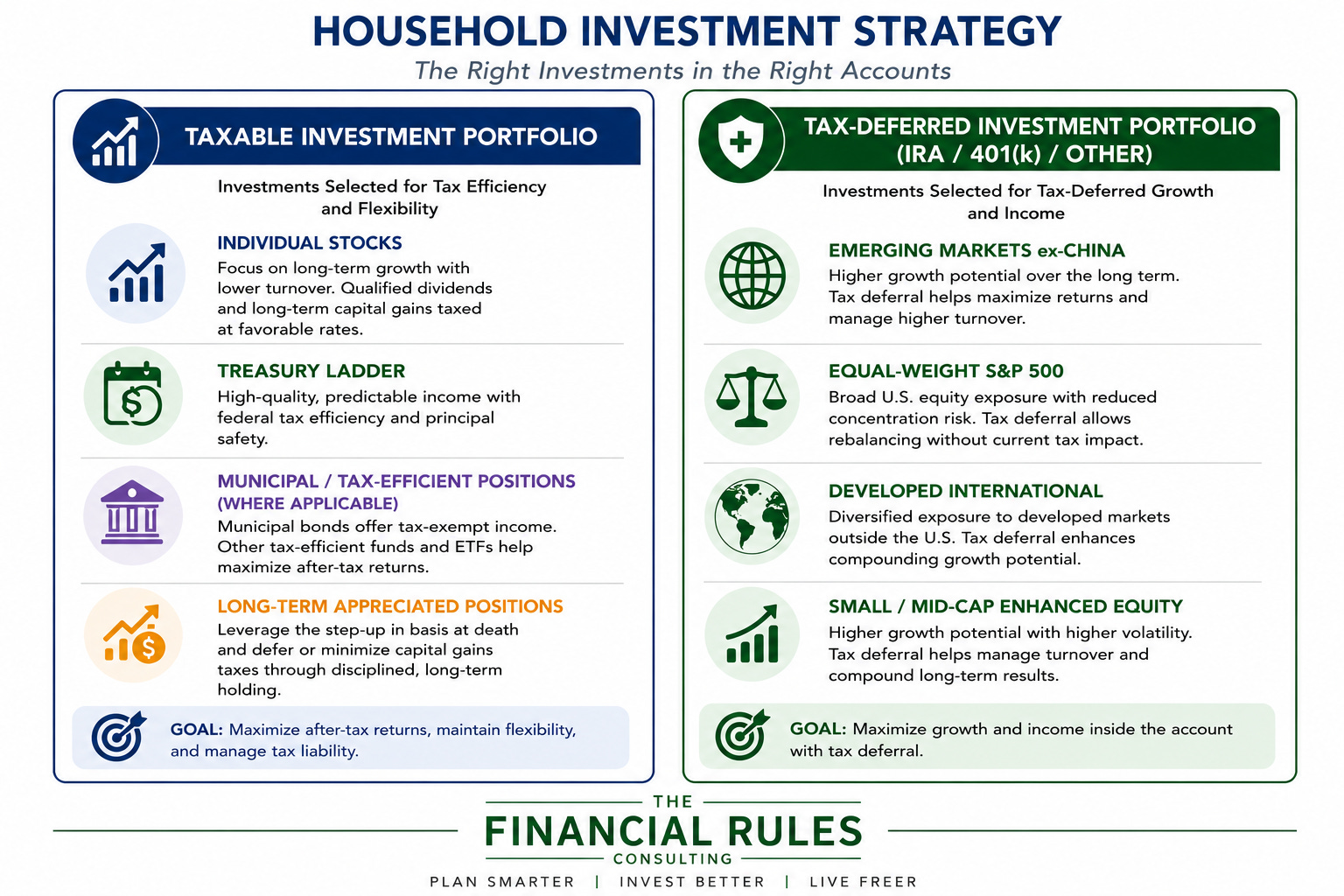
The taxable account, by contrast, contains:
Individual stocks
Treasury ladder
Municipal/tax-efficient positioning (where applicable)
Long-term appreciated positions
That suggests the advisor is thinking at the household level, not simply filling each account independently.
That’s a meaningful positive.”
It then reverted back to looking to simplify the portfolio, but added a layer of tax-sensitive nuance, with the following:
“What I would probably recommend
If the clients wanted to move toward indexing, I would likely recommend something like3:
Schwab U.S. Broad Market ETF
50%
Schwab International Equity ETF
25%
Schwab U.S. Aggregate Bond ETF
25%
…but I would not necessarily hold those percentages in each account.
Instead, I’d use asset location:
Taxable account: mostly U.S. equities and any desired individual Treasury holdings for tax efficiency.
Traditional IRAs/SEP: most or all of the bond allocation plus international equities, since interest income and foreign fund distributions are sheltered from current taxation.
This approach keeps the overall allocation at 50/25/25 while potentially improving after-tax outcomes.”
Honestly, this is standard investment management advice, but it’s definitely beyond most non-professional investors’ knowledge. It would push a non-professional household investor to consider this second-order complexity: The idea that you can think about not just stock-and-bond allocations, but the proper tax-efficient type of account for stocks and bonds. Color me impressed.
Not everyone would know how to go about doing “asset location” but it would go a long way to suggesting the direction that non-professional household investors should look, and that itself is very valuable.
Cost Savings
The next thing I wanted AI to provide was a quick analysis of the cost differences between using the advisor instead of choosing a radically simple self-managed portfolio like a 3-ETF Portfolio.4
Within a few seconds, the chat provided this annual comparison:
“Annual Costs
Assuming a combined portfolio value of $2.8 million:
Advisor fee (1%)
~$28,000
ETF expenses (0.04%)
~$1,100
Annual savings: about $27,000.
That savings alone is meaningful in retirement—it covers a significant portion of annual spending without requiring additional investment risk.”
And then the AI, metaphorically, went in for the kill.
“Twenty-Year Retirement Comparison
Let’s assume:
Initial portfolio: $2.8 million
Gross investment return: 7% per year
Annual withdrawals: 7% of portfolio value
Same asset allocation in both approaches
Tax-aware implementation in both cases
Under those assumptions, investment performance should be very similar before fees.
The principal difference is the ongoing cost.
Gross return
7.0%
Annual costs
~1.0% - Advisor cost
~0.04% - Indexed cost
Net return before withdrawals
~6.0%
~6.96%
That roughly 0.96% annual advantage compounds over time.
A reasonable estimate is that, over 20 years:
The advisor-managed approach would incur on the order of $500,000–$600,000 in advisory fees.
The indexed approach would incur roughly $20,000–$30,000 in ETF expenses.
The combined effect of lower fees and the additional compounding could leave the indexed approach ahead by approximately $600,000 to $1 million, depending on the sequence of market returns and withdrawals.
The exact outcome will vary, but the difference is large enough that fees become a first-order consideration rather than a rounding error.”
If you are reading all these words and you don’t totally understand what the AI is getting at, that’s fine. But you should at least be inspired5 to ask some follow-up questions. Like…what costs am I incurring? How much do I pay for investment advisory work? How much do I pay for investment transactions? How much do I pay for the funds I currently own? If I plugged some of this information into my AI chatbot, would the potential fees be a meaningful amount? What about costs not just considered for one year, but also over the coming decades?
Answers Yes, they will be a meaningful amount!
My conclusion
The differences pointed out by the AI chatbot are so big and astonishing that even if the advisor is adding extraordinary value - in terms of behavioral finance advantages, help with withdrawals, and retirement income planning - a reasonably competent household should be thinking carefully about the advantages and disadvantages of advisory help versus self-direction. Save $27K a year here and $27K a year there, and pretty soon you’re talking about half a million dollars. Which, most people I know would prefer to have in their account, rather than not.
If you are a person of a certain (old) age, that astonished phrase I’m exclaiming is said with the same intonation and energy of knocking my palm into my forehead saying “I could have had a V8!”
I have shortened considerably the amount of information provided by AI chat, in order to show the highlights only, from my perspective. As I mentioned in the first post in the series, the chatbot wants to offer, continuously, more and more information, sometimes to the detriment of the reading experience. But there’s no shortage of excellent guidance in addition to its logorrhea of ideas. The way to tame it is probably to add something like “In three paragraphs or less” or “Just one page of response” or something like that, to rein it in.
Readers of long-time financial columnist Scott Burns (who preceded me at the newspapers I wrote for) will recognize this type of wisdom as an extension of his “Couch Potato Portfolio,” which had many variations but essentially consisted of the smallest number of holdings possible, while maximizing diversity, matching a preferred risk level, and minimizing costs.
Again, a 3-ETF portfolio is classic Couch Potato advice. Good stuff from the chatbot.
Do you find half a million dollars inspiring? I do.
No posts
Comments
Nothing yet. Say the first thing.
Sign in to join the conversation.