
Please see my related-post Experiments in Personal Finance AI - Part 1
I began with a failed AI experiment earlier this month. Maybe because failure is a better teacher than success. Maybe because I wanted to begin with the idea that I’m definitively not an AI expert, in the summer of 2026.1
Maybe as I continue to learn I can turn that failure into a success, showing progress over time.
The second personal finance AI experiment I tried, however, was a smashing success.
Like the first, a friend had suggested I try this one.
He had begun by dumping a barely-formatted spreadsheet of his investments into his AI of choice.2 He was pleasantly surprised at how in-depth the results are.
Barely formatted?
By barely formatted, I mean you can almost be certain that in whatever way you currently track your investments, your AI can make sense of it.
The AI itself suggests formats like a .xls (Excel) or .CSV (rougher, less formatted version of Excel), or a PDF, or a Word Document. Compared to other things I’m more familiar with from the business and investment world that involve data dumps, this is all extremely forgiving.
In the old, pre-AI days, much of the time spent on data analysis came from setting up every label, every column, every persnickety cell format in some specific way. Mistakes or deviations from the required format would mean the analysis couldn’t be done, or that it would be done wrong. That just isn’t the case with AI. You can dump your information into the chat box as is.
So barely formatted just means you drag-and-drop your word document, your pdf, your excel file, your whatever - into the AI chat. And then you watch the magic happen.
But also, first: Privacy Thoughts
Here I should point out that we’re in the early days of knowing what data-security features these AI tools have. For that reason, you should hesitate before dumping a copy of your brokerage-statement PDF into your AI tool, because that would potentially expose your data to the unknown uses of that company, or the unknown capabilities of hackers to access information entered into AI chats. That PDF statement would have your account number, name, address, plus important data about your net worth. Could it be hacked? I don’t know! Probably?
An anonymized spreadsheet, without your name or address, is safer for this experiment. To be clear you can absolutely get incredible AI results by simply dropping a downloaded PDF of your brokerage statement into you AI chat tool. It will read it all immediately and accurately and give you all the quick data you could imagine. But the safest way to learn about your investment holdings according to an AI chatbot will be through an anonymized list or spreadsheet or Word document.
Ok - on to the fun and useful parts of AI analysis!
Use Case #1 - Substitution Analysis/Simplification
So for the purposes of this experiment I accessed my client’s Schwab account3 and downloaded a .CSV file (a simplification of an Excel file), and saved it (anonymously) as an Excel file.
The portfolio at the time I downloaded it was worth $2.1 million. The largest portion was 41 individual stocks worth $1.3 million, primarily large capitalization US stocks, although they were not labeled that way by Schwab in any way. They just were generally companies I’ve heard of, which means they were mostly large caps. The portfolio included 7 different ETF positions worth a total of $322 thousand. It contained 11 individual bond positions. Finally, it contained a small cash position, separately labelled.
For my consulting clients, they are paying an investment advisor 1% per year to build and manage this particular taxable portfolio, as well as other portfolios. I did not include those other portfolio positions in this first experiment although that would be as simple as uploading other Excel sheets and asking Chat GPT to redo the analysis integrating these new portfolios.4 I just wanted to see what could be generated in 5 minutes of downloading and then uploading to a paid version of Chat GPT.
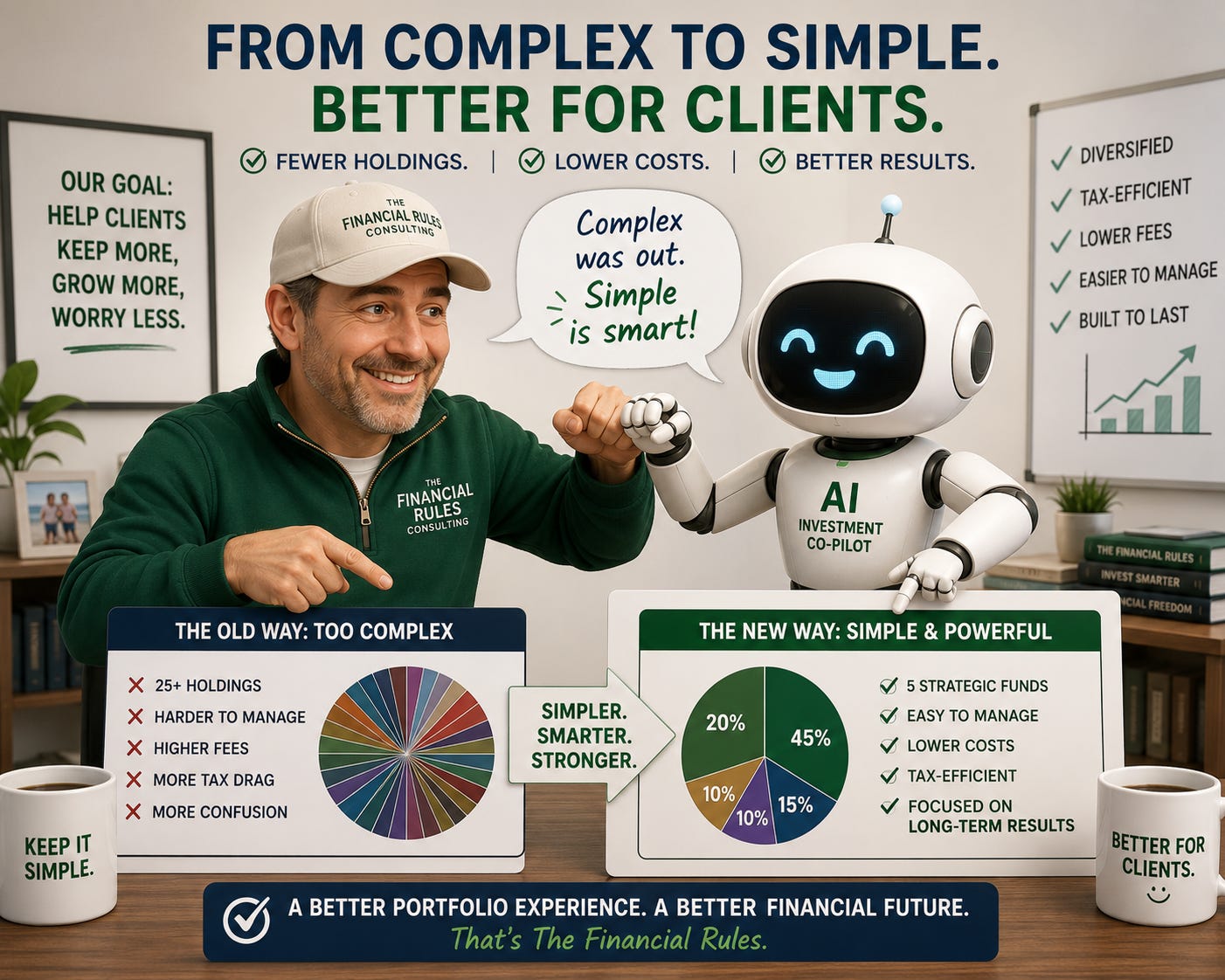
After about 17 seconds of thinking about the client portfolio, it gave me a quick summary:
“Executive Summary
This looks like a well-constructed but fairly complex portfolio with roughly $2.19 million invested.
It appears to have three major components:
61% individual stocks
25% laddered fixed income (primarily U.S. Treasuries plus one FDIC-insured bank note)
15% ETFs (primarily international, small-cap, and TIPS)
Overall, I would characterize it as:
Moderate risk
Above-average diversification
Moderately income-oriented
Much more complicated than necessary to obtain similar exposure”
So obviously I could and did perform the same analysis, but it took me quite a bit longer than 17 seconds. Then I asked whether, given the fact that it is “more complicated than necessary,” how could I replicate the risk and diversification in a simpler way? That AI chatbot answered immediately:
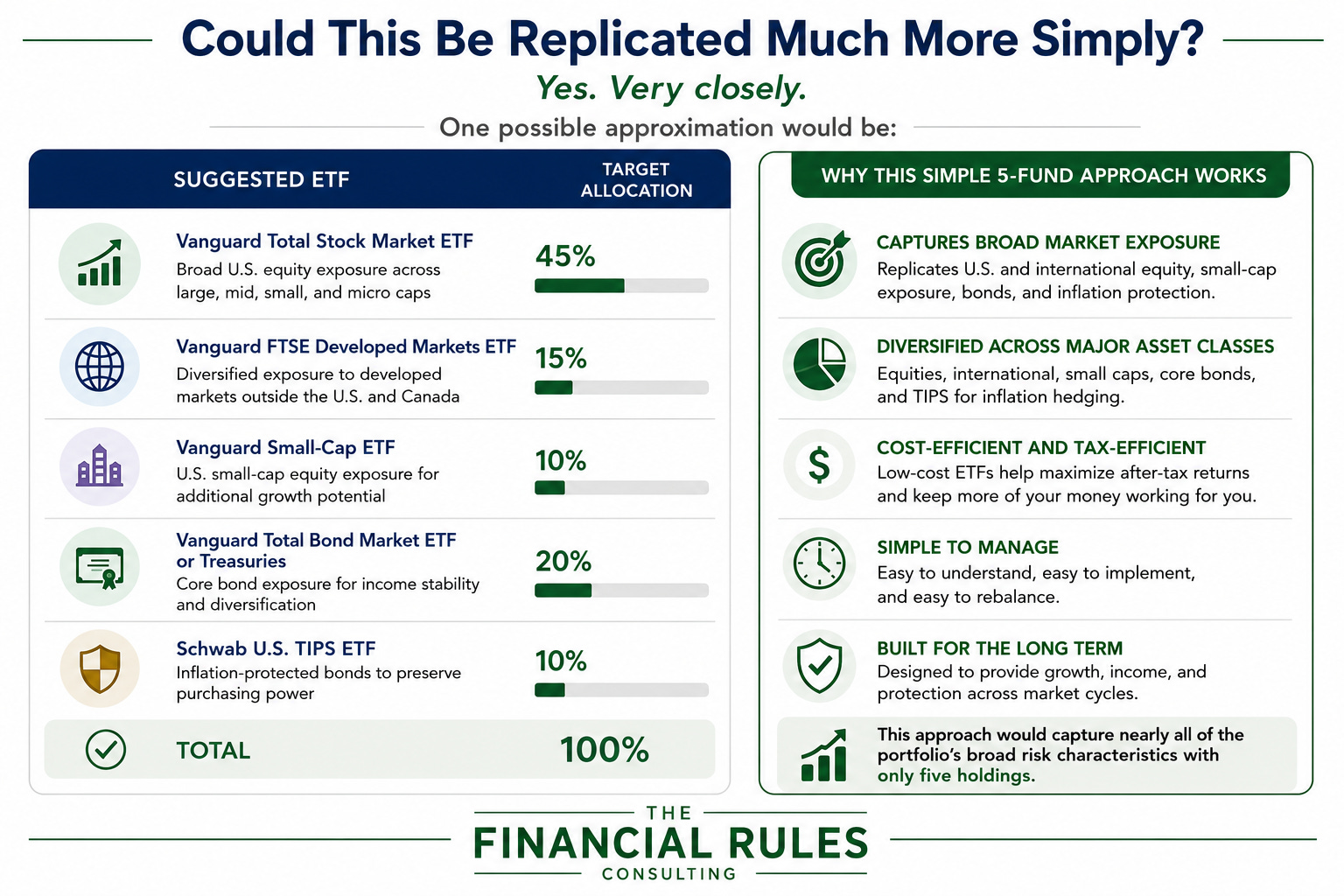
“Could This Be Replicated Much More Simply?
Yes.
Very closely.
One possible approximation would be:
Vanguard Total Stock Market ETF
45%
Vanguard FTSE Developed Markets ETF
15%
Vanguard Small-Cap ETF
10%
Vanguard Total Bond Market ETF or Treasuries
20%
Schwab U.S. TIPS ETF
10%
That would capture nearly all of the portfolio’s broad risk characteristics with only five holdings.
An even simpler approach could be:
75% Total Stock Market
25% Total Bond Market
using only two ETFs.
You would lose some of the advisor’s specific tilts (international weighting, Treasury ladder, TIPS allocation, individual stock selection), but the overall behavior would likely be surprisingly similar over long periods.”
So again that’s kind of what I was thinking and had shared with the clients, but I was interested to see the same response from the chatbot. There was a lot more information that the AI provided in addition to this, but it’s analysis of how to substitute and simplify precisely aligned with my priors.
In that same chat, introducing a few more elements as well as a rounded picture of the same client’s situation, we got into diversification analysis, tax-sensitive investment management, and maybe most importantly, cost analysis. I’ll save those final two for a subsequent post (an upcoming “Experiments in Personal Finance AI - Part 3”).
Use Case #2 - Diversification Analysis
A next useful thing I did with a different client’s portfolio - and this trick is even more cool - is to ask the AI to integrate a variety of different investment portfolios into the household analysis. So you dump one portfolio of various stocks and bonds and mutual funds, and then the dump the other portfolio of various stocks and bonds (you don’t need to particularly format them the same way!) and then just ask the AI to look at diversification across all portfolios.
It’s very good at recognizing that the holdings of one mutual fund (or ETF) might be remarkably similar to the holdings of another mutual fund (or ETF), which in turn reproduces individual stock holdings. It will give you an analysis of your diversification - or the opposite - your concentration, by individual company or sector.
Of course this is the kind of thing I can do for clients. But it might take me 2 hours to do what the AI can do it in 33 seconds. This is astonishing.
The chatbot then went on to give a precise rendering of the stock/bond ratio, as well as the ways to think about diversification across market sectors and industry sectors. It highlighted which US large caps are broadly overlapping with holdings inside large cap ETFs or mutual funds and overlapping with individual stocks. It listed the 11 largest holdings within the portfolio and points out that no single position dominates the holdings, which it noted is a good thing.
It pointed out that the fixed income diversification is strong because of the individual bond and CD positions, but the trade-off is additional complexity, which is exactly my view as well.
Comments
Nothing yet. Say the first thing.
Sign in to join the conversation.