
I recently had the opportunity to read Alisa Liu’s viral blog post on her experiences navigating the industry job search process as a PhD student working on modern LLMs. It was an incredibly insightful and thoughtful piece and inspired me to similarly reflect on my own experiences and see if it might be helpful for others, too.
I’m a final-year MD-PhD candidate at the University of Pennsylvania. I defended my PhD back in 2025 nominally within the Department of Bioengineering, although much of my research was in Computer Science. I applied for PhD Research Internships for the summer of 2025, and full-time Research Scientist / Data Science positions (including extended internships) for the 2026-2027 academic year. I was generally interested in working in leading industry labs working on some sort of health AI research.
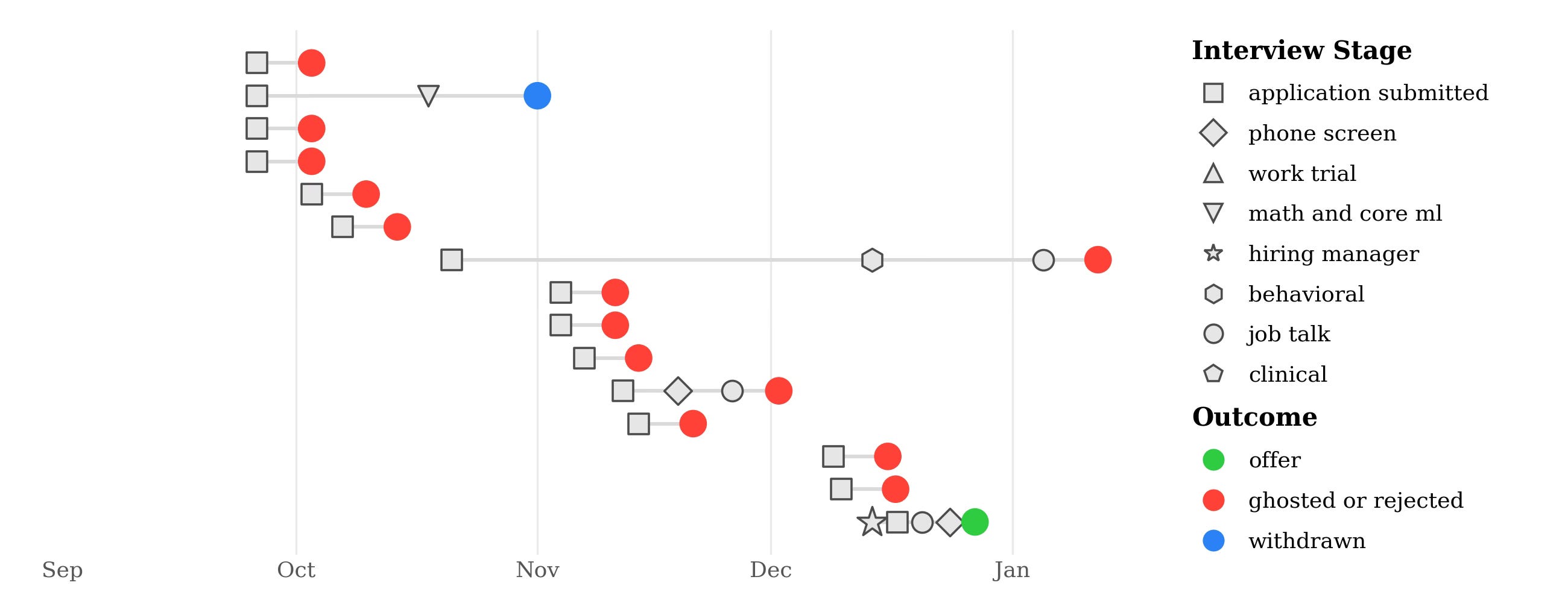
I made two figures showing my job search timeline for each of the two interview cycles. The figures are heavily inspired by Alisa Liu’s figures in her blog post - all credit on the figure design goes to her. Firstly, for the 2025 PhD internship search, I did a total of 8 interviews at 4 companies, although I applied to 15 positions in total.
A couple of points I’d like to comment on about this process:
The one position I withdrew from was for an opportunity where a recruiter contacted me first, and in field with absolutely no relevance to healthcare whatsoever. I was initially excited because I was simultaneously going through whatever the equivalent of a “quarter life crisis” is for MD-PhD students. Fortunately, at some point along the interview process, I started questioning what I was even doing the interview for and whether it was important for me to practice medicine down the road (spoiler alert: it is). After much thought, I ultimately decided to withdraw because it was too big of a career shift into a field that I wasn’t sure about.
You’ll notice that for the one position I ended up getting an offer for (and accepting), it actually started out very different when compared to all my other applications. This was the one position I actually met with the hiring manager first for a coffee chat at a CS research conference I attended - we had a very interesting conversation about research directions and my thoughts on some ideas their lab was working on. From that conversation, they mentioned that they had an unannounced summer research internship position that was opening up soon, and encouraged me to apply where I got to meet my research mentor for that summer. This was a great example of how amazing getting to network at research conferences can be - I’m forever grateful for being able to attend that conference, reaching out to the hiring manager for coffee, and eventually that leading to an offer.
Unfortunately, most applications didn’t go anywhere for me - 11 out of the 15 applications I submitted either ended up getting rejected or ghosted, meaning I never heard back from the company. I’ll talk about why I think this might have been the case below.
The 2026 job search was very different. During the previous cycle, my goal was to find a short summer internship that’s similar to the PhD internship opportunities that your “standard” PhD students apply for in computer science. However, for the 2026 cycle, I was primarily interested in finding a long-term opportunity for at least the 2026-2027 academic year, which coincides with my last year of medical school. My reasoning was that the last year of medical school gives you a lot of free time, and so I wanted to do something exciting within industry prior to potentially starting residency.
However, this change in motivation also came with its own set of difficulties. I knew well in advance that finding year-long positions is extremely challenging - it’s not really short enough for you to be considered as an “intern,” but companies are also making a huge gamble on taking you on as a full time employee because there’s a likely chance that you’ll only be around full time for one year before disappearing into residency. I made sure to be upfront with all the companies I applied for that I was potentially considering residency training starting in July 2027 to be transparent from my end. As a result, I also ended up applying to a mix of both full-time and internship opportunities.
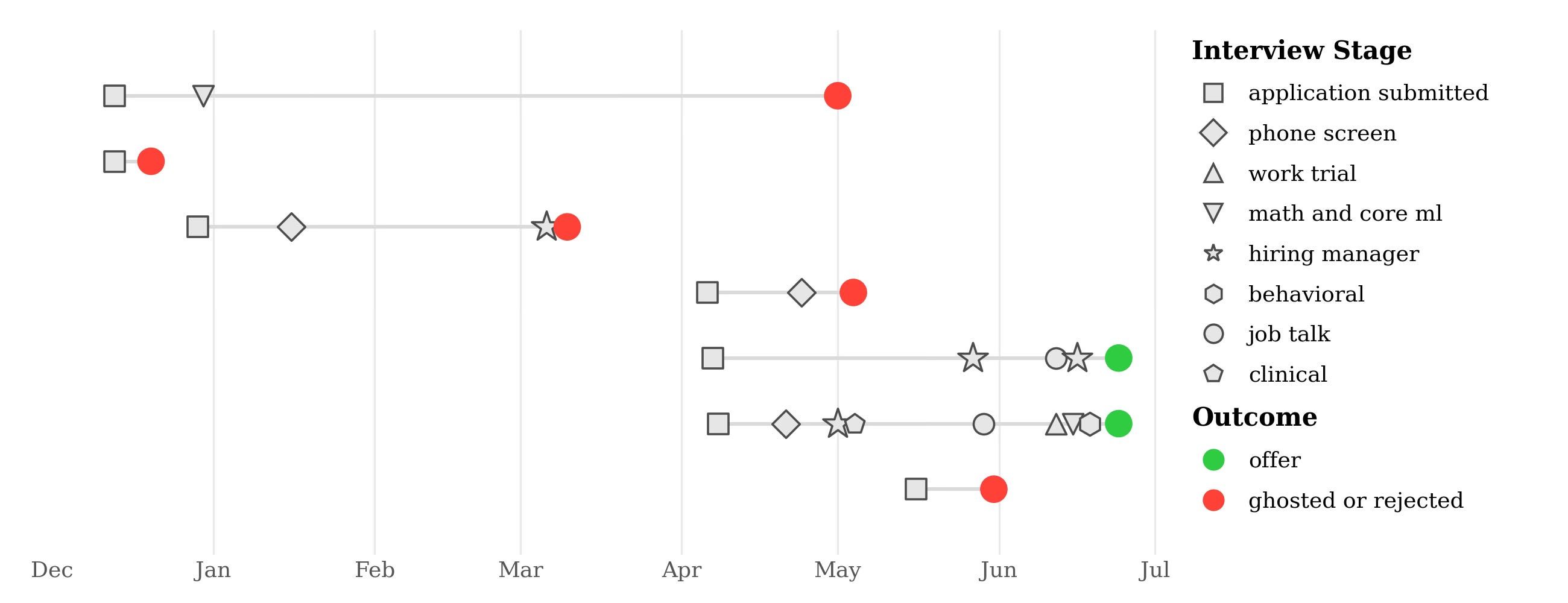
Overall, I applied to a total of 7 companies. I completed a total of 13 interviews for 5 different positions, and ultimately received 2 job offers where I ended up going with one of them.
A couple thoughts on this interview cycle:
In general, I felt like this cycle was a lot less stressful because I was a lot more selective with the places that applied for. I feel like the process of defending my PhD and writing my thesis forced me to have a very clear vision of my research direction and research goals, which made me better able to express these things in my applications and conversations with potential employers. I think this definitely worked in my favor.
The 3 positions where I had at least one interview but no offer at the end all had some hesitancies with my timeline (likely max 1 year employment) as discussed above. However, I note that they all tried to work with me and it didn’t seem like that was a complete reason for rejection. The main reason why these opportunities didn’t work out (according to the recruiters) was my unwillingness to relocate - these positions were based on the West Coast, and I really wanted to stay near Philadelphia for personal reasons. While it’s all guesswork at this point, I imagine that I more opportunities might have been available if I had been more flexible with location.
Many of the positions that I was applying for required me to know a lot of the technical details (e.g., math and programming) in addition to having a strong clinical + research background. I occasionally had technical interviews where I was asked questions just like any other applicant regardless of degree. I say this because I remember having a (fairly arrogant) worldview early on during my graduate training that somehow doing an MD-PhD would allow me to be “pretty good” at both the clinical and technical aspects of a job and still get by, since any knowledge deficiencies in one realm could be explained away by having to study a lot of knowledge in the other. This is far from the case - for industry research positions, I needed to perform as well as any other PhD-level job applicant from all aspects, including math and programming. At the same time, I also had a clinically oriented interview with MD collaborators where I was held to the same clinical standards as other MD-only applicants. Put simply, it felt in some ways that pursing dual-degree training really meant that you needed to know twice as much information as an MD-only or PhD-only applicant.
Generally, the interviews I had roughly fell into the following buckets:
Job talk. This was probably one of the more common interview types I came across - generally a 15-20 min presentation on a specific first-author paper I worked on of my choice, followed by extensive Q&A. Main advice I would have here is to pick a simple enough project that you can actually realistically cover in such a short time frame. I would also make sure the project is actually relevant to the work the company does as well.
Hiring manager interview. These were usually pretty informal conversations with the team leads that I would be working under. For those that are coming from a more academic background, you can sort of think of these as interviews with the PI of the lab. They were generally interested in my background, why I was interested in the role, and often asked me to give a mini job-talk on my general research direction and what types of projects I’d be interested in working on.
Math and core ML. These were either take-home programming assignments or a virtual interview where I’d be asked a series of math or programming questions ranging from basic statistics and probability distributions, to experimental design, to intricacies of transformer model design, possible failure modes, and commonly used loss functions. Interestingly enough, I did not have a single “LeetCode-style” interview that involved programming during a synchronous interview.
The rest of the interviews were typically pretty straightforward and definitely less stressful.
I made sure I always had a few slides (definitely adapted from my dissertation defense) on different first-author projects that I thought might be relevant to talk about. Sometimes (especially during conversations with hiring managers), interviews might not necessarily be marketed as a job talk, but can often benefit from having a short couple of slides to illustrate some of the main points instead of just waiving your hand around in the air. This part wasn’t too stressful other than making the slides in the first place. The night before an interview, I would also make sure to review my slide decks and think about how they might relate to the specific company I was interviewing with the following day.
The most challenging part from my standpoint was really preparing for the technical interviews. A few weeks in advance, I would prompt an LLM (Claude Sonnet 4.5 with extended thinking in my case) to generate sample interview questions based on the job description and any information about the interview that I received beforehand from the recruiter. Claude would typically spit out a laundry list of 50+ questions that I would slowly work through and take notes on prior to the interview.
I think the hardest part about all of this is really in the dual nature of your MD-PhD training. Not to beat a dead horse, but as mentioned above, it was challenging to find time to prepare for interviews during my clinical training. When I was a full-time PhD student back in 2024-2025 and looking for 2025 internship opportunities, it was easier for me to put my research on hold for a few weeks because everyone around me, including other PhD students, was also actively looking for internships. PhD advisors were generally pretty understanding when research was a bit slower to prepare for interviews. However, most of my interview prep during the 2026 cycle was during my clinical training (e.g., my internal medicine sub-I and one of my core clerkships), which does not afford you any flexibility in your schedule because it’s expected that you’re 100% focused on your clinical responsibilities. As a result, I often ended up working long days and having to prepare slide decks and go over practice questions well into the evening after my shifts. It was exhausting but (I think) ultimately ended up paying off.
Other than AI, resources that I highly recommend include knowing Pratik Chaudhari’s ESE5460 course notes inside and out, and also (unsurprisingly) Alisa Liu’s LLM notes and math notes. I personally didn’t use the last two during my own prep, but was able to review them afterwards and definitely wish I had them available.
If you’re lucky enough to land an offer (or offers), congratulations! Personally, I have really enjoyed doing exciting research in industry and hope to continue doing so as part of my long-term career.
I’ve traditionally read that navigating the post-interview process can be challenging. However, in my experience I think the importance of negotiating the monetary details of the offer are a little bit less important especially if residency training is still potentially on the table for you. This is because whether your salary changes by a little bit for only one year doesn’t really affect your long-term earnings. For internship roles, there’s basically no negotiations whatsoever (or I’m just really bad at doing negotiations :)). I’ve typically tried to seek out roles where I was genuinely excited by the work culture and the coworkers I’d be sitting next to, and I think it’s served me well.
No posts
Comments
Nothing yet. Say the first thing.
Sign in to join the conversation.