
I recently read a piece by the Healio team that featured a discussion between multiple pediatricians on the tangible gap in AI innovation between adult and pediatric medicine. The article itself is worth a read, but I also wanted to expand on some of the points that they raised in their work and dig deeper into why we’re seeing a common discrepancy in AI research, deployment, and utility amongst different patient populations.
First and foremost, clinical research has always enrolled adults at far higher rates than children. The reasons are structural and intuitively make sense: adult patients can consent for themselves which make research less ethically ambiguous, and adult diseases have larger market incentives. As a result, data repositories that allow us to learn the dynamics of adult clinical pathophysiology generally dwarf their pediatric counterparts in both scale and variety. Furthermore, the NIH did not mandate pediatric inclusion in federally funded trials until the Pediatric Research Equity Act that was passed in 2003 in order to obtain pediatric labelling for therapies undergoing FDA clearance.
The downstream effect is profound. I can say from personal experience that when machine learning (ML) researchers reach for training data, they find a landscape that is orders of magnitude richer for adults. EHR databases built from large academic medical centers (e.g., MIMIC-IV, UK BioBank, Penn Medicine BioBank, All of Us) skew heavily toward adult encounters for both inpatient and outpatient. Pediatric-specific EHR corpora comparable in size simply do not exist at scale.
Several factors help explain this gap (see Bourgeois FT, et al. Pediatrics (2012) and Rose CD. Pediatrics (2017) for excellent detailed discussion):
Consent complexity. Every pediatric research encounter requires parental or guardian consent plus, for older children, patient assent. This friction substantially inflates recruitment cost and time relative to adult studies.
Low disease prevalence. Many conditions that dominate adult medicine (hypertension, type 2 diabetes, ischemic heart disease) are understandably rare or absent in children. Pediatric-specific diseases, such as inborn errors of metabolism, congenital heart defects, and rare pediatric cancers, each affect small absolute numbers of patients, making data aggregation and protecting patient anonymity difficult.
Privacy protections. HIPAA and FERPA create overlapping protections for minors’ health data that make de-identification, secondary use, and data sharing more legally complex than for adult records. Navigating these protections has also been an ethical challenge in the past (for example, in computer vision research on autism), and the corresponding breaches in privacy and patient trust understandably make future patients and families cautious about participating in future research studies.
This data imbalance has real consequences for the pace of discovery. Pediatric access to novel therapeutics are about a decade behind their adult counterparts. Regulatory guidance for pediatric devices consistently trails adult approvals. And clinical decision support tools are predominantly validated on adult cohorts before any pediatric adaptation is attempted (if it’s attempted at all).
The publication record makes the disparity concrete. As an example, a systematic search of PubMed for studies evaluating large language models (LLMs) or vision-language models (VLMs) in clinical settings reveals a striking and widening gap between adult and pediatric medicine research activity.
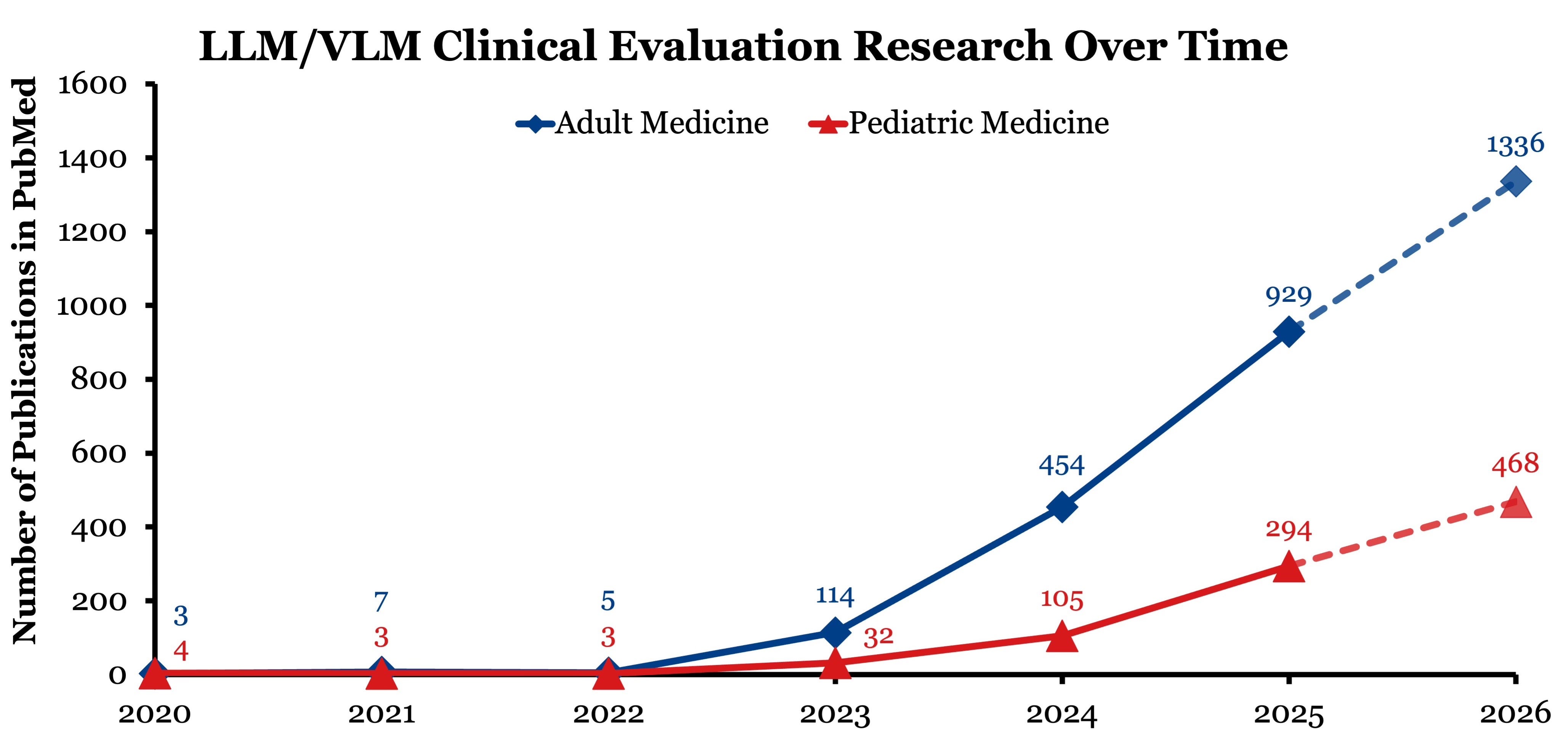
Year over year, PubMed researchers are publishing approximately 3x more studies on the applications of LLMs and VLMs in adult versus pediatric medicine, translating to a widening gap in research output over time. Because fewer researchers are working on pediatric applications, the available technologies are also less performant in pediatric care: a study in JAMA Pediatrics found that ChatGPT-3.5 had an 83% error rate on 100 pediatric case challenges from JAMA Pediatrics and NEJM, and a follow-up study in 2024 by another research team found that LLMs have a diagnostic accuracy of only 13.1% on rare pediatric disease case reports. In contrast, adult-focused studies are close to achieving near-perfect accuracy on complex internal medicine cases. (Admittedly, the linked adult study is more recent and uses more performant models with different benchmarks, but I hope the message is still clear even if we’re comparing apples to oranges).
Ultimately, my point is that the discrepancy is not just about capabilities of technology: it’s a broader issue that propagates upstream to the available training data, validation populations, and the sheer volume of iterative evaluation. This fundamentally introduces a gap between how much evidence clinicians have to work with in adult versus pediatric medicine.
The most direct intervention is encouraging pediatric patient participation in research. I’ve so far been focusing a lot on the gaps, but there has been substantial progress on this front as well: PEDSnet, the Pediatric Cancer Data Commons, and EchoNet-Pediatric are just a few examples how expanding data acquisition efforts, working together with patients and families, and mandating pediatric validation as a condition of clinical AI deployment are concrete policy levers that we have access to.
At the same time, it’s important to also acknowledge that data generation is slow and expensive. A parallel (and perhaps more tractable) strategy is to ask a different question: which insights from adult medicine are safe to translate to pediatric populations, and which are not?
Translation is already standard in pharmaceutical research (pediatric extrapolation modeling) and device approval (e.g., the FDA Pediatric Device Consortia). The same logic might apply to other therapies and interventions as well, and I’m hopeful especially with modern LLMs that we might be able to scalably and systematically characterize the conditions under which therapies validated in adults might actually generalizes to children (and to which children), and build frameworks that flag cases where it won’t.
One reason that this translation question has been hard to answer is computational: properly assessing whether an adult-trained clinical algorithm is safe for pediatric use requires large-scale counterfactual testing, where we need to either simulate or actually run (via RCTs) different clinical scenarios across age-stratified patient populations and measure the divergence in outcomes. This is, and has always been, expensive to do with real patient data and ethically complex to do in real life. Fortunately, modern technologies are beginning to make this more feasible. Warpspeed is an example of a new class of tools designed to accelerate exactly this kind of evaluation by using LLMs to enable rapid, large-scale clinical simulation and counterfactual hypothesis testing across patient subpopulations. The applications of technologies like this might include:
Probing generalization bounds. We might be able to accurately test whether a model trained on, for example, adult emergency medicine notes performs equivalently on pediatric presentations of the same chief complaint before any child is exposed to the model in a clinical setting.
Identify high-risk translation failures. We ideally would be able to predict the diagnostic categories, age groups, or disease subtypes where adult-model predictions diverge most from expert pediatric consensus. This would help us prioritize situations where human oversight is non-negotiable.
I think it’s important to note that I’m not arguing for in silico experiments to be a replacement for real-world pediatric validation. However, in a field where the data deficit is structural and unlikely to close quickly, these tools represent a meaningful way to extract pediatric-relevant signal from the vastly richer adult evidence base while maintaining the scientific rigor that pediatric patients deserve.
Pediatric patients account for roughly a quarter of all clinical encounters in most health systems. Perhaps by definition, they are among the most vulnerable: less able to advocate for themselves, more likely to suffer long-term consequences from diagnostic error, and historically the last to benefit from medical innovation. While closing the gap between adult and pediatric medicine requires a long-term willingness to invest in pediatric data infrastructure, I believe that the creative use of emerging technologies to bridge the gap where primary data is unavailable can help, too.
If you enjoyed this content, consider subscribing! I’m an MD-PhD candidate at Penn and hope to share advancements in AI research as they pertain to internal medicine and pediatrics.
No posts
Comments
Nothing yet. Say the first thing.
Sign in to join the conversation.