
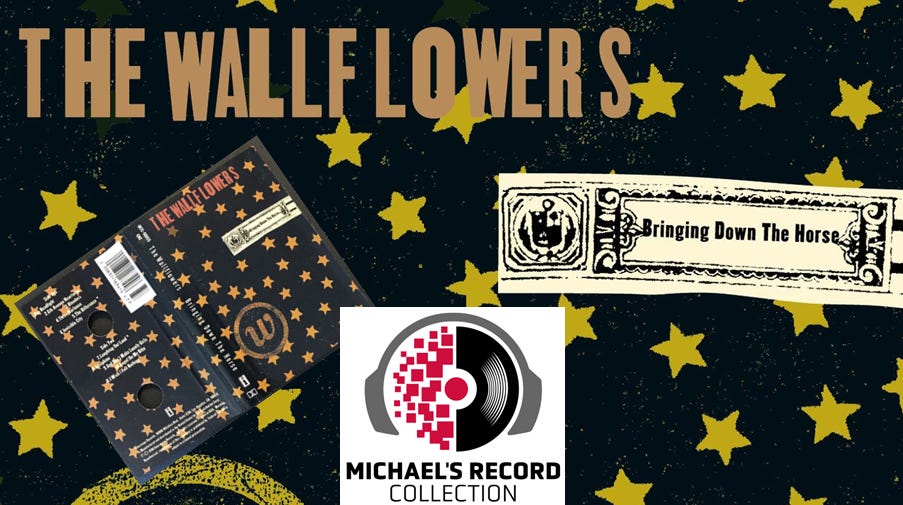
Thank you for spending part of your day with Michael’s Record Collection. There are a lot of big album anniversaries this year, and I want to talk about one of those this week. The subject of today’s newsletter recently turned 30 years old, and it just doesn’t seem possible that Bringing Down the Horse, the 1996 breakout hit album by the Wallflowers, has been around for three decades.
Let’s talk about this…err…classic. (Sorry, that just sounds weird.)
Hearing “One Headlight” on the radio was my first brush with the Wallflowers, a five-piece outfit led by singer-songwriter and guitarist Jakob Dylan — son of folk legend Bob Dylan. It was the second single released from the band’s second album, Bringing Down the Horse. Recall can be hazy after 30 years, but I believe I’d heard the first single, “6th Avenue Heartache,” and simply didn’t know who recorded that song, because when I got the album, I was like, “Hey, I’ve heard this. I like this song!”
When the album was released on May 21, 1996, it was a time of great upheaval in my life. I was preparing for finals ahead of college graduation and working two jobs. I didn’t have a lot of time for active music listening then, as one might imagine. My graduation was just a few weeks after the album was released, and it wasn’t long before I drove to Chicago for a job interview in the lobby of the Drake Hotel that ultimately took me to Amarillo, Texas, to work for an expansion minor league hockey team in a brand new league.
That job required insane hours, as I arrived in town just weeks before the Amarillo Rattlers’ first game. The arena didn’t have the equipment yet to make ice for the playing surface, the players and coaches were in preseason camp in Colorado, and the club hadn’t even bought a Zamboni yet. I had to acclimate to a new town, find living accommodations, and set up utility and bank accounts while trying to work about a hundred hours a week to get ready for the team’s first season in the Western Professional Hockey League.
Consumed by all of that, I just didn’t have much time for listening to music.
Flash forward to January of 1997, when “One Headlight” came out as a single. I must have heard the song 10 or 12 times before I knew who performed it. I can remember driving back to my apartment from the arena after a game and hearing the DJ on the radio identify the song. I said “the Wallflowers” out loud to myself several times to make sure I could remember it when I went looking for the album later.
I came across a cheap cassette copy of Bringing Down the Horse in a used bin at a record store and bought it, even though I didn’t have a tape player in my car by that point. I still had a stereo with a dual cassette deck at that time, so I listened to it at home. I fell in love with that album and it turned out to be one of my go-to listens for basically all of 1997, joining the likes of Fizzy, Fuzzy, Big & Buzzy by the Refreshments and Lemon Parade by Tonic.
The personnel on Bringing Down the Horse are as follows:
Jakob Dylan — vocals, rhythm guitar.
Rami Jaffee — piano, Hammond B-3 organ, Vox Continental, upright piano.
Greg Richling — bass guitar.
Michael Ward — lead guitar.
Mario Calire — listed as the band’s drummer but did not perform on the album.
But the band used several additional musicians on the record and there were some heavy hitters involved, including Mike Campbell of Tom Petty & the Heartbreakers, Adam Duritz of the Counting Crows, Gary Louris from the Jayhawks, and Michael Penn. Matt Chamberlain played drums on the album.
The album starts out with one of the best 1-2 punches of songs in rock and maybe the best of the entire 1990s in the form of opener “One Headlight” and “6th Avenue Heartache.” Even if the rest of the album was terrible — and it is far from that! — the first two songs alone would make Bringing Down the Horse worthy of being in anyone’s music collection.
But I’m in the mood to be succinct today (please take that with a grain of salt, considering the source), so let’s just go through the album track by track in capsule form.
“One Headlight”
I don’t know if this song is the best 1990s song to sing at the top of your lungs while drunk at the bar with your friends at 1 a.m. or if that distinction belongs to fellow 1996 release “Banditos” by the Refreshments or “The Way” by Fastball, which came out two years later, but it’s definitely one of those three. A song about “the death of ideas,” the lyrics seem like a jumble of Bruce Springsteen ideas pieced together in a way that makes it a catchy and cohesive song.
It’s got a chorus with which one can hardly resist singing along. You can hear a hint of Dylan’s father in his vocal, but his voice sounds more like Springsteen’s. Producer T Bone Burnett is a guitarist himself, so it’s no surprise that the guitars sound immaculate on this track, which has an underlying southwest flavor to it that reminds me a little of the Refreshments. Jon Brion, who performed with ‘Til Tuesday and the Grays, is credited with lead guitar on “One Headlight,” but it’s both the electric and acoustic guitar sounds that shine through over the slow gallop of Richling’s bass and Chamberlain’s drums.
It’s a great album opener, but you don’t have to take my word for how good the song is, because it won both Best Rock Song and Best Rock Performance by a Duo or Group with Vocals at the 1998 Grammy Awards. In the United States, it reached No. 1 on several Billboard charts, including: Adult Alternative Airplay, Adult Pop Airplay, Alternative Airplay, and Mainstream Rock. It also reached No. 2 on Billboard’s Radio Songs and Pop Airplay charts and was a No. 1 single in Canada.
“6th Avenue Heartache”
Mike Campbell of Tom Petty and the Heartbreakers provides the song’s signature slide guitar. He seems to be channeling George Harrison to some extent, possibly inspired by Petty’s work with Harrison in the Traveling Wilburys in the late 1980s. Campbell’s guitar work, along with tasteful organ and great vocals make this an infectious song. Counting Crows frontman Duritz guests on backing vocals and his voice works well with Dylan’s.
It’s surprising Campbell sounds so seamless on this song, as he recorded his parts separately in his home studio and reportedly never even met the band members prior to submitting it. Everything hangs together so well that it’s my favorite song on the album.
The most interesting thing to me about the opening two tracks on the album is that they work well regardless of the listener’s mood or situation. Whether you’re angry, melancholy, euphoric, chilling out, have had two or three beers too many, or whatever, the tone of “One Headlight” and “6thAvenue Heartache” are malleable enough to work in any headspace. They never seem out of place. They have elements of sadness, introspection, and anger baked in, but they’re melodic enough to hit a happy spot in the listening center of the brain. I’m sure there must be a mood for which they don’t work, but I haven’t found it yet.
The song reached No. 2 on the U.S. Adult Alternative Airplay chart and also charted on Billboard’s Alternative Airplay (8), Mainstream Rock (10), Pop Airplay (25), Adult Pop Airplay (26), and Hot 100 (33) lists. It also received two Grammy nominations.
“Bleeders”
The verses in this song share musical DNA with both the Heartbreakers and the E Street Band, coming off a bit as a hybrid of the two, although it rocks out a little heavier in the chorus than those bands typically do. Jaffee’s work on the album and Chamberlain on drums are the standout performances for me. While there is something a bit more generic about this song than some of the others that I can’t quite put my finger on, I always enjoy hearing it.
“Three Marlenas”
Dylan channels Springsteen on this mid-tempo track, but there’s also something straight out of “Waiting on a Friend” by the Rolling Stones and more than a hint of “Sweet Jane” in the acoustic guitar work and just the general vibe of the song. There’s even a couple of “ooh ooh oohs” thrown in late in the song that make me think the “Waiting on a Friend” flavor is intentional.
Despite the familiar sounds, whether intentional or accidental, this is one of my go-to tracks from the record. The lyrics are interesting and sound like they’re trying to be meaningful, but I’m not picking up everything Dylan is laying down on this one. I just like the groove and vibe of the song and the chorus melody.
It was the fourth single from the album and deserved a far better fate than to climb only to No. 51 on the Billboard Hot 100 chart.
“The Difference”
An up-tempo rocker, “The Difference” again splits erm…the difference…between the sound of the E Street Band and Tom Petty & the Heartbreakers. Jaffee’s Hammond B-3 organ stands out as shaping the sound that is otherwise a fairly standard guitar-driven song with a strong bass line from Richling. Louris from the Jayhawks lends his talents to the backing vocals. There’s a solid guitar solo from Ward in the middle.
If I have a criticism, it’s that I think Dylan could have dialed in his chorus vocal on the word “see” a little bit better, but it’s not offputting the way it’s sung. It’s possibly a lyric issue, because the word “see” has to do some heavy lifting, as it has to occupy a full five syllables in the song.
“The Difference” was the third single released from the album. Maybe it’s because it’s one of the more rocking tracks and the label wanted some contrast, but I don’t think it was the best choice. That shows what I know, because even though it didn’t make the Billboard Hot 100, it reached No. 2 on Billboard’s Adult Alternative Airplay chart, No. 3 on the Billboard Mainstream Rock chart, and No. 5 on the Billboard Alternative Airplay chart. It’s not a bad song, it just seems unremarkable next to others on the album.
“Invisible City”
Dylan channels his father a bit on this one but also there’s a forlorn Tom Waits quality that cuts through it, especially in lyrical passages like this one:
Now every heart has a blind side
Where it learns how to improvise
Well this place is a whorehouse tonight
Cheaper lovers make expensive wives
The acoustic guitar work in “Invisible City” is sublime. I assume it’s Ward. Focusing attention on Chamberlain’s tasteful drumming is rewarded when listening to this track.
“Laughing Out Loud”
A solid up-tempo number, my favorite thing about “Laughing Out Loud” might be the way Sam Phillips lends her voice on backing vocals. She melts into what Dylan is doing in a way that’s pleasing to the ear. Overall, this is a song that I periodically forget how it goes if I haven’t heard the album in a while, so it doesn’t stand out for me too much, but it’s a perfectly fine song that I don’t skip in the run of the record. As one of the few faster-paced songs (along with “The Difference”), it breaks up what could otherwise be an excessively mopey album.
“Josephine”
A ballad written during the album’s recording sessions, “Josephine” is a song I enjoy for the most part, though I have an issue with rhyming Josephine with “tangerines.” It seems a bit forced. “You taste just like sugar and tangerines.” What? Might as well have gone with Ovaltine, which rhymes better and makes as much sense. I don’t know. It sounds a bit forced to me but it’s a nitpick.
It’s a good song, though, and I can imagine hearing some band playing it live in some sad honky tonk while the locals nurse their beers and metaphorically rub their emotional scars. It has that sweet pain of forlornness about it that only a song can pull off in a way that actually feels good.
“God Don’t Make Lonely Girls”
I love the title of this song, which was written between the band’s first and second albums. Leo LeBlanc plays pedal steel guitar on it, which gives the song a slight classic Jackson Browne quality at times. It’s got a great singalong bar song vibe to it and it’s one of the album’s rockier tracks, with a little more heft in the drums than most of the tracks have and a meaty bass part in the song’s big finish from Richling.
There’s a little back-and-forth with the “yeahs” at the end of the chorus vocals that is reminiscent of Springsteen and Steven Van Zandt from the E Street Band during “Glory Days.” It just sounds like the Wallflowers are having a blast playing this song and that’s infectious.
“Angel On My Bike”
There are some similarities between this song and “The Difference,” but I like this one a little better. The vocal sits more in the pocket of the instrumentation in “Angel On My Bike,” whereas it’s more up front and in your face on “The Difference.” As mentioned above, Penn joins Dylan on backing vocals for this track with yet another voice that complements Dylan’s well. Duritz, Louris, Penn, and Phillips are all excellent singers in their own right, but it’s interesting that they all lock in so well with Dylan’s.
The acoustic guitar pattern, electric guitar flourishes, and organ lock together tightly on this track, and the chorus is better than the one in “The Difference.”
In retrospect, perhaps “The Difference” should have been a B-side for one of the singles rather than the album’s third single, which would have cut the album’s run time under 50 minutes. But either Dylan or the label must have liked “The Difference” better, because “Angel On My Bike” was a B-side for the “6th Avenue Heartache” single release and a live version of the song was used as the B-side for “One Headlight.”
What do I know? I like what I like and will make no apologies for it.
“I Wish I Felt Nothing”
The most overtly country song on the album, “I Wish I Felt Nothing” vaguely reminds me of Don Henley’s “You’re Not Drinking Enough” in tone, although this song is less sparsely accompanied than Henley’s. LeBlanc’s pedal steel guitar is easily the star of this cry-in-your-beer-style song. While I wouldn’t typically want such a downer of a song to close an album, it’s suitable in this case, given the tone of the album overall and its theme of failure.
The song was written with LeBlanc in mind, as the blind guitarist was fighting cancer during the making of the album and died not long after Bringing Down the Horse was complete. Dylan dedicated the album to LeBlanc.
It’s a beautiful song, yet sad.
After 30 years, Bringing Down the Horse still sounds great. The songs hold up, even though in retrospect, perhaps the Wallflowers stay too comfortably in the musical territories mined by their influences. At the time of the album’s popularity, it sounded like Dylan would become the next great storytelling singer-songwriter in the vein of artists like his father, Springsteen, Petty, Browne, and others. Burnett did a good job with production, with Tom Lord-Alge handling mixing and engineering.
It was a huge hit for the Wallflowers, and one that they haven’t yet topped. Bringing Down the Horse went quadruple platinum, climbed to No. 4 on the Billboard 200 albums chart, received two 1997 Grammy nominations and three more in 1998 (winning two). The album was a slow burn with listeners, requiring 10 months to climb to its peak chart position and was in the charts for more than 90 weeks.
It’s still a standout listen, and 30 years later, it stands out as one of the best albums of its decade.
One Headlight (5:13)
6th Avenue Heartache (5:37)
Bleeders (3:41)
Three Marlenas (4:59)
The Difference (3:50)
Invisible City (4:48)
Laughing Out Loud (3:39)
Josephine (5:09)
God Don’t Make Lonely Girls (4:49)
Angel on My Bike (4:22)
I Wish I Felt Nothing (5:04)
Thanks again for your time. Please consider sharing this issue of the newsletter with the music lovers in your life via the first button below, or sharing Michael’s Record Collection (in general) with the second. And be sure to check out the podcast version of MRC at your favorite podcast dispensary. I invite you to visit my website at michaelsrecordcollection.com and if you find value or entertainment in this newsletter, please consider subscribing to my Patreon at patreon.com/michaelsrecordcollection to support independent writing and podcasting for as little as $2 per month.
No posts
Comments
Nothing yet. Say the first thing.
Sign in to join the conversation.