
Thank you for spending part of your day with Michael’s Record Collection.
I have this strange affliction where I love discovering new music, yet at the same time I’m always skeptical of bands I’m not familiar with. It’s very weird. I love new discoveries and I’m always willing to try a new band or album, but I feel like I start each of these experience believing this new thing will not impress me.
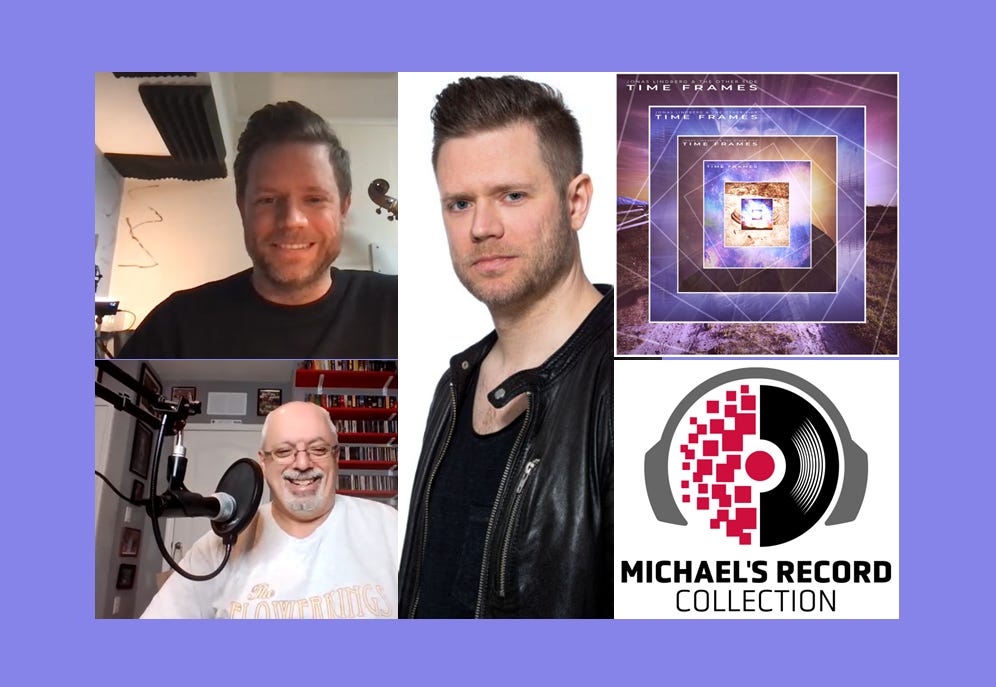
It’s always delightful to be proven wrong on that front. With that in mind, I had heard of Jonas Lindberg & The Other Side, but I had not yet heard their music until recently. The Swedish act is set to release its third album, Time Frames, and I finally got a chance to check them out on the recommendation of a publicist that I have worked with often. He assured me I would enjoy it. He was right.
After hearing the new album, I had to request an interview, and I recently caught up with Lindberg to talk to him.
Let’s get to that story.
Much of the best progressive rock released since 1990 has come out of Sweden. While many prog rock aficionados know about The Flower Kings, Moon Safari, Anglagard, Beardfish, Ritual, and Paatos, there’s a newer act that is making quite a name for itself — Jonas Lindberg & The Other Side.
This group of musicians will release its third album, Time Frames, on Lindberg’s own ModeMusic label on Nov. 7. Time Frames may end up on a lot of Best of 2025 lists despite coming out so late in the year, as the album presents seven standout servings of delightful melodic progressive rock that features tasteful-yet-accomplished playing without showing off or making it about the technical musicianship. Everything Lindberg and his team puts into the mix serves the song; nothing feels wasted.
The lineup on the album is similar to it was on Miles From Nowhere, although there is, unfortunately, no guest appearance from Roine Stolt this time.
Jonas Lindberg – Bass, keyboards, guitars, backing vocals, lead vocals (“Someone Like Me,” “Running Out of Time,” and “The Wind”)
Jonas Sundqvist – Vocals (“End of the Road,” “Faces of Stone,” and “The Wind”)
Jenny Storm – Vocals (“End of the Road,” “Galactic Velvet,” and “The Wind”)
Calle Schonning – Guitars (All tracks except “Someone Like Me” and “Running Out of Time”)
Nicklas Thelin – Guitars (All tracks except “Someone Like Me” and “Faces of Stone”)
Jonathan Lundberg – Drums
Maria Olsson – Percussion
Joel Lindberg – Guitars (“Gruvan,” “Running Out of Time”)
Conny Lindgren – Violins (“Someone Like Me”)
Lindberg’s approach to this “band” is that of a solo project. The multi-instrumentalist writes and demos the songs. If there’s a part he feels he plays well, he uses his own work. If he feels a member of The Other Side could play it better, he asks them to do it. Where he gets the most help is on guitars, where his brother Joel tends to play on the heavier, more metal tracks. Thelin plays more country/blues-rock style parts. Schonning is more jazz-fusion in style. In the past, he has let others handle the vocals, but on this one, he felt his voice on the demos suited a few of the tracks, so he sang those parts (“Someone Like Me,” “Running Out of Time,” and parts of “The Wind”)
“I always see Jonas Sundqvist as the lead singer, because he sang on the first albums all the way,” Lindberg said. “I assume Jonas is going ton sing everything, and then, because I sing the demos, once I think ‘Well, this sounded quite good with me on it,’ maybe I can sing that one.”
Time Frames got its name from Lindberg allowing himself a set portion of time to perform each task in the recording process for the album to keep the work progressing.
“Because I’m doing everything myself, you know, from writing songs to demoing to recording — mostly everything — and mixing and cover art and, you know, all of that. So, if one guy is doing everything, it takes time, especially if it’s not the only thing that you’re doing,” Lindberg explained. “Because, we also had a kid, you know, since the last album. So that also means that I can’t work all the time. Sometimes there can be a few weeks between sessions. I had to make mini deadlines all the time. For example, I got the drums from Jonathan. I started recording the bass and I knew that I had to be finished with the bass before Christmas, because then there will be a month before I can do anything else, and then I will have forgotten any ideas that I had. And that (process of setting time limits) was all the way, even up until the mastering process.”
The album itself is made up of seven tracks ranging from just under six minutes long to 17-and-a-half minutes, with the two longest tracks bookending the album and the five shortest tracks in between. The songs lean heavily on melody but without sacrificing musicianship and the kinds of interesting twists, turns, and solos that make prog rock such an enjoyable and exciting genre of music. The production levels are high, so the album sounds good from start to finish. With quality songwriting, playing, and production, Time Frames is an enjoyable listen from start to finish.
“End of the Road” kicks the album off with a big opening reminiscent of a Spock’s Beard epic. At nearly 13 minutes, it qualifies as an epic, but it is not the longest track on the album. To me, this song blends everything I love about Spock’s Beard/Neal Morse, The Flower Kings, and Kaipa, but only two of those bands were influential on Lindberg, who said he is not that familiar with Kaipa’s music. It is likely Lindberg’s folk influence and perhaps having both male and female vocals (mainly Sundqvist but Storm also has some lead parts) in the song that that I’m hearing.
The highlight of the song for me is a Lindberg keyboard solo that starts just before the five-minute mark, although the chorus has a nice hook to it as well. There’s a part just past six minutes in that shares some musical DNA with “Duke’s Travels” by Genesis, although Lindberg said he is influenced more by 1990s and 2000s prog than 1970s classics.
“‘End of the Road’ is one that I think turned out really good. It’s fun to play. It’s fun to listen to,” Lindberg said.
The opening epic has a huge, soaring, majestic section near the end that should satisfy the most ardent progressive rock fan. It gives way to a soft acoustic guitar and piano instrumental outro. As an album opener, it sets the tone, painting the picture with all the colors that will be used throughout the album.
“Someone Like Me” is a fun and quirky song that cleanses the palate. At just 5:43, it’s the shortest song on the album. Lindberg, who sings lead vocals on this one, wrote it about his baby daughter looking at her reflection in the mirror. He said that a lot of the lyrics for Time Frames were written while on parental leave, adding that lyric writing was the most difficult part of completing the album.
Conny Lindgren’s violins add a beautiful element to “Someone Like Me,” and Lundberg’s drums shine on this shorter, melodic track. Jonas plays a wonderful extended keyboard solo in the instrumental outro.
“‘Someone Like Me’ is the most different song (from the rest of the album),” Lindberg said. “It’s got a completely different vibe and a different groove. It works on the album.”
“Faces of Stone” is my early favorite after about a dozen listens to the album. It opens with a short and unassuming guitar pattern before busting into a melodic guitar-and-keyboard-driven main riff. Another standout keyboard part segues into Sundqvist’s lead vocal on the first verse, which plays over minimal music. More instruments jump in and suddenly it feels like there are a thousand layers to the music.
It’s breathtaking as the song crescendos into the titular lyric. Lundberg’s drumming is again quite enjoyable. He never overplays but he’s always present as a driving force in the song. Calle Schonning’s guitar solo just over a minute before the end is another highlight.
“Calle is like the Alan Holdsworth kind of fusion guitarist, you know,” Lindberg said. “So it’s very easy, you know, if I have a fusion part, it’s like, yeah, that’s perfect for Calle there.”
The song was a great choice for the album’s first single because it’s infectious, energetic, grabs one’s attention early, and never lets go.
Up next is “Galactic Velvet,” a song that was partially written a long time ago.
“I wrote the music for that one back in college,” Lindberg said. “I think it was 2001 or something, and then it sort of evolved over time. But I think the first demo was in 2005, and then I didn’t really think of it really up until now. Then, you know, I did ‘Summer Queen’ on the last album, which is really old — from the same time period. And I felt like that turned out really well. What if I do that with more songs? So, I tried it with ‘Galactic Velvet’ and finished it.”
That decision worked out well again for Lindberg. The song has a soft opening with acoustic guitar and keyboards. Drums and more layers of instruments join in before the first verse, which provides an excellent vehicle for Storm’s vocals — accompanied by acoustic guitar. It’s a lush, mid-tempo track in which Storm takes center stage rather than sharing it with Sundqvist, Lindberg, or both. However, there is a spoken word section by Lindberg just before a beautiful flute part. I didn’t see a flute listed in the album credits, so it may be a keyboard.
There’s a second spoken word part, which when combined with the music gives the song a bit of a folk-meets-psychedelic feel to it. There’s a gorgeous “ah-ah-ah” vocal melody line that feels like being wrapped in a warm blanket on a chilly day.
“Gruvan,” an eight-and-a-half-minute instrumental, is the album’s second single, which was a bold choice.
“My brother said, ‘I think you should try and release that one as a single,’” Lindberg said. “I said, ‘Why?’ (He said), ‘It’s really catchy, you know, it’s a happy song.’ Jonas (Sundqvist) always asks me, ‘Why didn’t you write lyrics for this one? It’s nice. It feels great singing that melody. I was like, ‘Nah’ (laughs).”
Gruvan is a Swedish word that means “the mine,” which is what the area where Lindberg’s studio is, which inspired the name.
“They call it Gruvan and I just used that title because I’d recently moved in here when I started demoing songs for the album,” Lindberg said. “I had a bunch of working titles named ‘Gruvan I,’ ‘Gruvan II,’ ‘Gruvan III.’ And this one hasn’t got any lyrics so I just went with the working title.”
The song has a little bit of everything. It starts out kind of folky and pastoral, but with, as Joel Lindberg said, a happy, upbeat feel to it. All of The Other Side guitarists appear in various places throughout the song, which is driven along by acoustic guitar with some keyboard-heavy sections and tons of little bits and pieces that add texture and depth. I particularly like Schonning’s Holdsworth-esque parts and how they fit into the overall song, which flies by in what feels like a lot less than eight minutes.
“Running Out of Time” alternates light, folky bits with a lush, melodic chorus as well as heavier parts. Some of the heaviest stuff comes in around the four-minute mark, with some scorching guitar solos by Joel Lindberg. The heavier section gives way again to the more pastoral music and then back into the layered chorus. The end cleverly time shifts the music to grind it to a halt as if someone had cut the power on a reel-to-reel tape machine, as the song literally runs out of time.
The album’s showstopper is the epic “The Wind,” clocking in at 17 and a half minutes. The closing track on Time Frames offers up a microcosm of the entire album, with all three vocalists getting their moments and all the guitarists except Joel Lindberg also contributing. The beginning features about three minutes of just mainly a vocal by Sundqvist, acoustic guitar, and piano with a light touch on the bass.
As epics do, the song then shifts repeatedly over its run time, with denser and lighter parts, various keyboard and guitar bits, and standout instrumental solos. The combined vocals at times are as good as what Moon Safari puts together, although with fewer parts to the harmonies, and the synth, guitar, and drums all shine. I especially like a guitar solo around the 11:30 mark (Schonning, I think, as it’s vaguely Holdsworth-esque). There are also some keyboard theatrics with about four minutes remaining that are outstanding.
As with all good prog epics, it feels shorter than it is when you listen to it. However, it was nearly an even longer song than what ended up on the album.
“‘The Wind’ was much longer,” Lindberg said. “And when I sent it to (Joel, his brother), he was like, ‘No, I think this whole section in the end is completely unnecessary. What if you remove that and extend this part instead, you know?’ And I was like, ‘Yeah, why not? Let’s try.’ And so, that (feedback) really helps.”
Time Frames comes to a satisfying and breathtaking close at the conclusion of “The Wind.” Lindberg said it was important for him to use the epics to bookend the album, noting that apart from “Someone Like Me,” the song titles are in alphabetical order, although that’s not how he chose the running order.
“The long epics actually I think capture the whole album within them, but they are too long to release as singles. It doesn’t work,” Lindberg said with a laugh. “I knew that I wanted the epics to be framing the album, start and finish. I juggled around with which one should go where.”
The album should satisfy fans of modern progressive acts like Spock’s Beard, The Flower Kings, Kaipa, and Moon Safari, while giving them something fresh, with modern production. The musicianship is solid, as are the songs. This one will be in serious consideration for a spot at or near the top of my 2025 prog rock albums.
As for tour plans, it’s been over 10 years since Jonas Lindberg & The Other Side played a live gig, as these musicians have other jobs and live in different areas. That said, there is still hope that the band can unite to do some live shows to promote Time Frames.
“There are many reasons for why we haven’t played live,” Lindberg said. “Mostly it’s because since I am also a freelance guy, I have been busy touring with other stuff, so I never had the time to actually put that together. But I really feel like now is the time to do it — to do something about it. I hope so. I’m going to look into that and see how we can make that work.”
Time Frames will be available digitally and on CD Nov. 7, and a vinyl version is planned for a future release. You can order it at www.lindbergmusic.com. Lindberg said he is also working with other retailers such as Just for Kicks Music in Germany for distribution.
Tracklist:
End of the Road (12:47)
Someone Like Me (5:43)
Faces of Stone (7:26)
Galactic Velvet (9:41)
Gruvan (8:24)
Running Out of Time (8:00)
The Wind (17:31)
Learn more about Jonas Lindberg & The Other Side at www.lindbergmusic.com or follow the band on Facebook.
For my full interview with Jonas Lindberg, check out the video below or download stream Episode 161 of the Michael’s Record Collection podcast. Jonas was kind enough to discuss the album with me as well as his background and influences, how he got Roine Stolt to do a guitar solo on his last album, how becoming a father affected his work, and much more.
Thanks again for your time. Please consider sharing this issue of the newsletter with the music lovers in your life via the first button below, or sharing Michael’s Record Collection (in general) with the second. And be sure to check out the podcast version of MRC at your favorite podcast dispensary. I invite you to visit my website at michaelsrecordcollection.com and to take a look at the membership levels on my Patreon site at patreon.com/michaelsrecordcollection to find out how you can support independent writing and podcasting for as little as $2 per month.
No posts
Comments
Nothing yet. Say the first thing.
Sign in to join the conversation.