
Thank you for spending part of your day with Michael’s Record Collection. It’s been a minute since the last issue, and I’m sorry to keep you waiting. December was a fairly dry month for media availability and a hectic day job and holiday preparations left me little time and energy for writing.
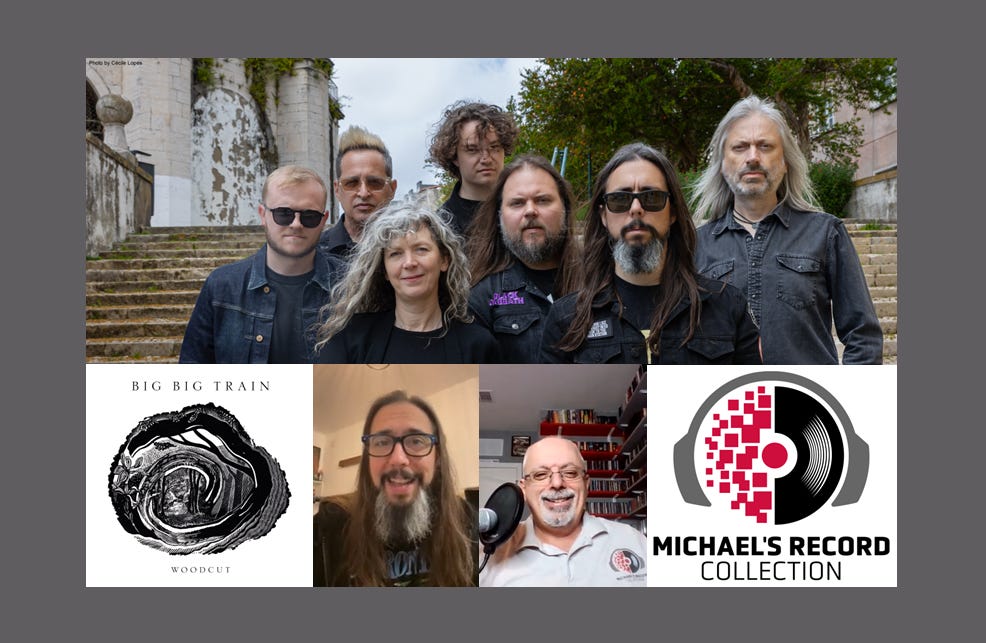
I did manage to do one interview in December, but it was for an album that doesn’t drop until the end of this week. I spoke with Alberto Bravin of Big Big Train on Dec. 2 to discuss the band’s first-ever concept album. Despite having this interview in the can for almost two months, there are certain restrictions that sometimes must be adhered to in terms of proximity of a release. Record companies often want to build a buzz close to the release date so people don’t forget about it and move on to the next thing, so I held my coverage of the new Big Big Train album, Woodcut.
So…now that we can…let’s get to that story.
Big Big Train has slowly built a following that has seen it grow into one of the most successful and popular modern day progressive rock bands. The group has undergone a lot of changes over the years since releasing Goodbye to the Age of Steam way back in 1994, and at the same time, Big Big Train has reached greater heights over the years, particularly during the time the late David Longdon served as lead vocalist from 2009 to 2021.
It may not be an overnight sensation, needing nearly three decades to reach the height of its popularity, but Big Big Train has struck a nerve among fans of progressive rock. Their sound is a modern take on classic, symphonic prog, and — interestingly — one hears perhaps more Anthony Phillips influence than classic-era Genesis or Yes in their sound.
Now, more than 30 years since the band’s first record came out, Big Big Train is set to release its 16th studio album, Woodcut, which is (remarkably for a progressive rock band) the group’s first concept album.
The current lineup is a seven-piece, international collective of outstanding musicians that seemingly raises the bar with every new release. The band members are:
Alberto Bravin – Lead vocals, guitar, keyboards
Nick D’Virgilio – Drums, percussion, 12-string acoustic guitar, vocals
Oskar Holldorff – Keyboards, vocals
Clare Lindley – Violin, acoustic guitar, vocals
Paul Mitchell – Trumpet, piccolo trumpet, vocals
Rikard Sjoblom – Guitars, keyboards, vocals
Gregory Spawton – Bass, bass pedals, 12-string acoustic guitar, Mellotron, vocals
Multi-instrumentalist and composer Spawton, who I interviewed for the band’s last studio album, The Likes of Us, back in 2024, is the band’s unquestioned driving force and the only constant in the group since the beginning. Mitchell, conversely, is the new kid on the block, having joined in 2025 to complete the current lineup.
Perhaps one of the most underrated reasons for Big Big Train’s success is the band’s willingness to record together in a studio — despite living far from each other — rather than sending files back and forth over the internet. This builds more chemistry and cohesion, and as good as musicians have become at producing songs using clips, recording together in a studio makes a difference. Although Bravin originally built the songs for the album in this now-popular, cut-and-paste style, they were ultimately recorded in the more traditional collaborative way once the arrangements were set.
Big Big Train has been busy, coming off the success of The Likes of Us and a pair of live releases: A Flare On The Lens and Are We Nearly There Yet? Live Around The World in 2024 and 2025, respectively. The band has even managed to play some short tours in the United States over the last few years.
Woodcut represents the second Big Big Train studio album for Bravin, who said the thought of doing the concept had been discussed among the band members as a possibility for a while.
“If we find the right story or the right spark for it, it would be interesting to do it,” Bravin said. “So actually the spark arrived. Me and Greg were in Oslo at the Munch Museum, and we were just looking at art and stuff one morning in Oslo. And there were a couple of pieces that were woodcut. And I don’t remember the name of the piece of art, but underneath it was like ‘Woodcut’ written down. And we just looked at each other. We said ‘ Oh, that’s the title.’ And we had no music, no story, nothing. We said ‘This could be the title of the album.’ And the woodcut technique is like the negative and the positive because you have to cut out what you don’t want on the press. It was an interesting theme and we could write stuff about it. We kept it a secret between me and him for a couple of days — we were on tour, actually. And then we shared it with everybody.”
Spawton and Bravin brought the title and idea to the band to discuss whether everyone was on board with attempting to use the idea as the basis of a concept album.
“And everybody was (like), hell yeah,” Bravin said. “So everything that we wrote after that was with this story in our minds. The story wasn’t actually written down. We had the music and then we had the lyrics after that. It was a long process, actually.”
The band had written a lot of music for what became Woodcut, but not wanting to make it a sprawling double album — though for vinyl it will still require two discs — they kept it to just over an hour of music.
“It talks about an artist, it’s this guy that doesn’t have a name,” Bravin said of the story. “And he is making this woodcut piece. Greg or Clare will explain it better, of course, but what I had in my mind was an artist or maybe a musician or also a listener. When a listener listens to something and he’s really into it, and you close your eyes and you are maybe on headphones or maybe a beautiful Hi Fi system. You’re listening to something and you’re in like another dimension, kind of. You don’t understand anymore if you are in that dimension, or if it’s your life. You have a feeling you have something there happening. So, this is the story about this artist that’s just doing this piece of art and just loving it and just feeling what’s happening. He is, like, trapped into his piece of art or this kind of other dimension, and the music goes with it. It is a little bit Pinocchio, and it’s more dark as a situation, but that’s it, actually. That’s the story.”
Once Bravin had crafted about an hour’s worth of cohesive parts together, only then did he share it with the rest of the band. The group was on board with what Bravin had put together and then Woodcut was ready for recording and lyrics.
The band recorded the music at Sweetwater Studios in the United States before returning home to finish the lyrics. Bravin recorded his vocals at Rob Aubrey’s studio in Southampton, UK.
“I kind of produced the whole thing without knowing that I was the producer,” Bravin said with a laugh. “I realized I was the producer when it was done. There was like a draft of the artwork going through emails, and I received it, and I saw ‘Produced by Alberto Bravin.’ I said, ‘Am I the producer of the record?’ I didn’t know, so I asked Greg. I said, ‘Am I the producer?’ He said, ‘Yes, you are.’”
The album kicks off with a gentle instrumental lasting less than a minute. “Inkwell Black” creates a mood and melds seamlessly into the first proper song.
“The Artist” is the album’s first pre-release single, and it’s a feast for the ears if you’re a fan of bass guitar. Spawton’s bass runs are meaty and integral to the song. He and D’Virgilio have become a formidable rhythm section and rarely play what is expected, keeping subsequent listens fresh to the ears. Bravin’s vocal and the backing harmony vocals shine, with intricate guitar bits and soaring Mellotron washes. It features an insane instrumental bridge section just shy of the five-minute mark in which the band unleashes its full power.
Although it’s the longest song on the album, “The Artist” falls short of epic length at 7:16. However, it started as a much longer piece.
“It was Rikard’s song. It was like 16 or 18 minutes with a huge instrumental stuff in the middle,” Bravin said. “And then, this is the producer role, saying ‘Well, Rikard, can we cut this part out?’ And he kindly said, ‘Yes, my friend, you can.’ Because I was seeing the (album) as one long song, so putting as the first song like a 16-minute song, it was unbalanced for me.”
The end of “The Artist” gives way to the gentle piano-based opening of “The Lie of the Land,” which builds in intensity as it goes. Everything Big Big Train does well is packed into less than three minutes — violin, acoustic guitar, layered vocals, electric guitar runs, rumbling bass, and D’Virgilio’s machine-gun drumbeats.
“The Sharpest Blade,” starts with a folky vibe, but with a modern keyboard over acoustic guitar. Lindley gets a spotlight, both on vocals and with her essential violin work. The repeated harmony vocal refrain of “it just takes longer!” over dark and explosive instrumentation is a highlight of the album for me.
At nearly six minutes, “Albion Press” allows the band to rock out. I like the subtle use of Mitchell’s trumpet in this song, giving more depth and texture to a rolling instrumental melody for a good chunk of the song’s opening. D’Virgilio goes absolutely mental on his drum kit. Lyrically, the artist is creating his woodcut masterpiece. He’s locked in and creating something special, and he seems to be about to step into the world he’s created.
If I close my eyes and let go, I could step into the scene
A world that feels so perfect
How could it ever be a dream?
And I never thought
I was one step away
Following a whisper on the breeze
“Arcadia” opens with a gentle and pastoral section featuring Holldorff’s (or maybe Bravin’s?) keyboards, strings, and what may be Mitchell’s piccolo trumpet or a sampled flute. The artist is inside the world he’s created.
Morning lights the room
A room which has no walls
A murmur fills my ears
The sound of distant birds
I walk into a world
Shaped by my own hand
Once in inkwell black
Now a spring and summer land
The mournful violin of Lindley playing over piano is a sublime instrumental outro moment in the song.
“Second Press” is only a brief piece of connective tissue, but it is gorgeous and could have walked right out of the quiet part of a classical symphony.
Sjoblom’s guitar riff pulls the listener into “Warp and Weft,” a funky, disjointed, Crimson-esque piece. Spawton and D’Virgilio drive things forward after the intro, leading into a vocal section in which the drummer’s vocals also come to the foreground. There’s a bridge with a Gentle Giant-type, layered vocal counterpoint section. Another intense, frenetic instrumental section completes the track and leads into “Chimaera,” which opens with a contrasting acoustic guitar and vocal intro over a constant, steady bass drum beat. Another tasty recurring Spawton bass run joins in to add depth to the song in the second verse. The band becomes a symphony as the song swells in the back half, with some standout trumpet work from Mitchell and an emotional vocal climax.
“Chimaera” contains the phrase, ‘a flare on the lens,” which is the name of the band’s 2024 live album. I asked Bravin which came first, the name of the live album or the lyric.
“I think that it’s Greg’s song,” he said. “That song was around for I don’t know, for some time. I think I heard it, and I loved it. I said, like, ‘This could be a really interesting song to put on this record.’ And so, I don’t know, I think Greg just put (it as) the title of the live album, because it was a nice title, actually. So then we kept the lyric on the song.”
The song comes to a conclusion in one of the few places on the album that seems like a normal break between songs.
“They’re still single songs, because you can listen to the songs in order,” Bravin said, “but all the songs are linked and it’s a flow that’s just going from the start to end.”
“Dead Point” quickly follows with an acoustic guitar intro into the verse vocal. It’s a dark song with the artist finding he’s not alone in this world, encountering a dark figure.
This cannot be real
A figment of my mind
Frightened to look
Can’t look away
This is not from my mind made
“Light Without Heat” opens with pastoral acoustic guitar and gentle vocals. This short song serves to move the narrative forward but can also stand alone as classic Big Big Train, which continues to sound distinctly British-pastoral at times despite being made up of musicians from multiple countries. Sjoblom’s guitar solo is emotional, evoking thoughts of David Gilmour without sounding like the Pink Floyd legend.
Lindley opens “Dreams in Black and White” with a vocal countered by what sounds like D’Virgilio’s voice and a glockenspiel. More voices and instruments join in, forming a lush, layered arrangement for this short song. It quickly builds to a climax with Sjoblom providing standout guitar leads. The color has gone out of the world for the artist as he tries to make his way back home. After the song rises to its crescendo, it ends as gently as it began, with what sounds like strings drenched in effects or a slightly unnerving synth string sound.
“Cut and Run” is the longer of two consecutive instrumentals that may well represent the artist’s flight and struggles to return home, starting with one of the heaviest/rockiest sections of the album. Some previous themes are slightly altered in this, particularly a keyboard melody.
“Whenever I was hearing like a theme or something that I liked, I tried to replicate that theme in the other songs with another instrument or another arrangement, or maybe a vocal line or whatever,” Bravin said. “So, it’s full of themes that are coming and going during the whole album.”
At times the opening minutes borders on Deep Purple crunch. Sjoblom cuts loose on guitar. Spawton washes things in Mellotrons and also provides some heavy bottom end with his bass, with a terrific galloping bass run in the middle of the song. D’Virgilio uses a variety of techniques and parts of his drum kit to great effect, and Holldorff provides some tasty keyboard riffs. Each of the musicians gets their chance to shine in this six-minute prog rocker.
“Hawthorne White,” the second consecutive instrumental, clocks in at just under two minutes and provides a brilliant come-down from its rocky predecessor. The track is gentle, features gorgeous piano and strings, and contrasts nicely with “Cut and Run.” Again, this is Big Big Train performing the modern rock equivalent to classical music.
The band’s trademark pastoral acoustic guitars return, reminiscent of early Genesis albums Trespass and Nursery Cryme, bringing a gentle opening to “Counting Stars.” The color has returned for the artist, lyrically. No longer seeing (dreaming?) the world in black and white, there is now brilliant gold and green. Bravin’s vocals are weighty and beautiful. “Counting Stars” is a highlight of the album for me, featuring a lovely, emotional guitar solo near the end.
“Last Stand” opens with about as bombastic a moment as anything Big Big Train has ever recorded. If this album were one, long, continuous epic, it would be the appropriate musical climax. It’s an uplifting end with a positive message.
Time to speak of love and hope
Life and death and letting go
Take each day not as it comes
Make it new and make it your own
There’s a terrific high vocal part at the end of the song that Bravin said he struggled to get right. The band went so far as to write a new lyric and record a couple of takes with the new lines.
“I spent the night thinking about it, and I said, ‘I mean, no!’ I had to sing that note with those lyrics. I loved the old lyrics,” he said. “In the morning, I just woke up, and I went there, I said, ‘Let’s try it again.’ And I did it.”
The song ends with a reprise of the same staccato musical theme that opens “The Artist,” book-ending the album nicely.
Admittedly, I find the concept story a bit opaque at times, but for me it’s more about vibes than anything. There are many stories about people who find themselves transported to other worlds (the “journey” story), and while the story itself may be conceptual, it’s far less important to me than the music and the quality of the songs. Big Big Train delivers in that respect.
I’ll state for the record that from a personal standpoint, I don’t foresee Woodcut becoming my favorite Big Big Train album and surpassing the likes of The Underfall Yard or English Electric Full Power. However, I will say the band has never been more at the top of its game. Musically, Woodcut is as good as Big Big Train has ever been, and this album is a stunning achievement destined to nestle (for me) among the band’s best work, but perhaps not at the very top. That’s all subjective, of course, and as they say, dear reader, your mileage may vary.
The fact that an album this good comes on the heels of a record as remarkable as 2024’s The Likes of Us bodes well for Big Big Train’s continued rise in the modern prog rock world and indicates a clear path of small-p progressing since Bravin replaced the seemingly irreplaceable and sadly no-longer-with-us David Longdon as vocalist.
At the end of the day, Woodcut is an album that will appeal to progressive rock fans regardless of whether or not they find the idea of a concept album cheesy. It is drenched in everything Big Big Train does well, but with sufficient variety to make a musical journey of an hour and five minutes feel more like half an hour. I expect it to be on a lot of best of 2026 lists come December.
To learn more about Big Big Train, visit bigbigtrain.com, sign up for their excellent e-newsletter, and follow the band on Facebook.
Woodcut is available Feb. 6 from Inside Out Music digitally, on CD, and various colors of vinyl depending on where you purchase.
Inkwell Black (0:56)
The Artist (7:16)
The Lie of the Land (2:55)
The Sharpest Blade (4:16)
Albion Press (5:46)
Arcadia (5:46)
Second Press (0:37)
Warp and Weft (3:45)
Chimaera (5:37)
Dead Point (5:28)
Light Without Heat (3:22)
Dreams in Black and White (2:34)
Cut and Run (6:19)
Hawthorn White (1:54)
Counting Stars (5:40)
Last Stand (3:34)
For my full interview with Alberto Bravin, check out the video below or download/stream Episode 165 of the Michael’s Record Collection podcast. In addition to discussing the inspiration for and making of Woodcut, Alberto talks about his first favorite album, his beginnings and influences, joining PFM, and joining Big Big Train.
Thanks again for your time. Please consider sharing this issue of the newsletter with the music lovers in your life via the first button below, or sharing Michael’s Record Collection (in general) with the second. And be sure to check out the podcast version of MRC at your favorite podcast dispensary. I invite you to visit my website at michaelsrecordcollection.com and to take a look at the membership levels on my Patreon site at patreon.com/michaelsrecordcollection to find out how you can support independent writing and podcasting for as little as $2 per month.
No posts
Comments
Nothing yet. Say the first thing.
Sign in to join the conversation.