
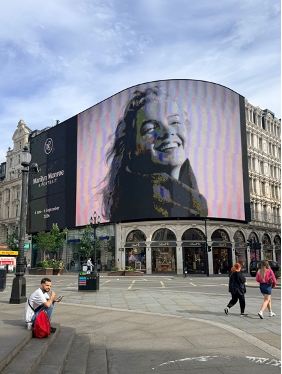
Last Monday evening, London’s National Portrait Gallery opened its centenary celebration of Marilyn Monroe’s birth. The exhibition assembles more than 200 photographs and other works tracing her life, including many from her earliest years as Norma Jeane. Walking through it, I found myself returning less to the images themselves than to the mind behind them, to what Marilyn Monroe understood that we seem determined to forget.

I came to the exhibition with an unusual stake in it. My colleagues and I collect entire photographic estates, the complete life’s work of a single photographer rather than scattered prints, an approach that has made the MUUS Collection the preeminent private holder of such estates in the world. Twelve years ago, before the market had fully recognized what was at stake, we acquired the complete archive of André de Dienes, including some 400 images of Norma Jeane becoming Marilyn Monroe, made between the ages of 18 and 24. Many of the works on the gallery’s walls this week came from that archive. I mention this not to claim authority over her story but to be plain about where I stand: the longer I study these photographs, the less they seem to be about a face and the more about a mind.
There is a recurring pattern in American entertainment that is rarely acknowledged. Some of the women who played the most naive or broadly comic roles were, behind the scenes, among the most disciplined and perceptive intellects in the business. Monroe chose to inhabit such a persona, then spent much of her career straining against it. The tension between projection and reality has long framed her story, but it is not the only instructive part.
A moment in 1955, often recalled but insufficiently examined, points in a different direction. The Mocambo nightclub in Los Angeles, then one of the most prestigious venues in America, did not book Black performers. Ella Fitzgerald, already widely regarded as the finest jazz vocalist of her generation, could not secure an engagement because of her race. Monroe intervened. She telephoned the owner and offered a proposition: if he booked Fitzgerald, Monroe would sit in the front row every night of the run. He agreed. She followed through. Fitzgerald later said the engagement changed her career.
What matters is not only that Monroe acted, but how she acted. This was not an appeal to conscience; it was an alignment of interests. Monroe reframed the decision so that doing the right thing also became the profitable one: a full house, guaranteed attention, and Monroe herself in the most visible seat in the room. The perceived risk of booking Fitzgerald disappeared. The ethical outcome and the advantageous outcome became identical.
That instinct stands in contrast to many of our dominant assumptions. Increasingly, power is framed as coercion, and influence as the ability to impose costs. Hard power, whether financial, legal, reputational, or military, is treated as the primary instrument, while persuasion is recast as weakness and mutuality as compromise. An administration that leans reflexively on coercive tools does more than shape immediate outcomes. It conditions allies and adversaries alike to expect ultimatums rather than alignment, producing compliance where it can but rarely commitment. In doing so, it forfeits one of the most durable forms of influence: structuring choices so that cooperation becomes the rational path forward.
History suggests that durable progress more often follows that logic. Arrangements built on aligned incentives tend to outlast those imposed through force, because they do not require constant enforcement to hold.
Consider the founding act of postwar Europe. Five years after the deadliest war in human history, the French foreign minister Robert Schuman proposed that France and Germany pool the very industries, coal and steel, that had fueled their militaries. The arrangement required neither apology nor capitulation; it would make further war, in Schuman’s phrase, “not merely unthinkable, but materially impossible.” Six countries joined in 1951. The Coal and Steel Community became, in time, the European Union. More than seventy-five years later, France and Germany have not fired a shot at one another, the longest such peace between them in a thousand years. Schuman did not extract concessions; he restructured incentives until conflict ceased to make sense.
Monroe’s intervention belongs to a quieter tradition of exercising power. Reframing situations, shifting incentives, and redirecting attention are not the fallback of those who lack leverage; they are a more sophisticated use of it. Wielded well, this kind of influence is not a consolation prize for the weak but the choice of the shrewd, because it tends to produce outcomes that are more durable and less costly than anything force can secure. These techniques are not secondary to power; they are among its most effective forms. Monroe’s gesture at the Mocambo, simple as it appears, reflects a precise understanding of that dynamic. That she reached for it so instinctively may owe something to the fact that throughout much of history, women, denied the physical, social, and financial leverage to confront a problem head on, often had to master these subtler instruments to prevail at all.
The analogy has its limits. A nightclub booking is not geopolitics, and reputational leverage is not state power. Yet the underlying principle, aligning interests to achieve outcomes that might otherwise require force, operates at every scale, and it is now in danger of being disregarded. Soft power, the ability to attract, persuade, and align without compulsion, is increasingly displaced by a governing preference for more forceful tools. That shift carries costs that are easy to defer and difficult to reverse. The European peace did not hold because anyone was compelled to keep it; it held because the incentives were built to make breaking it irrational. That is precisely the kind of advantage a preference for coercion leaves unclaimed.
None of this diminishes the importance of hard power. It remains necessary, and at times decisive. But when it becomes the default rather than the last resort, it displaces subtler forms of influence often better suited to lasting results. Monroe never presented herself as a strategist, nor wrote about power. Yet without formal authority or theory, she recognized the leverage available to her and used it in a way that expanded, rather than constricted, the space of possibility. The question her example raises is not whether such moments still exist. They do. It is whether we remain capable of recognizing them, and willing to act when they arise.
Walking through the gallery this week, surrounded by images of a woman the world thought it knew, I kept returning to a single thought. Monroe did at the Mocambo what too few of our leaders are willing to do at scale: she looked at a conflict others assumed could only be won by force and found the outcome that served everyone, then made it the attractive one. The lesson is not that soft power should replace hard power. It is that leaders who reach first and almost exclusively for conflict or coercion leave the most durable victories on the table. The challenge falls to the rest of us. Where a problem can only be crushed, force may be the answer. But where interests can be aligned and a better outcome made the appealing one, we should insist that our leaders reach for the instrument Monroe understood instinctively, and demand that they learn to use it.
Her image has endured for a century. Perhaps her example can be the model for the next one.

No posts
Comments
Nothing yet. Say the first thing.
Sign in to join the conversation.