
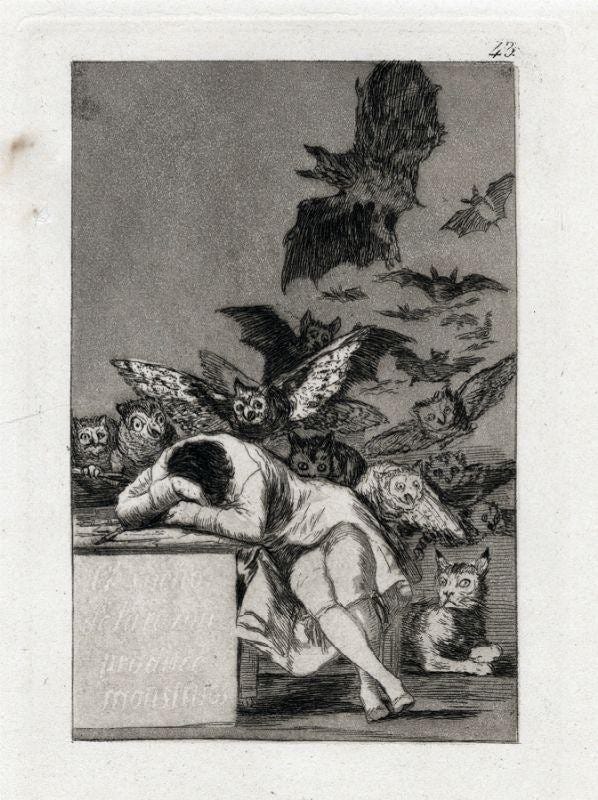
“El sueño de la razón produce monstruos.”
That was Francisco Goya (1746–1828), the Spanish painter and printmaker. It is Plate 43 of Los Caprichos, this particular image depicts Goya asleep at a desk while owls, bats, and other creatures swarm around him.
It is usually translated as:
“The sleep of reason produces monsters.”
The conventional interpretation is that when reason goes dormant, superstition, irrationality, fear, and folly emerge but Goya’s own commentary makes the idea far more subtle: imagination abandoned by reason produces monsters, while imagination joined with reason becomes the source of art.
I have been thinking about the role of reason in society, and how it seems societies are losing something critical to their continuance - a common basis for reason. Like Goya, I’m not arguing that imagination, emotion, or intuition should disappear.
I’m worried about what happens when they become untethered from reason.
I must admit that there’s a plethora of left-wing content creators posting videos on social media that form a flowing sewer of dumbass. If there ever was a confirmation of Reagan’s famous quote about the left knowing so many things that aren’t true, all you need is to drop into some of those channels and you will find a level of confident ignorance that the right can’t come close to replicating.
I find more disagreement in the comments on right wing vids than on the left, most of the left’s comments are of the “Yas, Queen! Slay!” category.
And the young leftist women are absolutely the worst.
In them, the sleep of reason has truly created monsters.
You have people over there who were freaking out about a CBS News piece out of Miami last week that alleged a Florida grand jury said that Ron DeSantis and his administration had conspired to direct $10 million in aid that was appropriated for feeding children to GOP coffers.
Not all that surprising because the CBS dispatch read like a DNC press release, but buried a dozen paragraphs in, we find that the grand jury said nothing of the kind. It said that while it appeared there were mistakes made and mismanagement of how the money was handled, they found no criminal effort and nobody who should be indicted.
I immediately thought about how the “Learing Center”/Hospice/Home Healthcare fraud, particularly in Minnesota, has been lightly covered by CBS.
It would seem to me as more rational and reasonable to be upset over the loss of $9+ billion, than $10 million, but what with the intersectionality and identity politics in play, I guess one can reverse the concern about the two.
I even asked a left-wing acquaintance of mine why he was screaming about Elon’s bank account and not screaming about all the billions of wasted Medicare and USAID funds that could have funded his preferred policy priorities.
The exchange didn’t have to get much deeper before I realized that, for this guy, the fraud was OK because it was perpetrated by people of a “protected” class. It was then I realized reason had not just gone to sleep; it had suffered a traumatic brain injury and was completely comatose.
Two people can now observe precisely the same event and inhabit entirely different causal universes. One sees individual agency while another sees structural forces. One sees criminal behavior while another sees resistance. One sees unequal outcomes and infers discrimination while another sees unequal choices, circumstances or abilities. Increasingly, neither begins by asking which explanation best fits the evidence. The explanation comes prepackaged with the worldview. That is the difference between pluralism and relativism. Pluralism permits us to disagree about what is true while maintaining common rules for discovering it. Relativism eventually leaves us with no common rules at all.
That distinction matters because when evidence and reason can no longer adjudicate disputes, something else must, and that something is usually power. If there is only “my truth” and “your truth,” there is no neutral ground upon which either of us can persuade the other.
Something important must be understood here and it is that civilization depends upon some things that cannot be voted into existence. Reality is not the property of the majority or the mob. Perhaps there is an even more fundamental social contract than the political one Locke described: an epistemic social contract. Reality exists outside ourselves and none of us fully or exclusively possesses it.
Claims about it must answer to evidence, logic must constrain our conclusions, and the same rules must apply whether they help or hurt our side. Without that agreement, political reconciliation becomes nearly impossible. We can compromise with people who disagree about what should be done about reality. It is far harder to compromise with people who no longer agree that reality exists, and places demands upon us all.
America’s deeper crisis may not be political disagreement itself, but the abandonment of the common rules that once made disagreement possible.
Monsters, indeed.
Comments
Nothing yet. Say the first thing.
Sign in to join the conversation.