
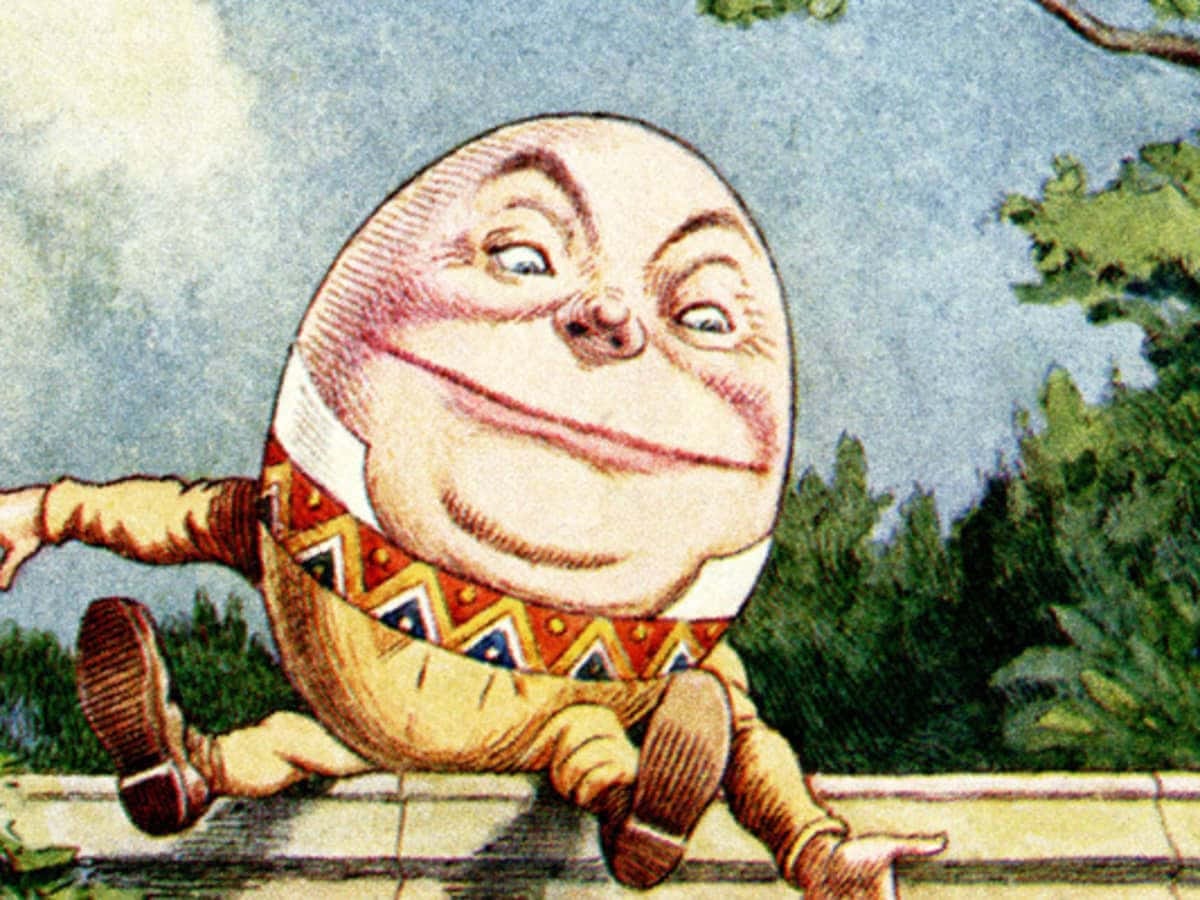
I’ve recently have mentioned Orwell, Huxley and H.G. Wells in my essays for valid reasons, but I think Lewis Carroll is one of the most underappreciated political satirists of all time.
My favorite exchange in all of his Alice stories is this one between Alice and Humpty Dumpty:
“When I use a word,” Humpty Dumpty said in rather a scornful tone, “it means just what I choose it to mean — neither more nor less.”
“The question is,” said Alice, “whether you can make words mean so many different things.”
“The question is,” said Humpty Dumpty, “which is to be master — that’s all.”
Carroll’s Alice’s Adventures in Wonderland may be one of the most misunderstood books in the English language. Most people remember it as a whimsical children’s story populated by talking animals, impossible riddles, and surreal landscapes. It has been adapted into cartoons, movies, stage productions, and every variety of pop culture reference imaginable. Yet beneath the absurdity lies something far more interesting. Alice in Wonderland is a remarkably sharp work of social and political satire, one that remains relevant precisely because it is not tied to a particular political movement, party, or era.
The genius of Carroll’s work is that he understood something about human institutions that remains true today. The further organizations drift from their original purpose, the more likely they are to become exercises in self-preservation, ritual, and performance. Wonderland is filled with authority figures, but very little actual authority. Rules exist everywhere, yet they appear arbitrary and often contradictory. Likewise, titles and offices abound, but competence is nowhere to be found.
Beginning to see a parallel with our own society, culture and governance?
Consider the Queen of Hearts. She is perhaps the most memorable character in the book, constantly screaming, “Off with their heads!” at anyone who displeases her. Yet remarkably few heads actually roll because her power exists largely as a threat. The performance of authority becomes more important than the exercise of it.
She is a ruler whose primary function is to remind everyone that she is a ruler.
It is difficult not to recognize echoes of modern politics in such a character. Governments, corporations, universities, activist organizations, and bureaucracies often seem consumed by the need to project power and moral certainty, even when their ability to accomplish practical goals appears increasingly limited. The appearance of control frequently becomes more important than control itself.
The trial near the end of the story may be Carroll’s sharpest observation. The proceedings are chaotic, evidence is largely irrelevant, and the verdict appears predetermined before testimony even begins. “Sentence first–verdict afterward!” screams the Queen. Procedure exists, but justice does not--the forms are present while the substance has vanished.
If that sounds familiar, it should. One does not have to look very hard in contemporary society to find institutions that remain committed to process long after they have abandoned the purpose that process was designed to serve. Whether the issue is politics, media, academia, or corporate governance, we increasingly encounter systems that seem devoted to preserving their own legitimacy rather than discovering truth.
The Mad Hatter’s tea party offers another enduring lesson. Everyone talks constantly, yet meaningful communication never occurs. The conversation circles endlessly, logic collapses into word games, and participants become trapped in a loop from which no progress is possible. It seems that way today, that there is an inverse relationship between the number of words spoken and meaning imparted.
Social media would fit comfortably at that table, too.
Carroll was also remarkably skeptical of education as it existed in Victorian England. Throughout the story, Alice attempts to recite lessons and poems she has memorized, only to discover that they emerge distorted and nonsensical. The target of the satire is not knowledge itself but the belief that repeating approved phrases constitutes understanding and that observation may be more relevant today than when Carroll first wrote it. Modern societies are increasingly filled with people who possess the correct vocabulary but struggle to explain the underlying concepts. They know what they are expected to say. They are far less certain why they are saying it.
As Glenn Reynolds of Instapundit would say, “Credentialled, not educated”.
What makes Alice in Wonderland endure is that Carroll was not satirizing a particular government, ideology, or political faction. He was satirizing human nature. He understood that people create institutions, and institutions inevitably develop habits, incentives, and absurdities of their own. The temptation to substitute ritual for substance, slogans for thought, and authority for wisdom is not unique to any century.
Wonderland feels strangely modern because Wonderland is not a place--it is a condition. It emerges whenever people stop asking whether things make sense and begin accepting nonsense simply because everyone else does. The rabbit hole, as it turns out, is not beneath a tree. It is inside every society, and every generation eventually finds a way to fall into it.
Comments
Nothing yet. Say the first thing.
Sign in to join the conversation.