
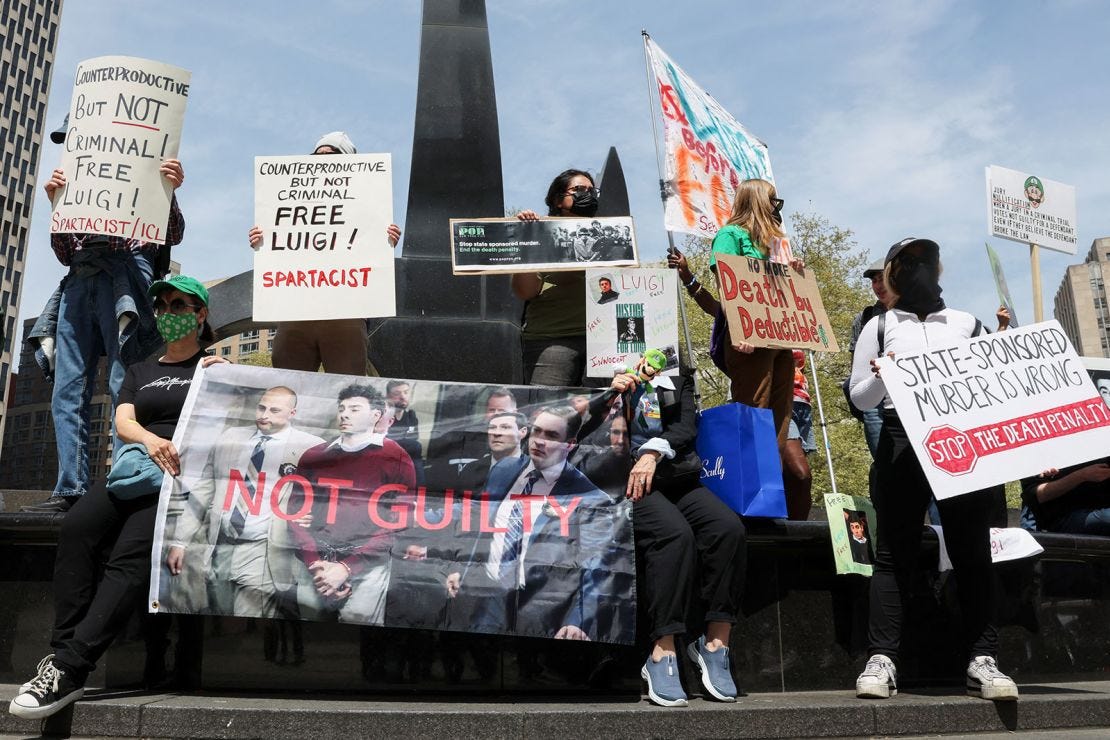
The proceedings involving Luigi Mangione, who openly admitted cold blooded murder, produced a predictable response from many observers. What was less predictable was the emergence of supporters willing to excuse or celebrate him. Online defenders of Lindsay Clancy, the Massachusetts mother who strangled her three children and admitted to the killings, continue to insist her husband was somehow responsible. Then there is the Candace Owens spectacle, where increasingly elaborate conspiracy theories claim Charlie Kirk was secretly assassinated by Israel rather than by Tyler Robinson, a disturbed man with a transgender romantic partner.
And in almost every case, like Karmelo Anthony’s murder of fellow high school athlete Austin Metcalf, these narratives almost always attempt to construct a way in which the victim was to blame, and even if the perpetrator unquestionably did it, they had a good reason. Race baiting lawyers like Benjamin Crump have made a cottage industry of exonerating the perpetrator due to some imagined racial slight or white supremacist coverup. His first task is to muddy the water as much as possible.
I understand the need for reasonable doubt in cases such as these, but what we are seeing approaches complete inversion of facts and truth.
What struck me is that these cases are not isolated. Over the past two decades, a pattern has emerged in public reactions to certain crimes and tragedies. Individuals who commit acts once regarded as beyond the pale increasingly attract organized communities of defenders, theorists, and even admirers. Clear evidence is inverted. Admissions are ignored. Victims fade into the background while perpetrators become symbols of larger political, cultural, or ideological grievances.
The impulse itself is not new. Human beings have always romanticized outlaws. Robin Hood, frontier vigilantes, and literary antiheroes have existed for centuries. What is new is the speed, scale, and intensity of the phenomenon. Modern technology allows these narratives to spread instantly, gather followers, and harden into belief systems before facts have time to catch up.
Twenty years ago, sympathy for a criminal defendant might have remained confined to a small circle. Today, it can become a full-fledged online movement complete with slogans, merchandise, fundraising efforts, and armies of amateur investigators convinced they alone possess the truth. The movement often requires participants to ignore admissions, forensic evidence, surveillance footage, timelines, and basic common sense. Rather than weakening as more information emerges, the belief system frequently grows stronger.
The rise of social media is central to understanding why. Platforms are designed to maximize engagement. Content that provokes outrage, moral solidarity, fear, or the thrill of possessing forbidden knowledge generates clicks, comments, and shares. A person who shows mild curiosity about an alternative explanation is quickly fed more of the same. Before long, their information diet consists almost entirely of material confirming the narrative they already prefer.
These systems do not merely reflect existing beliefs. They amplify them as curiosity becomes conviction. Skepticism becomes certainty and communities form around shared assumptions and begin treating contrary evidence as proof of a cover-up. Every interaction teaches the algorithm to provide more of the same, creating a self-reinforcing loop in which doubt becomes socially costly, and questioning the narrative is viewed as betrayal.
At the same time, trust in institutions has collapsed. Confidence in government, media, corporations, medicine, and the justice system has steadily declined. When official explanations are viewed with suspicion by default, alternative narratives gain credibility simply because they are alternatives. The facts matter less than the opportunity to challenge the system.
This changes the moral calculus. A healthcare executive’s killer can be transformed into a folk hero fighting a corrupt industry. A mother who murders her children can become a symbol of failures in mental health care. A straightforward act of violence can be recast as a geopolitical conspiracy. The victims become secondary as the perpetrator becomes the vessel through which broader grievances are expressed.
Cultural trends reinforce the process. Contemporary thinking often emphasizes trauma, systemic forces, and lived experience. Those concepts can encourage compassion and understanding, but they can also weaken the idea of personal responsibility when taken to extremes. Every crime becomes evidence of a system that failed. Every perpetrator becomes a victim of larger forces.
Accountability is pushed aside in favor of explanation, and explanation gradually morphs into justification.
The psychological appeal is obvious. These communities provide belonging, purpose, and a sense of insider knowledge. Participants are not merely discussing a case. They are defending a worldview. The more mainstream opinion rejects their narrative, the stronger the group identity becomes. Contradiction is interpreted as persecution. Evidence becomes propaganda. Doubt becomes heresy.
What is most remarkable is the willingness to suspend disbelief. Admissions, physical evidence, timelines, and eyewitness testimony are routinely discarded when they conflict with the preferred story. In a media environment dominated by short clips, selective quotations, and emotionally charged commentary, maintaining a coherent understanding of events requires effort. Embracing a simple narrative that identifies heroes and villains is far easier.
None of this means institutions are beyond criticism or that mental illness, corporate misconduct, or social failures are imaginary. Those problems are real and deserve serious attention. The trouble begins when legitimate concerns are used to rewrite reality itself. Reform becomes secondary to preserving the mythology.
The trend shows little sign of slowing. Social media continues to reward emotional intensity. Trust in institutions remains low. Entire generations have grown up inside algorithmically curated information environments. Cases that once would have produced temporary public fascination now generate durable subcultures capable of fundraising, lobbying, content creation, and years of sustained narrative warfare.
Most people still react to murder, filicide, and targeted violence with straightforward moral clarity. Yet the existence of increasingly vocal exceptions represents a genuine cultural shift. Twenty years ago, the infrastructure required to transform criminals into folk heroes and conspiracy theories into communities barely existed. Today it is immediate, vocal , and everywhere.
The cost is the erosion of a shared reality. Victims and their families suffer a second injury as attention shifts from what happened to elaborate stories about why it supposedly did not. More troubling still is the emergence of moral frameworks in which almost any act can be redeemed if it serves the right narrative. That is a far more dangerous development than any single conspiracy theory.
And of course, there is a geopolitical component to this in which America, no matter what good we do, is always the bad good guy.
Comments
Nothing yet. Say the first thing.
Sign in to join the conversation.