
During Session 2 of the Michael S. Heiser Foundation’s Live in Context study, someone asked whether any Divine Council worldview books or authors connect Egyptian gods with technology given to humanity and with images or pictographs that appear to depict that technology.
The question makes sense within the wider world of popular supernatural-Bible teaching. There is a familiar claim that certain Egyptian images appear to portray machines or advanced technology, and that such technology may have been given to humanity by supernatural beings. Dr. Michael Heiser addressed several claims of this kind through his FringePop321 project and the research material collected on his website. His answer was not to deny the supernatural worldview of the ancient world, but he insisted that supernatural claims should fit within the actual historical, archaeological, and textual evidence.
Discussions of Genesis 6, the Watchers, forbidden knowledge, lost civilizations, ancient monuments, and unusual technology often circulate together, and authors or speakers working in that broad space are sometimes grouped under the label “Divine Council worldview” whether or not they share Dr. Heiser’s conclusions or method. Heiser often called this space “Christian Middle Earth.” The caution with which Heiser navigated that space taught us that just because someone has written about ideas, we should not presume that those ideas are sound without careful examination.
So the simple answer is, yes, there are authors who connect Egyptian gods and technology, but the question that matters more than that is, how legitimate are those connections? Let’s look at some of the evidence for this.
Perhaps the best-known example comes from the temple of Seti I at Abydos. A group of hieroglyphs above a doorway appears, particularly in some photographs, to resemble a helicopter, an airplane, and other modern machines.
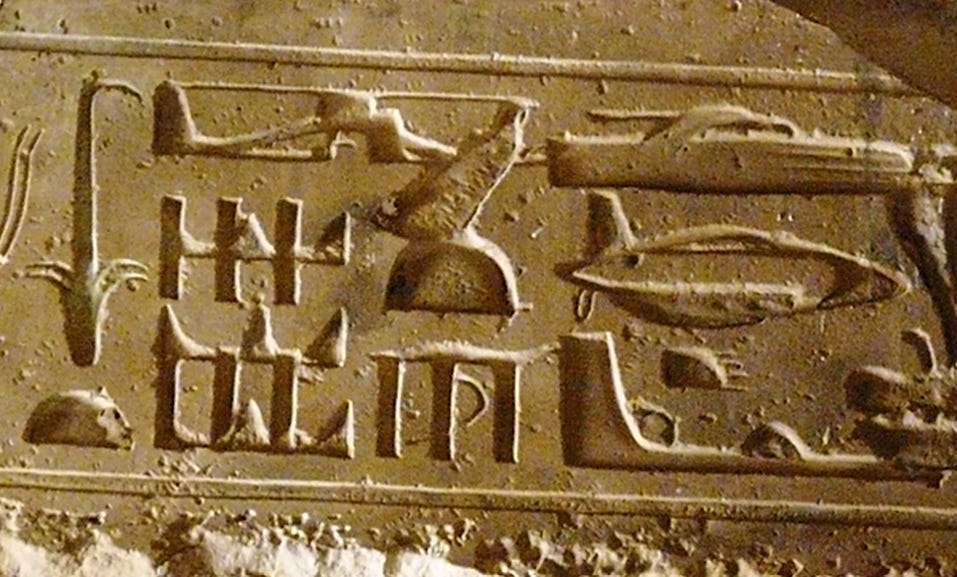
The resemblance is visually striking. It is also misleading.
The inscription was altered when one pharaoh’s royal titles was replaced with those of a later ruler. New plaster and carving were placed over the earlier inscription. As the plaster deteriorated, portions of both inscriptions became visible at the same time. The overlapping signs created composite shapes that were never intended to be viewed as an individual image.
Often (but not exclusively) found in parchment, this process is called a palimpsest: an earlier inscription was covered and reused, but portions of both stages eventually become visible. Once the separate inscriptions are reconstructed, the supposed helicopter disappears. What remains are conventional Egyptian royal titles and signs layered over one another.
This is an important reminder that identifying an image cannot begin with what its outline resembles to a modern observer. It must begin with the object’s physical history, the writing system to which it belongs, and the surrounding inscription.
Another frequently cited image appears in reliefs from the temple complex at Dendera. The scene includes an elongated oval form containing a serpent, with what looks to modern viewers like a cable, filament, or electrical apparatus.
It is commonly called the “Dendera light bulb.”
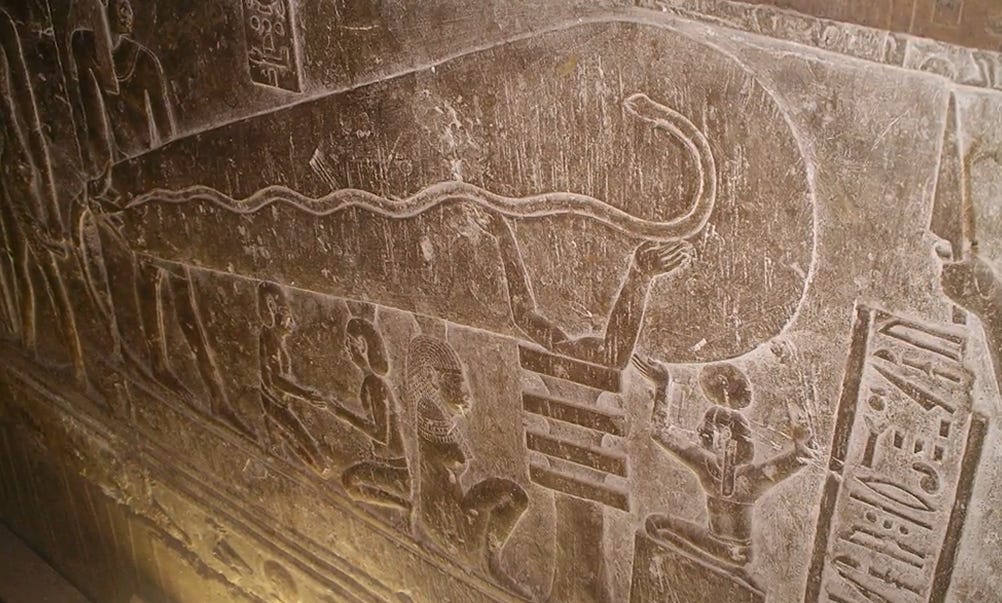
Within its Egyptian religious context, however, the image belongs to a creation and temple ritual involving the god Harsomtus. The serpent emerging from a lotus is part of Egyptian creation imagery. Other elements in the scene also have identifiable religious and iconographic meanings. The interpretation of the relief as electrical equipment depends largely upon its resemblance to modern technology. But resemblance by itself is not enough—particularly when the imagery can be interpreted within the known mythology, ritual life, and artistic conventions of the culture that produced it.
There is also no supporting archaeological infrastructure for an electrical technology of the kind proposed. We do not find the generators, distribution systems, wiring, manufacturing remains, technical texts, or widespread material applications that such technology would ordinarily leave behind.
The so-called Baghdad Battery is not Egyptian, but it often appears in the same discussions. The artifact consists of a ceramic vessel containing metal components. Modern reconstructions have shown that objects of this general form can produce a small electrical current when filled with an acidic liquid.
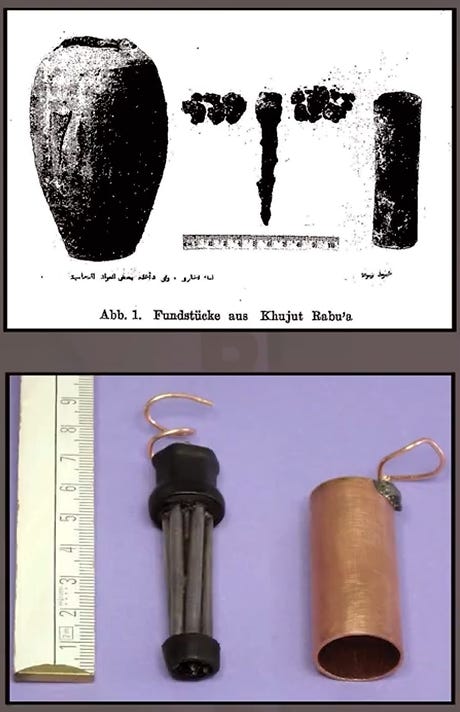
That does not by itself tell us what the original object was used for. Demonstrating that an artifact might function in a particular way is different from demonstrating that its ancient makers designed and used it for that purpose. Even should some ancient people have discovered a limited electrochemical effect, that would not demonstrate the existence of a lost electrical civilization—or that supernatural beings supplied the knowledge.
Dr. Heiser’s treatment of claims such as these consistently asks the same basic questions:
What is the object or image in its original context?
How do specialists in the relevant language and culture interpret it?
Is the proposed interpretation supported by related artifacts or texts?
Does the claim explain all the evidence, or only an initially surprising visual resemblance?
Where did the extraordinary interpretation originate?
These questions do not rule out unusual conclusions in advance. But they do require those conclusions to carry an appropriate burden of proof.
This is where the question becomes especially relevant to readers of Dr. Heiser. The Bible presents a populated spiritual world. The nations were associated with other gods, rebellious spiritual beings influenced human cultures, and supernatural rebellion played a role in humanity’s corruption. Traditions such as 1 Enoch describe Watchers teaching human beings practices connected with warfare, adornment, sorcery, astrology, and other forms of knowledge. That background can make the general idea of supernatural beings communicating knowledge to humanity seem possible. But a general possibility is not evidence for a particular claim.
The fact that the biblical and ancient worlds included beliefs about divine or forbidden knowledge does not itself give legitimacy to a damaged Egyptian inscription supposedly depicting a helicopter. Nor does it establish that unexplained artifacts or difficult building projects were created with technology supplied by gods, Watchers, aliens, or Nephilim.
A supernatural worldview should not weaken our standards of interpretation. It should make us more careful about distinguishing what ancient sources actually say from the stories modern interpreters build around them.
There is, nevertheless, a genuine ancient background behind part of the question.
Ancient cultures frequently associated the foundations of civilization with the divine world. Writing, kingship, ritual knowledge, agriculture, craftsmanship, astronomy, divination, and social order could all be described as divine gifts or as realities grounded in the realm of the gods. In Egypt, Thoth was associated with writing, language, calculation, measurement, wisdom, ritual knowledge, and the maintenance of divine order. Seshat was connected with writing, recordkeeping, surveying, and measurement. Ptah was patron of craftsmen and could be associated with creation through thought and speech.
While not evidence that Egyptian reliefs preserve pictures of modern machines, the underlying idea of human knowledge originating with the gods is genuinely ancient.
Thoth is a particularly interesting example because later traditions credit him with discoveries that we might broadly call intellectual technologies. In Plato’s Phaedrus, the Egyptian figure Theuth (Thoth) is presented as the inventor or discoverer of number, calculation, geometry, astronomy, games, and writing. This is, however, an origin of cultural and intellectual arts that reshape human life, not machinery.
Thoth was later identified with the Greek Hermes. The resulting Hermes-Thoth or Hermes Trismegistus tradition presented him as a primordial source of religious, philosophical, astrological, magical, and cosmic wisdom. These ideas find new circulation in occult circles all the time with modern esoteric writers who often connect Egypt with secret or lost knowledge. But the stream of tradition also reveals how easily different historical layers can be collapsed together:
ancient Egyptian traditions about Thoth;
Greek philosophical portrayals of Theuth;
later Hermetic teachings;
occult claims about secret Egyptian wisdom;
and modern ancient-astronaut theories.
These are related historically for the simple fact that ideas build upon ideas, but that doesn’t mean that simple, straightforward human invention isn’t involved. (In other words: later people might just be making stuff up, recycling old ideas.)
In point of fact, we have some evidence that people do just that. Thoth’s reputation as the keeper of primordial wisdom is fueled by the so-called Emerald Tablets of Thoth the Atlantean. These should not be confused with either ancient Egyptian texts or the Hermetic Emerald Tablet. Dr. Heiser linked to research tracing the modern work’s origins, identifying its supposed antiquity as part of its fictional and occult presentation. Its popularity illustrates how genuine ancient associations between Thoth and wisdom can be expanded into claims about lost science and advanced prehistoric knowledge without corresponding ancient evidence.
There is a significant difference between saying that Egyptians associated writing and measurement with Thoth and saying that Egyptian gods are behind giving grand technology to humanity.
The value of Dr. Heiser’s blog and FringePop321 work was not limited to debunking unusual claims. He was teaching a method that resists two opposite reactions.
One response rejects anything strange simply because it sounds strange. That approach can prevent us from taking the supernatural worldview of Scripture and the ancient world seriously.
The other response accepts a strange claim because it seems to confirm a supernatural worldview we already believe. That approach can turn visual resemblance, speculation, and internet repetition into supposed evidence.
Heiser’s approach was to investigate all available information. Find the original object or text. Understand its context. Consult people trained in the relevant field. Trace the origin of the popular claim. Then, armed with all the information at our disposal, we are equipped to decide what the evidence can actually support. That approach leaves room for the supernatural without making the supernatural an excuse for careless interpretation.
The answer depends upon what we mean by “technology.” If we mean the arts and systems by which civilization operates—writing, calculation, measurement, craftsmanship, ritual knowledge, and the ordering of society—then ancient Egyptian tradition, like many others, did associate several of these with the gods, especially Thoth. Later Greek and Hermetic traditions expanded those associations, presenting Thoth or Hermes-Thoth as a primordial source of a much broader body of human knowledge.
Those later traditions help explain why Egypt became associated with ancient or secret wisdom, but they do not provide evidence that Egyptian reliefs depict aircraft, electrical lighting, or other advanced machinery. The best-known examples of supposedly technological images have convincing explanations arising from Egyptian language, iconography, and the physical history of the monuments themselves.
Claims of this kind continue to circulate in the wider world of supernatural-Bible teaching, where Genesis 6, the Watchers, forbidden knowledge, lost civilizations, and ancient technology are often woven together. Their presence in that conversation does not make them part of Dr. Heiser’s conclusions or method, nor does it relieve them of the need for careful historical and archaeological evidence. The Divine Council worldview does not require us to accept particular interpretations. In fact, taking the ancient supernatural worldview seriously should lead us to listen more carefully to the ancient material—not to replace it with a modern story.
The ancient world was strange enough on its own. We do not need to manufacture additional mysteries by removing its images and texts from their proper setting.
Comments
Nothing yet. Say the first thing.
Sign in to join the conversation.