
GO PAID FOR $1.50/YEAR. 95% OFF. CLICK HERE.
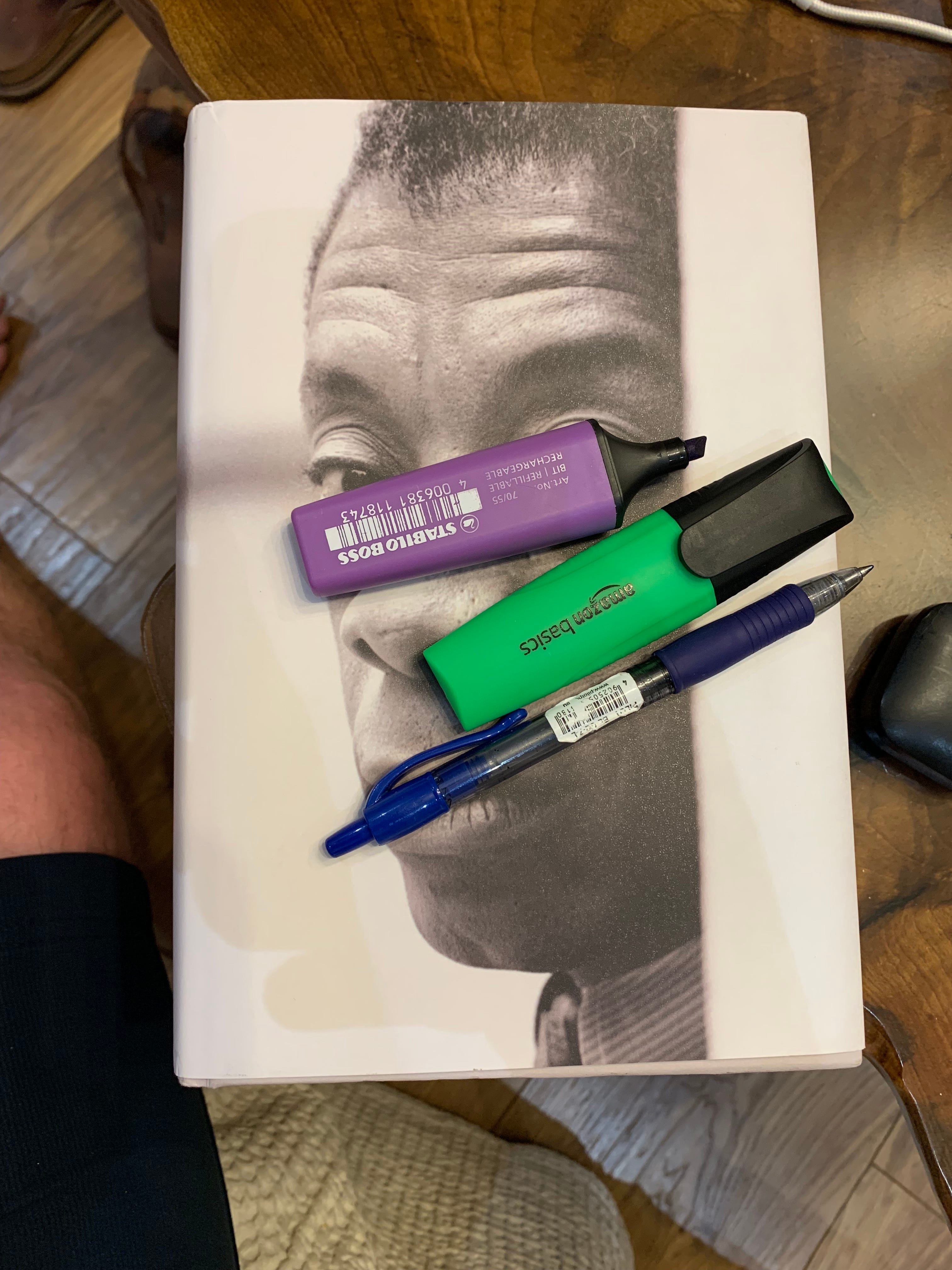
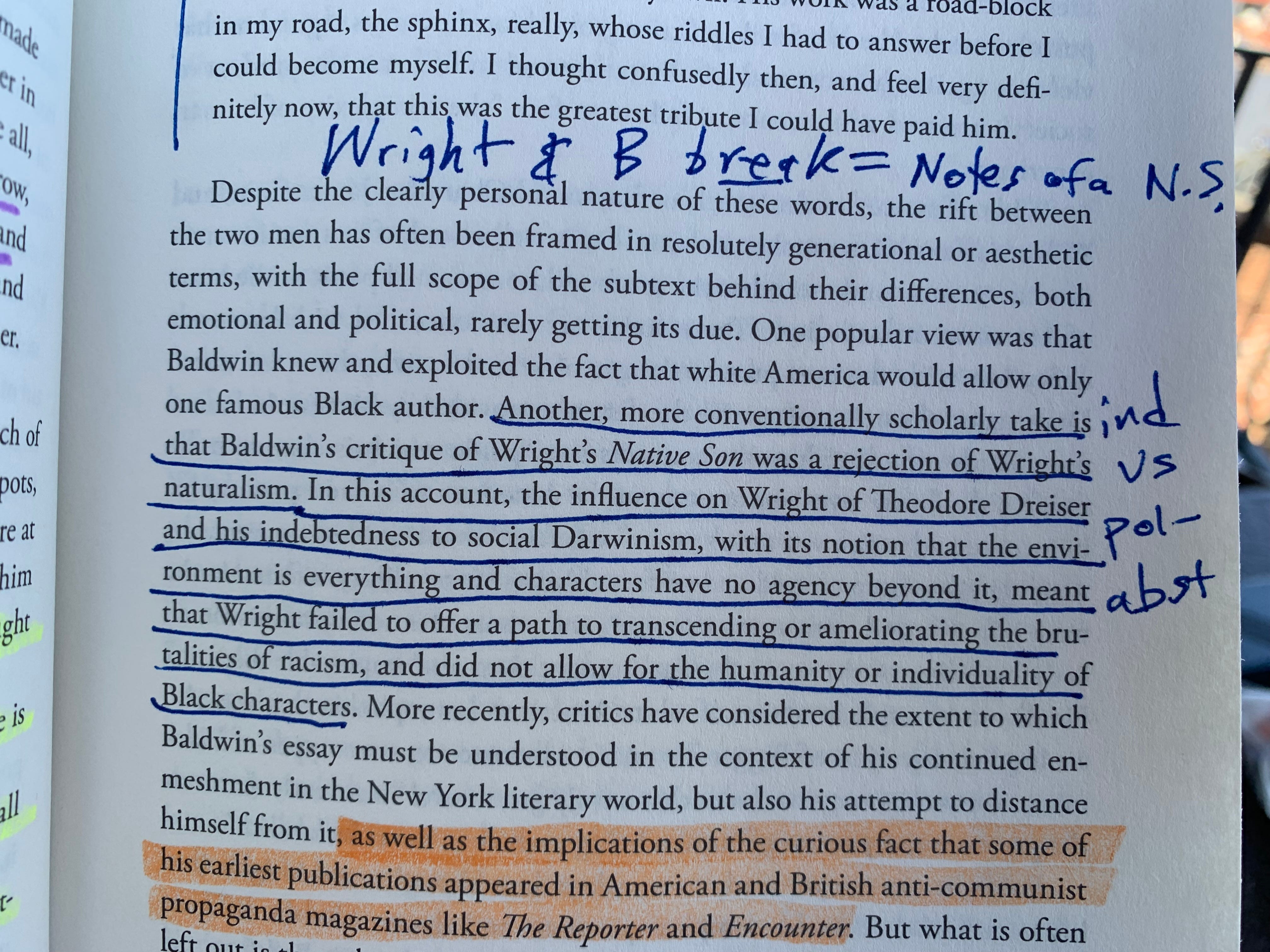
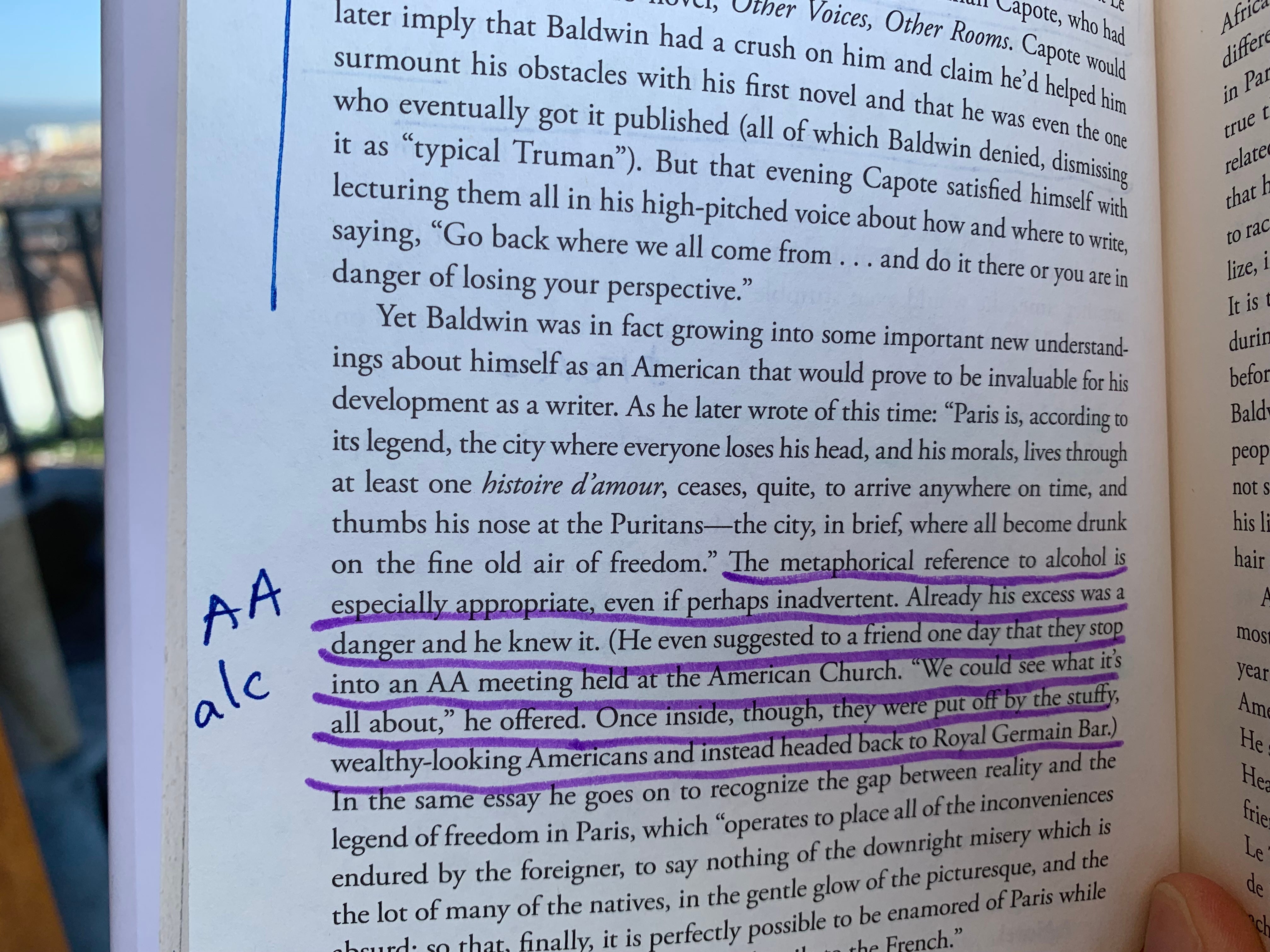
*All photos from Nicholas Bogg’s Baldwin: A Love Story
No one writes about these flaws in Baldwin because he has become a totem, a mythic creature, a symbol, an almost sexual need for progressives to use as a banner of goodness and moral righteousness. Further, to criticize anyone non-white and liberal has become coded, for progressives, as “conservative.” This labeling is just like cancelling or “deplatforming” writers for Wrong-Think. There’s a sort of holy, Protestant-like clinging to virtue and rightness which the left wraps around heroes like Baldwin, MLK, etc.
It’s a well-accepted fact now that Martin Luther King, aside from being a genius and powerful moral agent of a movement which was long overdo and clearly needed to happen, was also a terrible cheater and womanizer and also plagiarized the shit out of his doctoral thesis in college.
This does not in any way negate MLK’s profoundly important and crucial message, movement and contribution to civil rights, which was monumental.
But it does humanize the man and put him into perspective.
Similarly with another Black icon and literary grandfather of so much to come later, up to our current moment (one might call Ta-Nehisi Coates his spiritual grandson): James Baldwin.
Yes, I am going there.
I am about a third of the way through Nicholas Bogg’s massive 2025 biography on Baldwin, the first on this subject in decades. (Baldwin: A Love Story.) I have read a lot of Baldwin’s work—both fiction and nonfiction—and have always loved and admired his genius and his contribution to American literature. I have also read a couple of older biographies on Baldwin. But this new one is enlightening in fresh, original ways.
I could go on and on about how talented Baldwin was as a writer and creative artist. It’s obvious. Read anything from Go Tell it on the Mountain (which I have read perhaps half a dozen times over the years) to Another Country (also a great novel) to Notes of a Native Son (a genius and highly nuanced essay collection) and you’ll instantly understand how brilliant Baldwin was.
His talent was beyond simply talent and had shifted, morphed into becoming something closer to Homeric. He was not a Black writer or even an American writer but a global, universal writer which changed the landscape of writing itself. Many of his long, lovely sentences can make you bug your eyes out (pun intended because Baldwin famously had bugged out eyes which irked him all his life) and reread over and over, drinking in the deliciousness and emotionally penetrative wildness of his lines.
But.
Like MLK—and like all human beings of all races and genders—Baldwin had a dark side.
For one thing, well into his thirties he pursued sexual relationships with “men” in their teens. While this may be common in the gay community—and I’m sorry but it often (not always but often) is—it nevertheless shows something akin to a type of sexual predation. Some may want to parse because it’s two men versus a man and a woman, meaning there might be a different sexual-power dynamic.
But I call bullshit: Age is the power, life experience, social position, not gender. Or at least if gender plays a role it is only a partial role and certainly incomplete. We’re talking about a semi-famous (in the 1950s), connected, respected author praying on totally unknown teen boys with little to no sexual experience.
Further, Baldwin used people. He picked certain people, took what he needed from them—emotionally, psychologically, spiritually, literarily—and then tossed them aside. An easy example is Richard Wright, the famous older Black author of Black Boy (great memoir I have also read and praised) and the novel Native Son. He was Baldwin’s mentor for many years in Baldwin’s teen Greenwich Village days. Before Paris.
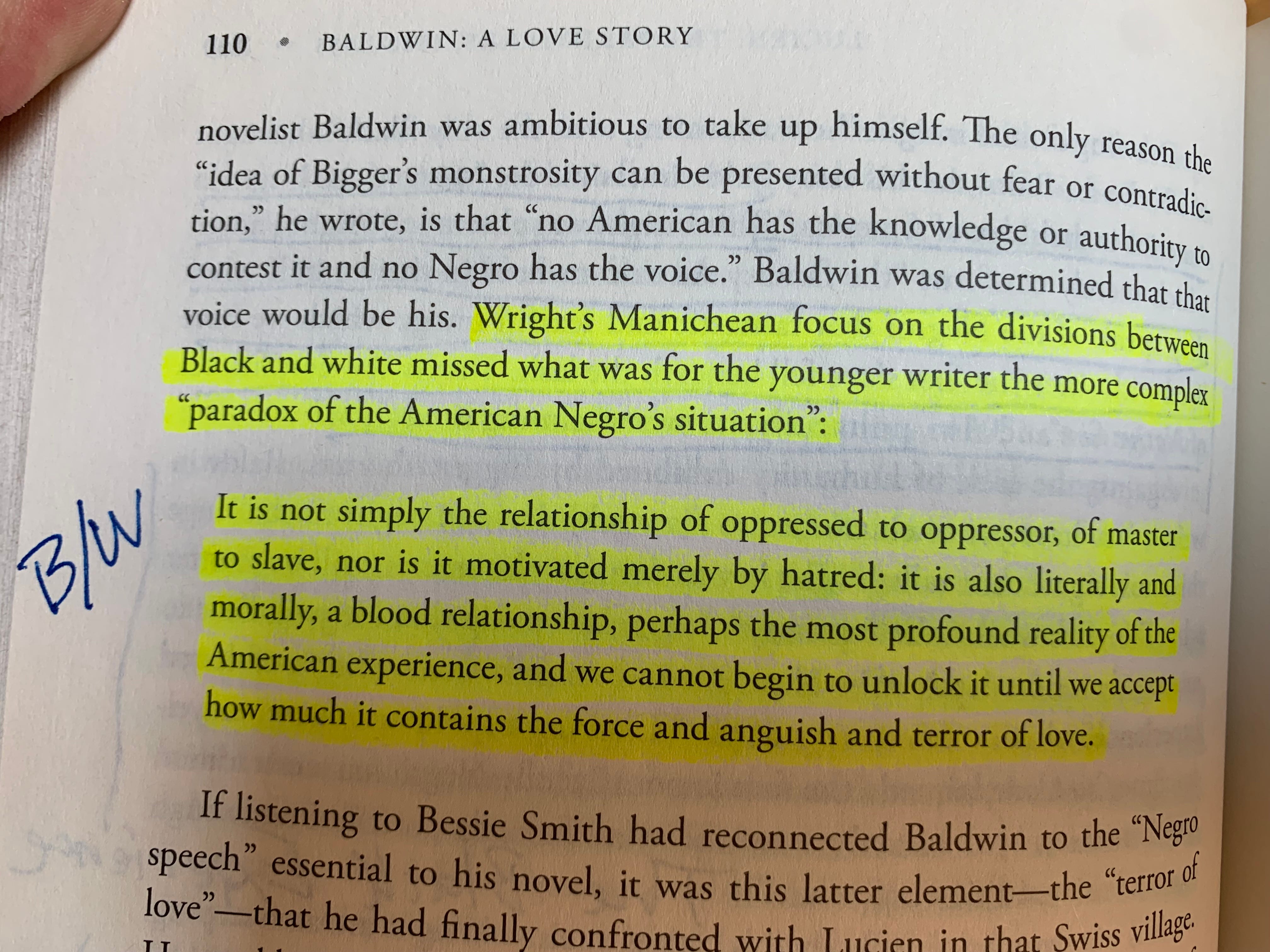
Baldwin pulled everything he could from Wright, winning writing colony and award recommendations from the older author as well as gaining insight and connections, and then he turned around and published Everybody’s Protest Novel, which deeply criticized Wright’s Native Son and in many ways tried to delegitimize and in fact destroy Wright. Later, Baldwin would essentially eclipse and take over Wright’s social-literary role altogether, transcending his former teacher. This demonstrates both a cunning, a cruelty and a lack of loyalty on Baldwin’s part.
Evidently he was also awful with money, particularly debt. Countless people—friends, acquaintances, his literary agent, his publisher, Marlon Brando (a friend), other writers, you name it—loaned Baldwin money back in the 1940s and 1950s and, apparently, almost none of them were ever paid back. Again, he took what he wanted or needed and then tossed them aside. He seemed to have a fairly narcissistic and solipsistic frame of mind.
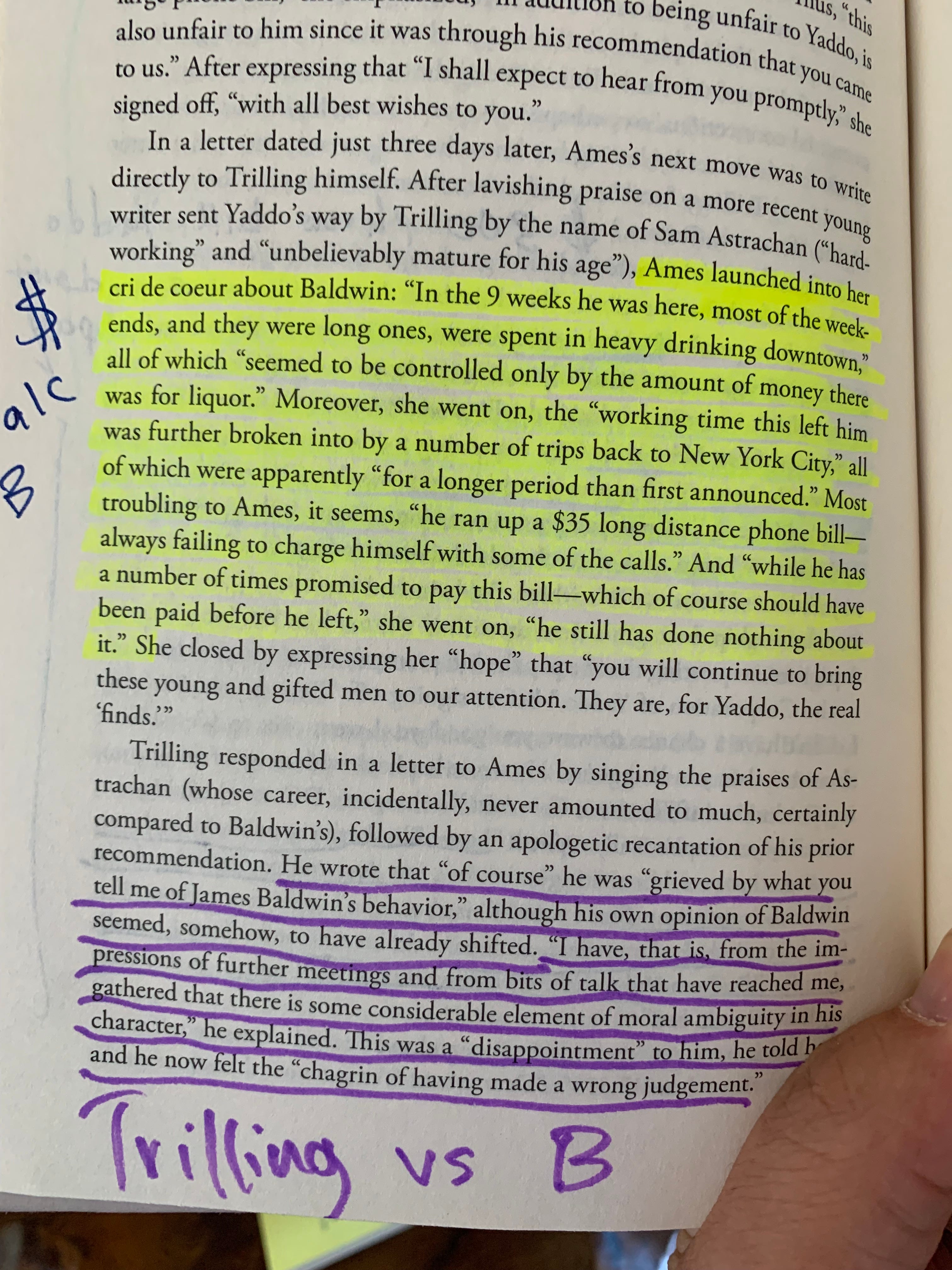
The worse instance in this case was the famous writers’ retreat in upstate New York, Yaddo. He stayed here once, for nine weeks in the early 1950s while working on what became his second novel, Giovanni’s Room, and evidently in that short span of time ran up a telephone bill of over $36, which would be $300 in today’s money. He had been totally aware that phone bills were to be covered by the writers themselves, not the colony. And yet Baldwin, who had been ceremoniously recommended for Yaddo by none other than the literary hero Lionel Trilling (a huge cultural monument in the 1950s and one-time teacher at Columbia of the Beat writers) never paid this debt. Not one cent.
Elizabeth Aimes, who ran the colony, implored him multiple times in desperation via letter, letting him know that this was deeply disrespectful and that it would cause issues with their taxes. And yet Baldwin did not pay. Like most debt he owed people, he ignored it. This happened time and time again with individuals and institutions alike.
When an author friend allowed Baldwin and his boyfriend to stay a few weeks at his Manhattan apartment while they were out of town, they returned home, Baldwin gone, with their apartment in complete disarray: Messy unmade dirty beds, stacks of dishes, food everywhere, etc. This was when Baldwin was 30 years old, by the way, not 21 or something.
Baldwin was, almost certainly—read my essay here on how mundanely common this is with writers then and now—an alcoholic. Almost everyone who knew him intimately commented on the consistent heavy drinking. He could afford to drink but not to pay his debts. Baldwin was once even quoted as saying he and a friend should go to an AA meeting, which they did. (He didn’t like it.)
He slept with married men and women, even when he knew and/or was friends with the partner. He used people for a place to crash. He willingly and happily accepted favors offered. He allowed white liberals in the publishing world to help him, support him, privilege him in any number of ways both geographical, literal, financial and otherwise for decades.
Now, some—progressives—will protest here, will protest at my whole essay. They’ll say, first, Who are YOU, a privileged contemporary White Man, to judge James Baldwin, a genius Black author born over a century ago now? After all, Baldwin wasn’t just Black, he was also gay (a double-minority) as well as deeply poor and from a dysfunctional family in East Harlem surrounded by heroin addicts, gangs and disadvantage.
Baldwin never knew his biological father and his step-father was, to say it with charity, a racist abusive asshole. He was a deeply bigoted and religious preacher who hated white people, calling them “white devils” even as he beat his own stepchild, prevented the kid from reading, and forced him into a religion he didn’t believe in or want any part of (ironically Baldwin briefly became a 14-year-old preacher in Harlem churches).
Baldwin always felt hated by his stepfather, who literally told his “son” he was “ugly,” which was something so embedded in Baldwin’s sensitive psyche that it took him decades to finally transcend it. His father had no respect for Baldwin’s love of reading or his early boyhood desire—almost spiritual need—to write. His stepdad died when Baldwin was 19—in 1943—and the author spent the rest of his life internally wrestling with being a man without a father of sorts. (He found replacement fathers in the painter Beauford Delaney and later, for a while, Richard Wright and others.)
In other words, the progressive idea here might be: Baldwin was a minority and an oppressed victim during a time of serious and horrific racism (yet they claim things are actually worse now) who grew up in poverty with nine siblings, an asshole violent father who died when he was young, an overwhelmed mother, and no real talent other than his genius as a literary writer.
Aka: It wasn’t Baldwin’s fault. He can’t realistically be blamed for his moral failings. He was instead a victim of the Oppressive White System. “Systemic racism,” the word so overused nowadays by the left that people no longer even notice its use, like oxygen or gravity.
But this facile argument fails easily before it even gets moving for the same reason that the argument that why young Black men in urban ghettos statistically commit more crime is because of racism and inequality also fails. That is: Because most Black Americans don’t commit crime and to the extent that they do it’s very minor. Yet this one very narrow band of young Black men in urban ghettos do commit crime, and a whole fucking lot of it. Why? Because of racism? Because of poverty? Because of disadvantage? No. Because of culture, which progressives are trained to reject out of hand. And besides, what does murder have to do with getting a meal?
The fact is that most Black Americans—most poor Black Americans and in fact most poor Americans in general—aren’t committing serious crimes. So what causes this tiny minority within a minority to commit higher levels of murder, arson, armed robbery, etc? How does murder pay bills, get food inside of a body, sustain someone longer? It doesn’t. Listen to 1990s and 2000s rap music. Is it any surprise some minority of young Black men in poverty do what they do? They are influenced by culture, not “systemic racism.”
And by the way, this should be obvious but: Baldwin was of the ghetto but was absolutely himself as an individual not ghetto. He was deeply refined, sensitive, sophisticated and an intellectual, even if he only had a “college degree” in Hard-knocks. (He never went to college because he couldn’t afford to. Add him to the list of other important authors who never went to college: Maya Angelou, Hemingway, Orwell, etc)
In the same way, plenty of poor writers with natural talent came out of rough circumstances but behaved much differently, from J.K. Rowling to Stephen King to Richard Wright to George Orwell to John Steinbeck to Maya Angelou and countless more. I am not claiming, obviously, that any of these or any other writers were or are perfect. Nor am I claiming that EYE myself have been or am perfect. (That’s a massive joke, as anyone who has read my work knows, especially when it comes to my alcoholic pre-sober past, which I have been more than open about.) Everyone has some skeletons in their closet and moral failings are in part universally human.
Still, the fact remains that Baldwin was, if definitely a literary genius, also not necessarily the best person as a human man. This is common amongst writers, of course. Most writers are deeply flawed. Henry Miller. Ernest Hemingway. F. Scott Fitzgerald. Charles Bukowski. Etc. The list of authors who were drunks, womanizers, assholes, violent, lost and confused, users of various kinds, is long and grotesque.
So why pick on Baldwin? Because he’s Black, progressives will say. Because he’s a leftist literary hero!
No.
Like I said, as an artist I have TONS of respect for Baldwin and his work. His writing has changed my life, as have many famous and important authors. (But his in particular.) You can’t read Baldwin if you’re a writer yourself without feeling stunned to the depths of your bones at his remarkable, sterling, almost never-ending talent; it drips off of each and every page he wrote (or close, anyway). I don’t think Baldwin was a “bad person.” I don’t think most writers were, are, or have been. I think writers are deeply flawed, wildly complex, sincerely sensitive, often tortured souls who, like everyone else, more or less do the best they can while they’re alive on this planet.
But I respect Baldwin which is precisely why I criticize him. Similar to how progressives claim to love America (some of them, anyway; a minority now) which is why they criticize the United States so harshly. Honestly criticizing someone you love, from a place of good faith, is true friendship.
Baldwin, like MLK, has become ossified over the decades, turning into one of those epic icons of Civil Rights and literary Blackness that has pushed him into a level of neat, potent transcendence and almost omnipotence which is, of course, as it always is regardless of race or gender, absurd. To understand Baldwin we must start out with an honest assessment of his work, yes, but also of who he really was as a person.
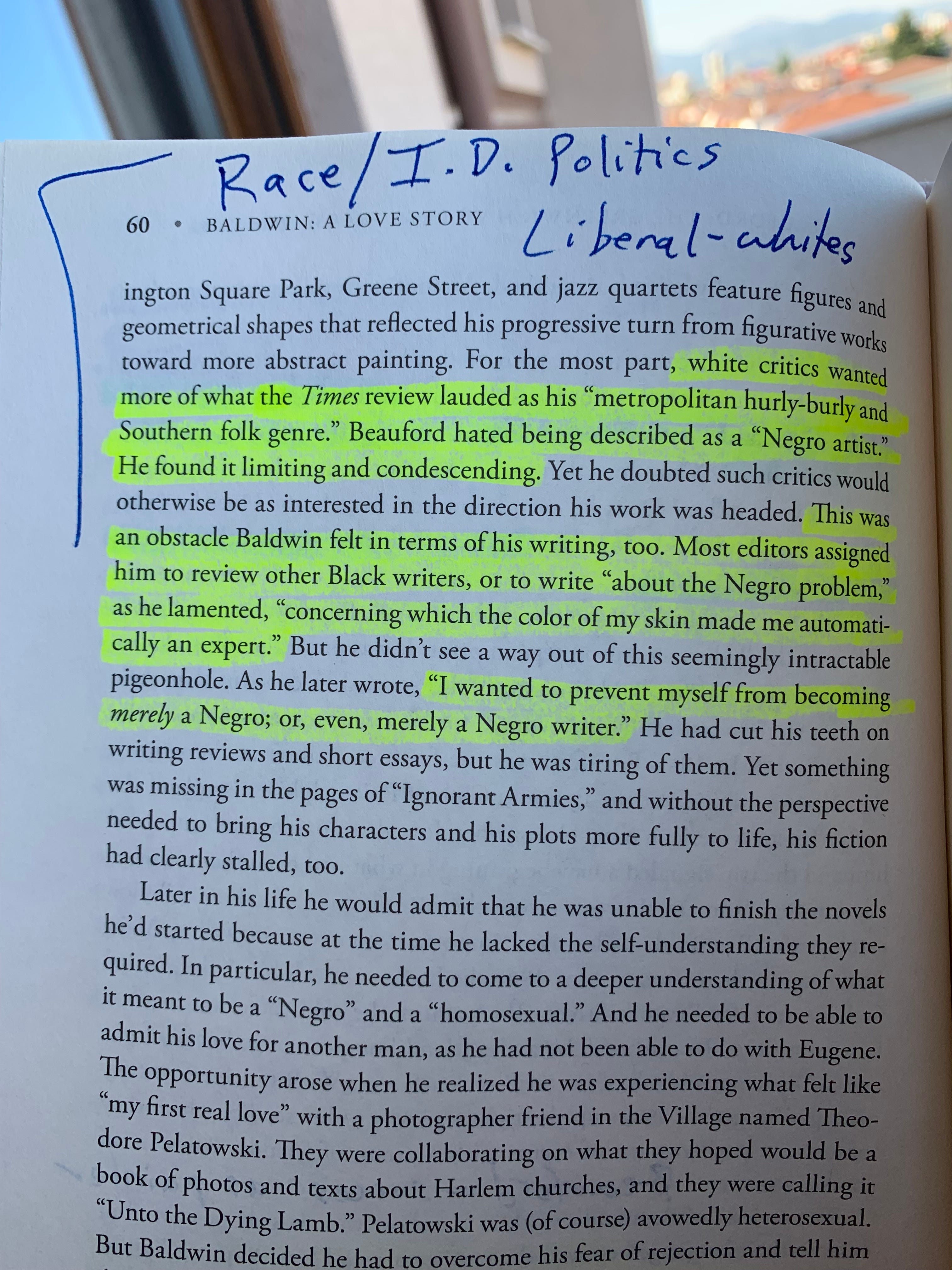
No one prior to Boggs has written about these flaws in Baldwin because he has become a totem, a mythic creature, a symbol, an almost sexual need for progressives to use as a banner of goodness and moral righteousness. Further, to criticize anyone non-white and liberal has become coded, for progressives, as “conservative.” This labeling is just like cancelling or “deplatforming” writers for Wrong-Think. There’s a sort of holy, Protestant-like clinging to virtue and rightness which the left wraps around heroes like Baldwin, MLK, etc.
But the thing is: I’m not interested in sides, politics, clickbait, any of that. I have a stark and healthy relationship with reality, and reality doesn’t pick sides. Reality doesn’t agree or disagree; it just is. It’s like pure math. You can hate it; you can argue one shouldn’t write about or say it; but it’ll never go away. No matter how hard you try to argue for trans women these people will NEVER menstruate or birth children. Sorry.
Baldwin’s flaws don’t bother me because, as I said, we’re all flawed humans. But also for another reason: Because, as I have written about often, I am a big fan of always separating the art from the artist. Most artists are intense, hardcore beings, the freaks, weirdos, outsiders, rebels, box-breakers, free-thinkers, fast-livers, etc. So it’s not surprising that writers overrepresent in alcoholism, mental illness, emotionalism, dysfunction. I very much include myself here.
So by all means I encourage everyone to read James Baldwin, both his fiction and nonfiction. Learn from his great talent. Reread his delicious, shocking sentences full of aesthetic beauty, depth and almost religious insight of the human soul and experience.
But know the man, too. Know the full human being. Be honest.
Tell the truth.
That’s what Baldwin always tried to do in his writing.
Even if he didn’t always succeed.
Comments
Nothing yet. Say the first thing.
Sign in to join the conversation.