
I’ve been a paying user of Google’s Gemini Advanced for 6 months and of Anthropic’s Claude Pro for 2 months and now use them daily, most often for help with small programming tasks (for example: showing me a better way to bind boolean variables to checkboxes in a JavaScript web application), help understanding basics of quantum computing (for example, questions about tensor products, density matrices, and partial trace), and getting advice about interpersonal situations or personal psychology (imagine a cross between Dear Abby and Psychology Today). Claude has a very useful search feature, and by adding keywords to the titles of our conversations, I can filter by keyword.
For more general generation and exploration of ideas, you might enjoy some of these prompts:
What are some of the most interesting things that an intellectual can ask an LLM?
I have the following current skills and background: ... What could I do to be better prepared if I lose my job unexpectedly?
I admire the following people: ... For each of those people, what kind of advice might they give me on the following question: ... ?
I admire the following thinkers: ... For each pair of such people, what kind of projects might they work on if they were to collaborate?
Certain activities have compounding or long-term returns, like investing money, improving communication skills, improving sleep / diet / exercise, developing good friendships, finding mentors ... What other activities are like this? In more detail: Some advise us to invest time and efforts in ways that produce compounding returns. Examples of this might be (1) saving and investing money to earn compound interest, or (2) learning to read or write better or become a better speaker because those are skills that can be used in many domains, or (3) cultivating a habit to do physical activity since that has many health benefits, or (4) creating new friendships that can last a long time, or (5) getting better at planning and managing our time and schedule since that will pay dividends over many years to come no matter what we are doing, or (6) in my case, since I already know how to write software, I could learn how to develop websites faster with modern web programming frameworks since that would make it easier to deploy new products and services that could potentially have a big impact. Would you have any other suggestions of activities like this?
I sometimes find myself mindlessly scrolling on social media on my smartphone and regretting the time lost to seeing ads or to silly shallow jokes that some algorithm has chosen for me. Are there alternative apps where I can scroll through content that is more enriching or that I have more control over, with fewer or no ads? Maybe even an app that is not for social media, but instead for scrolling over memories or thoughts or goals or advice that I have chosen for myself to be reminded of?
I would like to design a deck of cards, somewhat like Brian Eno's "Oblique Strategies", for stimulating creative thought and lateral thinking. Each card could contain a sentence to stimulate a new point of view, or suggest a strategy for breaking out of one's current frame, like sketching on paper, finding a colleague to bounce ideas off of, changing one's physical environment, allowing time for ideas to gel, using an AI to reformulate ideas, recording one's own voice and listening to it afterward to gain a 3rd person perspective, etc. Can you suggest some ways to come up with a list of contents for such a deck of cards?
Emacs is more than a text editor; it's a text editor whose behaviors can be reprogrammed and modified using text itself. Could we design and invent analogous software for digital pen strokes, where the behavior of the software can be reprogrammed and modified using pen strokes?
Outline an alternative history of late 20th century computing where the following events happen: …
I like (insert list of types of literature / art / games / activities / books / films ...) because of (insert list of properties...). What similar authors, activities, etc. would you suggest that I investigate?
Tell me some examples of science fiction stories that are less well known and that introduce interesting concepts about future trends. For each example of a story, summarize the interesting concepts of the story.
Help me choose a title or name for my grant application, software project, etc.
Give me feedback on the following abstract for an article I’m writing.
pretend that you're my debate opponent on the following topic ... What response might you have to these arguments for this position? What are the strongest arguments for your side, and how could I criticize them?
pretend that I'm an LLM and that you want to ask me questions about ...
imagine that you're one of my future great-grandkids and that you want to interview me ...
I’ve also used LLMs as tutors, with prompts like these:
(I have no background in economics, so this prompt is my attempt to better understand a bit of it:) I've encountered different descriptions of future scenarios for our world economy based on technology trends and demographic trends. (… enumerate and describe them …) 1. What do you think? 2. Is there a unified economic theory that can explain these difference scenarios, or is there debate among economists over which scenarios would emerge and why? 3: Are there software simulations or board games or video games that demonstrate how various factors influence outcomes, that could help us better understand policy choices to steer the future?
I was confused for the longest time by (topic A) until I encountered explanation XYZ which allowed me to make sense of it much more easily, because I am (insert description of how you learn or what your background is). Is there an analogous way that I might more easily learn (topic B) ? (Concrete example: instead of defining Dirac bra-ket notation in quantum physics in terms of linear maps and dual spaces, I find it much easier to understand in more computational terms involving row and column vectors.)
I would like to better understand topology. I often read simplified explanations of it that it's like 'rubber sheet geometry', where we can stretch and deform a surface. However, I've noticed that there seem to be three different senses in which two surfaces can be topologically equivalent. First, there's the sense in which two knots might be equivalent under Reidemeister moves. Under this first sense, we can stretch the 'string' or 'surface' of the knot, but we cannot allow the knot to penetrate or pass through itself. I guess it's assumed that the surface of the knot must remain embedded in 3D space. Second, there's the sense in which a sphere can be everted in sphere eversion. In this sense, the surface can intersect and pass through itself, but cannot be torn or undergo discontinuities, and maybe it's again assumed that the sphere must remain embedded in 3D space. Third, there's the sense in which two surfaces are equivalent with respect to the classification theorem, where, for example, P # K = P # T and K = P # P. In this third sense, we don't care about the surface intersecting itself, and I don't think there's any assumption of the surface being embedded in any space. Am I on the right track? What are the technical terms for each kind of equivalence? Maybe the terms are something like homomorphism or homeomorphism or something along those lines.
It seems to me that works of art can be evaluated according to several criteria and may exhibit different qualities. A work of art might be notable for its masterful use of technique (for example, realistic depiction of light and shadow in a painting, or capturing the quality of soft materials like silk in a marble sculpture), or for creative use of media (for example, combining 2D and 3D media, or using empty space in a sculpture to imply the presence of an object), or for clever arrangement of content (for example, various work by Escher), or for the message in the content (for example, an artistic depiction of love or excellence or virtue meant to inspire the audience). Are there standard lists or taxonomies of such criteria or qualities of art? Can you give examples of works of art that are accomplished according to multiple criteria simultaneously?
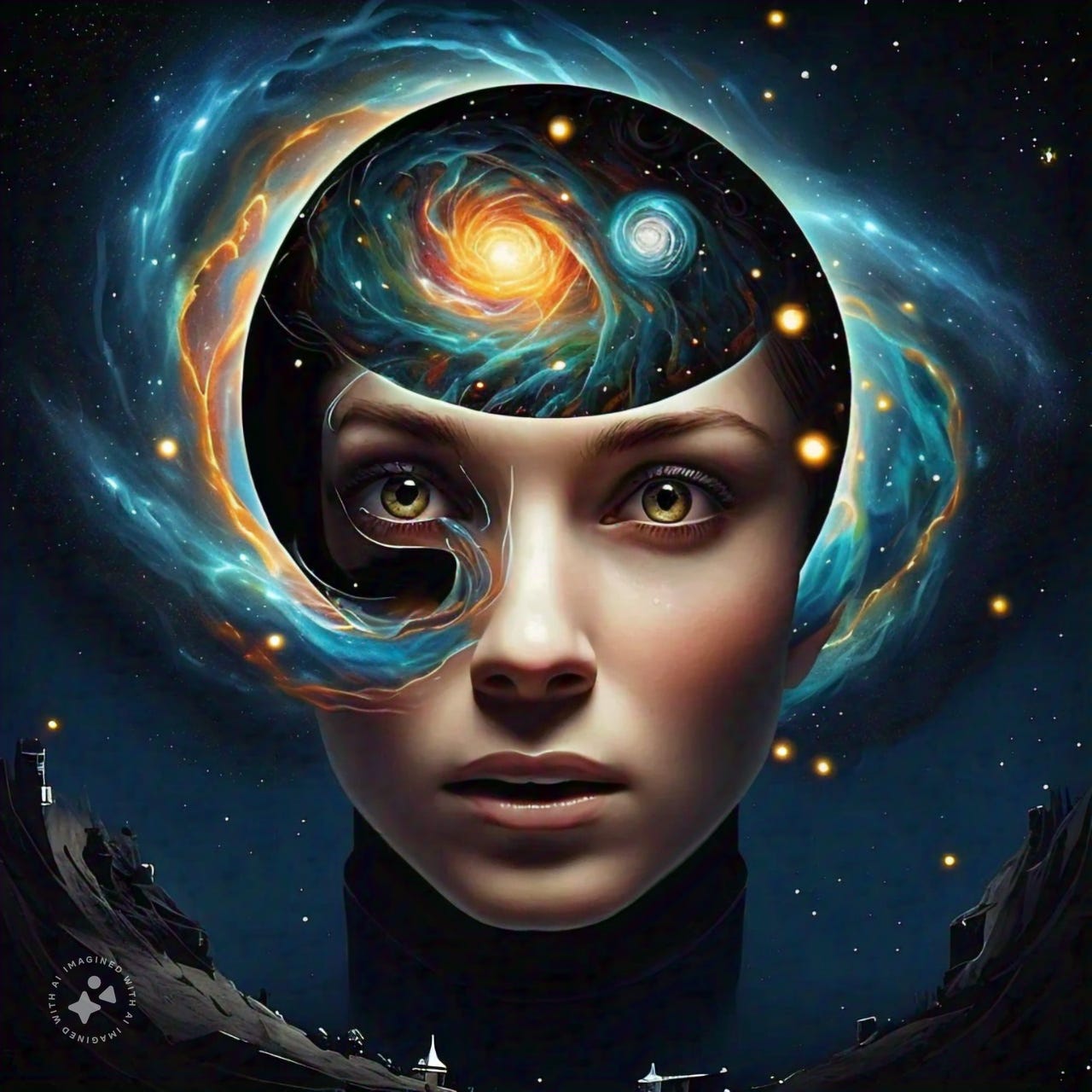
I’ve also been playing with vision boards and artistic reminders of goals and ideals to work toward. After seeing striking works by Iranian artist Fârzad Borousan ( https://designyoutrust.com/2021/05/false-gods-the-superb-retro-aesthetic-artworks-of-fa%CC%82rzad-borousan/ ), I generated several images with Facebook’s “Meta AI” using variants of this prompt: “Generate an image of a mysterious and attractive person's head with an opening or hole or cutaway in the head through which we see the mind's infinite potential inside the head. Also, around the head, it should be night sky.” Below is my favorite result. I think it succeeds in suggesting that the mind has endless capacities and potential within it that we should seek to discover, and also suggests other ideas: the outside world also contains endless experiences; the creations of our mind can leak out into the world and change it; and the experiences in the outer world flow back into our mind and change it.
No posts
Comments
Nothing yet. Say the first thing.
Sign in to join the conversation.