
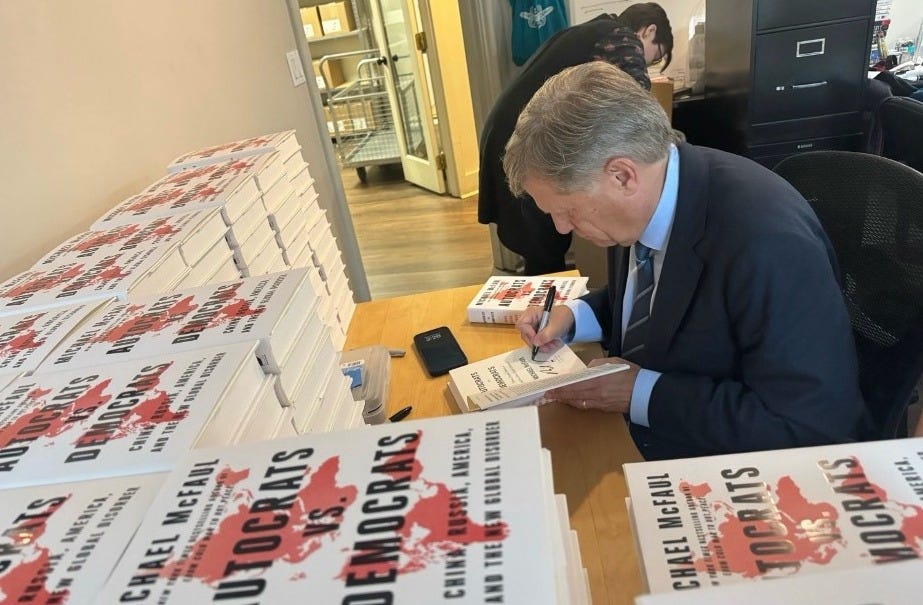
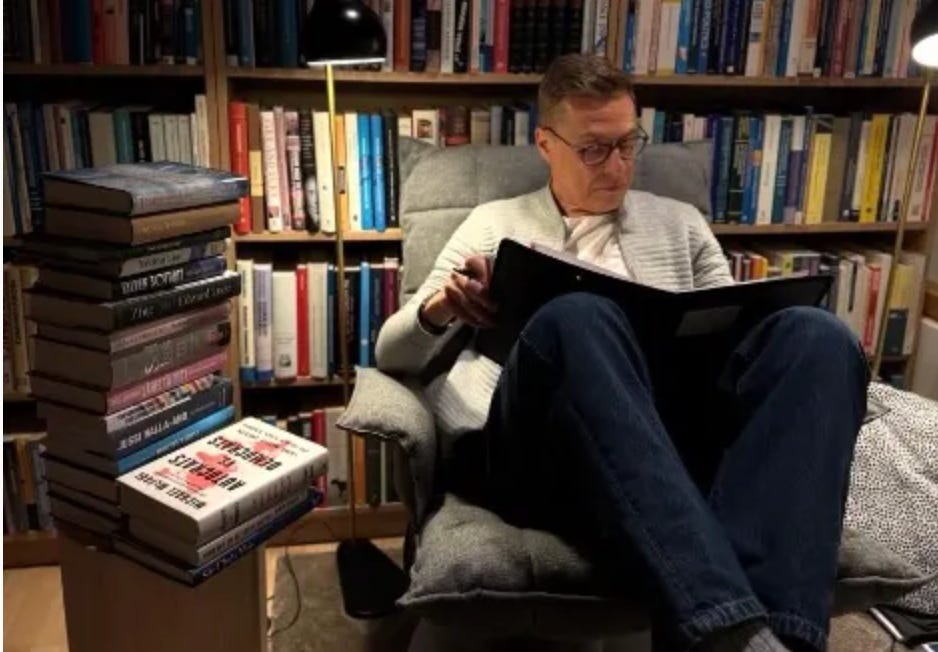
Last week, I did my last book talk about Autocrats vs. Democrats for this academic year. Since the book came out last fall, I’ve given talks in California, Colorado, Florida, Georgia, Idaho, Maryland, Massachusetts, Montana, New Mexico, Ohio, Pennsylvania, South Carolina, Texas (four times!), Washington, and Washington, DC. I’ve done three talks in China, and one each in Tallinn, Estonia, and Munich, Germany. And I’ve heard reports of people reading my book all over the world, including President Alexander Stubb of Finland, here!
These stops all around our great country have given me the chance to meet and hear from people in different parts of the country. From Boston to Bozeman, here’s what I’ve learned so far:
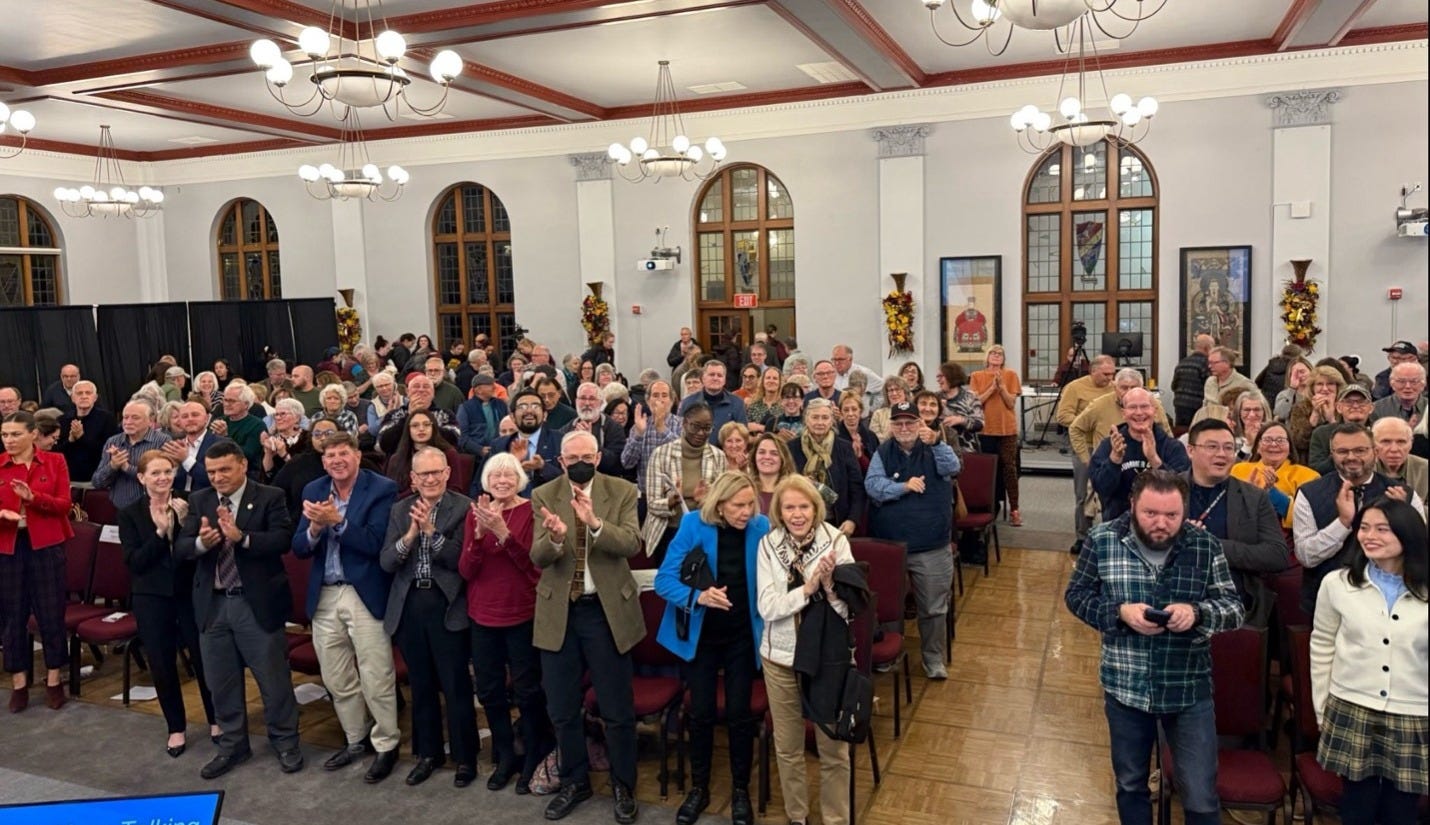
First, I have been constantly amazed at the size of the crowds. There’s an assumption among elites in Washington and academics on the coasts that Americans don’t care about the world. That has not been my experience. I was especially impressed by the giant crowds in Erie, Pennsylvania and the University of South Carolina. At my talk in Bozeman, Montana, people were turned away because there was no room!
Second, the crowds in “red” states were just as big as those in “blue” states. Of the 14 states I spoke in, eight voted for Donald Trump in 2024. Now, I understand there’s a selection bias regarding who attends a talk by me. And as my Stanford colleague Jonathan Rodden has written eloquently in his book, Why Cities Lose, the real political divide in the United States is not between red and blue states, but between blue cities and red rural areas within states. That all said, I did speak to some crowds that had significant Trump voters in the audience. I could tell by the questions! In one talk in Palm Springs, a few people walked out even before I spoke when they heard in my introduction that I had worked for President Obama. But I was generally impressed that the crowd sizes were roughly the same whether speaking in big cities or smaller towns. And even those who disagreed with some of my arguments wanted to engage in a conversation. Some of the most interesting interactions were at receptions and dinners after my talks.
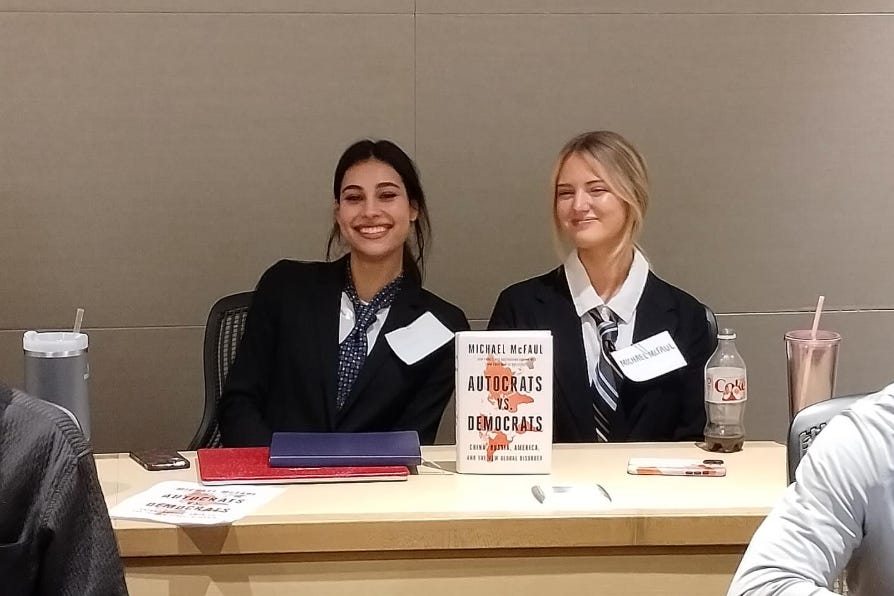
Third, my audiences tended to be older, even on college campuses. That disturbed me. When speaking about international relations, we need to find ways to reach younger audiences. That’s why I recently got on TikTok! But sometimes, I was pleasantly surprised by the number of college students who showed up, especially at Claremont-McKenna College, Georgetown, and Trinity College. I even inspired a few students at USC to dress up like me for Halloween.
Fourth, on the substance of my talks, my impression from the reactions to my slides and remarks is that Americans really value our allies. I got some of the biggest applause when I underscored the imprudence of invading Greenland or joking about making Canada the 51st state. Unlike the Trump administration and some of its supporters in the think-tank community, Americans I met on this book tour do not want to go it alone when dealing with autocratic China and Russia.
Fifth, again from my impressions of the audience reaction to my remarks, I sensed a rejection of isolationism and an appreciation for how engagement in the world helps to advance our security, prosperity, and values. I found this sentiment strongest when I was explaining why it is in America’s interest to support Ukraine. Unlike the current administration, my audiences understood that a victory for Putin in Ukraine will create the potential for future conflicts with Russia in other NATO allies, while emboldening Chinese President Xi and his threats against Taiwan. Conversely, a Ukrainian win will reduce the probability of war between the United States and Russia in Europe and the United States and China over Taiwan.
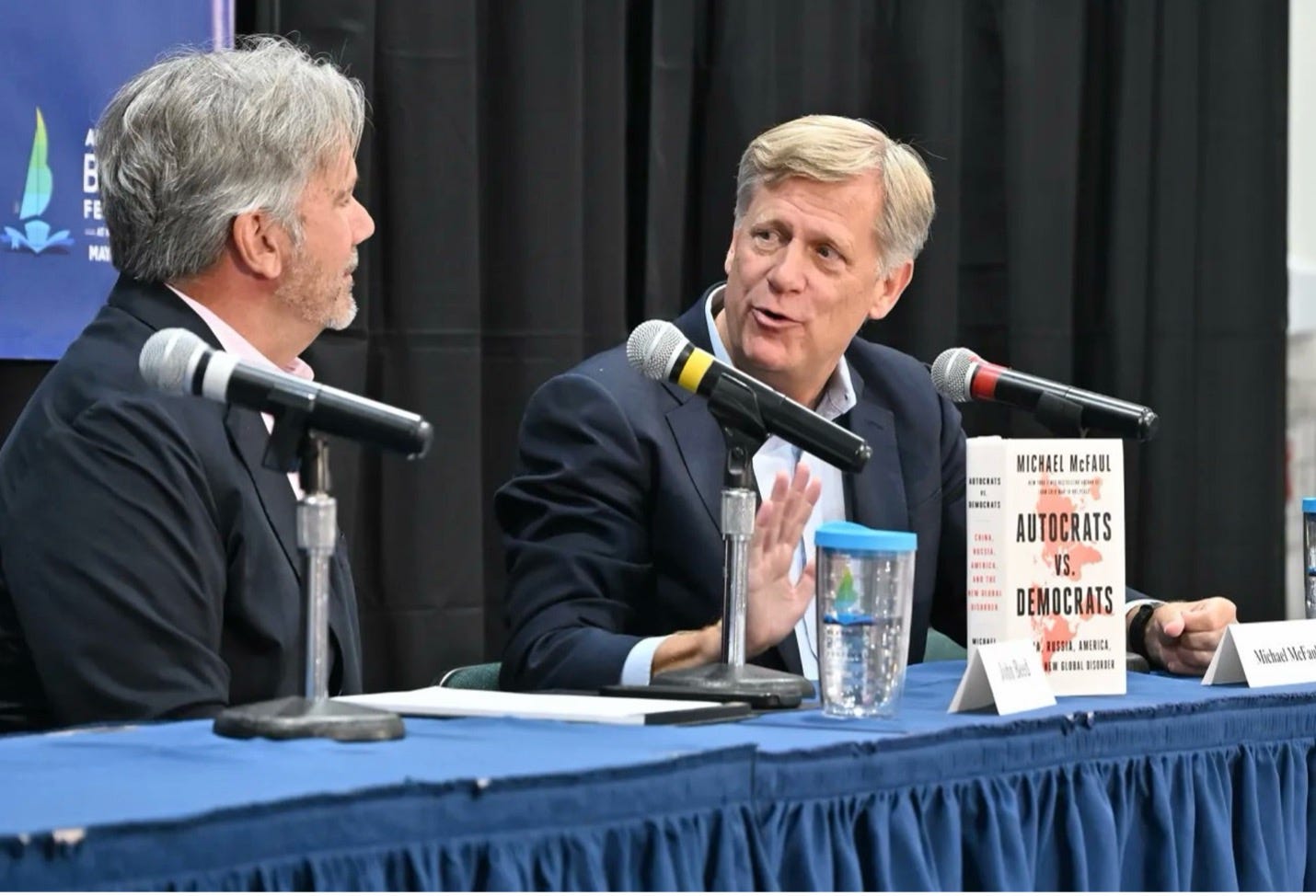
Sixth, at the same time, the Americans I met on this book tour are tired of overreach. When I discussed mistakes made by the United States in the Cold War (Chapter 12), the biggest reactions I got were about overreach. Just as the Vietnam War was a mistake in the last century, my audiences seemed to really dislike Trump’s war in Iran. Rejecting overreach, however, is not the same as embracing isolationism. When I discussed the successes of the Cold War (Chapter 13) and mentioned the United States Agency of International Development (USAID) or Voice of America (VOA), I got applause. In this respect, my audiences seemed to be in line with general American attitudes towards international engagement. The Chicago Council on Global Affairs has been polling Americans on this question for more than 50 years, and its data suggests that support for an active US role in global affairs has averaged about two-thirds of Americans since 1974. A Reagan Institute survey from 2025 similarly found that 66% of Americans polled believe U.S. international engagement benefits our country. Even regarding foreign aid, a majority of Americans support it.
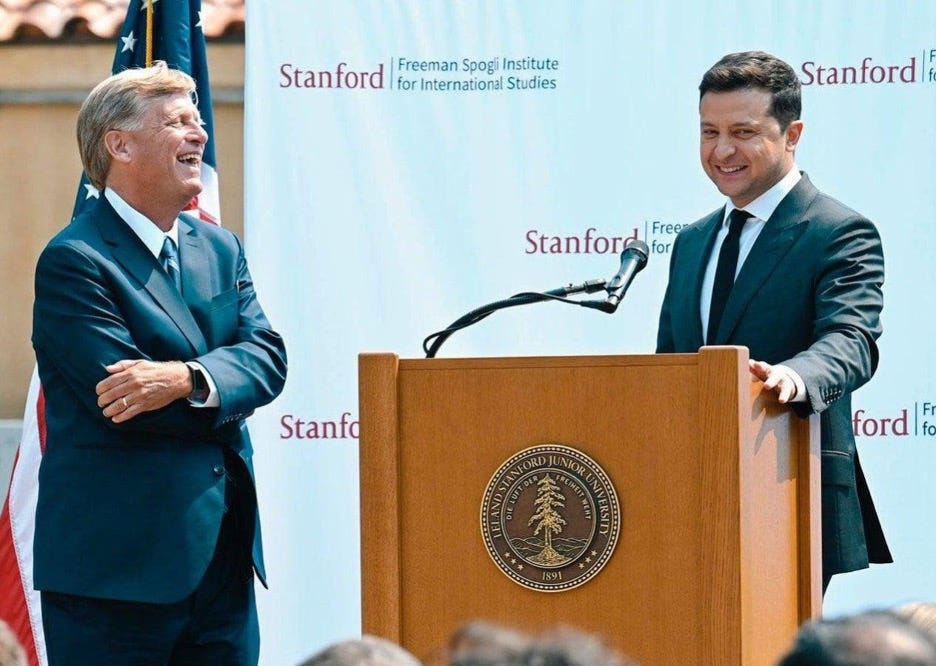
Seventh, and maybe most surprising to me, was the enthusiasm I heard when I was making the case for why we should support democratic ideas, democratic movements, and democratic leaders around the world. I got the most applause when I flashed a slide of me on stage with President Zelenskyy at Stanford in September 2021, a few months before the full-scale invasion of his country by Russia, and said: “I’d rather be on his side than Putin’s”!
Trump is all about economic transactions. He does not care about supporting democracy abroad. Many academics think the same way and assume that Americans care only about their own security and prosperity, too. I admit, I had a similar assumption before this book tour. I worried that my ideas were out of date and old-school. I came away from this year on the road with a radically different impression. The Americans I met think that our country was founded on values and still motivated by ideas, and not just business deals. Yes, Americans desire security for themselves and prosperity for their families, but that’s not all they care about. Some of the most passionate questions I got from my audiences were people asking me why our government is not doing more to protect Ukrainian civilians. Especially on campuses – I remember a particularly animated exchange at WSU Pullman– I also got questions about why the United States is not doing more to defend the human rights of people in Gaza. I came away with the impression that Americans living in Montana or Texas are a lot less cynical and a lot more idealistic about America’s purpose in the world than academics and think tanks on the coasts assume.
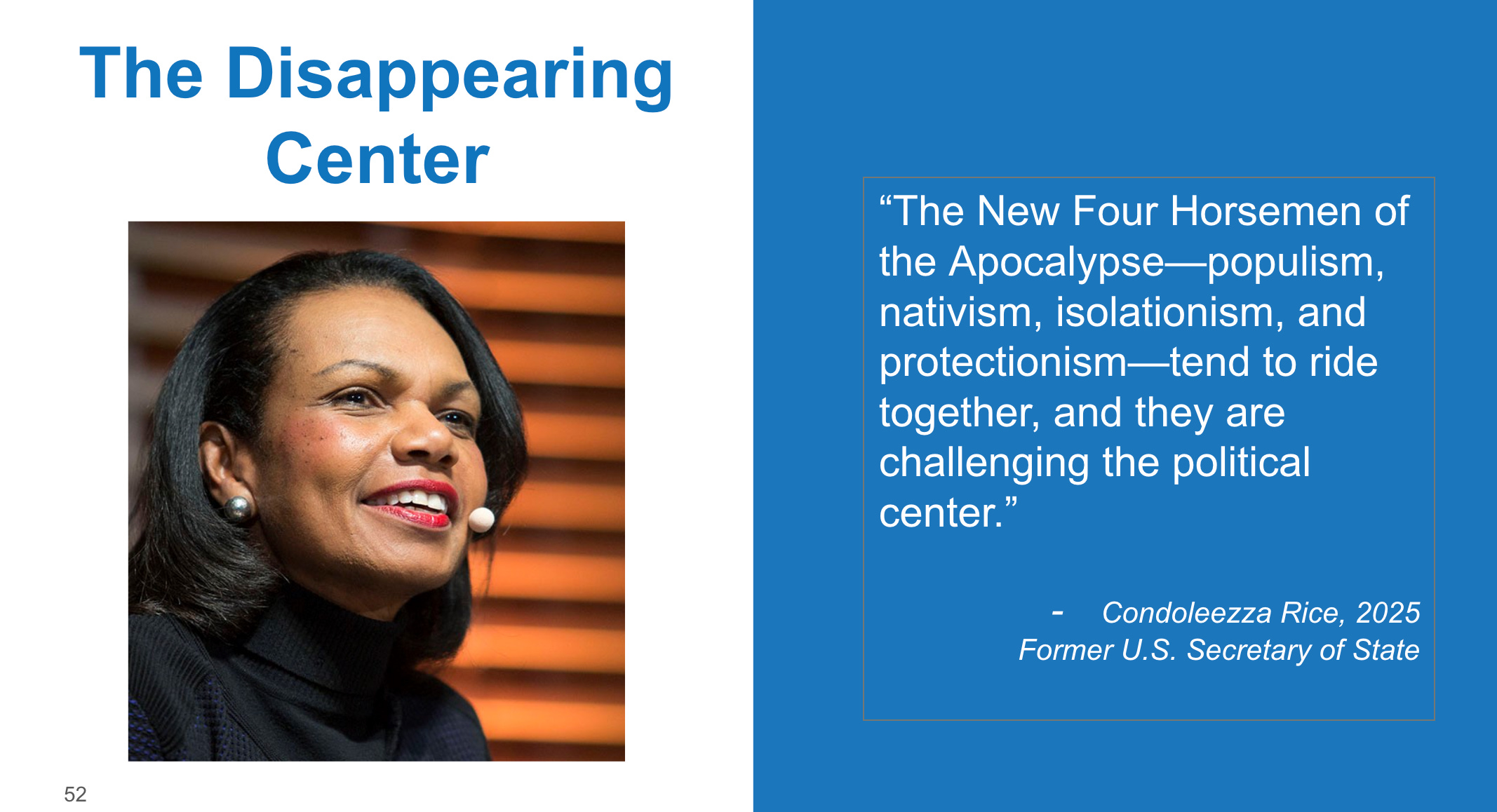
Eighth, I learned that Americans yearn for optimism. My talk ends with an upbeat set of slides about why, globally, small-d democrats not only have more military and economic power than the autocrats, but they also have better ideas. When was the last time you saw tens of thousands of people on the streets, protesting for greater censorship or communist rule? The epilogue of my book is titled “Don’t Bet Against America Just Yet” and, when signing books after my talks, the most common comment I heard was: “Thank you for that dose of optimism!”
At the same time, I got some very hard questions that I could not answer at the time—and that I am still thinking over. One was, “Will we have gained back the trust of our allies after the Trump era ends?” I hope so, but I did not provide a concrete action plan for doing so. Second, I mentioned in my talk the debilitating effect that polarization at home has on acting effectively abroad. However, when asked how to reduce this polarization, I always found my answers kind of lame. I have more work to do on that question. Third, one of the hardest questions I encountered was from Rachel Maddow in Cambridge, MA (that was a fun, raucous crowd! Over 600 people!) She asked me how we could more effectively support democracy abroad given that we hadn’t had many recent wins. That question has lingered with me ever since. I have a better answer now than I did in October, but it still feels like I have more homework to do. I hope to have better answers to all these questions and more for the paperback edition!
Finally, I want to say thank you to all who attended my talks. The giant, energetic, friendly crowds, the standing ovations at the end, and the long lines to buy my book afterward have inspired me to stay in the fight for defining America’s role in the world. I’m taking a break for the rest of the summer, but I’ll be back on the road in the fall, with stops already planned for Cornell University, New York City, Salve Regina University, University of Toronto, University of Utah, and again at Stanford. Stay tuned for details. And if you have ideas for other stops, send me an email! I’ll try to come.
Missed the tour?
If you missed my book talks, why not watch the one I gave at Stanford earlier in the tour—and follow along with my slide deck, too?
And if you want to dig even deeper, check out the syllabus for my Stanford course on great power competition, where Autocrats vs. Democrats is a key text. Find it here.
No posts
Comments
Nothing yet. Say the first thing.
Sign in to join the conversation.