
Begin with the mysterious “Lost Colony” of Roanoke during the reign of Elizabeth 1st. It was founded by Sir Walter Raleigh in 1590 (his second attempt). All 115 inhabitants vanished and presumably perished. Their precise fate (and their bones) is lost to history. They were there for gold, had no idea how to farm the land, and their crazy expeditions into primeval forests ended badly.
In the next century there were initially two tiny pioneering settlements that barely hung on for dear life. Good Queen Bess was moldering in her grave by then. One, founded by Anglicans, was called Jamestown (1607), named after King James 1, and one by Puritans, called Plimoth Plantation (1620). The latter and the Mayflower get way too much press IMO. Ronald Reagan was particularly obsessed with “Pilgrim Fathers” - and maybe didn’t know that Jamestown was the original location of madcap pioneers digging for gold (America’s only true religion).
The British Empire began to take shape during the early 17th century, with the establishment of the thirteen colonies of North America, each with their British governors. Most of those governors’ names won’t mean a lot, but an interesting case is Roger Williams (1603 – 1683), a Puritan minister and theologian who, after being expelled by the Massachusetts Puritans for being too liberal-minded, founded Providence Plantations. That became Rhode Island, and he was its “president” for a while.
Incidentally, the islands of the Caribbean - valuable because they were ideal for growing sugar cane to distill rum and give Brits a sweet tooth - had British governors too. They attracted acquisitive British landowners, and the slave trade began with working the cane plantations. Their landowners were culpable, and they brought the practice to colonial America. At least one of the wealthy beneficiaries of this trade was born in Nevis and came to America to become a founding father of the United States, Alexander Hamilton.
At this point there was no empire in Asia or Africa. The establishment of “joint-stock companies”, which raised equity from the public, greatly expanded British possessions, most notably the East India Company, founded in 1600, but turned into a monstrous predator of the Indian subcontinent under Robert Clive and associates in the mid-18th century, who used the money to buy off Indian troops and have them conquer their own states. Free enterprise and “leverage” of a most extreme kind. Colonial administration was subsequently given to the “crown”. Various acts of parliament regulated the company in the 18th century, but it did not cease to exist until 1874.
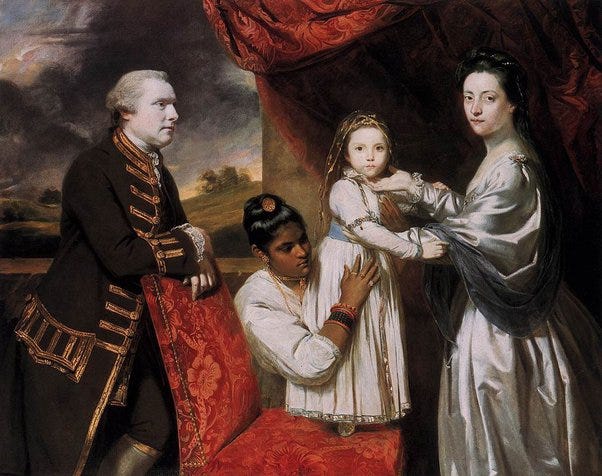
George Clive, cousin of Robert Clive, with an Indian maid. (Joshua Reynolds)
From 1756 the Seven Years War established Britain’s political and commercial dominance, including in North America, India, and parts of Africa. This all occurred under a brilliant wartime secretary of state and later prime minister William Pitt (the Elder), especially because of his single-minded devotion to defeat France.
Captain James Cook, who circumnavigated the world three times - some of the time with another nautical genius named Captain William Bligh (of “Mutiny on the Bounty” fame) - was actually not the first European to discover Australia and New Zealand (in 1770). He has a better claim for a first in Hawaii (in 1778), before sailing the west coast of Alaska - seeking the fabled Northwest passage (in reverse) - and stumbling on the Aleutian islands - neither of which he considered fit for the crown. Interestingly, with respect to Australia, the British Admiralty had sent Cook secret instructions to explore the South Pacific for a rich southern continent that they had already named “Terra Australis”.
Cecil Rhodes (d. 1902) was a rapacious merchant capitalist who essentially bought (“annexed”) southern Africa with diamonds, gold, and other precious minerals he dug up in the territories he took over. His name lived on for a while as Rhodesia.
No posts
Comments
Nothing yet. Say the first thing.
Sign in to join the conversation.