
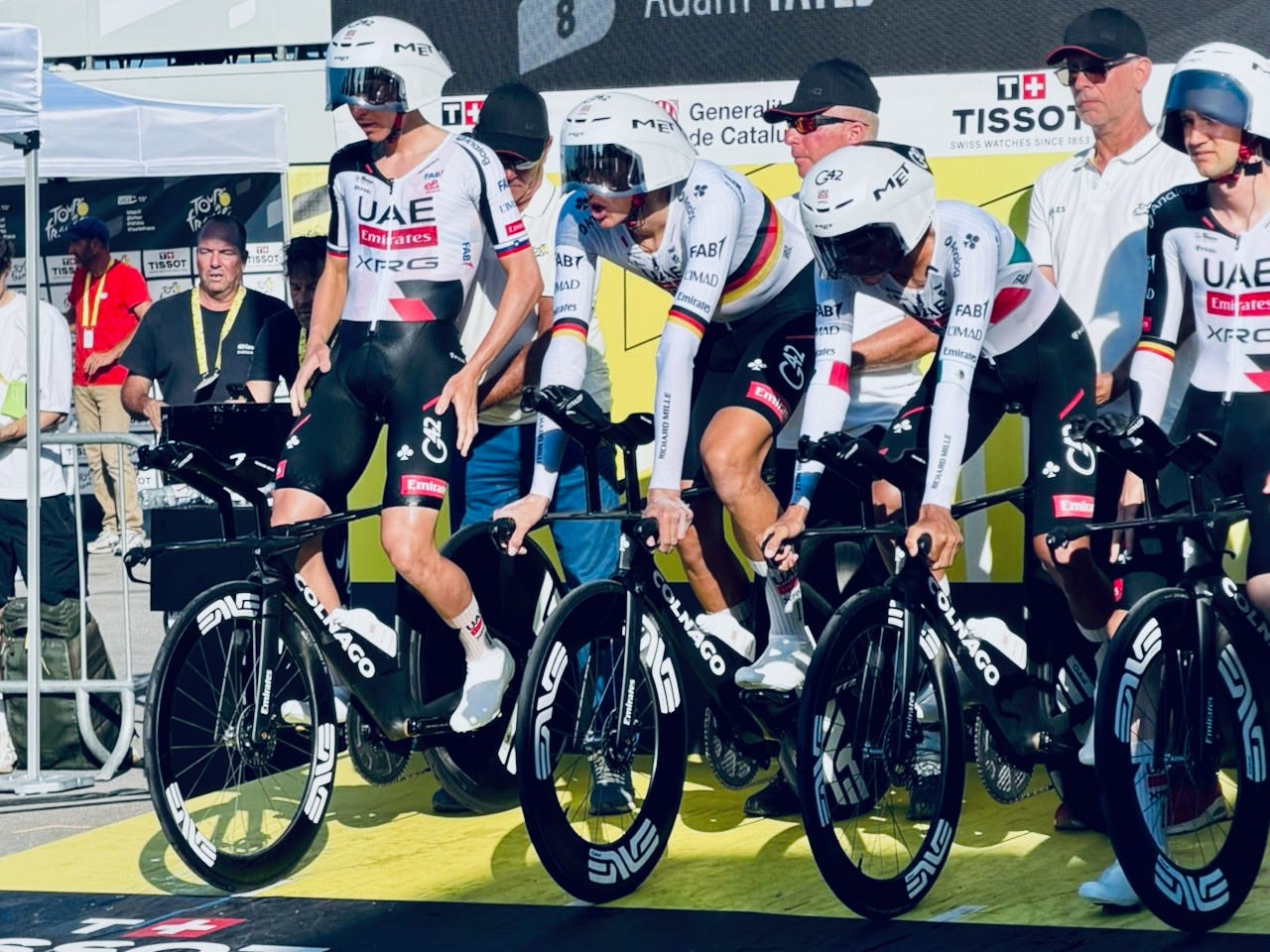
The Tour de France made its first Grand Départ from Barcelona this weekend. It began not with a chaotic dash, but with a ritual of coordinated movement: cyclists in peloton formations as precise and elegant as the Modernista architecture that lined the streets they scythed through. As the winning Team Visma demonstrated in July 4’s team time trial, disciplined drafting or slipstreaming rotates teammates through the wind, shelters leaders when they need it, and slices a path to victory. It’s the metaphor I’ve been waiting for to illustrate and rectify hedging in China-West relations.
This is Part IV in a series of articles on the wave of Western leaders visiting China since Donald Trump’s return to the White House. Read the original essay in Foreign Affairs and Part I, Part II and Part III here on Substack.
A peloton is game theory on wheels. Every rider wants to shelter inside it to spare energy. Nobody wants to take too much wind, but some riders must. What holds it together is repeated interaction and total visibility on who’s working and who’s free-riding. The group disciplines defectors by refusing to shield them in turn. It’s cooperation without central authority — stable until the moment it isn’t. An effective peloton requires riding like a team, forming a paceline and taking turns in the wind. Otherwise it’s an amorphous mess. The essence is energy allocation.
The wave of diplomatic visits to China has been the same. Look at each trip as a discrete verdict on bilateral relations and you miss the pattern of pack behaviour under collective exposure. Nobody wants to be the first or only one to take a leading position that risks windburn, either from Trump’s gusting crosswinds of tariffs and transactional threats, or from the PRC’s steadier headwinds of diplomatic intimidation, market access restrictions and supply chain chokeholds.
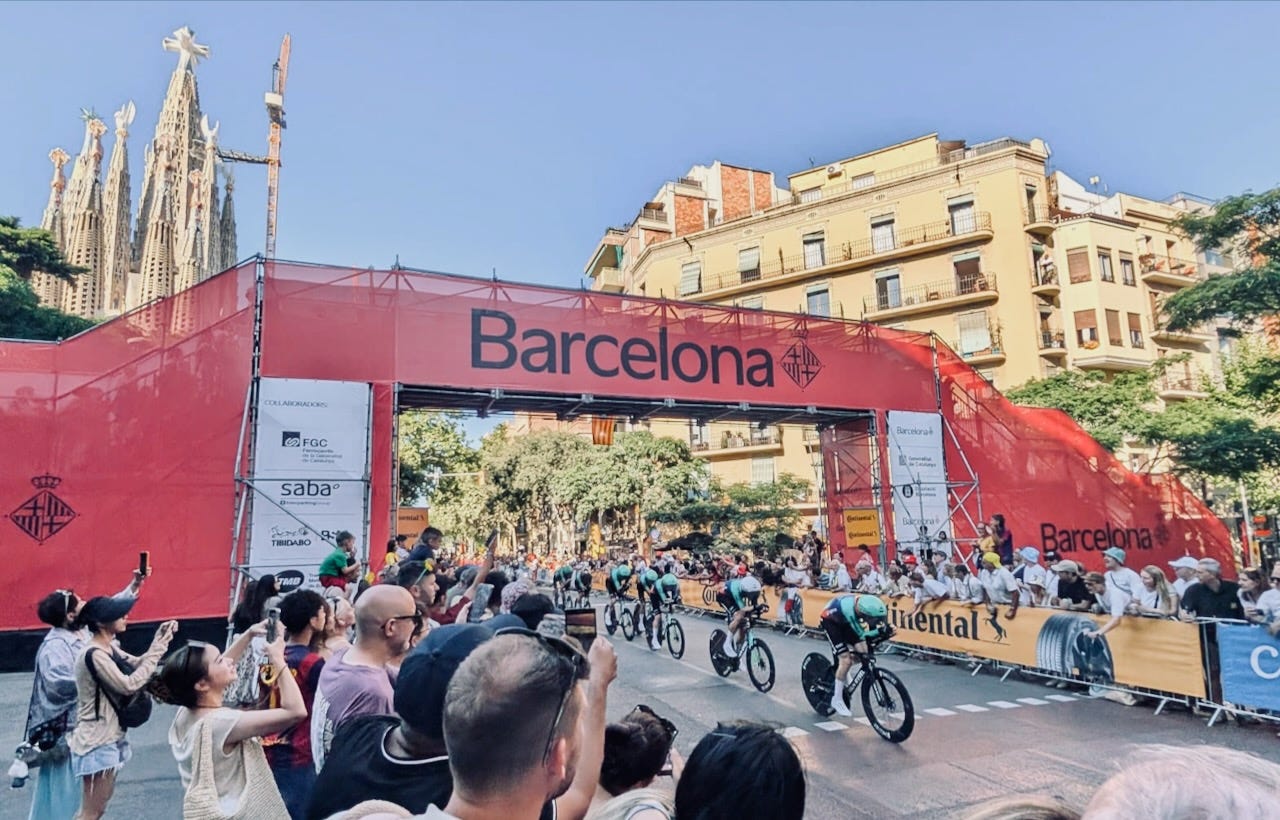
The peloton’s rotation problem is central to the metaphor: under a steady US alliance system, it’s sustainable. Under Trumpian volatility, it becomes more dangerous because the lead rider is no longer reliably pulling — and lately he may even be swerving into you. When the group can’t fully institutionalize reciprocity and enforcement, individual riders are tempted to try their luck with selective bilateral stabilization. They try to appear to be cooperating with their Western partners, while quietly looking for ways to reduce the risk they personally become the next test case for coercion. Look closely and you’ll see them smoothing dialogue with Beijing, finding transactional off-ramps, and avoiding public escalations.
Staying in the peloton saves enormous energy, which means that normally, leaving it is stupid — except at strategic moments. Tactical wheel-sucking behind another cyclist to reduce wind resistance is rational. In alliance politics, it’s also rational — and corrosive. The EU’s currently wheel-sucking at the bloc level: everyone stays in the pack but no one wants to take a long pull for stronger trade defence measures. Friedrich Merz’s February visit looked like Germany taking a short pull — with the team car shouting contradictory instructions and half the domestiques (German companies) riding for Team China.
Naming PRC coercion, interference, espionage, hostage diplomacy, and hostile policies on Tibet, Xinjiang, Hong Kong, Taiwan, Japan, and the Philippines burns a match in cycling parlance. It creates immediate retaliation risk, complicates deliverables, and can even look performative if you don’t have capacity and will to impose meaningful costs. So politicians draft like riders, hedging by tucking into a slipstream of convergent scripts with fuzzy concepts like “strategic stability,” “guardrails,” and “de-risking, not decoupling,” accepting the Chinese Communist Party’s script and choreography, and foregrounding economic deliverables for their voters.
Cycling puts buck-passing in colourful spandex and makes it more obvious, but the dynamics are much like governments letting Washington and the European Commission absorb China’s retaliation while preserving market access to placate farmers. Energizing for each rider; poison for the peloton, because if enough riders do it, the breakaways start determining de facto policy.
The leaders have moved in a wave because they’re marking their rivals — watching how other visits go. Their thinking is, “if another country wins access or tariff relief and I don’t follow, I’ll be the one caught in the gutter when the next gust hits, or left exposed by a deal Trump and Xi cut over my head.” The CCP is content to allow some controlled breakaways, because every visitor who bargains alone converts a shared problem into a separate negotiation and thins the group’s collective leverage. Split the pack in the crosswind (that’s what a wedge strategy is for) and you set the tempo.
But politicians aren’t bound by physics like cyclists. With time and effort, they can change the geopolitical aerodynamics by diversifying supply chains, building domestic capacity, and hardening anti-coercion tools. That’s the long, hard road that gets you back to genuine sovereignty and better leverage. In the meantime, effective diplomacy can buy time, hold the line, and eke out small advantages.
Coordinate your China policies and messages with allies before you travel, hold to common red lines, and collectively impose costs on PRC coercion rather than capitulating to it individually. Call it peloton diplomacy.
When he arrived in Beijing in May, Trump could have put that logic into practice. He could have rejected the Party-state’s stagecraft and slogans, refused ephemeral deals that disadvantage allies and deepen dependence, and used meetings to bolster deterrence and apply leverage rather than seeking illusory adulation. That would have diminished General Secretary Xi Jinping’s confidence that Chinese coercion inculcates accommodation, and strengthened Trump’s own hand by establishing a new pattern in which PRC pressure on one is met with resilient pushback from many.
He didn’t. Still, as they prepare for subsequent meetings, his and other governments could refocus on the limited collective action challenge of turning each meeting with Party-state officials into an opportunity to demonstrate more resolute alignment on positions and interests they already share.
Reframe the purpose of going to China. Move away from the self-censorship, ephemeral dealmaking and authoritarian choreography that cedes the advantage to the CCP, and toward a playbook of using such encounters primarily to gather information, test intentions, develop strategic empathy, defend bottom lines, and convey consistent messages on allied priorities.
Correct the misperception that drives buck-passing. As Part III showed, Emmanuel Macron’s “matter of life and death” is the template. Until enough Western leaders share the perception that another year of accommodation does more damage than a year of coordinated constrainment, buck-passing will continue to be each leader’s rational choice. Build the perception that Chinese economic statecraft can’t be consummated against any one ally in isolation.
Build the contingency element that superficial hedging currently lacks. Hedging without contingency planning is just commercial engagement with extra steps. The institutional architecture Mark Carney sketched at Davos — such as EU-CPTPP links, anti-coercion mechanisms, and critical-minerals coalitions — is exactly the institutionalism of Robert Keohane’s After Hegemony: cooperation maintained without a reliable American hegemon. It’s buildable, and it doesn’t require everyone to agree the threat is existential. It requires strong enough diplomatic agreements and commitments that nobody can be picked off alone.
Refuse the script even when accepting the protocol. Macron in Chengdu is the operational proof that this is possible. Take the panda lunch. Sign the letters of intent. And still say, on Chinese soil and at home afterward, what is actually true about the imbalances, the war in Ukraine, and the threat to European industry. The visit costs are sunk. The narrative costs are not. More on this below.
Let’s dig into #4 as an example. My Foreign Affairs essay calls on visiting leaders to “eschew the symbolic, rhetorical, and material accommodation that Beijing seeks.” Diplomats might fairly respond: Okay, but how, exactly? The visiting leader cannot refuse another host government’s protocol. They have to walk the red carpet, attend the banquet, sit at the long table opposite Xi. They cannot dictate the venue, the ceremonies, the seating arrangements, or the simultaneous interpretation of a state visit they themselves requested.
True. But there’s a useful distinction between protocol — what every state visit in the world entails — and optics and narrative, which are what the Party really wants to control, and which visiting leaders typically surrender. The first is unavoidable. The second is what matters. Stoicism teaches us to focus on what’s within our sphere of control, and stop worrying about what’s not.
Share Michael Kovrig's Strategic Narratives
Protocol: motorcades, honour guards, joint photo opportunities, hosted state banquets, simultaneous interpretation, seating arrangements determined by the host. Refusing any of this would be futile, rude, or both.
The composition of the delegation. Bringing a business delegation of 30 CEOs to China is itself a public statement. The CCP understands that those business leaders won’t pressure their political representative to engage in tough talk. They’re there to constrain and manage imminent risks and to seek new opportunities. Without the structural discipline of national and allied China strategies, CEOs’ short-term commercial logic dominates, even as decisions to locate research and development and production in China erode their home countries’ economic security. By contrast, it would send a very different signal to send a delegation that includes ministers responsible for human rights, defence, security, or intelligence, as well as technical experts, China specialists, civil society advocates, and labour union leaders.
Pre- and post-visit framing. What delegations say before boarding their planes and after returning is entirely under their control. “The meeting is the deliverable” was a phrase I heard too often from diplomats during my research. It made my head hurt, because that’s exactly the dynamic the CCP is working to create. In a market where demand for face time with Xi Jinping now exceeds supply, the Party is raising the price. It’s a classic Chinese tactic: use access for leverage and oblige you to make concessions just to get in the door. Diplomatic friends, that’s a sucker’s game, and you’ve got to stop playing it.
Repeat after me: The meeting is not the deliverable. Both sides should have an interest in meeting, and if you make concessions before negotiations even start, you’re only weakening your own hand. The Party strives to inculcate subservience, but don’t ever confuse that with mutual respect. Play your diplomatic cards well and insist on a dynamic of sovereign equals. Chinese officials might actually respect you.
Demeanour. Less affective warmth on camera. Fewer ad-lib smiles. Fewer lines that sound like gratitude or admiration. Instead, cultivate firm professionalism. Richard Solomon’s classic RAND paper, Chinese Political Negotiating Behavior, warned readers to expect that their hosts would “manage the ambience so as to maximize the sense of gratitude, dependence, awe, and helplessness.” It concluded: “resist the flattery.” That advice remains timeless. Leave your ego on your plane with your electronics.
The language of the joint communiqué. Beijing routinely tries to insert specific formulations into the public documents emanating from the visits. They include terms such as comprehensive strategic partnership, an equal and orderly multipolar world, the right side of history, reaffirmation of the CCP’s hardline one-China principle on Taiwan (rather than the “one-China policy” of most Western governments), and rejecting decoupling or a Cold War mentality. Negotiating the joint statement text rigorously in advance — and refusing accommodative language even when that means accepting separate parallel statements — is squarely within the visiting government’s power. So is subsequently disavowing any language in the PRC’s statement you don’t accept.
The leader’s own public remarks. What’s said in the recorded parts of meetings, the press conference, the business forum, or the academic address is entirely in the visitor’s control. Carney’s Orwellian “new world order” line at his appearance with Premier Li Qiang was not a protocol requirement. Same with Keir Starmer’s mealy-mouthed “more sophisticated relationship” formulation days after Jimmy Lai’s appalling sentencing. Pedro Sánchez didn’t have to endorse the “Four Global Initiatives” to sell pig stomachs. They were choices that provided free content for PRC propagandists.
Symbolic concessions Beijing extracts as preconditions. Approval of a contentious mega-embassy on the eve of the visit; the dropping of a pending counterintelligence prosecution; the granting of high-profile commercial approvals timed to the trip; state honours offered to Chinese officials whose conduct should disqualify them. These are sometimes presented as protocol but are actually substantive concessions made to secure the meeting itself.
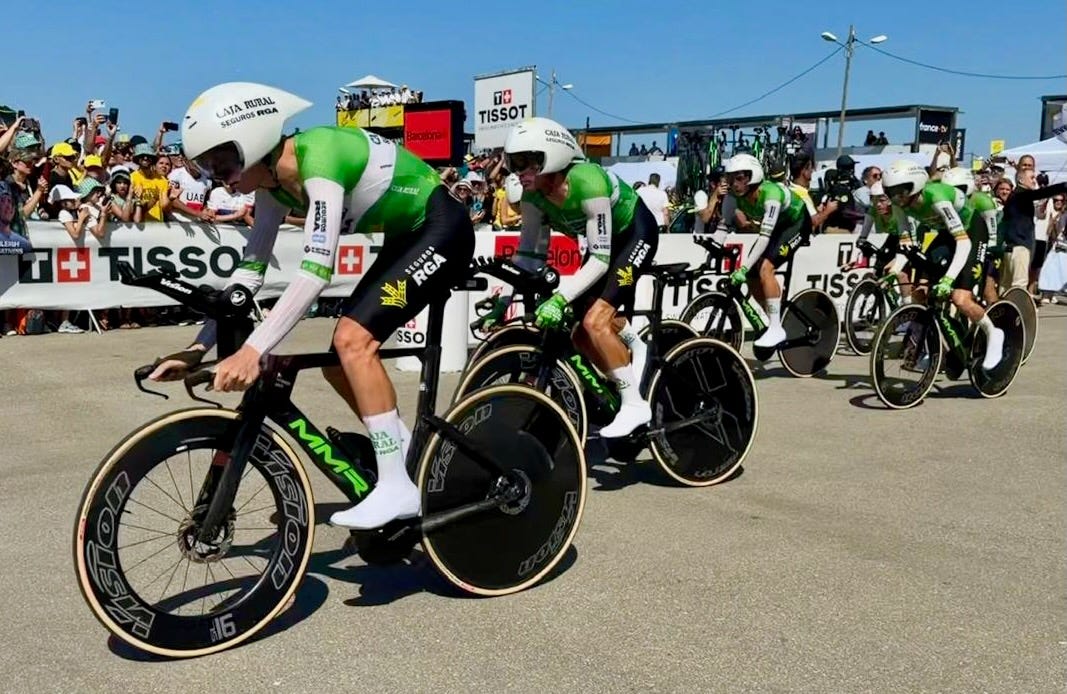
Getting the diplomacy right doesn’t substitute for material policy changes and the hard work of building national power any more than adroit peloton tactics substitute for a cyclist’s aerobic capacity or power-to-weight ratio. But for political signalling and shaping the strategic narrative, high-level diplomacy matters. Walk the red carpet but refuse the language of the joint statement. Sit at the banquet but use the press appearance to name detained citizens. Accept the toast but reject the slogan. That’s what disciplined engagement looks like. It’s tougher to pull off than it sounds. It’s also entirely possible.
As Canadian former foreign minister Lloyd axworthy recently wrote:
Sovereignty lives in small moments. When an ambassador oversteps and you push back. When an ally bullies and you say no. When a trading partner interferes and you name it. When a friendly autocracy fuels atrocities and expects your silence, and you refuse to provide it.
It’s not too late for the Trump administration and others to course-correct. What American officials and other statesmen say and do over the coming months can redefine in retrospect what all these visits have been about. It’ll be more effective when coordinated with likeminded capitals.
All these countries risk bullying, humiliation and loss of sovereignty when facing Beijing alone. But there’s a better way, as the Tour de France’s cyclists demonstrated this past weekend in Barcelona. The team that won the first yellow jersey moved as a unit — taking turns in the wind, protecting its leader, and preserving power for the climb. Here’s the upside for self-interested pragmatists: like efficient cycling, if you get the diplomacy right you’ll expend less energy for the same results. It’s not the strongest cyclist that automatically wins the Tour. It’s usually the best rider with an effective team and strategy.
There’s a long road ahead. You’re constrained by finite resources, incomplete information and uncertain terrain. Most interactions oblige restraint. A few challenges require total commitment. Wisdom is knowing the difference. Time to pedal hard and restore the peloton.
Comments
Nothing yet. Say the first thing.
Sign in to join the conversation.