
I am approaching 1000 subscribers. My goal is 10,000. Feel free to recommend this substack to friends. I am confident that 10,000 persons are interested enough in what I write to subscribe. Persistence will win the day.
This morning my son, Finnan, is competing in the club Match Play Championship. Our club is the University of Maryland Golf Course. Because Finnan is 9 years old, they are assigning him to the red, forward tees. I don’t know his competitor, but it will be a senior man over 70 years of age. (Only at this age can one compete from the red tees.) I hope Finnan can take advantage of the Surprise Factor, of this man discovering how well his diminutive boy opponent can play, and grab an early lead. Finnan shoots par except for the occasional double-bogey or blow up hole.
In any case, I won’t have much time to write this substack, as I need to take Finnan and caddy.
Happy Feast of the Assumption! I wrote two essays for the occasion. In the Boston Pilot, I wrote a précis of my argument in the Appendix to my book on the gospel of John, “John, a Witness to the Assumption.” It begins:
The latest date scholars give to Mary's Assumption, if they have faith and believe in the Assumption, is the early 60s AD. The earliest date at which scholars place the writing of John's Gospel is around 70.
If John and Mary lived together, in Jerusalem and then Ephesus, as tradition testifies, John likely witnessed Mary's Assumption. True, he might have been out of town on some apostolic mission. But it seems unlikely, in God's providence, that he would have been absent.
So then, if John is indeed the author of John's Gospel, as tradition holds and I believe, then it is natural to ask whether his Gospel shows signs of having been written by someone who was an eyewitness to the Assumption.
I then turn to Pope John Paul II’s observation, that Mary is the first human creature to enjoy the blessing of eternal life, body and soul, as is intended for all of us. And I point out that John emphasizes truths, in contrast to the synoptic writers, in just the same way as one would expect, if he had witnessed Mary’s Assumption.
It is a précis of a section of my book, but I do not promote or even mention my book in the essay. I let the argument stand on its own.
In The Catholic Thing today, I have an essay entitled “A Feast of Doctrinal Development,” which begins:
Why debate what the development of doctrine looked like in distant eras of Church history, when we have three instances in front of us, two of which were seen and commented upon by that great Saint of development, John Henry Newman?
By “right in front of us” I mean the extended present of the Church’s self-consciousness, which reaches back to Pius IX’s definition of the Immaculate Conception in 1854, the First Vatican Council’s definition of Papal Infallibility in 1870, and Pius XII’s definition of the Assumption in 1950.
These are three examples of the Church developing its doctrine. That is why today’s Feast may be viewed not simply as teaching a truth, that Mary was assumed body and soul into heaven, but also as exemplifying a truth about what development amounts to.
Maybe this sentence gives the main lesson I draw:
These paradigms of development point to sameness, not difference, in the Church’s teaching. They teach that the crucial move in development is not “we used to believe this, but now we believe this” but rather, “we see that we have believed this all along.”
I forgot to mention yesterday that after I called my second son Maximilian, I discovered that my mom’s father had the same name. He emigrated from Poland with his wife, Valeria, in the 1890s.
My mom describes him in an oral history:
He was short, mustached and wiry and ate standing up a lot of times. … Pop was a man’s man if you know what I mean. He was strictly an outdoors person and worked really hard doing what he did best. I grew up on a farm, and we had a very large vegetable garden, so in the summers we would harvest the veggies, and my father would load them on the back of his pickup and take off for points north on Long Island where the wealthier folks lived. He would drive up and down the streets yelling “Fresh vegetables for sale,” and the women would come out and pick and choose what they wanted for dinner.
I didn’t know it when I was young, but my father was a well-known shoemaker in Poland and repaired our shoes expertly with some tools he brought to the United States with him.
People often ask me if I can speak Polish, and when I was young I spoke very well, but my father felt we were Americans and should stick to English. He said that’s why he came here, and, even though he conversed in Polish at home, when away he would insist on English.
He was a fine man and loved all his children. He died of a heart attack while he was cutting the tall grass in the fields with a scythe.
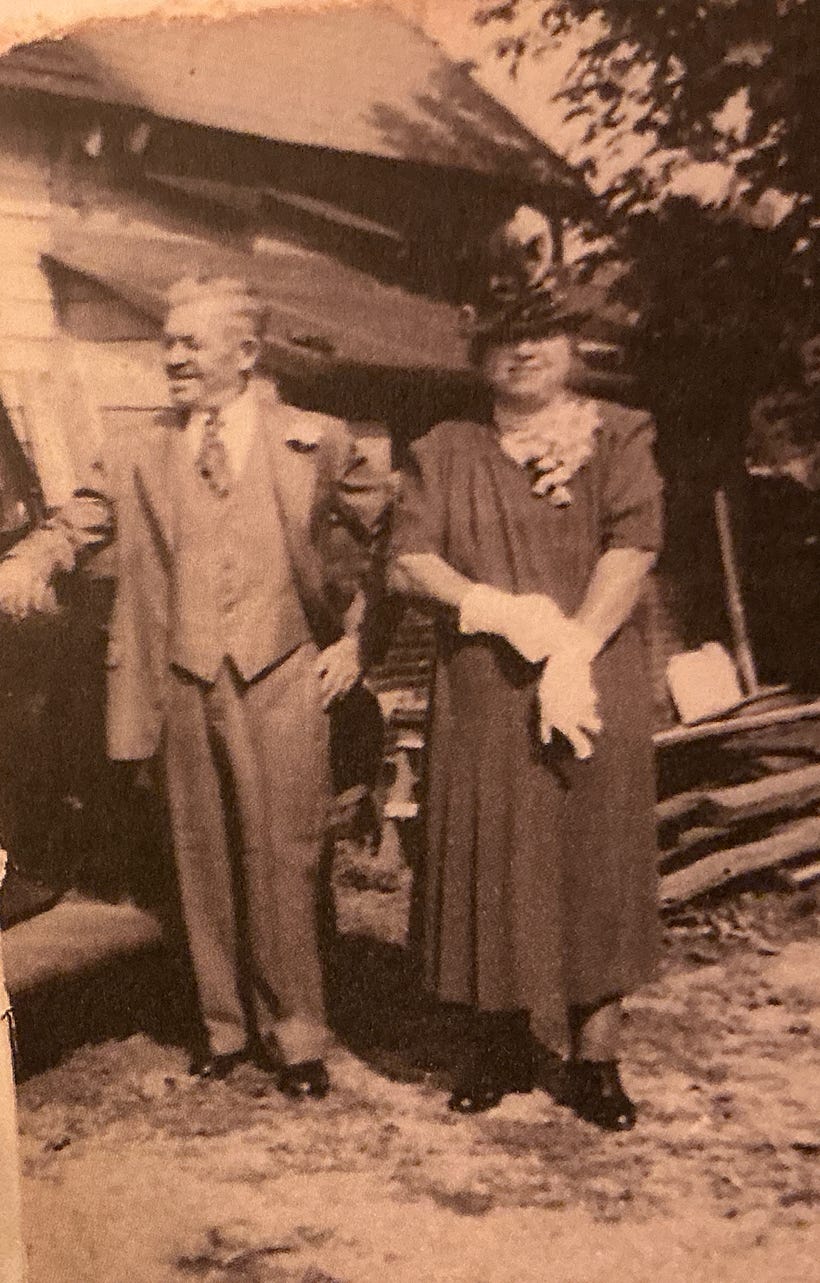
(My maternal grandparents, Maximilian and Valeria)
I was wondering yesterday on the memorial of St. Maximilian Kolbe whether it was essential to his specific act of self-surrender that he gave himself up for a man who had a wife and children, Franciszek Gajowniczek. When this man was condemned to starvation in the Hunger Bunker by the Nazis, in retribution for a prisoner’s escape, he cried out in distress pleading that he had a wife and children. Kolbe stepped forward, offering to take his place, on the grounds that he was a Catholic priest who had no dependents.
That is, was Kolbe a martyr not simply for the gospel but also for marriage and family life?
Suppose Franciszek Gajowniczek had been a single man who cried out for his own life only. Would Kolbe have stepped forward to take his place? If so, would Kolbe’s act have had the same meaning?
I raise these questions because people typically construe Kolbe’s act simply as an act of selfless love. But it is not that, I think. It is an act of witness to the beauty of marriage and having children. Kolbe as a priest is an alter Christus, ipse Christus. He teaches that Christ came in service to Marriage — not simply the marriage of myself to my wife, and of each husband to each wife, but also the Marriage of divinity to humanity.
What do you think?
But that’s all for now.
Ciao!
No posts
Comments
Nothing yet. Say the first thing.
Sign in to join the conversation.