
Today I will do no more than comment on the Scripture reading for Sunday.
The setting of the following scene is “the region” where there was an ancient shrine to Pan and a more recently constructed temple to Caesar Augustus. Caesarea Philippi, then, could be said to represent the religious powers esteemed by the gentiles.
Yet, because Matthew says merely that the conversation takes place “in the region” of the city and its shrine and temple, and Luke omits mention of the place altogether—and most readers throughout history would have had no clue as to the setting—it would be unwise to place too much weight on these facts. Jesus did not need stage props to make his points.
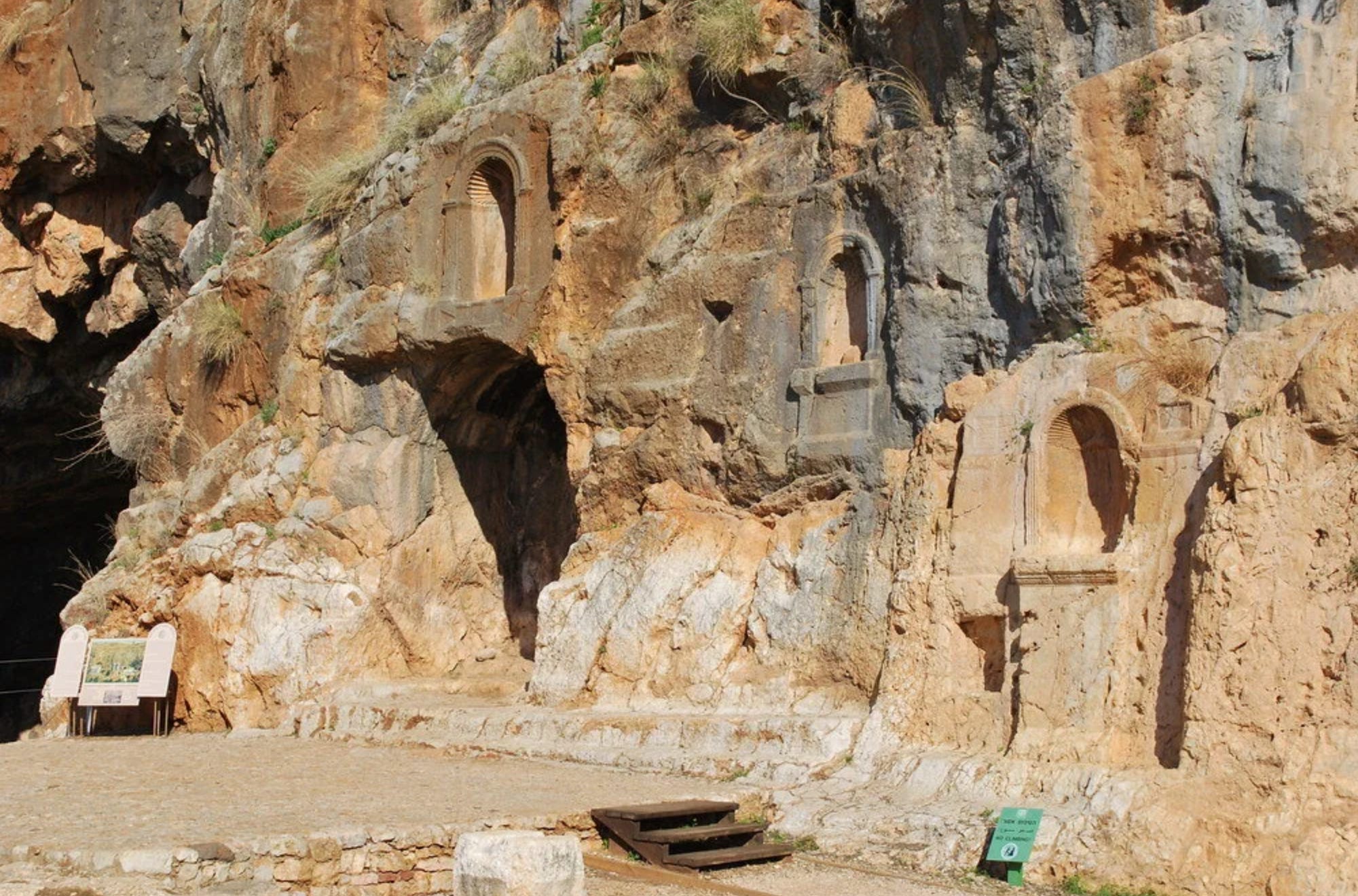
(The ancient shrine to Pan, “Banias,” in the region where this gospel takes place.)
Now to comment on the text:
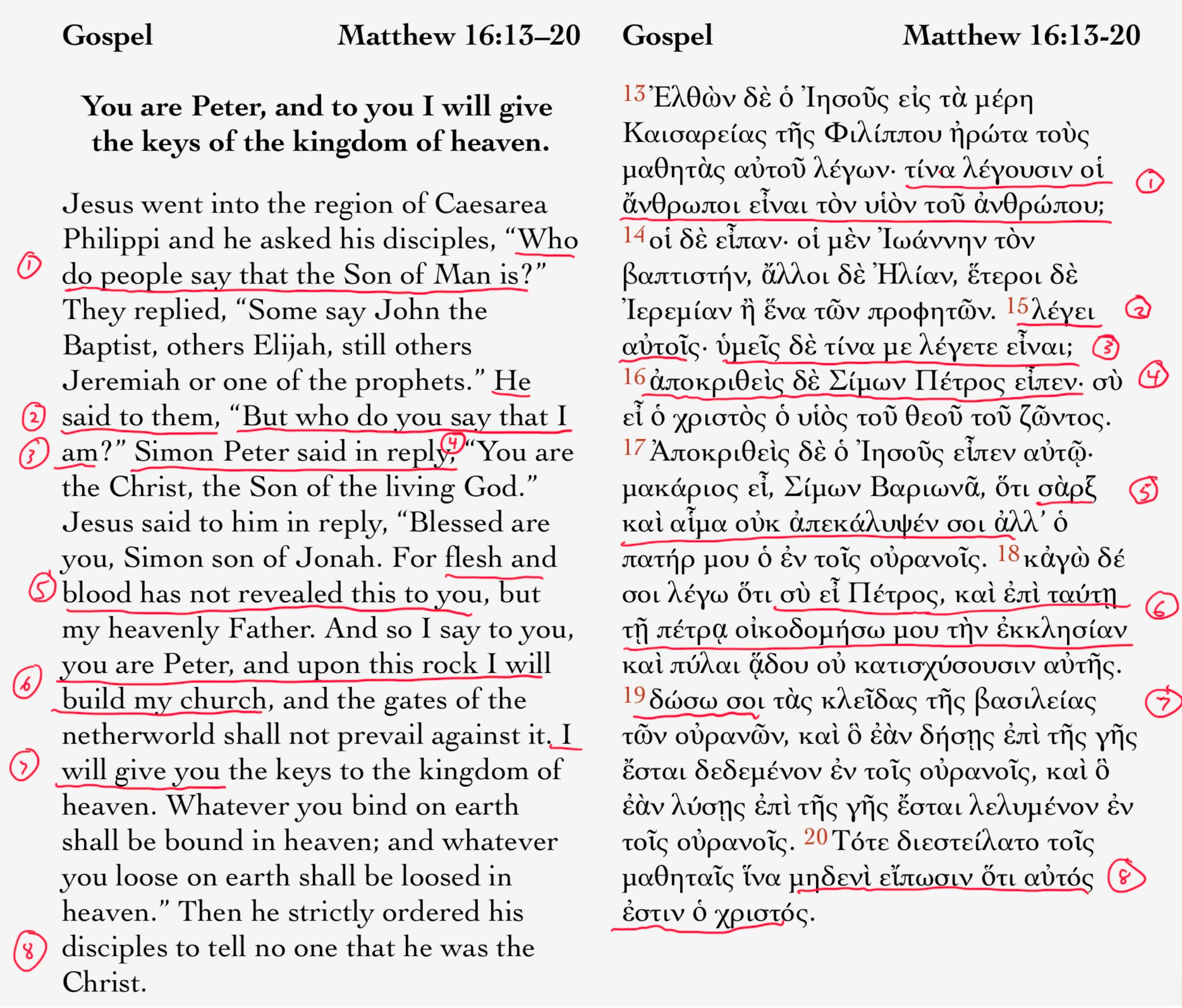
1—Because of political correctness, we miss the meaning of what Jesus asks here. He is not asking about “people,” but about members of a natural kind, human beings, and he is asking what they think about one of their own, as if, “Who do men say that this son of men is?” Vulgate: quem dicunt homines esse filium hominis. And let’s leave off the capital letters, because they were not marked in Greek or Latin.
2—Matthew switches to the present tense: “He says to them.” Why render it as historical present? As I emphasize in my book, The Memoirs of St. Peter, to switch in this way, as if randomly, to the present tense, is characteristic of an eyewitness.
3—Jesus addresses this question to all of them, to his disciples as a whole. This gets obscured by English. His question is, “But who do y’all say that I am?” — But also, his emphasis is not captured here by the translation. What he says is, “But you, who do you say that I am?” He is contrasting them with the natural kind, human beings.
4—Matthew says that Simon Peter spoke in reply. This is interesting for two reasons. First, Jesus addressed his question to the disciples as a whole, but only Simon spoke in reply. Second, Matthew refers to him not as “Simon” but as “Simon Peter,” as if to acknowledge that already, in being the only one to reply, he spoke as “Peter.”
5— “flesh and blood has not revealed this to you” — Now we see how important it was to render the sentence above, “Who do men say that this son of men is?” Not “people.” There is no natural kind, of flesh and blood, called “people.” Angels are “people.” Devils are “people.” (It should be “persons” anyway. As Fowler asks in his book on English diction, if three people are in the room, and two people leave, is one people left?)
6—It’s absurd to say that Peter (Petros) in Greek means a pebble (as it does) and Jesus would not have said his church was built on a pebble. His name in Aramaic, Cephas, means a rock. And no one would take the root, petr-, and add a feminine ending to make a man’s name. He had to be called Petros, if the point was to call him a rock. There was no alternative. (I’m sure that Matthew did not mean to indicate that Simon the Pebble was the only one to reply to the Lord’s question.)
7— “I will give to you”—the English obscures slightly that this “you” is singular. Only Peter gets the keys.
8—not “to tell no one that he was the Christ” but rather “not to say to anyone that he is the Christ.”
Ciao!
No posts
Comments
Nothing yet. Say the first thing.
Sign in to join the conversation.