
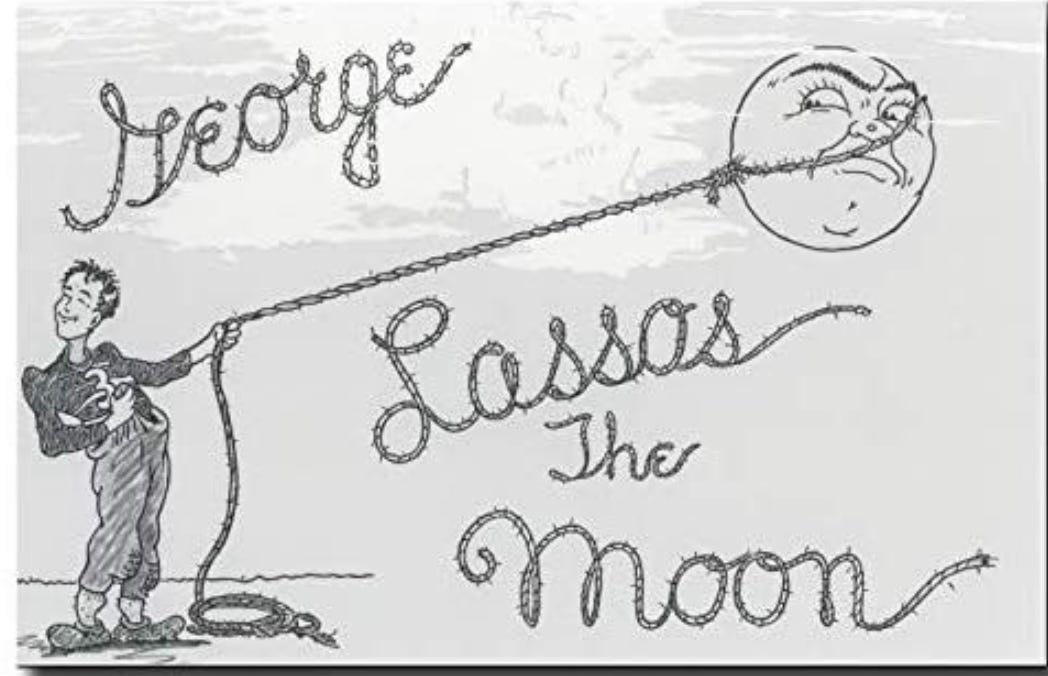
When George Bailey tells Mary Hatch that he will lasso the moon for her—a line that everyone remembers—Mary says that she’ll take the moon, and asks, “And then what?” A reasonable question. Do you remember what George says she should do with it? It’s so bizarre, that it needs an explanation. And I think I can give an explanation. I will tell you in tomorrow’s post.
Today is the last installment of my serialization of the banquet address I gave on whether St. Thomas Aquinas is a Christian romantic.
(Have you wondered about this word, lasso? The double “s” is odd. That’s because it’s phonetic transcription meant to imitate saying, in Spanish, lazo, which means a slip-knot. The word was made up by American cowboys. In contemporary Spanish, lazo and soga are used to mean a noose. If English speakers had spelt it “laso,” the “s” would have been voiced, leading to the wrong sound, LAH-zo.”)
In this final part of my lecture I turn to evidence in St. Thomas’s texts that he favors an all-or-nothing, burn your ships approach to love, which we saw in St. Paul.
That he [does], is shown I think in how he deals with the effect of ecstasy. I believe he wishes to raise the stakes entirely, so that we attain ecstasy completely, or not at all. Dionysius had presented ecstasy as an effect of any manifestation of any sort of love whatsoever. Peter Kwasniewski interprets St. Thomas in a similar spirit.
But St. Thomas’s approach, both in the Divine Names commentary, and in question 28, is actually seriously to delimit the realization of this phenomenon of ecstasy. He does so by bringing to bear the distinction between amor amicitiae and amor concupiscentiae, which he takes from Aristotle’s account of love and friendship. That he introduces this distinction ought to raise some eyebrows. Why is it even relevant to Dionysius? It pops out from his commentary as something alien.
I didn’t have time to say in my lecture how he follows here his master, St. Albert the Great, who had done the same thing.
Here comes the distinction which is the key to grasping St. Thomas’s interpretation of “three forms of friendship” in Aristotle. It depends on the theory of the categories:
If you do not know that distinction, it is based on the claim that goodness, just as much as being, displays a categorial diversity. There are goods which are substantival, and goods which have the character of an accident. Thus, love, which is always for a good, must also show a categorial diversity. Human beings, insofar as they have nous, are substantival goods. But they are loveable to us as substantival goods only if they have acquired the virtues and become good human beings. Our love for them in that case is called amor amicitiae, the love which can be constitutive of genuine friendship. If they have not acquired the virtues, and they are not good human beings, we cannot love them as substantival goods. We can love them only as goods in the category of relation, that is, only insofar as they can provide to the lover something good or something pleasant. In that case, our love for them is called amor concupiscentiae, because it is love for a good conceived of as good in relation to the lover’s own good, which is a substantival good for him, and such love can be constitutive only of bonds marked by the exchange of useful goods or incidental pleasures. At least, this is Aristotelian doctrine, which considers human beings in their natural condition, apart from any consideration of supernatural charity.
In amor concupiscentiae, then, because St. Thomas follows strictly what he takes Aristotle to hold, St. Thomas also holds that, although the love in that case may look like it is love of the other person, in fact that kind of love is, and is appropriately analyzed as, love for the lover himself. Only in amor amicitiae does love succeed in being for the other person and not for oneself.
There have been a lot of debates in the history of philosophy about whether a distinction between egoism and altruism exists and how to characterize that distinction. One might say that for St. Thomas the crucial difference is between ecstatic and non-ecstatic human love, whether one should call that altruism versus egoism or not. As he says in his Divine Names commentary, echoed in the question 28 corpus:
(I read from the magnificent edition of Michael Augros)
In either mode of love, therefore, the affection of the lover is drawn by an inclination to the thing loved, but in diverse ways: for in the second mode of love, the affection of the lover is drawn toward the thing loved by an act of the will, but by intention, the affection returns to itself; for while I seek justice or wine, my affection is inclined to these other things, but nevertheless it returns into itself, because it is borne toward the aforementioned things in this way: that through them the good may belong to it. And so such love does not place the lover outside himself, with regard to the end of the intention. But when something is loved in the first mode of love, affection is borne toward the thing loved in such a way that it does not return into itself, because one wills the good for the very thing loved, not for the reason that something might afterward result for itself. So then such love produces an ecstasy, because it places the lover outside himself.
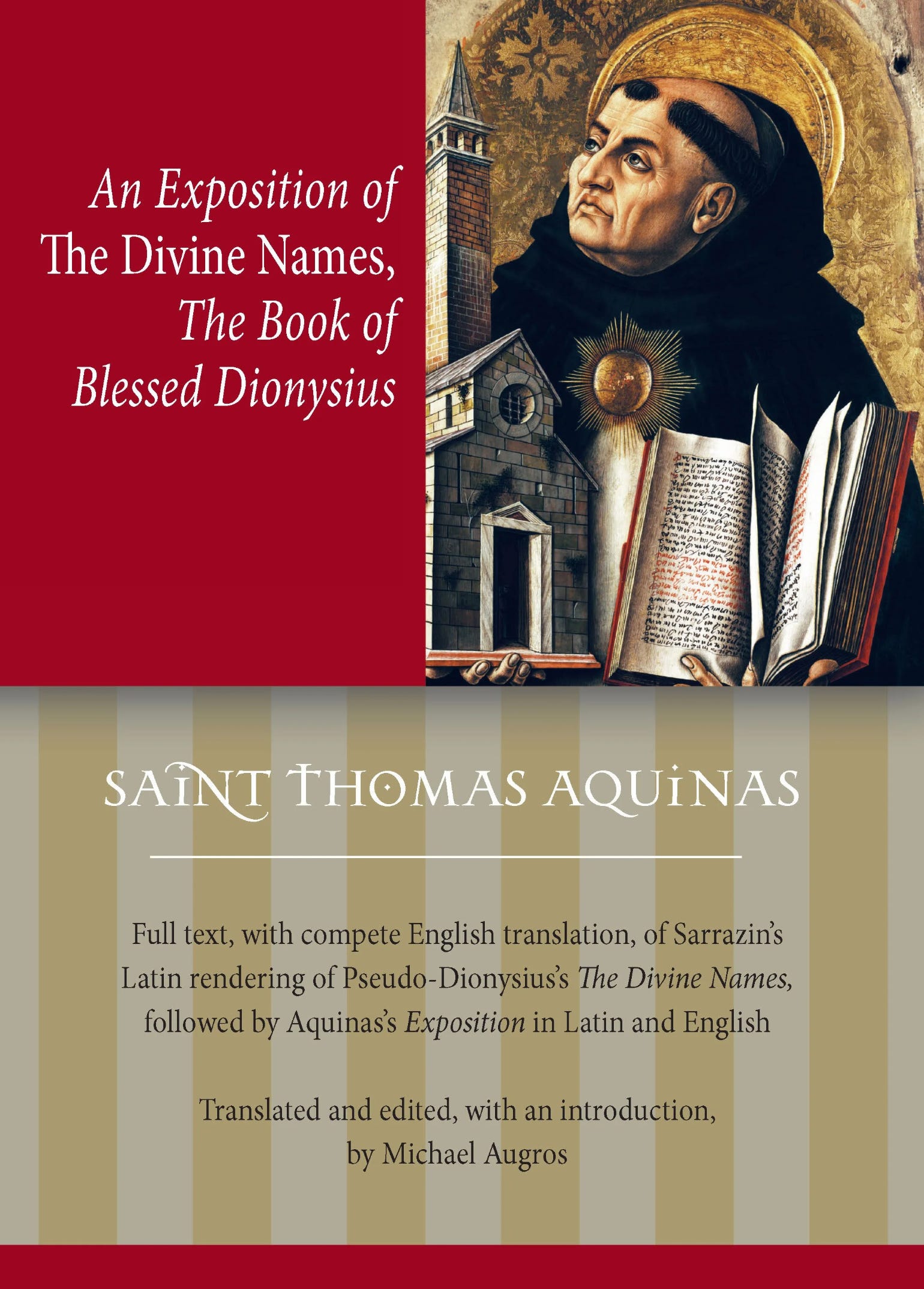
(Sad that “Pseudo” is found on the cover. Was this for cataloguing purposes? I believe Augros agrees with me that that denomination is unwarranted.)
Someone interpreting this text with Aristotelian eyes would conclude that ecstasy in natural human affairs is just about non-existent, because, according to Aristotle (and surely he is right) goodness is rare, amor amicitiae is rare, and genuine friendship based on a reciprocation of such love is rare. Obviously self-love, the dominant natural love in someone’s life, by definition involves no ecstasy. If such an interpreter were also a romantic, and looked upon ecstasy as a kind of elixir, the finest expression of divine love, and what made the difference between exhilaration or drabness in everyday life, he would look for some way to universalize this phenomenon of ecstasy.
Everybody senses this intuitively, and therefore some thoughtful philosophers have tried by mere reason as it were to force someone into being wholly ecstatic. This is how we should interpret the move of Thomas Nagel in The Possibility of Altruism. His argument there is that reasonable self-love forces someone to adopt a framework in which he views his self at the present time as one among many equal selves across time, but then on pain of irrationality he is forced to adopt a framework of seeing all human beings as one among equal others. It is an argument from prudence to justice and the core of just about everything that Nagel writes.
And this is what St. Thomas does. He develops the teaching of Dionysius, about how even self-love may become ecstatic. What Dionysius says is very compressed. “And the divine love also produces ecstasy, not allowing lovers to be their own, but to belong to the beloved ones; subjects [show this] by their divine conversion toward the primary ones.” (168, p. 187). This is a very cryptic and compressed remark. But St. Thomas gives its sense as follows: “So, then, when the affection of the lover is borne toward a superior beloved, of whom the lover himself is something, the lover orders his own good unto the beloved; for example, if a man’s hand were to love him, the very fact that it is in the whole would order [it], and so it would be placed totally outside itself, because in no way would anything of itself remain” (432, p. 189).
Dionysius at this point, again very cryptically and tersely, quotes in support St. Paul at Galatians 2:20—how striking, that very verse with which we began and which, we said, was so compelling and romantic in St. Paul! St. Thomas is happy to give an extensive gloss: “he says that ‘on account’ of the fact that love does not permit the lover to be his own, but [to belong] to the beloved, ‘the great Paul,’ constituted in divine love as in something containing [him], and, ‘by’ the ‘power’ of the divine love ‘making’ him go totally outside himself, speaking as it were with a divine mouth, says (Galatians 2:20), ‘I live, [though it is] no longer I, but Christ [who] lives in me,’ namely because going out from himself he surrenders himself whole unto God, not seeking what is his own, but what is God’s” (436, p. 191).
I found recently in Frank Capra’s autobiography his maxim, “There are no rules in filmmaking only sins. And the cardinal sin is dullness.” That is the maxim I tried to follow in my banquet address. Therefore, of course, I had to say next that St. Thomas is a really great adulterer!
Allow me to translate: if someone loves love, and loves what is finest in love, the only path for him to gain what he wants is to join with St. Paul, so that he is able to say, truthfully, “I have been crucified with Christ.” And when he does so (if I may return to that shocking image) he becomes a really great Adulterer, because he betrays and hands over to his enemies the person by rights dearest to himself, accepting shame and disgrace as they come, to fly into the arms of his beloved.
The same can be shown with the other three notes of courtly love, that, corresponding to each, there is a movement in St. Thomas towards venturing all and totalizing love. Consider how he deals with latria and sacrificium. I map latria to Humility, and sacrificium to Courtesy. In his treatise Contra Impugnantes, in which he defends the religious life-- that is, the way of life he has chosen--he begins by explaining that religion means a reuniting of the creature with God. “Every creature existed, originally, rather in God than in itself. By creation, however, it came forth from God, and, in a certain measure, it began, in its essence, to have an existence apart from Him. Hence every rational creature ought to be reunited to God, to whom it was united before it existed apart from Him.” How can he become reunited? First, he must be fully devoted to God, recognizing him to be the first cause of existence, and seeking to be united to him as such. This fundamental attitude of Humility he calls latria. But then, second, he must express this devotion in concrete acts of service, the chief of which are acts of sacrifice. He explains that there are three chief goods of life, which might serve to hinder our being reunited with God, viz., marriage, wealth, and one’s own will. Hence, the counsels of poverty, chastity, and obedience. “By these three vows, man offers to God the sacrifice of all that he possesses.” But St. Thomas does not stop here. He presses the point: “But it is not merely a sacrifice that is offered to God through these three things, but rather a holocaust.” He quotes Gregory: “when a man offers all that he has, all that he loves, and his entire life to the Almighty, he presents to him a holocaust.” This is the perfection of Courtesy, because only then will our external service mirror well our loving devotion to the beloved.
In the conclusion I could bring out an important point which had been in the background: that Christian romanticism is not in its essence spousal or nuptial. It is broader than that, although it becomes nuptial between an eligible man and an eligible woman, or between Christ and his Church.
A lot of mischief has come from people’s meditating on “Theology of the Body” and taking all Christian romanticism to be nuptial.
Conclusion
I have argued that St. Thomas was a great romantic, because he grasped and lived by charity, and charity is romantic. This is not to say that it is spousal or nuptial: romantic is the broader category, just as St. Paul is highly romantic without being spousal. And indeed romanticism we learn from non-spousal, courtly love.
The four notes, when you look for them, are found everywhere. Tibi se cor meum totum subjicit: I am placed entirely at your service, in Humility. visus, tactus, gustus in te fallitur: my service to you, of Courtesy, will be to believe, although tested by these appearances, that reality is as you say it is. cuius una stilla salvum facere, totum mundum quit ab omni scelere: make me faithless to this wicked world, a very Adulterer to it. visu sim beatus, tuae gloriae: may I be divinized joining you in your glory, celebrating eternally your and my Religion of love.
And that’s it for today.
Tomorrow we discuss what Mary Hatch is supposed to do with the moon, once she has it.
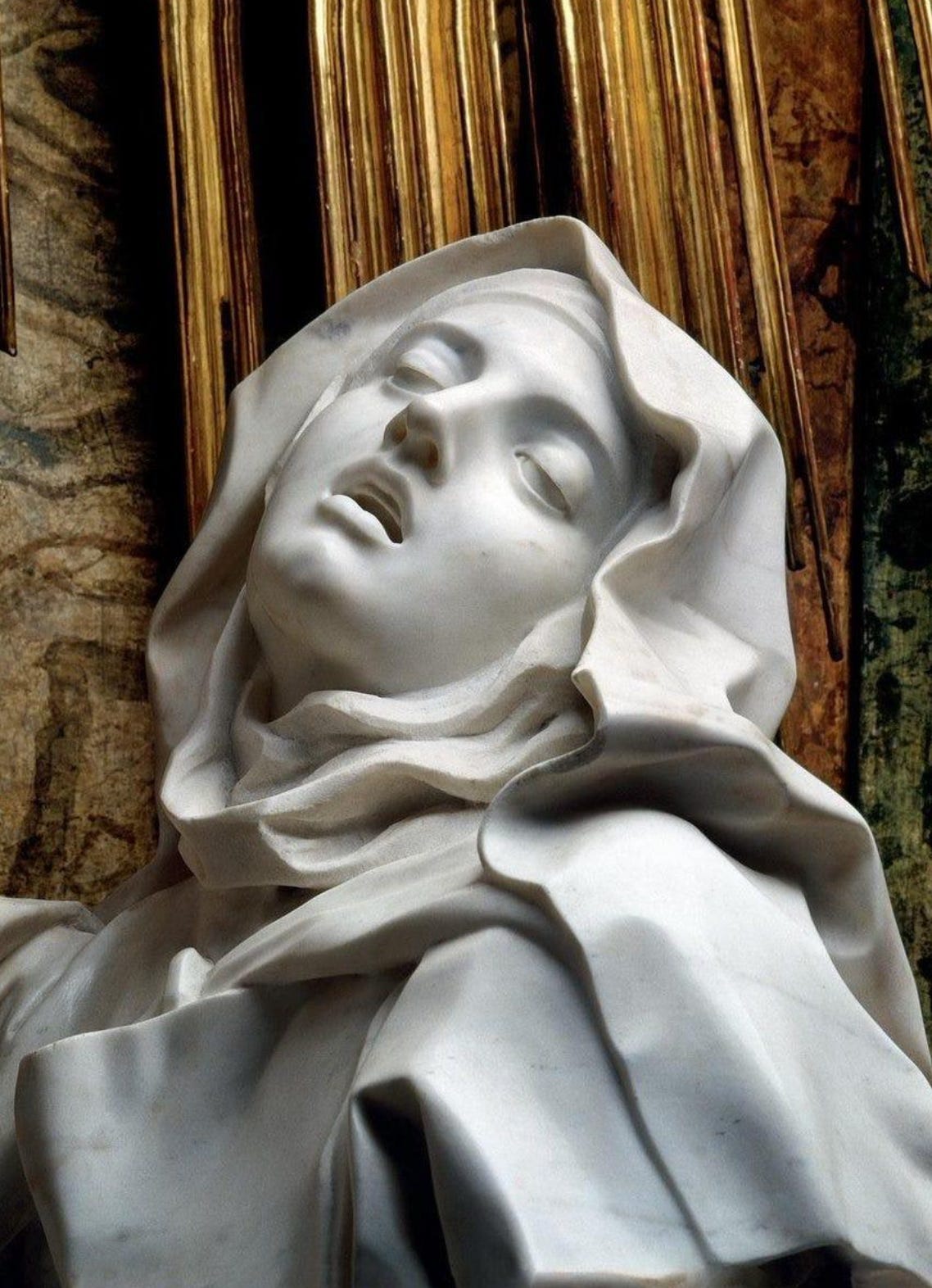
(St Theresa in ecstasy. Remember that she is undergoing non-spousal, non-nuptial love. St. Thomas Aquinas might be pictured experiencing the same ecstasy—if ecstasy were an experience.)
Ciao!
No posts
Comments
Nothing yet. Say the first thing.
Sign in to join the conversation.